Guides
Part of How to report regional adaptation in vintage diner interiors without overpromising
Before you compare vintage diner interior budgets, check the regional source
A regional diner award covers many buildings. Report the scope, the source date and the disclosure, and never divide one figure across individual diners.
A regional grant figure is not a diner price. Most of these awards cover a corridor, a county or a program, and the money is split across buildings the source never names.
The vintage diner interior regional guide covers what changes from one region to the next. This article covers the arithmetic that goes wrong when a multi-diner award is read as a single-diner cost.
What to take away
- A regional award covers a stated group of buildings, not one diner. Report the group.
- Never divide a multi-region or multi-facility figure by the number of diners it touches.
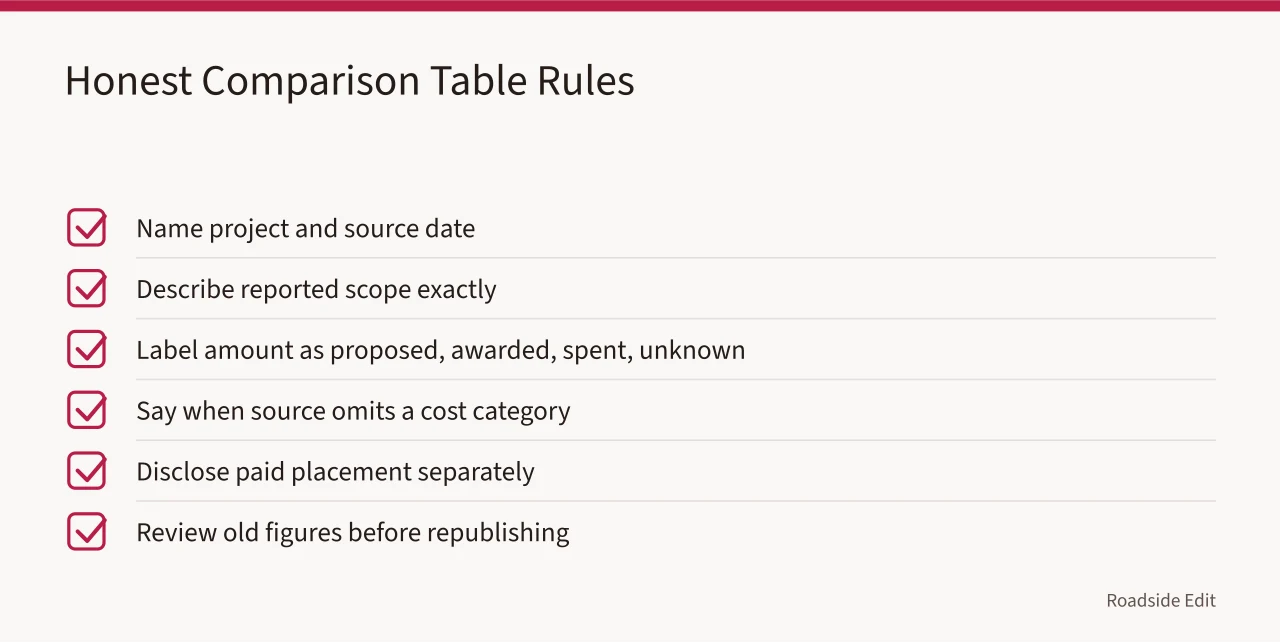
- Label every amount as proposed, awarded, spent or unknown, with its source date.
- Two figures belong side by side only when their scopes match. Otherwise, say so in the text.
- A paid listing is advertising. It is not a cost benchmark.
Why the division is the error
A grant of a stated amount to a preservation program across a named set of counties is one number describing one program. Divide it by the diners in those counties and you have invented a per-building figure the source never published.
The same holds for a state award covering several facilities, or a foundation grant covering a corridor. The award is the unit. The diner is not.
The honest note is the scope sentence: what the money was awarded for, who received it, and the date the source published it. If the source does not break the amount down, the article does not either.
Record the source before the number
Keep comparison tables honest
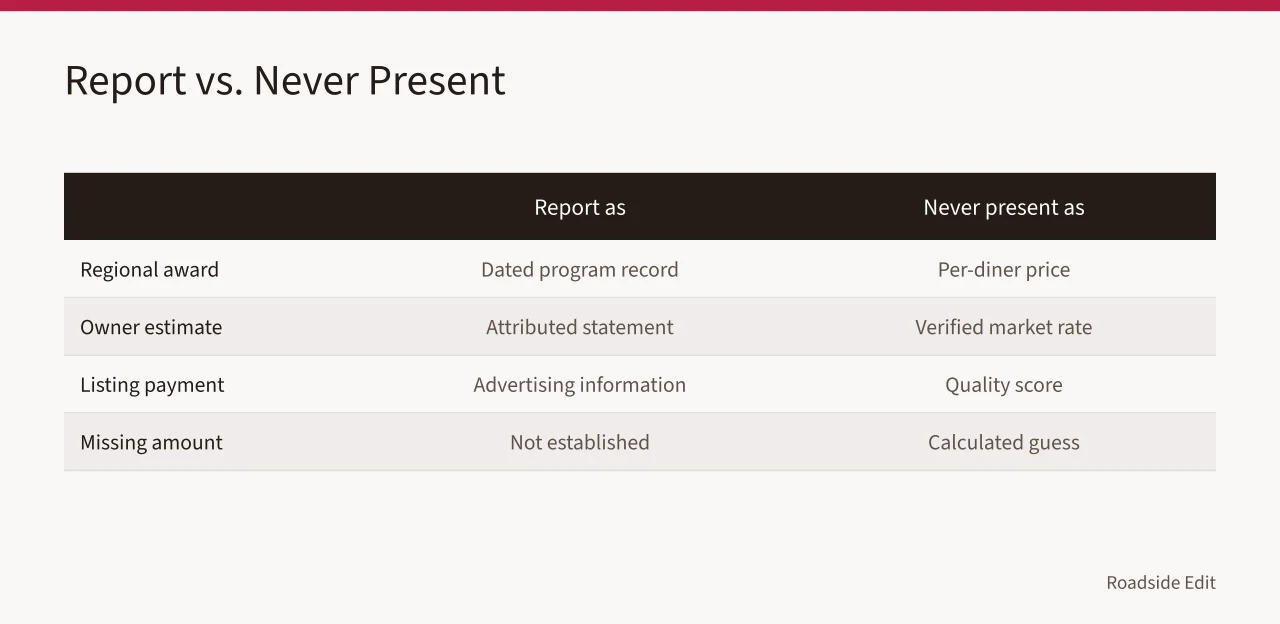
- Name the project and the source date.
- Describe the reported scope exactly, including how many buildings it covers.
- Label the amount as proposed, awarded, spent or unknown.
- Say when the source omits a cost category.
- Disclose paid placement separately from editorial evidence.
- Review old figures before republishing them.
Two dollar figures in one table read as a ranking. If one is a program award across eleven buildings and the other is a single owner's estimate, the table is lying about the comparison. Put the mismatch in the sentence above the table, or drop the table.
The National Park Service coastal adaptation case studies treat cultural resources as one factor inside documented regional planning. That is the whole of what the report supports here: geography and cultural resources can be considered together in a planning record. It carries no budget, scope or recommendation for any diner.
Match the scope before you match the amounts
Ask what each source was written to describe. Planning, design, a grant award, and construction are four scopes. A completed phase and a wider program are two more scopes. A number from one scope does not sit beside a number from another.
A public award states what was awarded. A cost report states what was spent at a stage. Repetition does not turn either into a local price guide. Keep the source title and date attached so a later editor can tell whether the figure is historical, preliminary or revised.
When a business gives an estimate, record the relationship and ask permission before describing it as an attributed statement. Do not average it with other amounts. If scope details are missing, the amount cannot be compared, and that is the note.
The Government Accountability Office cost-estimating guide sets out documented assumptions, a technical baseline and a defined purpose as the basis for any estimate. A reported amount cannot be compared responsibly without knowing what it was meant to cover. The guide does not estimate private diner work.
The Internal Revenue Service explains the historic rehabilitation tax credit in terms of qualifying expenses and certified historic structures. That is the reason to keep an incentive separate from a total project cost. Eligibility and tax results belong to a tax professional and the adopted statute, not to a regional guide.
The Federal Trade Commission's endorsement guidance covers disclosure when payment could affect how a reader weighs a listing. A paid entry can say it is advertising. It cannot be used as a cost benchmark.
Carry the scope label everywhere
A number repeated without its label drifts. The social caption, the summary table and the list entry each need the same date and scope sentence as the full article.
That is the difference between a dated record and a present quote. The record stays useful for years. The quote is wrong the month after it is written.
The gas station preservation case studies show the same drift on forecourts and canopies, where a program figure is quoted later as a single-site cost.
Common questions
Can a regional award be divided across the diners it covers?
No. The award describes one program with a stated coverage. Dividing it produces a per-building figure no source published, and readers will treat that figure as a price.
When can two figures appear in the same table?
Only when both sources describe the same scope and the same stage. If one is a program award and the other a single owner's estimate, state the mismatch in the text instead.
Does a paid listing belong in a budget article?
Yes, when it identifies itself as advertising and is kept out of any comparison. Payment cannot be presented as evidence about cost or quality.