Costs
Part of How to plan vintage diner interiors coverage with an evidence-first workflow
Vintage diner budget notes: how to decide which cost figures belong in your story
A figure-admission test for diner interior stories: four screening questions, a photo set that fixes scope, and a publish, background or exclude call.
A cost figure in a diner interior story is a claim about scope. Booth laminate and chrome-edge trim, a counter rebuild, a new dry-stand pipe: each carries its own boundary. Decide that boundary before the outline, not after the draft.
What to take away
- Run four screening questions on every amount before it enters an outline.
- Photograph the condition the figure describes, with dates, so scope is checkable later.
- Mark each figure publish with context, background only, or exclude, and write the reason.
- Pair any published amount with a scope sentence that names what it does not cover.
- Cut the figure when its evidence cannot travel with it into the article.
The four screening questions
Ask these of every amount, in order. A no at any step sends the figure to background or out.
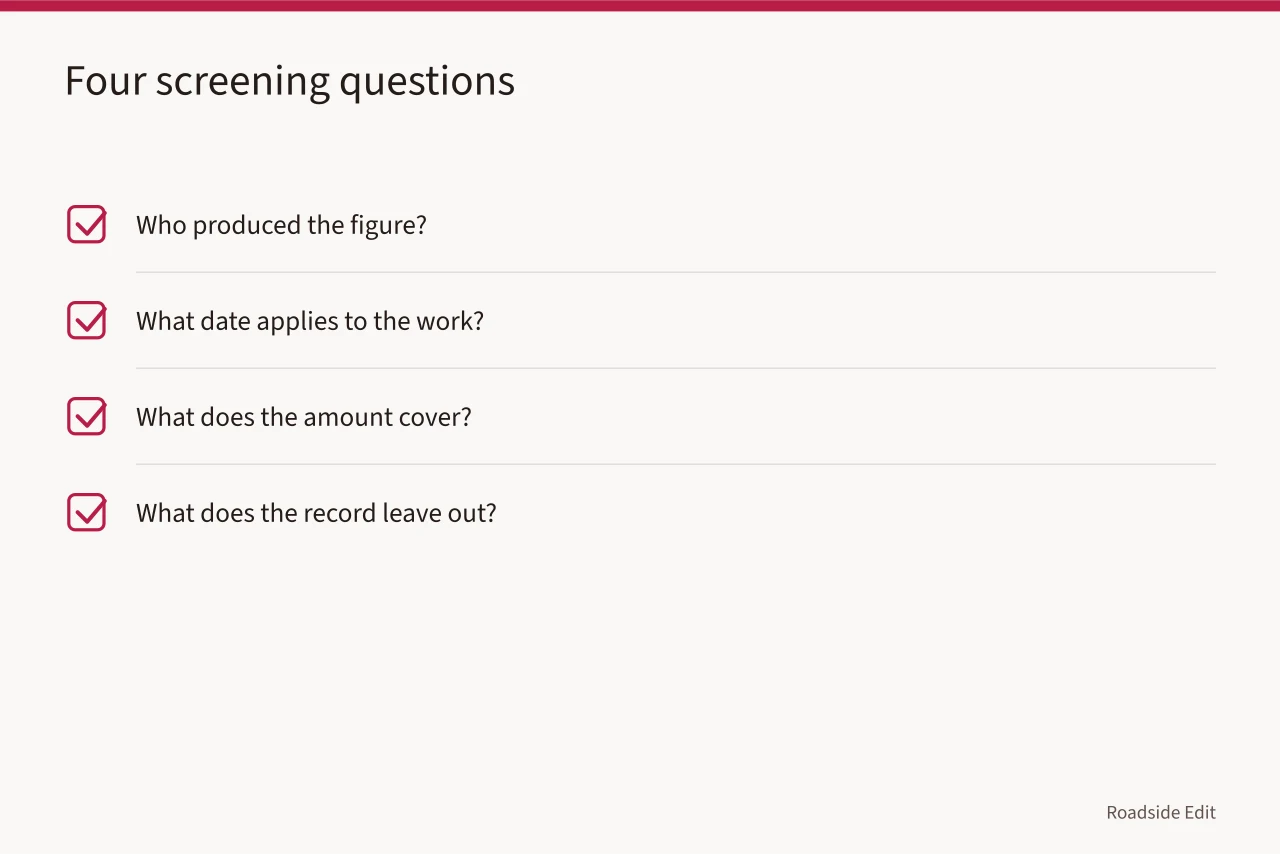
Record the four answers in the planning file even when the figure is excluded. A later writer will ask why the number is missing.
Fix scope with a dated photo set
The National Park Service existing-conditions photo guidance treats photographs as the record of what was there and how it varied across a building. Use the same habit on a diner interior.
Shoot the condition the figure describes: the booth run, the counter edge, the floor under the stools. Include a wide frame and a detail frame, and note the date and the photographer.
A dated set does two things. It pins the scope to what the money touched, and it lets a later editor check the claim without trusting the writer's memory. A figure with no matching frame is a figure with no boundary.
Write the outline decision
Before drafting, give every figure one of three marks and a one-line reason.
| Mark | Use it when | What the article does |
|---|---|---|
| Publish with context | All four questions have answers | Prints the amount with its scope sentence |
| Background only | The figure is real but partial | Shapes the reporting, never appears |
| Exclude | Origin, date or scope is missing | Leaves the file entirely |
The mark is a decision, not a note. An unmarked figure drifts into the draft, and by then the scope sentence is being written to fit a number instead of the other way round.
The National Archives records-management overview sets out how records are created, described and kept. The planning version is narrower: a figure that cannot be traced to a described record cannot be published. "From the owner" is not a record description.
The Government Accountability Office's cost estimating guide folds assumptions, data and documentation into what makes an estimate credible. An editorial profile is not an estimate. The transferable point is that documentation travels with the number or the number means nothing.
What the scope sentence looks like
A published amount needs one sentence next to it, naming the work, the date and the gaps.
For example: "A 2024 owner-supplied estimate covers booth upholstery and counter laminate; it does not name permits, electrical work, tax or final payment." The reader now knows what the money touched and what it did not.
Do not move that sentence to a disclaimer at the foot of the page. A scope note far from its figure reads as a hedge, and readers treat it as one.
When a business supplies the number
A fabricator, booth supplier or restoration contractor may hand over a project amount. The article can report it if the business, the date and the scope are all named.
If the business paid for placement, supplied free or discounted goods, or has another tie that could sway a reader, say so where the figure appears. The Federal Trade Commission's endorsement guidance calls for material connections to be disclosed clearly and conspicuously.
A disclosure tells the reader how to weigh the claim. It does not verify the amount, the workmanship or the outcome.
Two figures, one diner
A planning file often holds several amounts from the same address. Keep them apart.
One may cover a dining room repaint, another a set of stools, a third a full building project. Access, season, materials, labor and exclusions differ. Adding them, or turning the high and low into a range, produces a number no source ever reported.
If a range is the only honest form, attribute it to the single record that states it, with that record's date and scope. Anything else is arithmetic the article invented.
Common questions
How many figures should survive screening?
As many as clear all four questions, and no more. A diner interior story built on one well-scoped amount beats one built on six loose ones.
Can a photo set replace a written record?
No. The frames fix condition and date; they do not state who paid, what was specified, or what was left out. Use them together with the document.
What if the source will not be named?
Mark the figure background only. An unnamed source for a specific amount gives the reader nothing to check, and the number will be read as a market rate.
Does the screening apply to a diner interior feature with no numbers at all?
Yes, as a check. Run the four questions over any scope claim, including one made in words, and mark it the same way.