Guides
How to plan vintage diner interiors coverage with an evidence-first workflow
Build a vintage diner interiors feature from dated records, a room inventory, captioned photographs and a correction log that keeps sources visible.
A vintage diner interior is documented in layers: the room as built, the room as photographed, the room as reported today. A coverage plan keeps those layers apart so a caption never has to carry a claim it cannot support.
The workflow below runs from scope note to correction log. It suits a single-room feature, a corridor survey, or a set of supplied images from an owner.
What to take away
- Write the article question first, and write down what it cannot answer.
- Give every source a date, an access date, and the one sentence it supports.
- Describe what a photograph shows; date it only from a record, never from style.
- Label business-supplied text and paid placement where the reader meets them.
- Log every correction with the old wording, the new wording, and the evidence.
Step 1: Write the scope note before the research
A scope note is one paragraph that names the question and the limits. "What does the available record show about the dining room layout at this address?" is answerable from dated images, collection records, and attributed accounts.
"How should this room be restored?" is not. That question needs a licensed architect or engineer, the State Historic Preservation Office, and the property owner. Say so in the note.
Keep the note in the working file. It stops a strong photograph from pulling the draft toward claims nobody can check.
Step 2: Open the evidence file
The evidence file is a table with one row per source. Columns that earn their place:
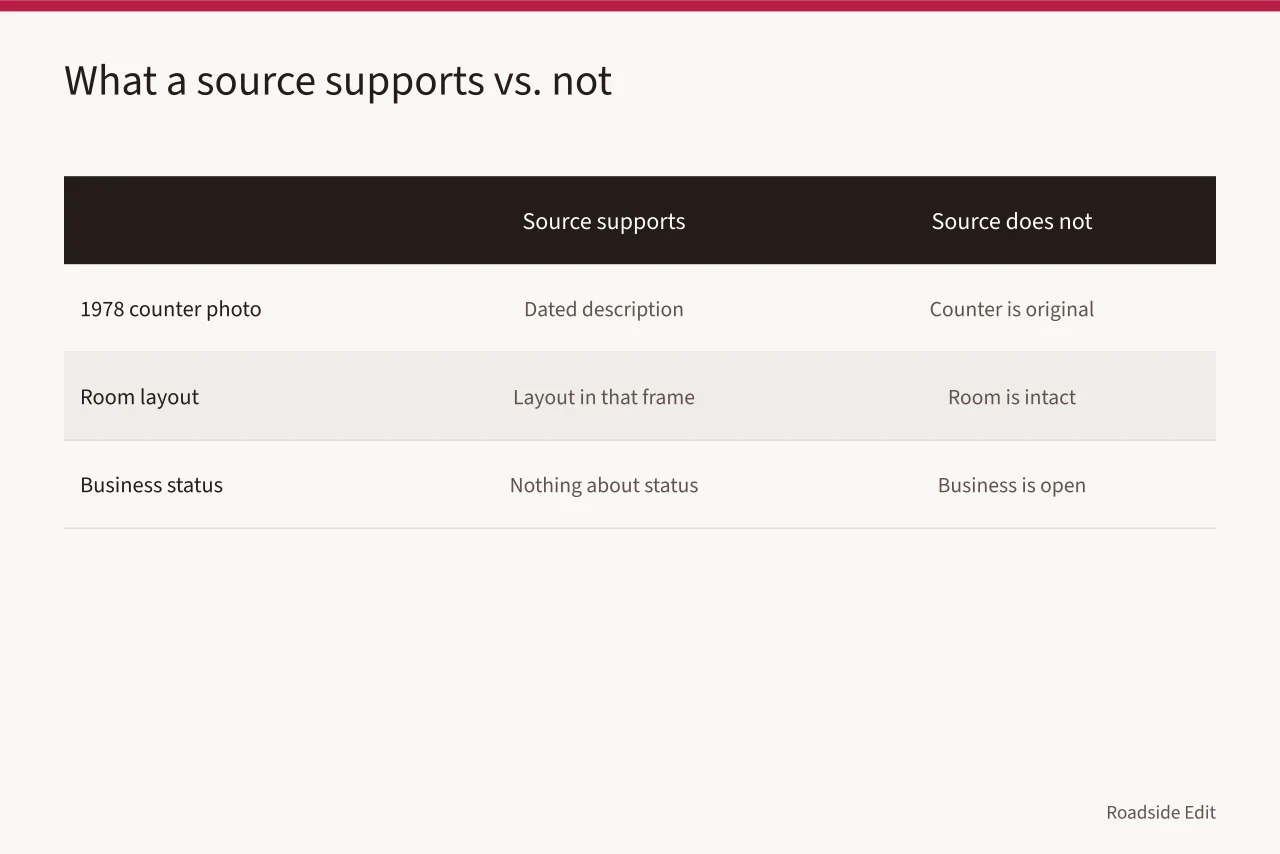
Column four is the one that saves editing time. A 1978 photograph of a counter along the window wall supports a dated description. It does not support "the counter is original," "the room is intact," or "the business is open."
The National Archives primary-source explanation makes the point that a source's role depends on the question asked of it.
The National Park Service describes what formal documentation produces in its HABS, HAER, and HALS overview. This includes:
- measured drawings
- large-format photographs
- historical reports
A coverage feature is not that product. The evidence file is the smaller habit borrowed from it.
Step 3: Build the visual inventory
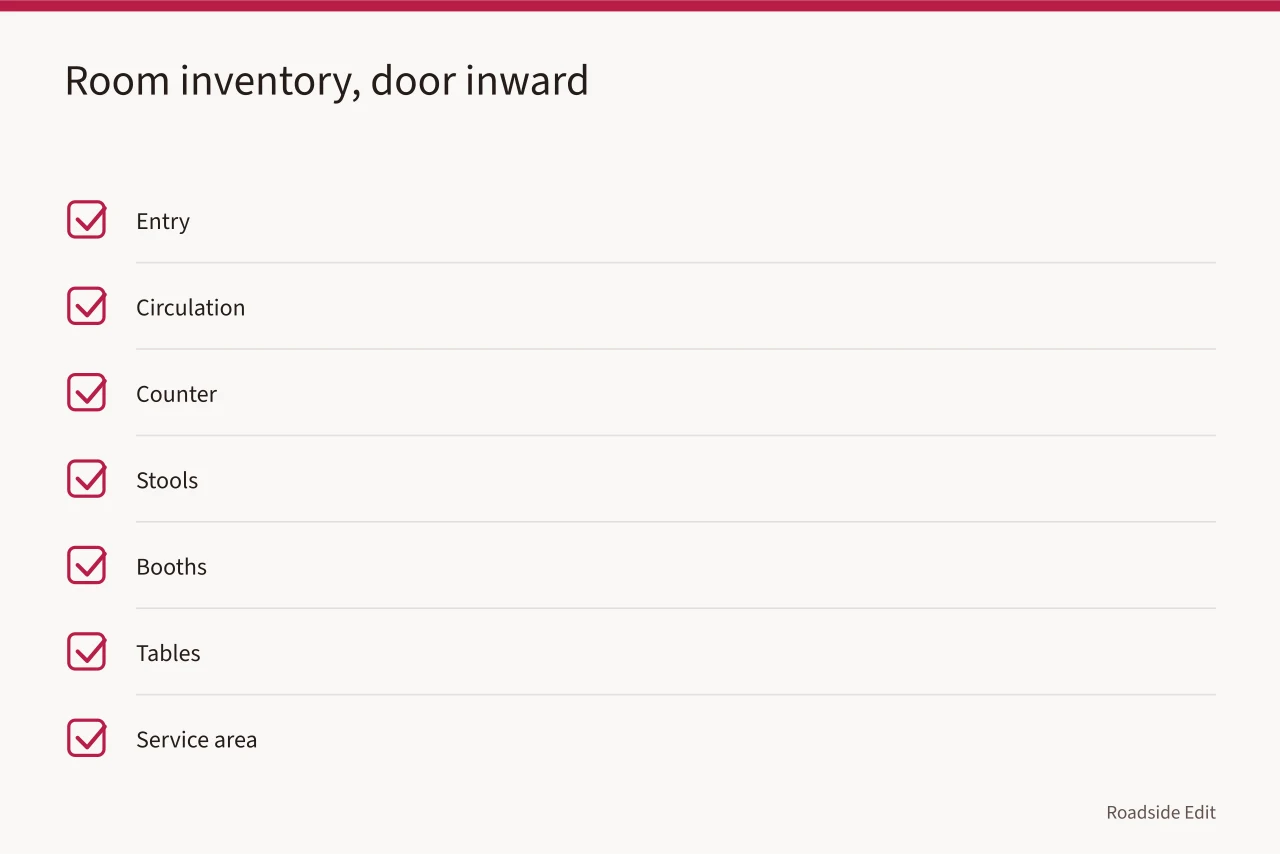
The inventory describes the room as a source represents it. It is not a condition assessment, and it does not date anything by eye.
Work from the door inward:
| Field | Wording that holds up |
|---|---|
| Counter | "A counter with fixed stools runs along the left wall in the 1978 image" |
| Seating | "Booths appear opposite the counter in the same frame" |
| Floor | "Patterned floor visible; material not identified in this source" |
| Ceiling | "Curved ceiling profile visible above the counter" |
| Change over time | "The 1978 and 2004 images show different seating arrangements" |
Two cautions belong in the file. First, material and date are separate questions: a porcelain-enamel panel and a plastic-faced box sign can sit in the same room, and only a record tells you which is which.
Second, a later replacement is not automatically a loss of significance, and that call belongs to the SHPO and the property owner, not to the caption.
The Library of Congress primary-source analysis guide sequences observation before reflection. The inventory follows that order: describe, then find a record, then interpret.
Step 4: Put the room on a timeline
Sources show different moments. Do not force them into one continuous story. Give each its own date and its own limited point.
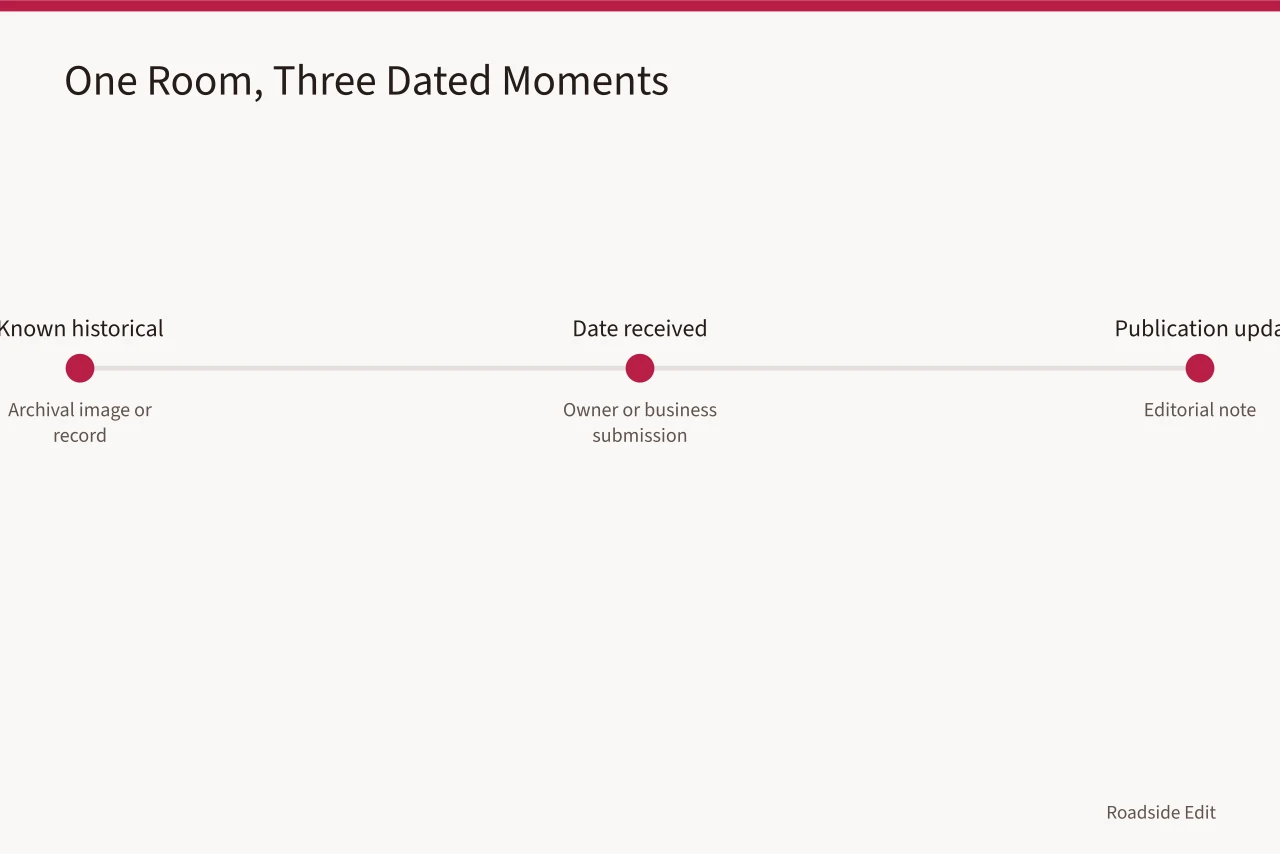
| Date | Source type | What it can carry |
|---|---|---|
| Known historical date | Archival image or record | What that record identifies |
| Date received | Owner or business submission | What the contributor reported |
| Publication update | Editorial note | When the page was last reviewed |
If an image is undated, write "undated." If records conflict, state the conflict and leave it standing. An unresolved difference is a finding, not a failure.
Step 5: Keep historical context and current information in separate boxes
Archival images do not confirm hours, ownership, menu, accessibility, or operating status. Never infer those from a photograph.
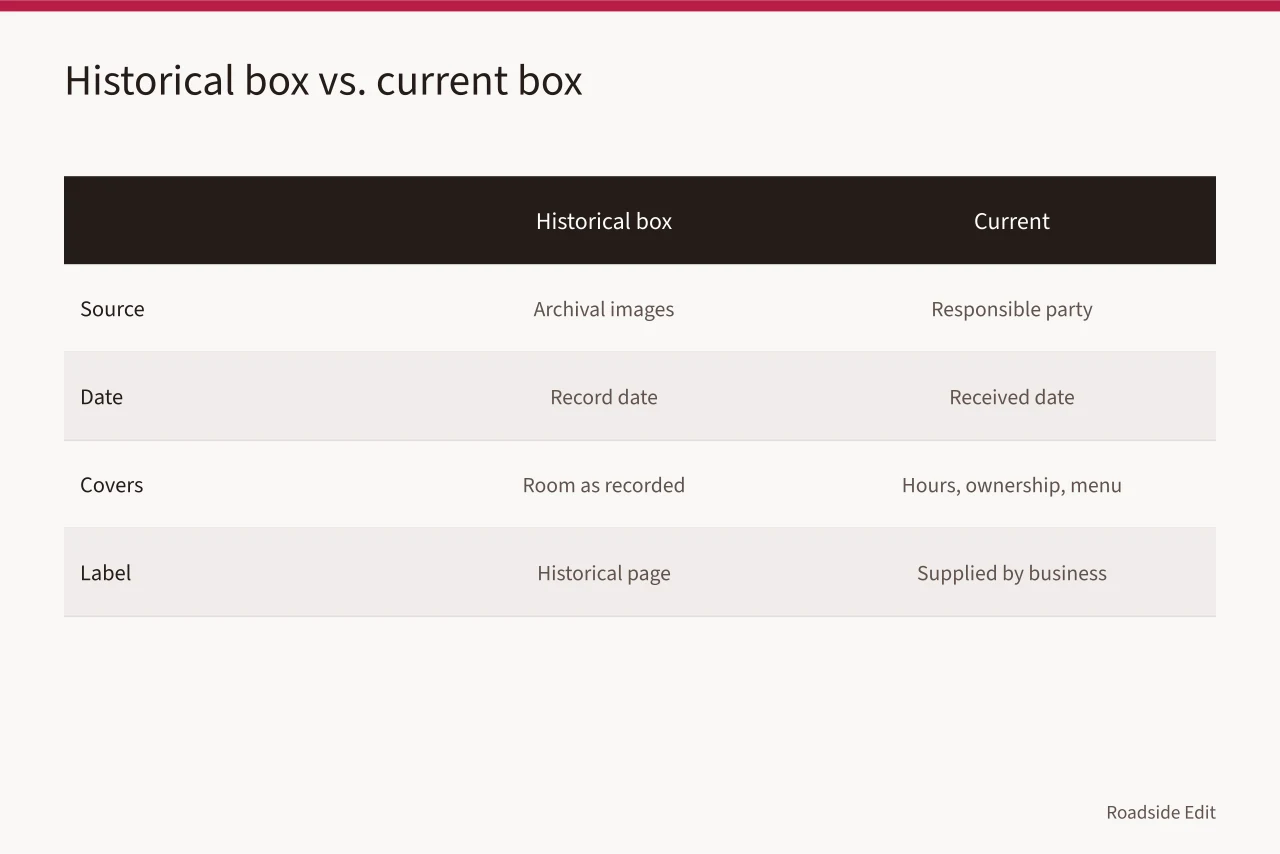
Create a current-information box only when a responsible party supplies a date and a contact. Label it: "Current information supplied by the business, received [date]." Where no current information exists, say the page is historical. That is honest and still useful.
This separation matters most on pages that later take paid placement. A business profile can report its own current details. Payment should never move a business above the evidence in the historical section.
Step 6: Plan photographs and captions before styling
A caption identifies the subject, the source, the date if known, and whether the image is contextual illustration or evidence about the featured property. A contextual diner photograph must never stand in for the subject diner.
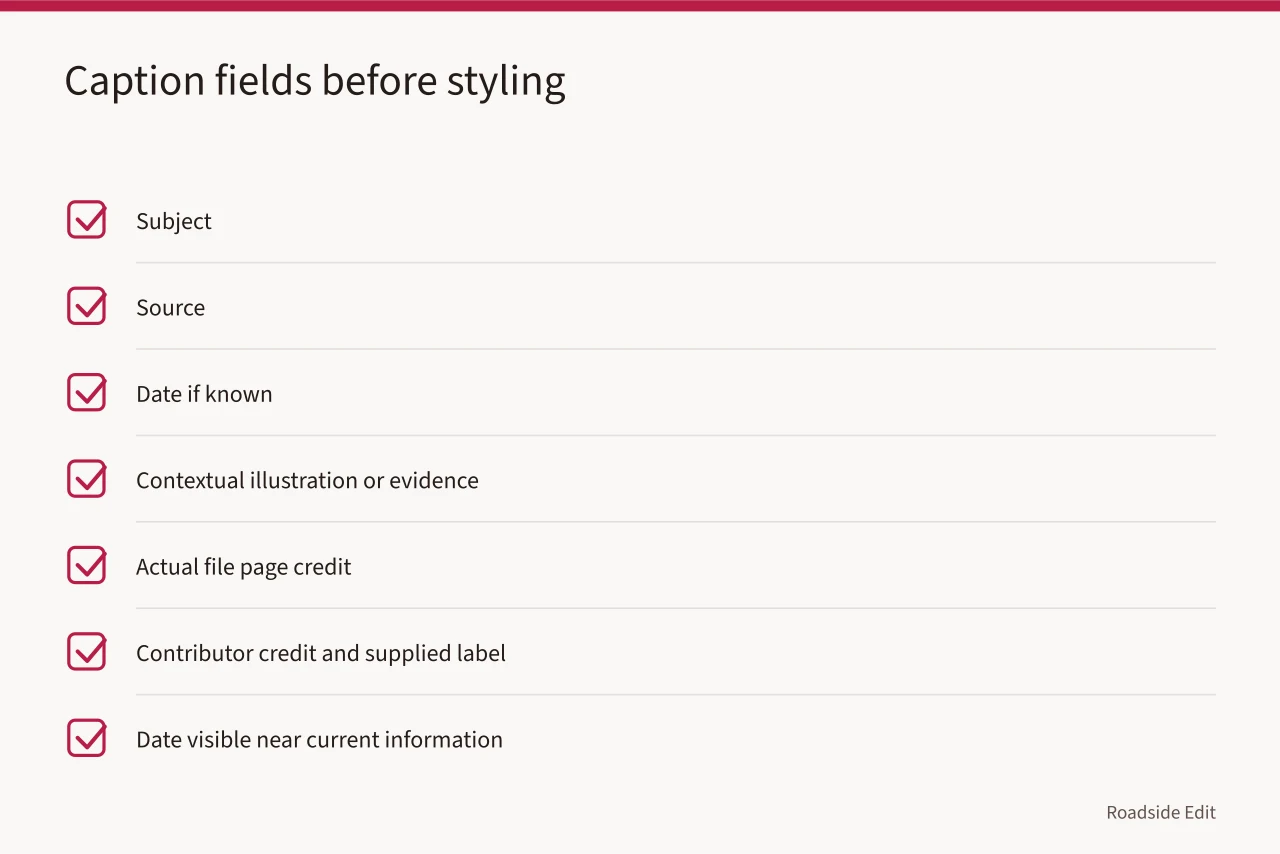
Credit the actual file page. Keep a contributor's credit and label the image as supplied. Do not crop away context that changes what the caption means. Where an old view sits near current information, make the date visible in the caption so no reader mistakes it for a current record.
The interior checklist carries the field list for this stage, and the interior fundamentals cover the room elements a caption is likely to name.
Step 7: Set the correction route
Invite corrections about names, dates, captions, and source links. Also invite corrections about contributor roles and business-supplied text. Ask for three things: the exact wording to change, a supporting record or a responsible contact, and the date of the request.
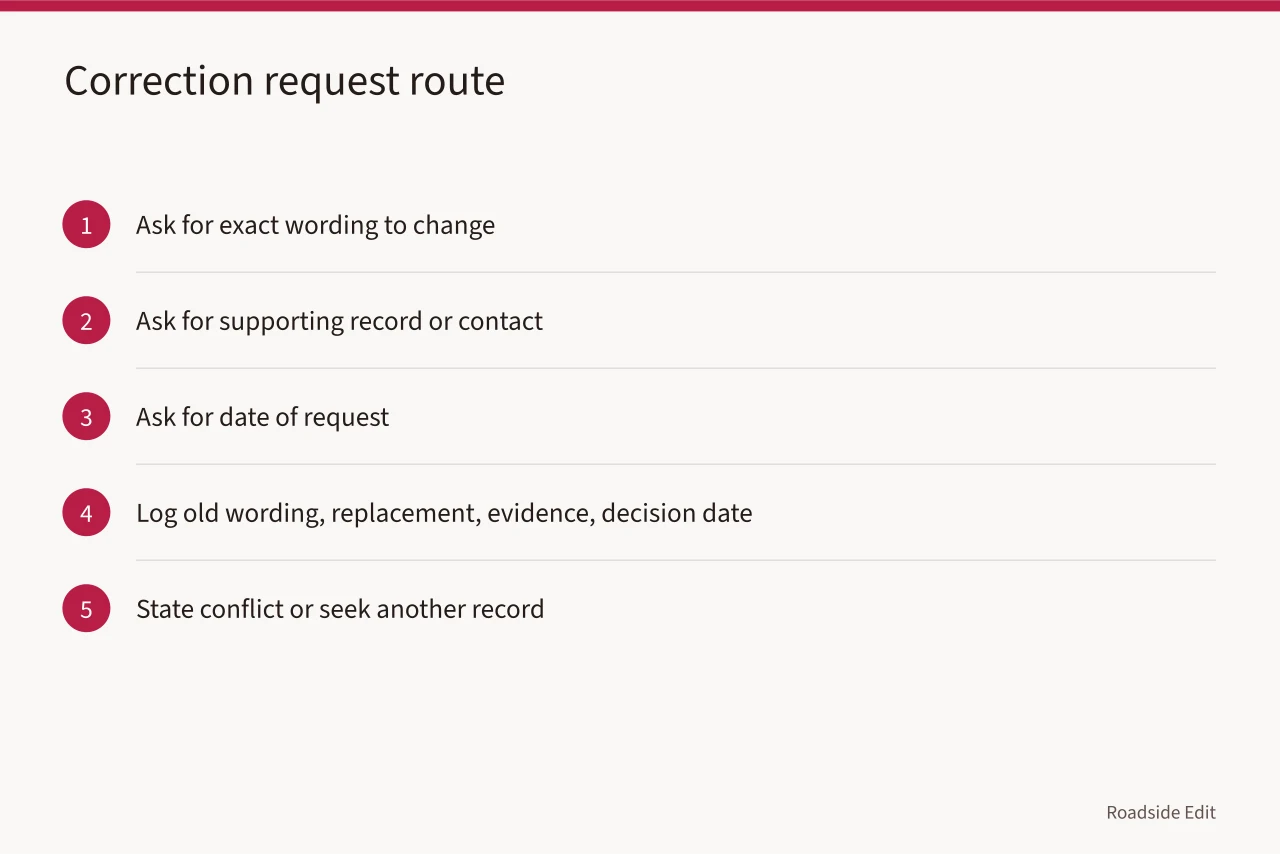
Log the old wording, the replacement, the evidence, and the decision date. Do not promise to publish every request. An owner's fact that cannot be independently verified can run as an attributed update. If a source contradicts the request, state the conflict or look for another record.
Step 8: Write disclosures a reader can see
When a business funds a feature, supplies a benefit, or provides substantial copy, label the relationship next to the content it affects. "Paid placement" beats a vague badge. A disclosure in the footer arrives after the reader has already formed an impression.
The Federal Trade Commission's endorsement guidance treats material connections that could affect how readers weigh a claim as something to disclose clearly and conspicuously. Disclosure supplies context. It does not validate a provider's description or a project result.
Step 9: Run the pre-publication review
- The article question is narrow and answerable from the records used.
- Every historical claim has a named source and a date.
- Owner and business reports are attributed and dated.
- Every image has a credit, a caption, and a context label.
- Paid relationships appear where the reader first meets the content.
- The headline promises no diagnosis, restoration outcome, or recommendation.
- A reader can submit a factual correction without guessing the process.
Worked example: one image, three claims
Take a dated photograph showing a counter along a window wall, booths opposite, and a patterned floor.
The supportable caption: "Interior, [date], showing a counter along the window wall and booths opposite. Source: [collection], accessed [date]." The unsupportable additions: that the counter is original, that the floor is linoleum, or that the layout survives today.
The third claim is the one readers most want and the one that needs a second source, a dated current photograph, or an attributed statement from the owner.
That modest discipline is the whole method. It does not reduce a diner interior to a list of retro details, and it does not let a writer decide what should happen to a specific place. It builds a record that survives the next update.
Two related files carry the rest of the sequence: the neon sign restoration planning workflow for exterior signage, and the motel exterior case study questions for the same method applied to a different building type.
Common questions
Can a planning article tell an owner what to change?
No. It organizes documentation and questions. Any decision about a specific property belongs with the owner, a licensed professional, and the State Historic Preservation Office or local landmarks commission under the adopted ordinance.
What is the most useful first record?
A dated image or collection record with a clear caption, as long as the draft keeps its claim inside what that source shows. An undated photograph is still usable if the caption says it is undated.
Can a paid diner profile carry historical information?
Yes, with the paid or supplied material labeled and the historical claims carrying their own source and date. Payment should not change the order in which the evidence appears.
What happens when current and historical records conflict?
Keep both dates and both sources visible, describe the conflict accurately, and leave it unresolved until a record settles it.