Costs
Part of Vintage diner interiors fundamentals: how to read a classic counter and booth honestly
How to keep vintage diner interior budget notes accurate
Vintage diner interior budget notes stay accurate when each figure is tied to its source record, stated scope and date rather than treated as a current price.
A dollar figure in an interior-history article is a fact about one document. It is not a price. The writing job is to say which document, from what year, covering what work, and what the document leaves out.
What to take away
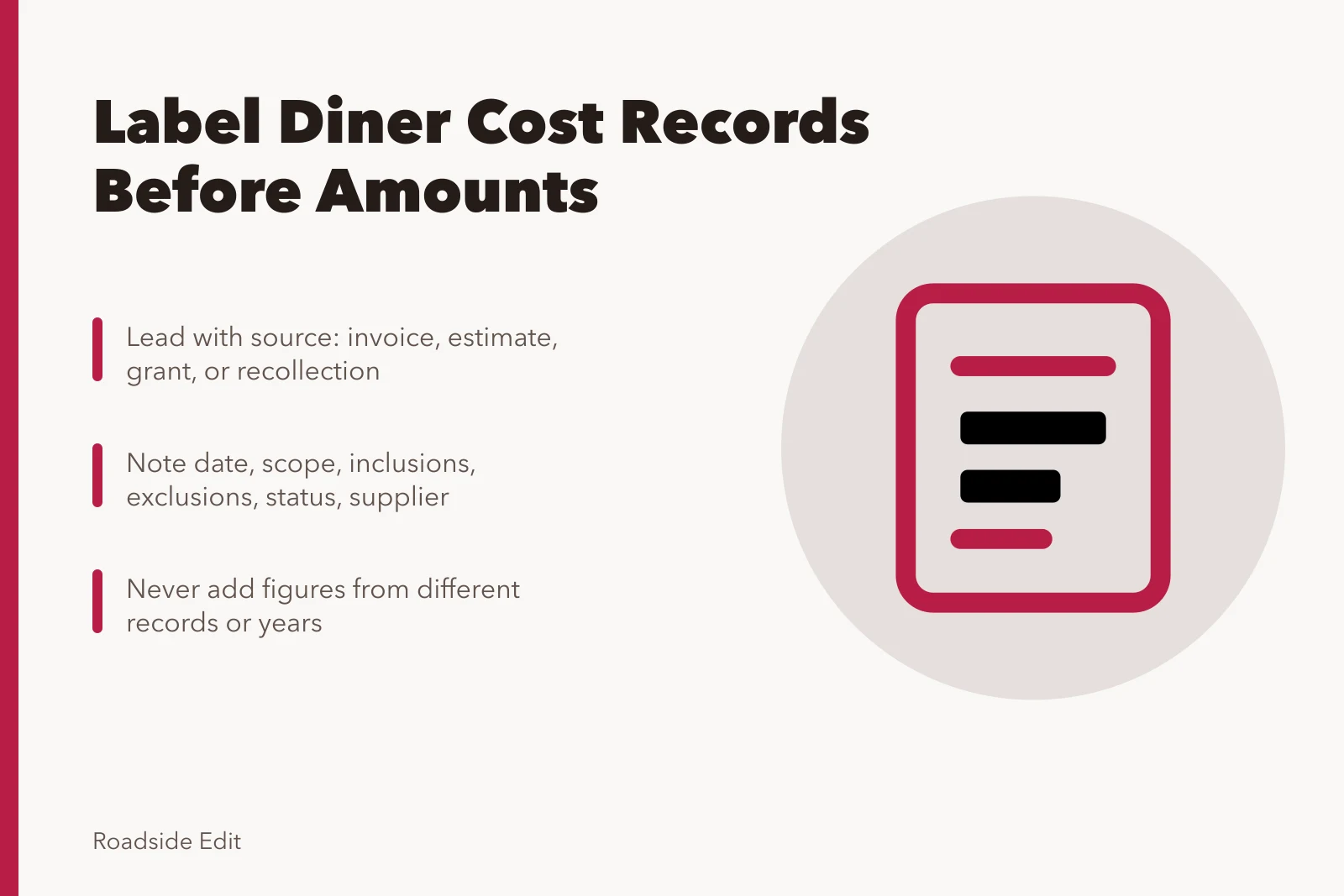
- Name the record type before the amount: invoice, estimate, public budget, owner recollection or news item.
- Carry the stated scope and the named exclusions in the same sentence as the number.
- Never total figures from different records, years or scopes into one project cost.
- Attribute business-supplied amounts and disclose any material connection beside them.
- Use the Library of Congress John Margolies archive for period context only, never as a cost source.
Identify the record before the amount
Lead with the source, not the number. A completed invoice, a preliminary estimate, a public allocation, an owner recollection and a news item each answer a different question. A 1962 invoice for a diner's booth upholstery tells you what one operator paid one upholsterer that year. It tells you nothing about what the same work costs now.
The Government Accountability Office's cost estimating guide treats documentation, assumptions and data quality as the backbone of a credible estimate.
A local feature does not need that full process. It needs the same habit: keep the assumptions and source details that give a number its meaning.
For a closer look at separating scope, assumptions and allowances in practice, see these roadside planning budget notes.
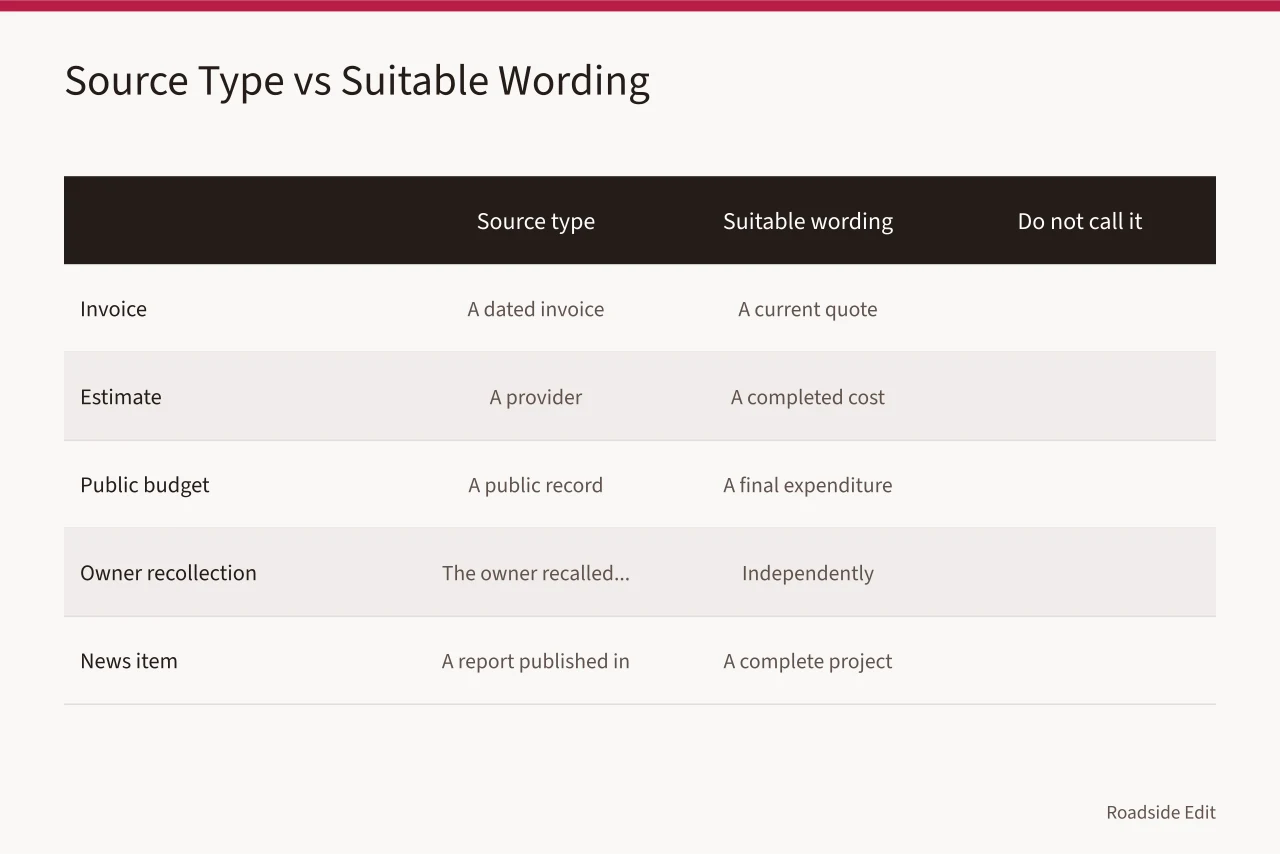
| Source type | Suitable wording | Do not call it |
|---|---|---|
| Invoice | "A dated invoice lists..." | A current quote |
| Estimate | "A provider estimated... for the stated scope" | A completed cost |
| Public budget | "A public record allocated..." | A final expenditure unless stated |
| Owner recollection | "The owner recalled..." | Independently confirmed fact |
| News item | "A report published in [year] said..." | A complete project account |
Annotate scope instead of guessing it
The most misleading cost sentences are the shortest. "The interior cost $20,000" could mean several things. These include furnishings, electrical work, painting, and permits. It could also mean a whole building or an early guess. Quote the scope the record states, then say what the record omits.
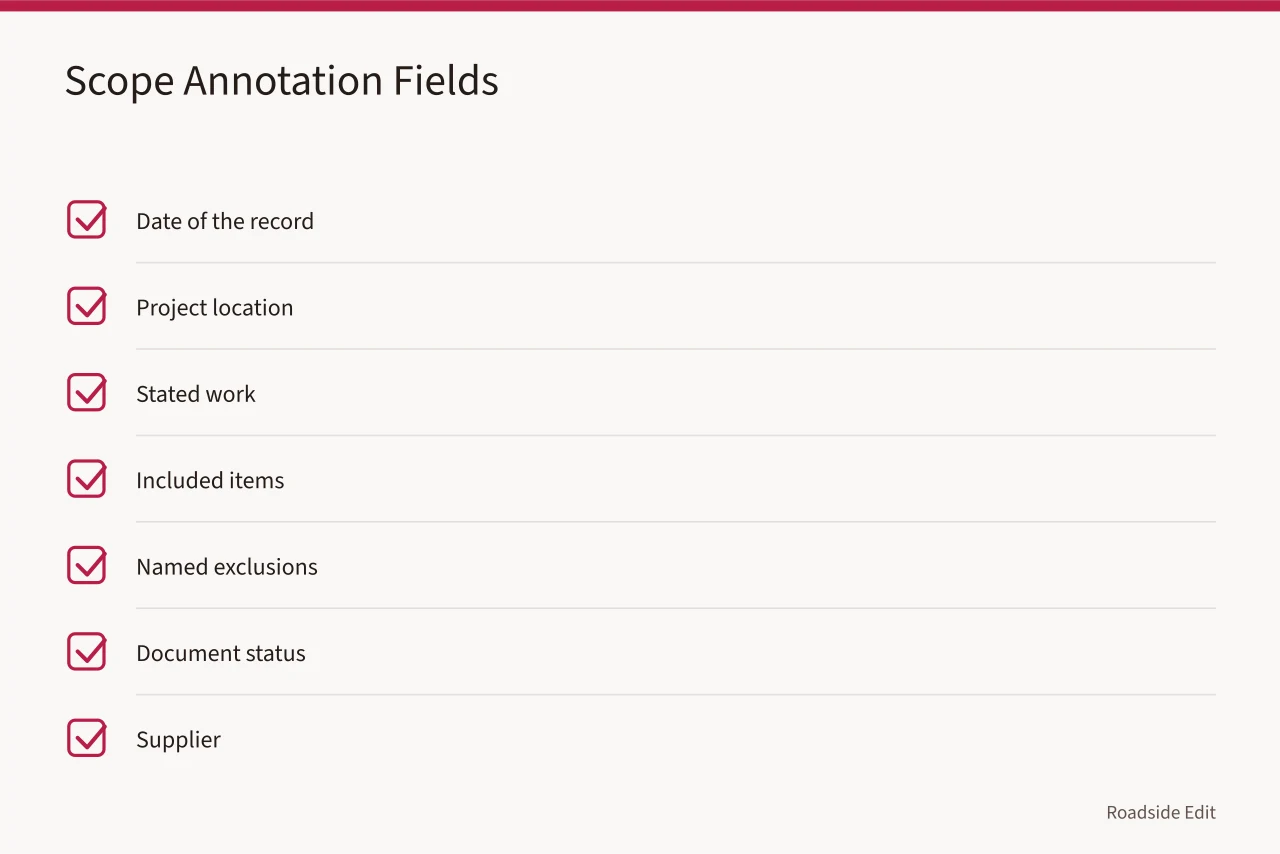
Fields worth carrying:
- date of the record
- project location
- stated work
- included items
- named exclusions
- document status
- supplier If a document says only "renovation," do not expand that into a room-by-room account. If tax, delivery, design fees or electrical work go unmentioned, write that the material reviewed does not identify them.
The National Archives records-management overview sets out a framework for keeping records traceable. For an editor the point is narrower: save the direct record and describe it the way it describes itself. A vague citation to "an archive" or "a local business" leaves a future reader unable to weigh the number at all.
Keep historical images in their own lane
A period photograph can show why a room mattered. It cannot produce a present-day benchmark. The Library of Congress John Margolies archive holds decades of roadside commercial photographs, including diner exteriors and interiors. Those images date a sign face, a glazing pattern or a color scheme. They do not date a budget.
Use the photo to describe its own documented scene. Use a separate dated record for any figure. Pairing an appealing historic image with an unrelated estimate invites the reader to assume both describe one project.
Do not build a composite price
Do not add figures from several articles, providers or years. One source may cover booth upholstery, another exterior paint, a third a full rehabilitation. The total is not evidence. It is a new number the writer created.
Report each amount in its own sentence with its own scope. If the article compares, compare the records: invoice against estimate, public allocation against final payment, supplied claim against public document.
Never present them as interchangeable bids. Where a current figure matters, give the arithmetic in named variables the reader fills with their own numbers, or point to where the current figure is published.
Treat supplied cost claims with care
A business may hand you a figure for its own project. That can be useful when it is attributed, dated and tied to a stated scope. If the business paid for the profile, supplied free goods or holds another connection a reader would weigh, disclose it next to the figure.
The Federal Trade Commission's endorsement guidance says material connections that could affect credibility should be disclosed clearly and conspicuously. Disclosure gives context. It does not verify the price, the workmanship or the claimed result.
Close with a line beside the record description, not buried in site policy: "This historical figure is reported for context only. It is not a quote or prediction of current costs."
Common questions
Can a historical amount appear in a case study?
Yes, if you identify the date, source, stated scope and missing details. It stays historical context, not a current quote.
Why are exclusions important?
They stop a partial figure from reading as a complete project cost. Readers need to know which items the record does not identify.
Does paid placement verify a price?
No. Label the paid relationship, and keep business-supplied cost information clearly attributed to the business.