Guides
Part of Vintage diner interiors fundamentals: how to read a classic counter and booth honestly
How to build a vintage diner interiors checklist before you assign photos
A field inventory for diner interiors: record the counter, booths, finishes, lighting and signage you can see, and date every image before it goes to caption.
A diner interior survives in layers, and the layers disagree. The counter may be 1948, the booths 1972, the ceiling tile 1994. A checklist built before you assign photos keeps those layers separate instead of averaging them into one date.
What to take away
- Inventory five zones in fixed order: counter, booths, floor and wall finish, lighting, signage.
- Record the image date and source page before you write a single caption.
- Photograph the counter from the same angle each visit so wear and replacement show up as differences.
- Write what the surface is, not what it means: "curved chrome edge trim" beats "original detailing."
- Keep current operating facts in a separate file from the historic inventory.
The five zones, in the order you walk them
Walk the room the same way every visit. A fixed route means a missing zone is a visible gap in the file, not a thing you forgot.
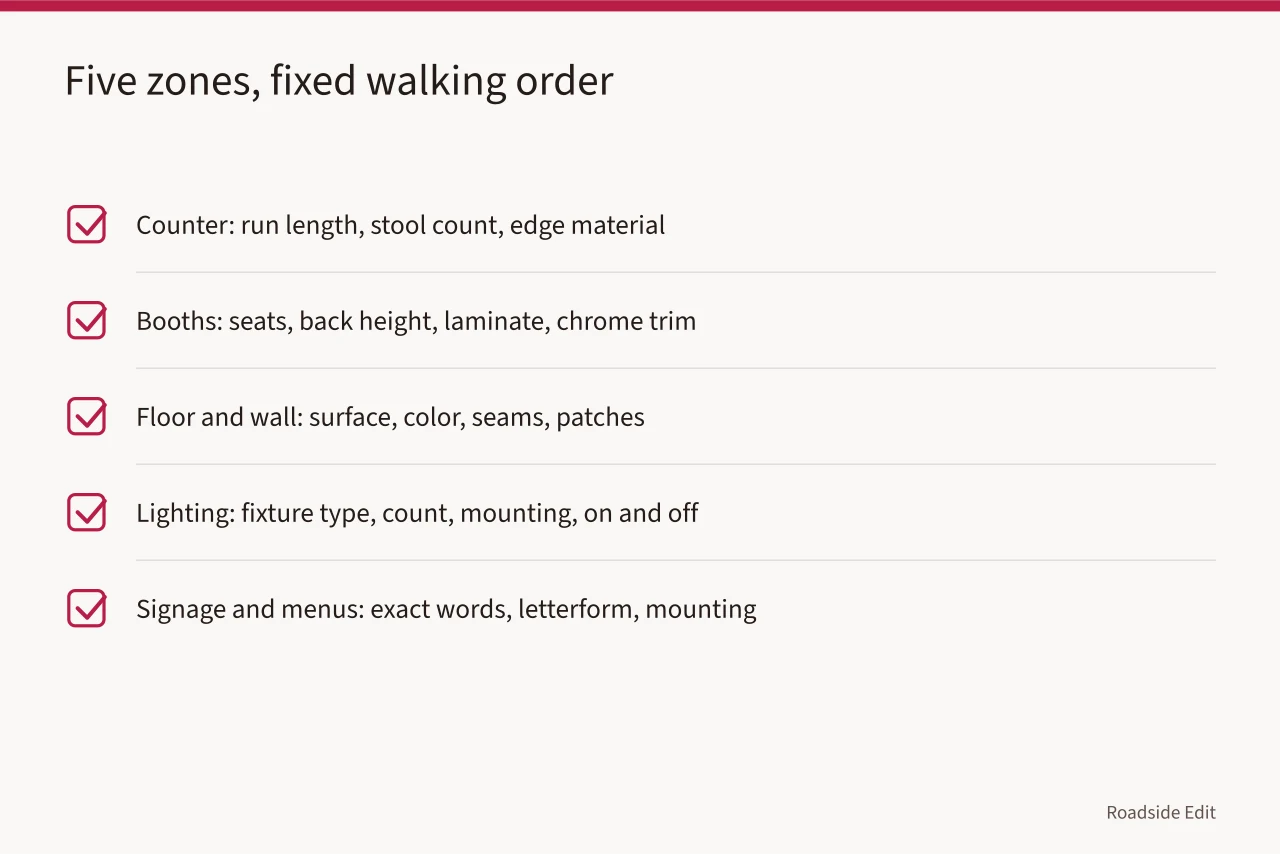
Counter. Note the stool count, stool base type, and whether the counter face is laminate, enamel, or stainless. Photograph the under-counter edge, where replacement shows first. Measure the counter run in feet so a later photo can be matched to it.
Booths. Count seats, record the back height, and photograph one booth straight on and one at an angle. Laminate pattern and chrome-edge trim are the two features that date a booth fastest, and both read clearly in a flash photo.
Floor and wall finish. Record what the surface is, its color, and any visible seam or patch. Do not name a material from a photograph alone; "dark red tile with a chipped corner near the door" is a field note, "original 1940s quarry tile" is a claim.
Lighting. Note fixture type, count, and mounting. Photograph fixtures with the room lights on and off. Never open a fixture or comment on its wiring; that is the licensed electrician's call and the local authority having jurisdiction sets the standard.
Signage and menus. Photograph the exact words, the letterform, and the mounting. A menu board is a dated object; a hand-lettered special is not.
| Zone | Record this | Leave to a named authority |
|---|---|---|
| Counter | Run length, stool count, edge material | Structural condition |
| Booths | Seat count, back height, laminate and trim | Upholstery fire rating |
| Floor and wall | Surface appearance, color, visible patches | Material composition, asbestos |
| Lighting | Fixture type, count, mounting | Wiring, load, transformer condition |
| Signage | Exact wording, letterform, mounting | Sign code compliance |
Dating an image before you caption it
An undated photo is a mood board, not evidence. Before a photograph enters the file, attach the source page, the stated date or date range, and the collection name.
The Library of Congress Modern Diner record is a useful model because it ties each feature to one documented property: counter, booths, glass block, stainless steel, Streamline Moderne trim. It says nothing about any other diner, and it is not a template for yours.
The National Archives explanation of what makes a primary source makes the point that usefulness depends on the question asked. A 1962 postcard is strong evidence of what the room looked like in 1962. It is not evidence of what is there now.
The Library of Congress primary-source analysis guide puts observation ahead of interpretation. Describe first, then list the questions the image raises, then go find the separate record that answers them.
That habit of separating observation from interpretation is the same discipline behind vintage diner interiors: comparison questions to ask before you trust a source, where the goal is weighing one account against another rather than accepting the first confident caption.
Field inventory template
Carry one page per visit. Numbered entries survive a lost notebook better than prose.
- Source page and direct link.
- Creator or collection, as given.
- Image date, or the stated range.
- Zone, feature, and position in the frame.
- Case evidence or contextual illustration.
- Open question, and which record would close it.
Terms that carry weight
"Streamline Moderne," "original," and "restored" are claims, not descriptions. Use them only when an institutional record uses them about that property, and quote the record's wording. Otherwise describe the shape: "curved metal trim, radius roughly two feet."
The National Park Service Secretary's Standards overview sets principles for treating historic properties. It is not a scoring sheet for a diner article. Its use here is narrow: identify the property and the record before you make any preservation claim.
Supplied material and disclosure
Operators, architects, and designers hand over good dates and bad ones. Attribute both: "the operator said the booths were replaced," not "the booths were replaced."
The Federal Trade Commission's endorsement guidance asks that a relationship which could change how a reader weighs a claim be disclosed clearly and near that claim. Disclosure gives context. It does not verify anything.
Common questions
How many photos per zone?
Two minimum: one straight on, one at an angle. Add a detail shot wherever a material or joint is the point of the entry.
What if two sources disagree on a date?
Record both with their dates and say the material does not settle it. A stated conflict is more useful than a confident caption.
Can I use a supplied photo?
Yes, credited, dated where possible, labeled as supplied, and never presented as independent evidence.
What is the last check before publishing?
Every historic, material, and current claim has a source or an attribution, and every image credit points to its source page.
When the record is a property file rather than a photograph, the same standard applies. That standard covers the documents behind it. This is what roadside architecture case study questions to ask before you trust a property record walks through.
And when the claim is about the building itself rather than the file, the baseline facts come first, as laid out in roadside building fundamentals: comparison questions to ask before you trust a historic record.