Reviews
Part of Vintage diner interiors fundamentals: how to read a classic counter and booth honestly
Vintage diner interiors: comparison questions to ask before you trust a source
Vintage diner interior research questions for 2027 help readers test images, layouts, historical labels, current details, and supplied claims with care.
An interior profile becomes more reliable when its questions are specific. Instead of asking whether a diner is "authentic," ask what a dated image identifies, what a property record names, who can confirm a current detail, and where the evidence stops. These questions help a writer compare sources without turning taste into history.
What to take away
- Ask what the record shows before asking what it means.
- Match each question to a source that can actually answer it.
- Keep historical details and current information on separate timelines.
- Treat an owner or business response as an attributed account.
- Leave an unanswered point visible when no record resolves it.
Ask image questions before style questions
An image can show a counter, booth, stool, menu board, or window treatment. It cannot automatically establish a date of installation, an original material, or a preservation status. Start with the image itself: who made it, when, where is the original page, and what does the caption identify?
The Library of Congress diners and restaurants collection groups visual material about restaurants, architecture, signage, and people. It can provide useful context and research leads. It is not a property record for every diner in the collection or outside it.
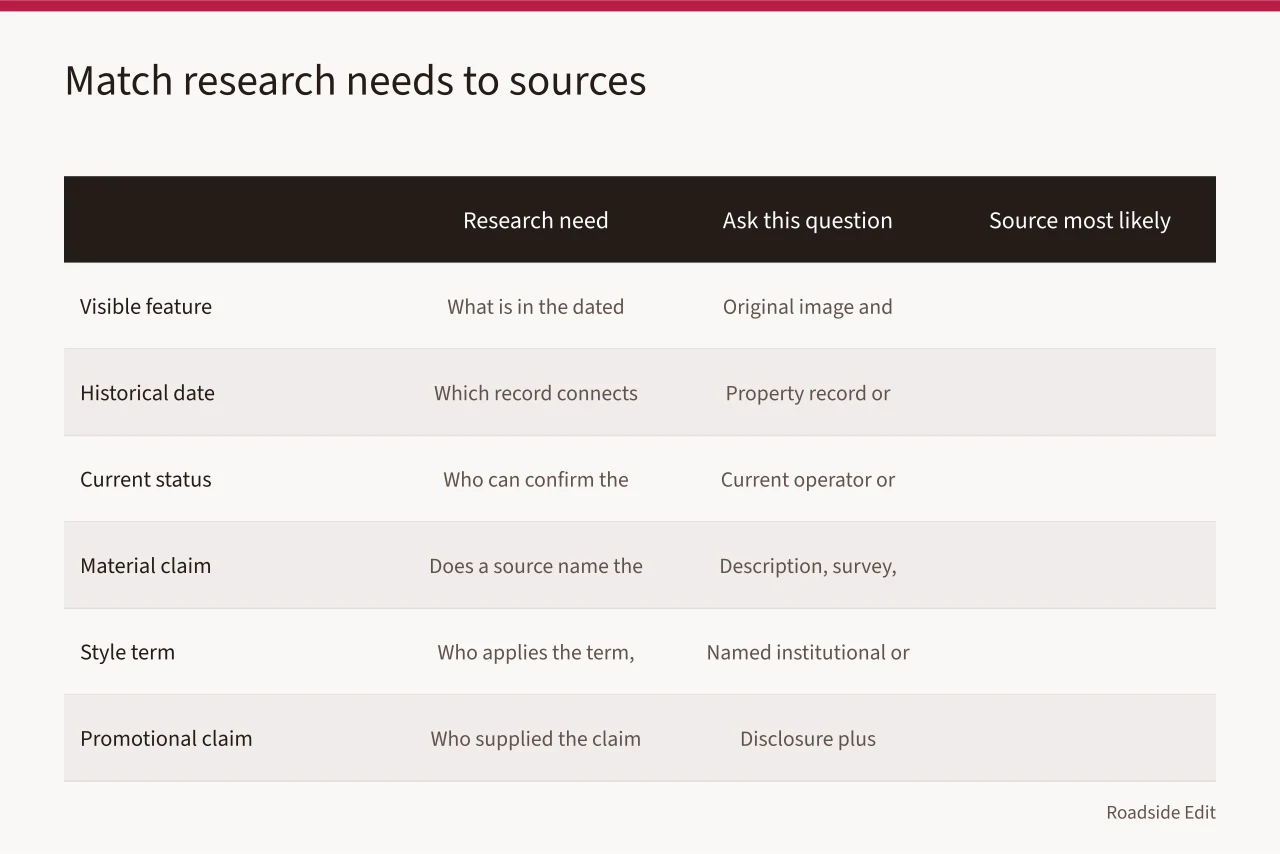
| Research need | Ask this question | Source most likely to help |
|---|---|---|
| Visible feature | What is actually in the dated frame? | Original image and caption |
| Historical date | Which record connects this feature to a time period? | Property record or dated collection note |
| Current status | Who can confirm the room as it exists now? | Current operator or direct current record |
| Material claim | Does a source name the material? | Description, survey, or manufacturer record |
| Style term | Who applies the term and on what basis? | Named institutional or scholarly source |
| Promotional claim | Who supplied the claim and what relationship exists? | Disclosure plus attribution |
Compare sources by what they can answer
The right source changes with the question. A historic photograph may be the best source for a caption and visible layout on its stated date. A current operator may be the best source for present access or a recent change. Neither source should be stretched into an answer it does not contain.
The National Archives primary-source explanation explains that a source is primary in relation to a particular question. That is why a writer should not call a document authoritative in the abstract. Name the narrow point it supports, then name what still needs a different kind of evidence.
Use these comparison questions:
- Do the sources describe the same room and time period?
- Does one source identify a feature while another only shows it?
- Is a date attached to the record or only inferred from appearance?
- Does a current account distinguish between original, replacement, and recent work?
- Does a source conflict reflect different dates rather than a factual error?
When two sources disagree, describe the conflict precisely. An older caption and a current owner account may both be accurate about different periods. Do not force a single story simply because a smoother paragraph reads better.
Ask better questions about historical labels
Words such as "vintage," "original," "restored," and "historic" need support. "Vintage" can be a general description; it is not a designation. "Original" requires a record about installation or surviving fabric. "Restored" requires a source describing work, not just a later photograph. "Historic" may describe local context without showing a formal listing.
The National Park Service Secretary's Standards overview explains principles for treating historic properties. It does not classify a diner from an online image. Use it as a reminder to locate the actual property record before applying preservation language to a specific interior.
If the record remains incomplete, write a clear limit: "The sources reviewed identify the counter in a 1970 image but do not establish its installation date." That sentence gives readers a useful fact and directs future research toward the missing evidence.
Keep current information separate
Interior profiles can drift when a historic feature is described beside a current business claim. Split those subjects. Put history in a dated section. Put current information in a separately dated section with an attributable source. This avoids making a decades-old photo sound like proof of present operations, ownership, or access.
The Library of Congress primary-source analysis guide begins with observation and moves to reflection and further investigation. That order works well here: identify the visible feature, ask what it may suggest, then look for a record before writing a conclusion.
Ask disclosure questions before recommending anyone
An interior profile may include a business, designer, owner, or product company. Ask whether the article includes payment, free goods, a hosted visit, or supplied promotional copy. If the relationship could affect how readers weigh a recommendation, say so in direct language next to the relevant content.
The Federal Trade Commission's endorsement guidance says material connections that could affect the credibility given to an endorsement should be disclosed clearly and conspicuously. The disclosure provides reader context. It does not make a supplied description an independent fact.
Common questions
Can a style description be useful?
Yes, when the article presents it as a description or attributed interpretation rather than a documented installation date or original feature.
Should a profile show unanswered questions?
Yes. A clear evidence boundary helps readers and gives responsible contributors a useful path to provide a relevant record.
Can readers compare two diner interiors?
They can compare dated, described records. Do not turn the comparison into a quality ranking unless the article states and supports a suitable method.