Guides
Part of Vintage diner interiors fundamentals: how to read a classic counter and booth honestly
Before you run vintage diner interiors copy, check these warning signs
Vintage diner interior warning signs for 2027 help editors catch unsupported originality claims, old images, weak captions, and hidden promotion.
Most errors in a vintage-diner interior feature are editorial. A stylish photo can be undated. A current owner account can get retold as history. A paid profile can read like an independent endorsement. Catching these signals early protects readers and makes corrections much easier.
What to take away
- "Vintage" and "original" are not interchangeable claims.
- Every image needs a source page, date when known, factual caption, and stated purpose.
- Historic records and current business updates should appear in different time frames.
- A provider's account should remain attributed to that provider.
- Promotional relationships need a clear label where readers encounter the claim.
Flag language that promises too much
Read the headline, subheads, captions, and opening paragraph on their own. Mark words such as "original," "restored," "authentic," "untouched," and "best." Each one asks the article to prove something specific. If no record supports that exact meaning, replace it with a visible description or a dated, attributed statement.
The National Park Service brief on painting historic interiors emphasizes understanding a preservation goal and the information needed before work proceeds. This is not a repair guide. The editorial lesson is narrower: do not frame a room as historically proven before the relevant evidence is available.
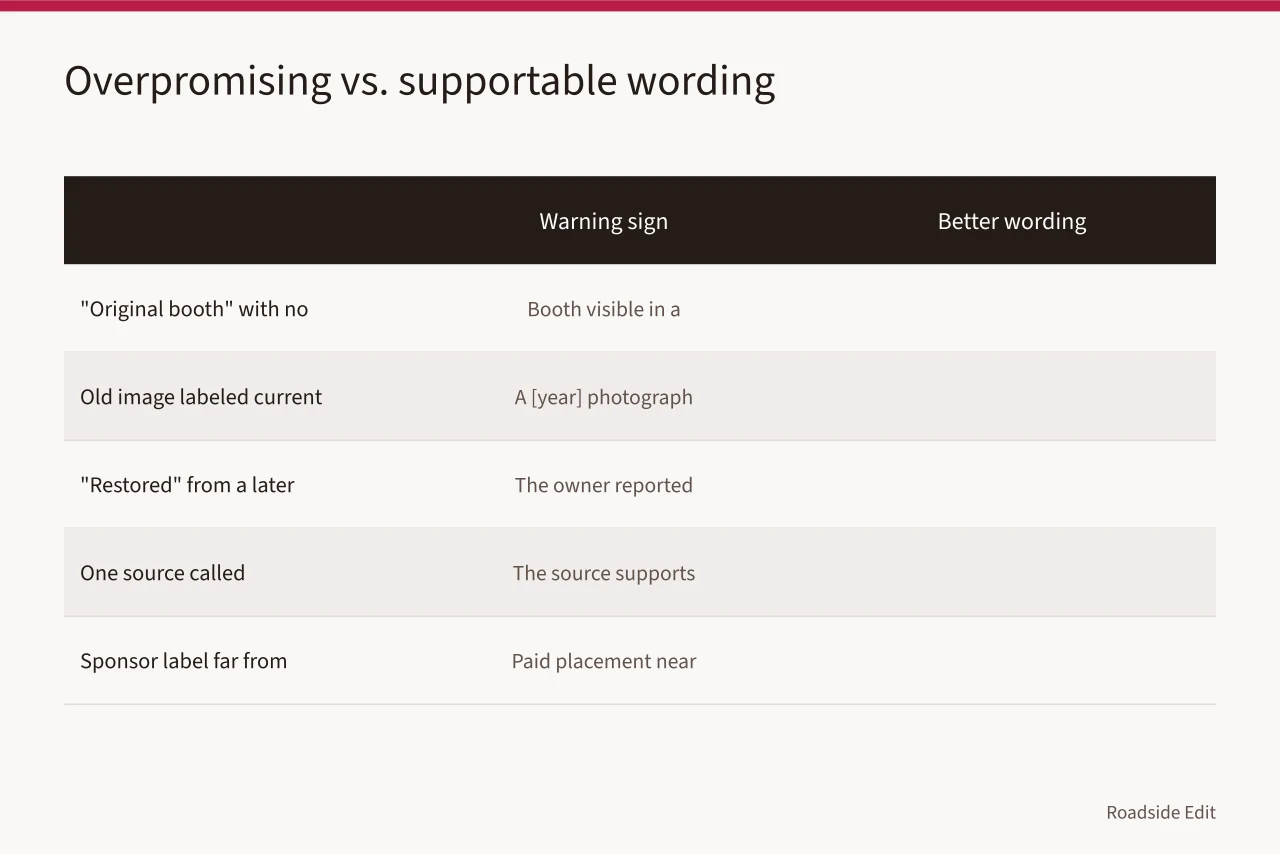
| Warning sign | What it can mislead readers to believe | Better wording |
|---|---|---|
| "Original booth" with no record | The installation history is known | "Booth visible in a dated image" |
| Old image labeled current | The room still appears that way | "A [year] photograph shows..." |
| "Restored" from a later photo | A specific project occurred | "The owner reported work in [year]" |
| One source called definitive | The record answers every question | "The source supports this limited detail" |
| Sponsor label far from claims | The profile is independent | "Paid placement" near the content |
Audit every image as evidence
An appealing room image can make an article feel researched before the reporting is complete. Check the original source page first. Record the creator or collection, stated date, location, caption, and whether the image is evidence for the featured diner or only context.
The Library of Congress primary-source analysis guide begins with observation before reflection and further investigation. Follow that sequence in the draft. "Chrome trim appears along the counter in this 1964 image" is an observation. "The diner preserved its original trim" needs a record about the trim's history and present condition.
Do not use a photo from another diner as evidence for the featured interior. A contextual image is acceptable when the caption says so. It should never be placed beside a claim in a way that implies a connection it does not have.
Separate date drift from factual error
An old source can be accurate and still not be current. Business ownership, menus, access, seating, and room finishes may change. Preserve the historic statement in a dated section, then add a current account only when it has a current source. Avoid silently replacing an archival caption with present-tense language.
The National Archives primary-source explanation notes that the meaning of a source depends on the question. A 1950 interior photo is strong evidence for its own moment. It is not proof of a 2027 room arrangement or operating status.
When accounts conflict, identify the period each one describes. The conflict may reflect change over time, not an error. If the record cannot resolve it, say so instead of selecting the version that makes a cleaner story.
Keep promotion visible
An operator, designer, or manufacturer may supply photographs and project details. Attribute the material: "The owner said" or "According to material supplied by the business." Then ask whether payment, a free service, or another relationship could influence the weight readers give to the account.
The Federal Trade Commission's endorsement guidance says material connections that could affect an endorsement's credibility should be disclosed clearly and conspicuously. A disclosure gives readers context. It does not independently establish that an interior is original, successful, or better than another one.
Place "Paid placement" at the beginning of the affected profile. Do not hide it in a footer or general policy. Keep the business account separate from any independently sourced historical material.
Leave a correction trail
Before publication, note the source for every historical label and the date for every current claim. If a correction later changes a material fact, add a dated note explaining the change. Keep the working evidence so an editor can see why the original wording was revised.
Common questions
Is a photo caption enough to prove an interior is original?
No. It can support the image date and visible description. Installation history requires a separate source.
Can a restaurant submit a current update?
Yes. Attribute it, include a date, and do not transform it into an independent historical conclusion.
What should be removed before publishing?
Remove or revise words such as "authentic," "original," "best," or "restored" unless the article can support their exact meaning.