Reviews
Part of Roadside building fundamentals: how to date claims and credit images
Roadside building fundamentals: comparison questions to ask before you trust a historic record
Comparing roadside records by date, subject and scope keeps a Seligman, Missouri storefront listing from being read as proof of a 1933 building.
A 1933 district nomination, a 1998 photograph, and this year's storefront listing can all be right at once. They describe different dates, different features, or different parts of the same block. The job is to sort them before you compare a word of them.
What to take away
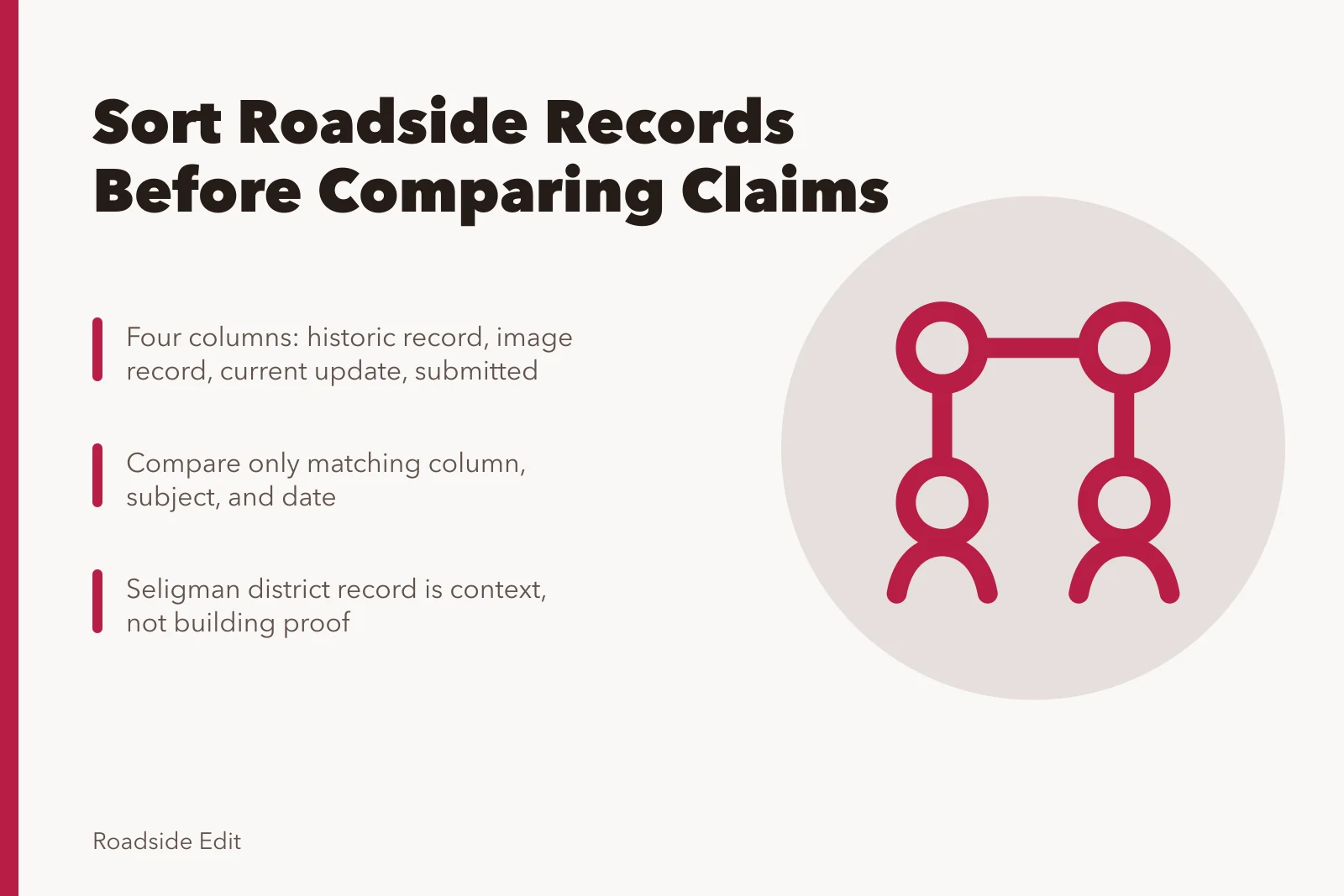
- Sort every source into one of four columns before reading it against another.
- Compare only claims that name the same property, feature and date.
- Keep both names for a renamed property, each with the years it was used.
- Write a conflict note when records disagree and no source settles it.
- Treat a district nomination as context for a building, never as proof of its current use.
Sort the sources first
Four columns cover most of what reaches a roadside file: historic record, image record, current update, and submitted information from an owner or provider. A claim only compares with a claim in a matching column on a matching subject.
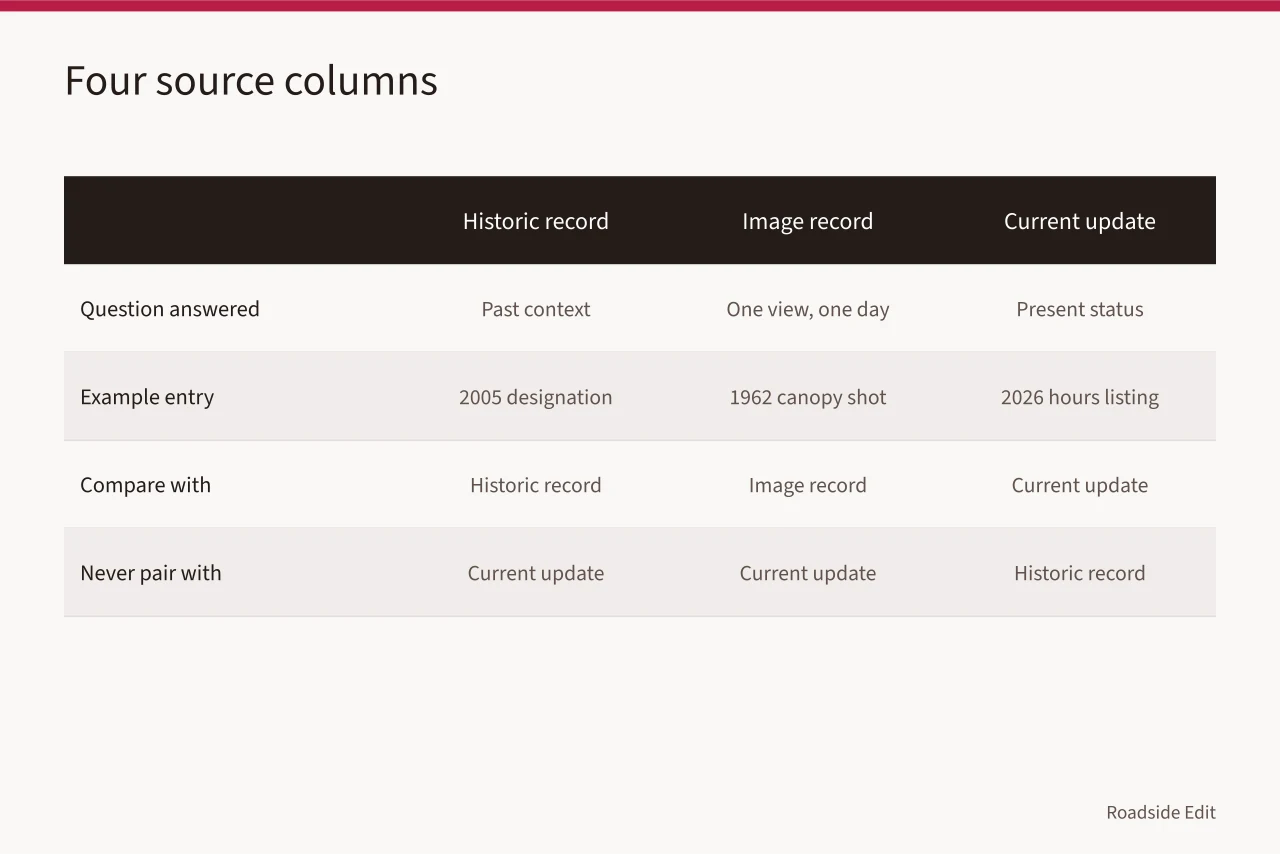
A 2005 designation and a 2026 hours listing are not competing facts. They answer different questions, and putting them side by side produces a disagreement that does not exist.
The Seligman example
The National Park Service entry for the Seligman Historic District names commercial buildings and roadside businesses tied to the 1933 rerouting of Route 66 through northern Arizona. Read the NPS Seligman Historic District record.
That entry works at district scale. It can carry a statement the district record itself makes. It cannot tell you which storefront still hangs a porcelain-enamel sign, whether a canopy soffit has been reclad, or who holds the deed this year.
A district boundary drawn in 1933 and a business operating under a new name in 2026 both belong in the file. They belong in different columns.
Compare like with like
Line the columns up and read across only where the subject matches. Where a property appears under two names, keep both with the years each was in use rather than choosing the one that sounds more familiar. A building may have changed name, changed trade, or been folded into a nearby district's paperwork.
State the relationship the sources actually show. If nothing connects the two names but a street address, say that.
What a photograph can and cannot establish
A photograph documents one view on one day. It cannot show concealed conditions, current ownership, access rights, or how a project turned out. The National Archives notes that photographic records need attention to their own history and handling. Read National Archives guidance on photographs.
That guidance does not authenticate a particular scene. It supports keeping the source page, the date, the photographer and the limits of the copy you hold. A 1962 canopy shot proves the canopy existed in 1962. It says nothing about the soffit behind it now.
Maps carry the same boundary. The U.S. Geological Survey describes topographic maps as representations of natural and man-made features. See the USGS explanation of topographic maps. A quadrangle sheet can place a pump island on a lot line. It cannot establish current use, condition or ownership.
Keep present-tense claims out of historic context
A district record is background. It is not evidence that a business is open, that a neon sign still hangs, or that a building keeps its original use.
Ask for a dated current source for any present-tense claim. If an owner supplies one, label it submitted information and file it apart from the historic record.
The National Park Service publishes professional qualification standards across the preservation disciplines. Review the NPS qualification standards. They designate no property and endorse no person. They tell you what training to look for when a project needs a preservation review, and which licensed trade to call for canopy, electrical or tank work.
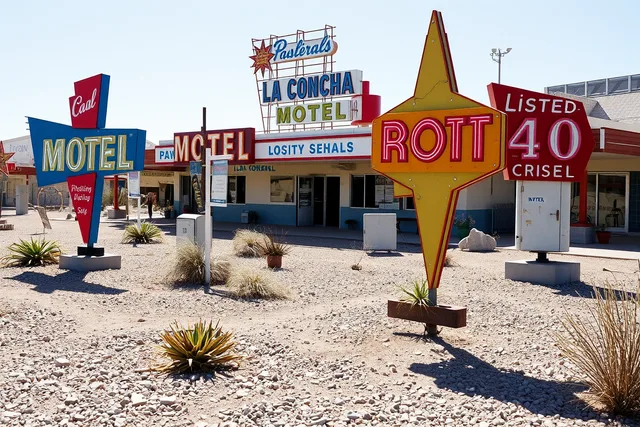
The image is illustrative. It does not establish current conditions, ownership, safety, or project status.
Write the conflict note
When two records disagree and neither settles the question, write it down in three lines.
- Source A says this, with its date and its scope.
- Source B says that, with its date and its scope.
- The available record does not resolve the difference; the next authority is [named office or trade].
Do not erase the inconvenient source. Do not pick the newer statement because it is newer. A 1978 survey and a 2019 nomination may both be accurate about different decades of the same facade.
Keep the note dated and readable, and leave room for an editor or a named authority to correct it later. An unresolved question that stays visible is worth more than a tidy paragraph that hides it. For the survey vocabulary these notes depend on, start with roadside building fundamentals.
Common questions
Which source wins when two records differ?
Neither one automatically. Compare date, subject and authority, then report only what the evidence resolves and name the office or trade that can settle the rest.
Does a district record identify every building's current use?
No. A nomination gives historical context for a district and usually leaves current operation, ownership and condition unaddressed.
Should an unresolved difference appear in the article?
Yes, when it affects the claim. State the limit, keep both sources dated, and point to the authority that holds the answer.