Costs
Part of Roadside building fundamentals: how to date claims and credit images
Roadside building basics budget notes: what to record before you spend
Roadside building basics budget notes for 2027 help U.S. readers match spending records to a source, scope, status, limit, and responsible decision.
A roadside building budget note should help a reader understand one small decision. It might describe a documented source, a recurring task, an open question, or a provider proposal. It should not make a roadside photo look like an inspection report or make an old project amount look like a 2027 price.
The basic method is simple: every spending line needs a source, a defined task, a date, a status, and a limit. When one of those pieces is missing, call it missing. That is more useful than filling the gap with a neat but unsupported estimate.
What to take away
- Keep routine care, research, proposals, approvals, and completed work in separate budget lanes.
- Pair every figure with the document, project phase, work area, and exclusions that give it meaning.
- Record visible facts without claiming a cause or repair need that the source cannot support.
- Label business submissions and paid placements as commercial material, not independent findings.
Make a basic building record first
Start with a simple record for each visible area: front elevation, sign, entry, roofline seen from authorized ground space, parking edge, exterior lighting, or a drainage path. The record does not need to be long. It needs to be consistent enough that a future editor can tell what changed.
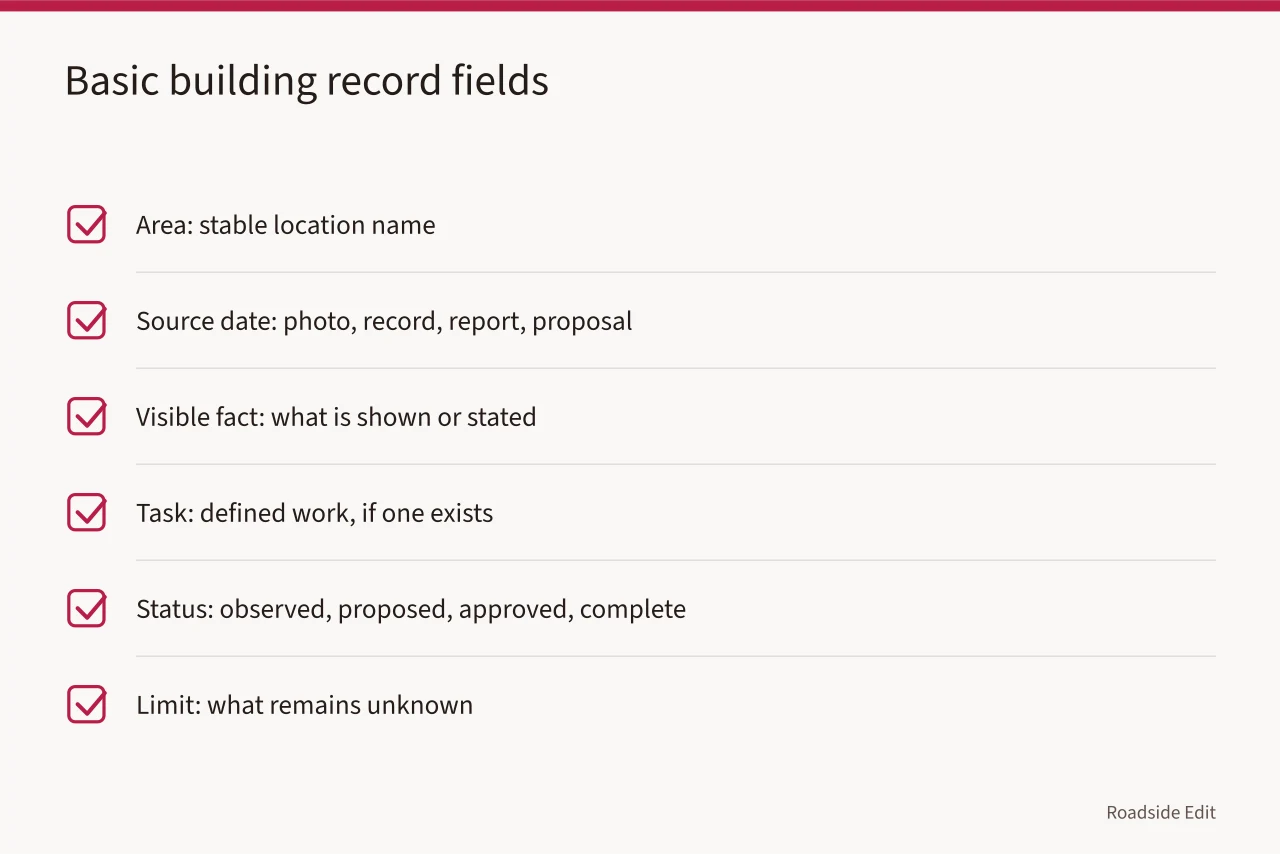
| Field | What to record | What not to infer |
|---|---|---|
| Area | A stable location name | Conditions beyond the identified area |
| Source date | Date of photo, record, report, or proposal | That the source describes the present day |
| Visible fact | What is shown or stated | Hidden cause or material condition |
| Task | The defined work, if one exists | A repair scope not yet prepared |
| Status | Observed, proposed, approved, or reported complete | A stronger phase than the record says |
| Limit | What remains unknown | A conclusion created from the gap |
The National Park Service's Researching Route 66 guide directs researchers to sources for Route 66 history, assistance, and property documentation. It is not a building-cost manual. Its relevant lesson is that basic property research should lead back to the specific document that supports a claim instead of relying on a summary or memory.
Separate a building question from a building project
An observed question is not yet a project. A note may report an unlit sign, a changed surface, or water visible after a stated event, but it cannot say why or what work will correct it without further evidence.
This boundary matters most when an article includes a budget field. Readers tend to see a number as a decision, even when it is only a preliminary thought.
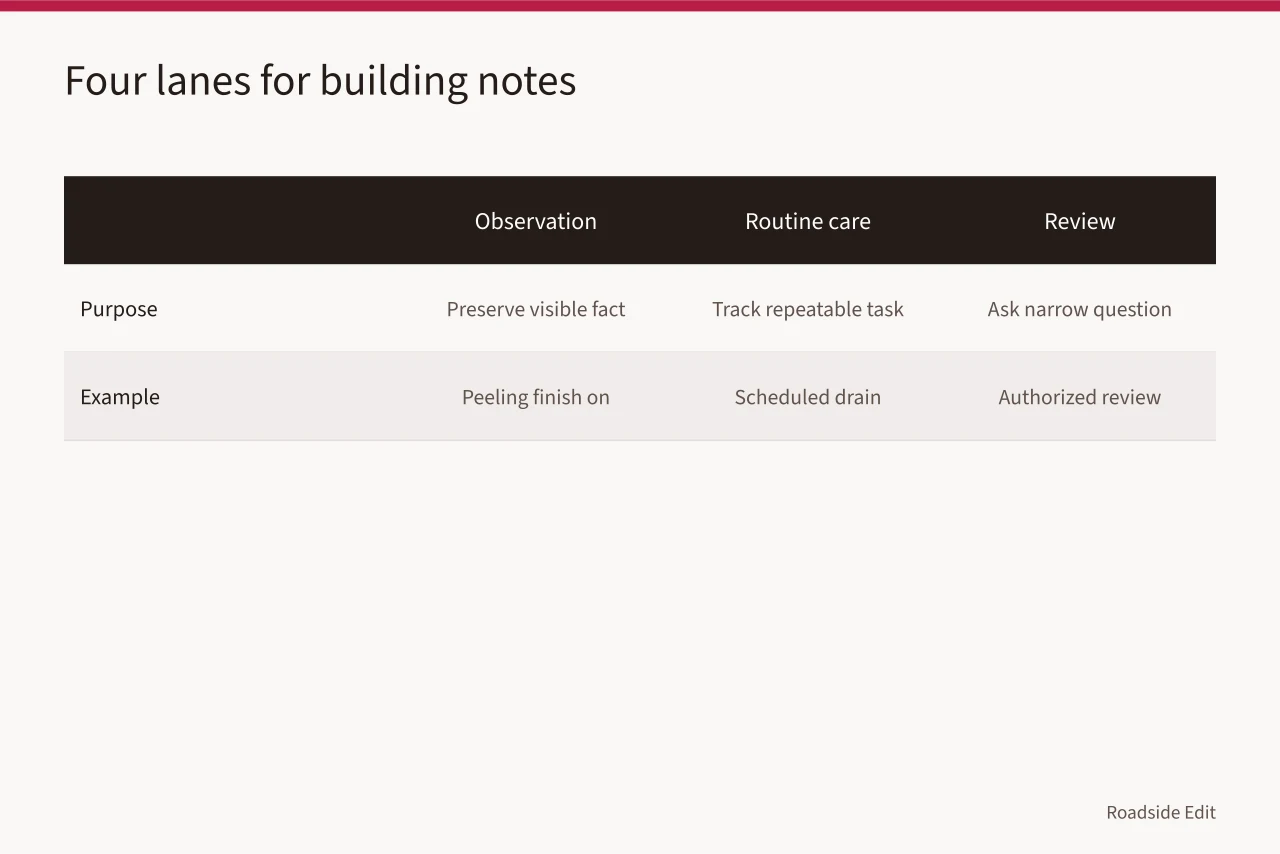
Use four lanes:
| Lane | Purpose | Example of a valid record |
|---|---|---|
| Observation | Preserve a visible fact | "Peeling finish is visible on the south entry trim." |
| Routine care | Track a repeatable, defined task | "Scheduled clearing of the named ground-level drain path." |
| Review | Ask a responsible person a narrow question | "Authorized review requested for the stated area." |
| Project | Describe a documented proposal or approved scope | "Provider proposal dated May 8 addresses the named feature." |
The National Park Service's Preservation Brief 47 on maintaining building exteriors describes regular inspection and cyclical maintenance as parts of preventive care. The brief does not decide what any roadside building requires. It supports placing defined routine tasks in their own lane rather than treating every visible change as proof of a major project.
Keep the number next to its source
The same dollar figure can mean very different things. A public award, an owner budget, a provider proposal, an invoice, and a paid amount are not interchangeable. They must never appear in one table without labels that tell readers what kind of record they are reading.
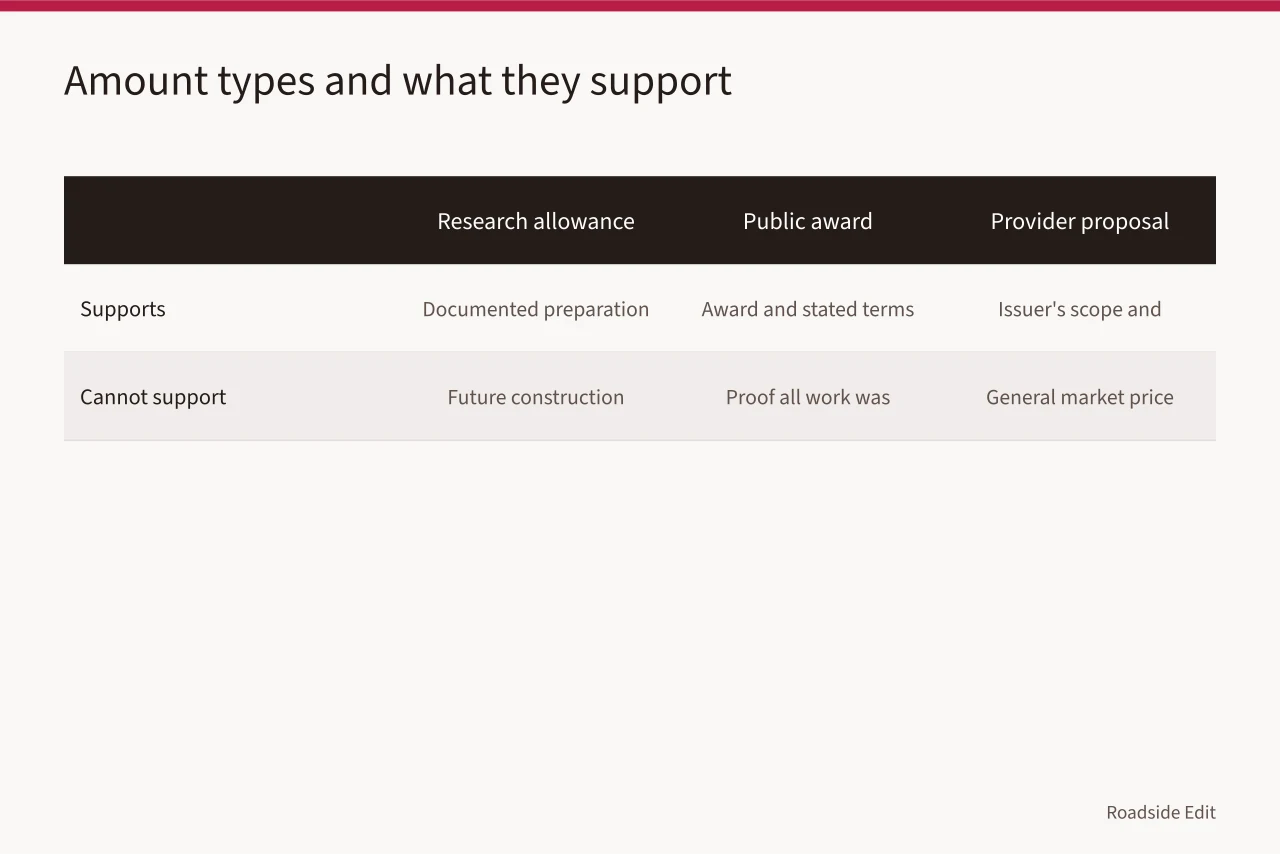
| Amount type | What it can support | What it cannot support |
|---|---|---|
| Research or planning allowance | A documented preparation task | A future construction total |
| Public award | The award and terms stated by the source | Proof all work was done |
| Provider proposal | The issuer's stated scope and price | A general market price |
| Invoice | A bill for described work | An independent quality finding |
| Paid amount | A documented transaction if supported | A universal cost estimate |
Keep the original page or document with the line item. If the source is a provider's proposal, record its issue date, described scope, access assumptions, exclusions, and expiration date where given.
If a later site visit changes the request, keep the earlier proposal and add a revised one. Do not edit the old total to make it look comparable. The difference between two proposals may be the evidence readers need to see.
Preserve source relationships
A roadside building file may include photos, messages, permits, proposals, invoices, and published records. The order matters. A later record can clarify an earlier one, but it should not erase the original context. Keep items that concern the same area or question together, then add a dated correction when new evidence changes the status.
The National Archives agency recordkeeping requirements state that related records should be kept together when their relationship gives them context. The policy governs federal records. For a local building file, the same practice helps an editor distinguish a visual observation, a submitted statement, a proposal, and a later decision.
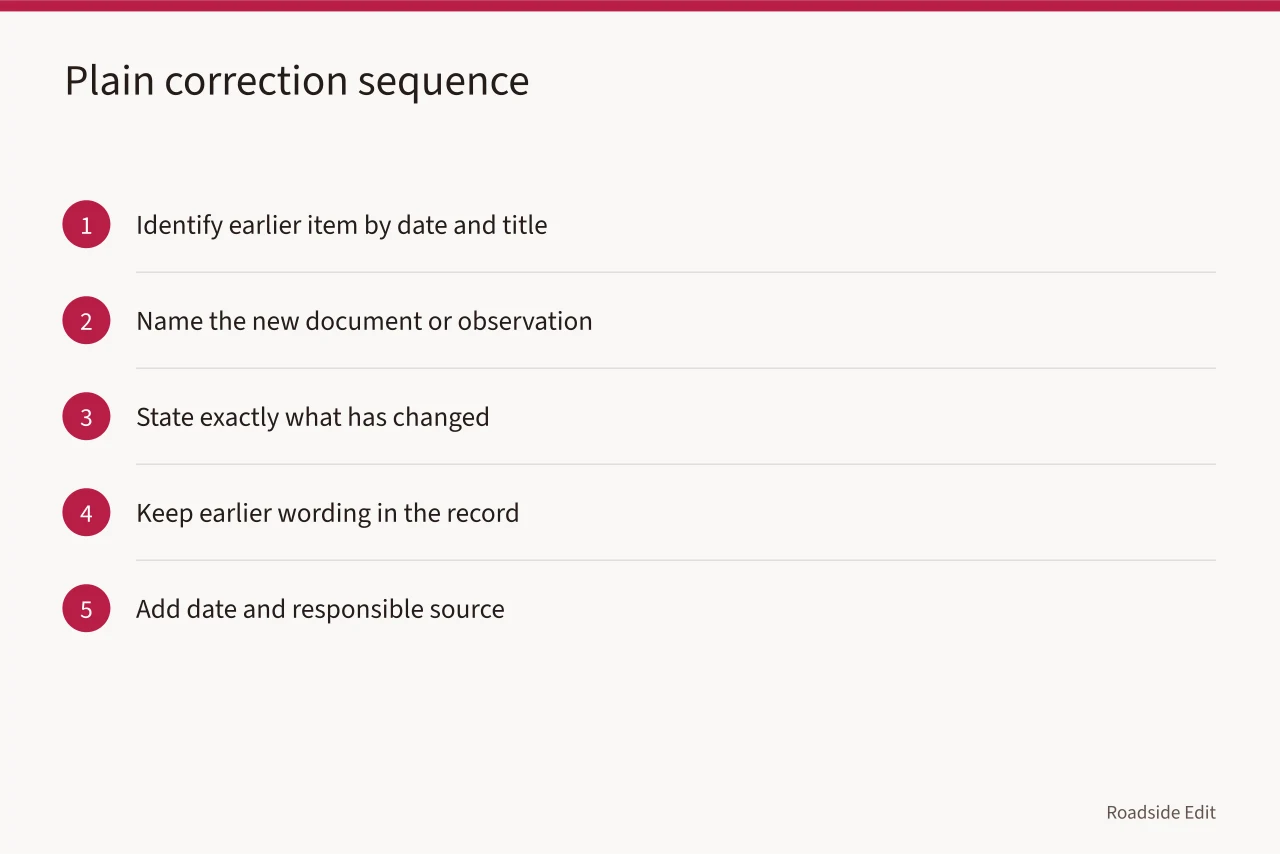
Use a plain sequence for corrections:
- Identify the earlier item by date and title.
- Name the new document or observation.
- State exactly what has changed.
- Keep the earlier wording available in the record.
- Add the date and person or source responsible for the new information.
This prevents a common article error: reporting that a project is complete because a later post sounds more confident than the earlier evidence. A completion claim needs a record that says completion, not an assumption based on time passing.
Give temporary actions their own notes
A weather event, report, or visible change may lead to a short-term action. That action can be appropriate without becoming a full repair plan. Record it separately from annual care and future project work.
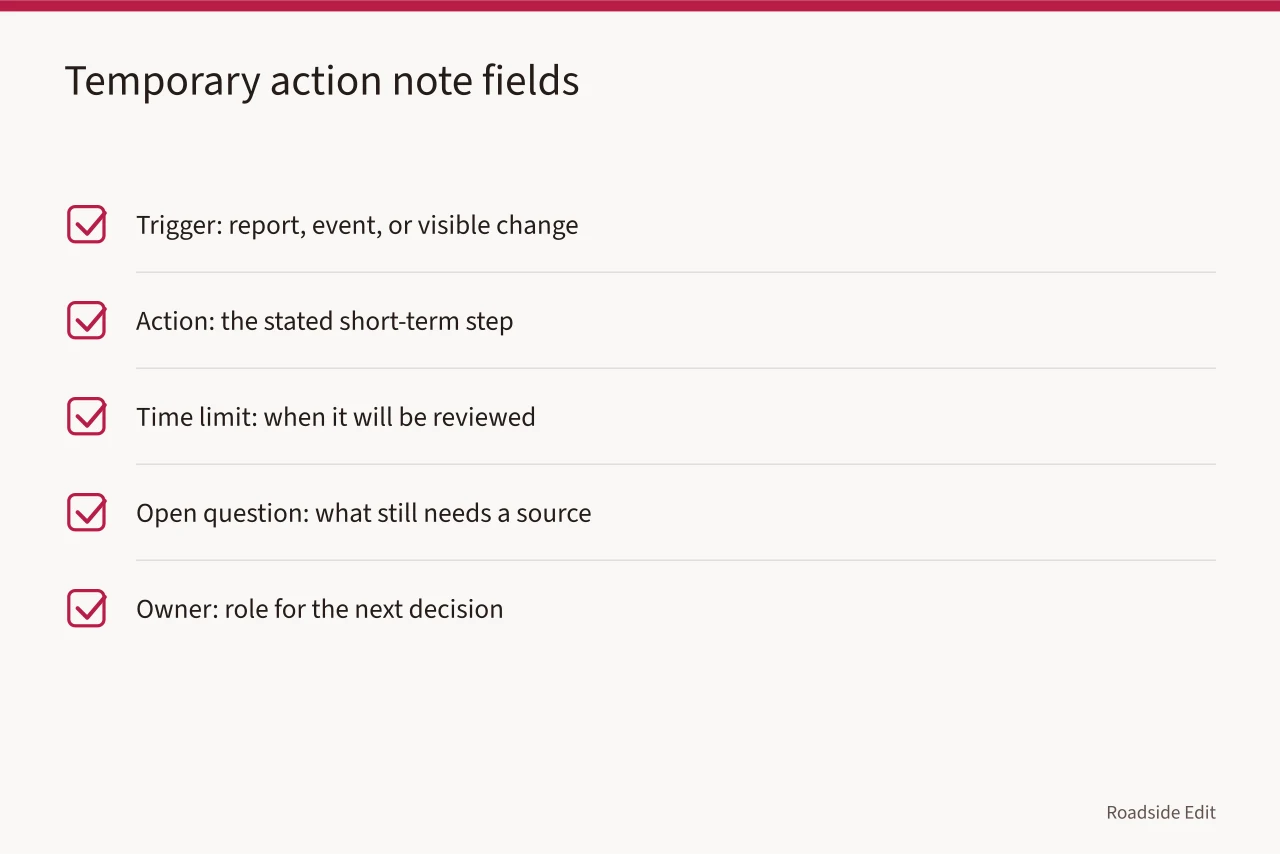
| Event entry | What to include |
|---|---|
| Trigger | The report, event, or visible change |
| Action | The stated short-term step |
| Time limit | When the action will be reviewed |
| Open question | What still needs a source or authorized review |
| Owner | Role responsible for the next decision |
Do not call a temporary action a completed solution. A temporary step can preserve access or document an issue while the responsible party decides what additional information is needed. The article should say only that the temporary action was recorded or reported.
Keep commercial content outside the evidence file
Roadside-building articles may later attract provider profiles, owner updates, and paid placements. These can be helpful if readers can recognize them. A provider is allowed to describe a service. The article is not allowed to blur that description into an independent conclusion about safety, quality, necessity, or standard price.
The Federal Trade Commission's endorsement guidance addresses disclosures when a material connection could affect how people evaluate an endorsement. Put a clear disclosure near a paid listing or provider statement. Do not rely on a distant policy page or a vague label that does not explain the relationship.
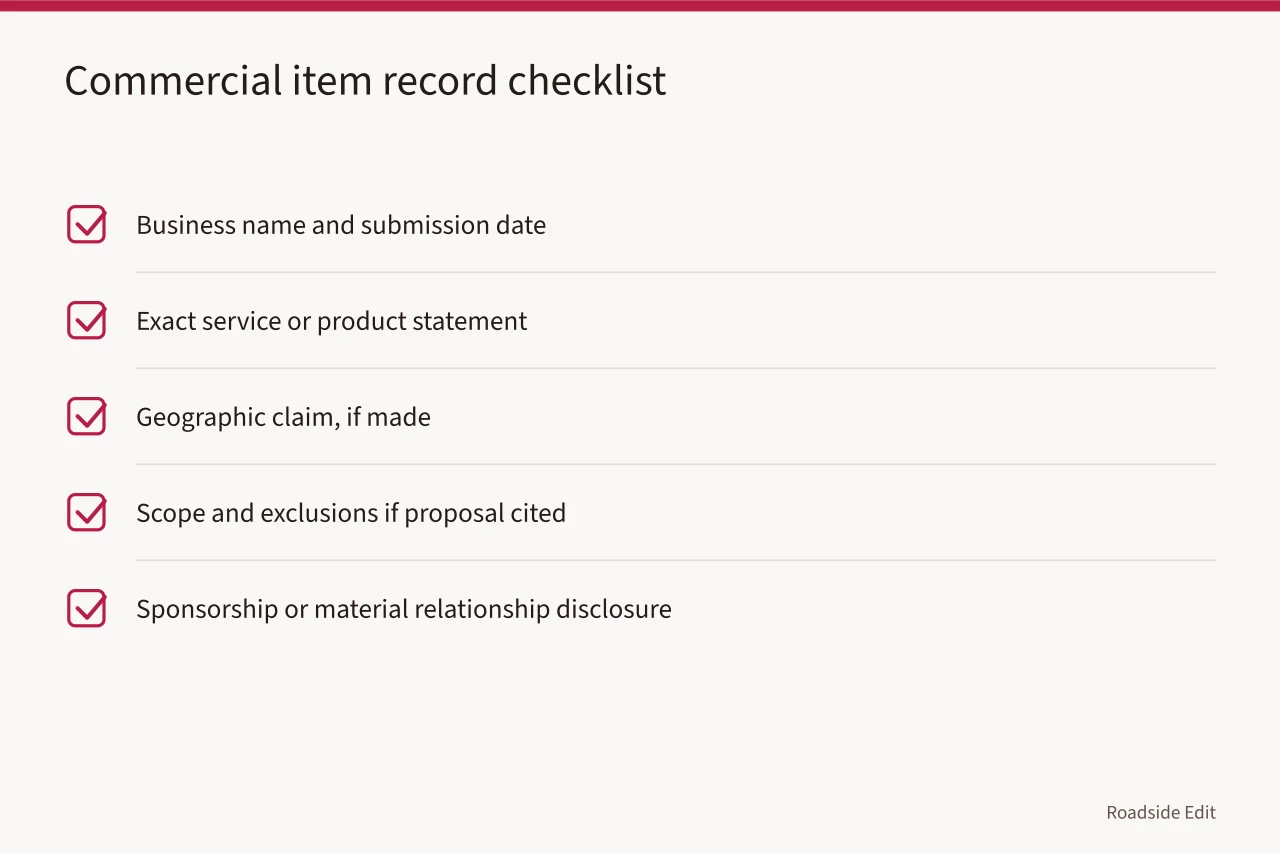
For each commercial item, preserve:
- Business name and date of submission.
- Exact service or product statement.
- Geographic claim, if the business makes one.
- Scope and exclusions if a proposal is cited.
- Sponsorship or material relationship disclosure.
This protects both the editorial record and the business. Readers can see what the business said without mistaking it for a verified building finding.
Final basics-budget check
- Does each line name a source, date, work area, task, status, and limit?
- Are routine care, review, temporary action, and project work in different lanes?
- Does every visible condition remain an observation until a suitable source supports more?
- Are related documents kept together with corrections visible?
- Is commercial information attributed and disclosed near the relevant statement?
- Does the closing status reflect the latest record rather than an assumed outcome?
Building basics are not about making the budget file bigger. They are about making each entry easy to understand, check, and hand to the next responsible person.
Common questions
Can an old project award be listed as a current repair price?
No. Keep it as a historical record with its original date, scope, and status. A current project needs a current, defined source.
Is a provider proposal the same as an approved project?
No. A proposal is the provider's stated offer. It becomes an approved project only when a separate responsible record says so.
Can a public photo prove why a building feature changed?
No. It documents a view at a time. It cannot establish hidden conditions, cause, or a required repair without further evidence.