
Reviews
Part of Neon sign restoration provider selection: a 2027 reporting checklist
Neon sign restoration provider comparison questions to ask before you choose
Questions for neon sign provider profiles in 2027 that make scope, supplied details, paid relationships, unknowns, and correction routes easier to compare.
Provider profiles are easier to compare when they answer the same factual questions. These prompts do not ask a business to diagnose a sign or guarantee a result. They organize information a publisher can attribute, date, and correct.
What to take away
- Ask the same questions of every participating provider.
- Separate a business response from editorial research.
- Make a paid relationship impossible to miss.
- Preserve unanswered questions instead of filling them with assumptions.
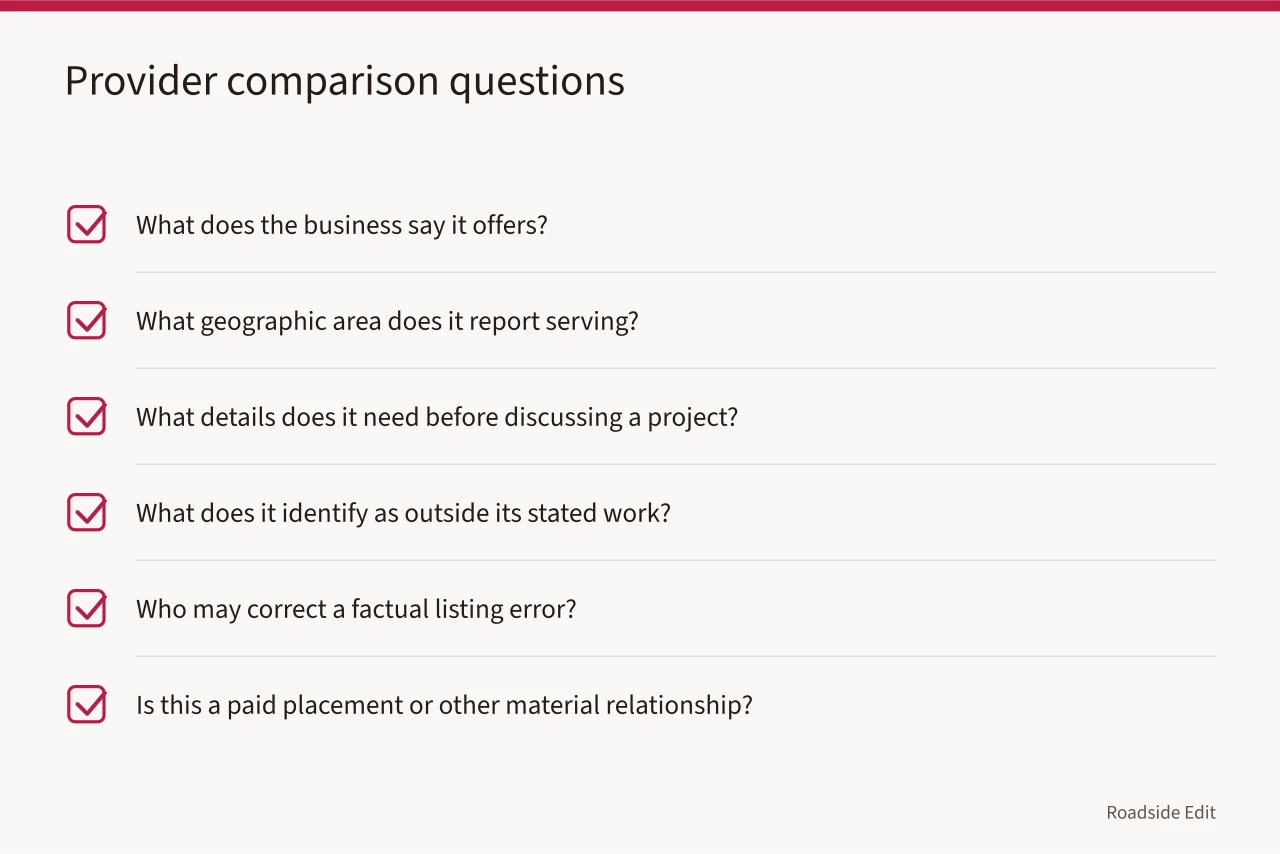
Comparison questions
| Question | Why it matters |
|---|---|
| What does the business say it offers? | Keeps the description in the provider's own stated scope |
| What geographic area does it report serving? | Avoids implying present availability |
| What details does it need before discussing a project? | Makes the limits of a short profile visible |
| What does it identify as outside its stated work? | Helps prevent a vague service claim |
| Who may correct a factual listing error? | Gives the page an accountable contact |
| Is this a paid placement or other material relationship? | Lets readers weigh the listing properly |
The FTC's consumer reviews and testimonials Q&A describes disclosures that are clear and conspicuous as ones readers can notice and understand without having to take an extra action to find them. For a provider profile, put "Paid placement" near the profile heading rather than relying on a footnote, an icon, or a separate terms page.
How to record answers
Publish answers with a date and a label such as "Business-supplied response, received October 2027." Do not rewrite a provider's answer into a score. If the answer is incomplete, say that the information was not supplied rather than trying to infer it from a logo, a photograph, or a social post.
Use a comparison grid only for like-for-like fields. A reader can compare a stated service area with another stated service area. They cannot fairly compare one provider's claimed experience with another provider's absent answer unless the page explains the difference.
Questions to avoid
Avoid questions that force promotional language: "Why are you the best?" "Can you guarantee a restoration?" "Are you approved?" They create claims that a general publisher cannot validate. Replace them with narrow, recordable questions about the information the business is willing to stand behind.
Ask for a dated answer, not a general promise
Each response should identify the business, responder role when provided, date received, and exact question answered. Before discussing a project, a provider may state the services it describes, its reported service area, or the type of information it requests.
It should not be asked to turn a short profile into a guarantee, technical assessment, or official designation. Preserve a declined or partial answer as a declined or partial answer.
The National Archives overview of records explains that records can include photographs and electronic material. It is not a provider-comparison method. It supports retaining dated source responses behind a listing rather than relying on an undated summary.
Ask how the commercial relationship will appear
Ask whether the profile is editorial coverage, a paid placement, a sponsored listing, or a provider-supplied directory entry. Put that label where a reader sees the profile, not only in a general policy page. Record the label decision with the submitted material. If the business supplies a testimonial or quoted endorsement, keep that wording separate from the publisher's own description.
The Federal Trade Commission's endorsement guides address endorsements and testimonials in advertising. They do not rank providers. They support conspicuous disclosure and attribution when a business relationship affects a profile.
Ask whether the image is only visual context
An image next to a profile can be useful, but it should not make readers think the pictured sign was a provider project or that it demonstrates a service result. Keep the source page, caption, rights information, and purpose in the record. If the image is not tied to the business, label it as contextual illustration.
The Library of Congress Prints and Photographs collections provide image records with descriptive and rights information. They do not compare service providers. They support checking an image's context before placing it beside a commercial profile.
Common questions
Should every provider get the same number of questions?
Yes. A consistent set of questions makes the limits of each response visible and reduces the chance that a profile reads like a hidden ranking.
Can a provider decline a question?
Yes. Record that the detail was not supplied rather than replacing it with an assumption.
Is a provider response an independent fact?
No. Attribute it to the provider unless the article also cites a specific source that supports the exact point.