Guides
Part of Neon sign restoration provider selection: a 2027 reporting checklist
How to build a neon sign restoration provider listing checklist for 2027
Use this neon sign provider listing checklist for 2027 to separate editorial coverage, paid placement, supplied facts, source dates, and correction details.
A provider listing should help readers understand what is being presented. It should not quietly turn advertising into a recommendation. Use this checklist when preparing a profile, roundup, or paid placement related to neon sign restoration.
What to take away
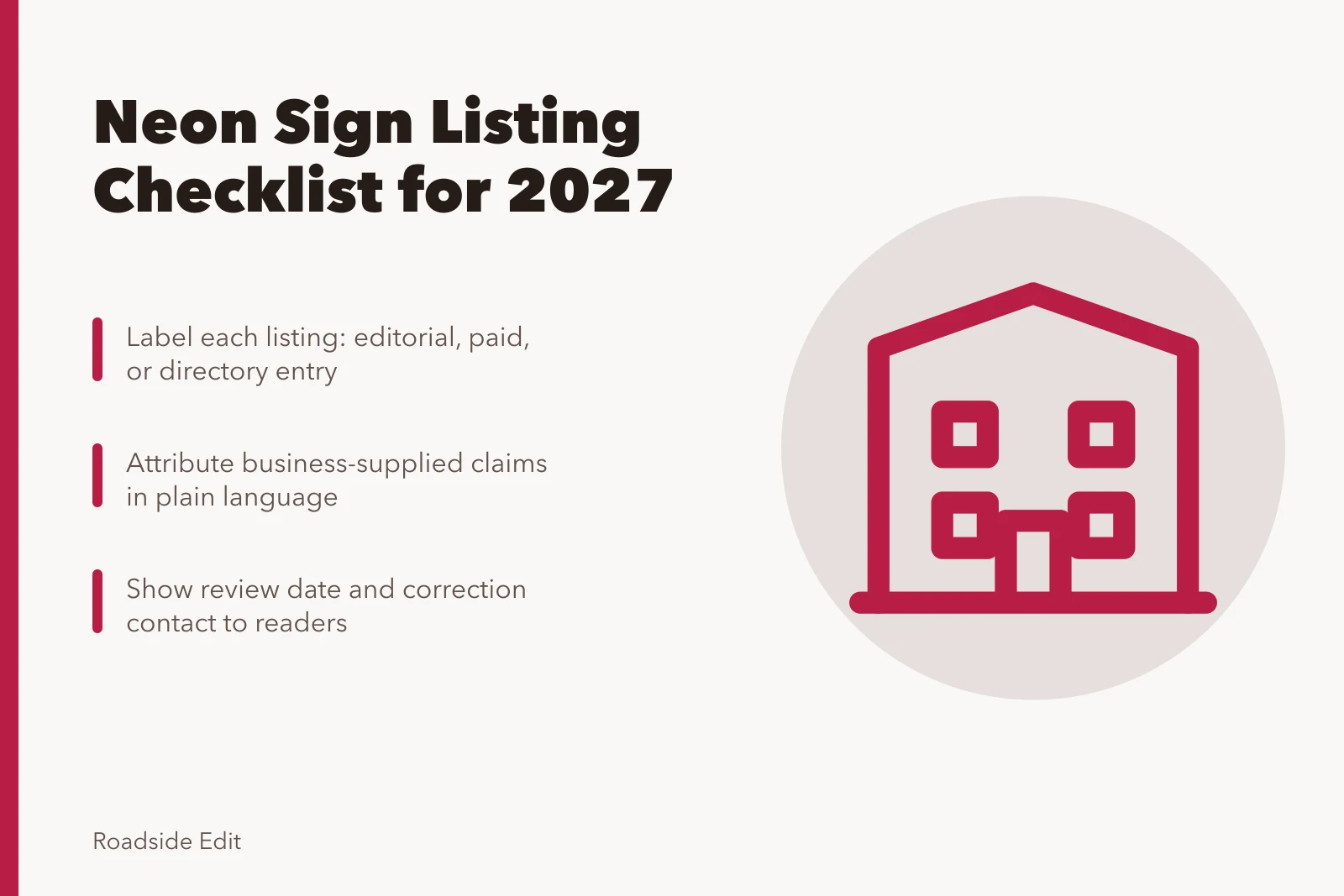
- Give every listing a purpose, source date, and correction contact.
- Label paid content before the reader reaches the provider description.
- Attribute business-supplied claims in plain language.
- Do not use scores, badges, or ranking words that the page cannot prove.
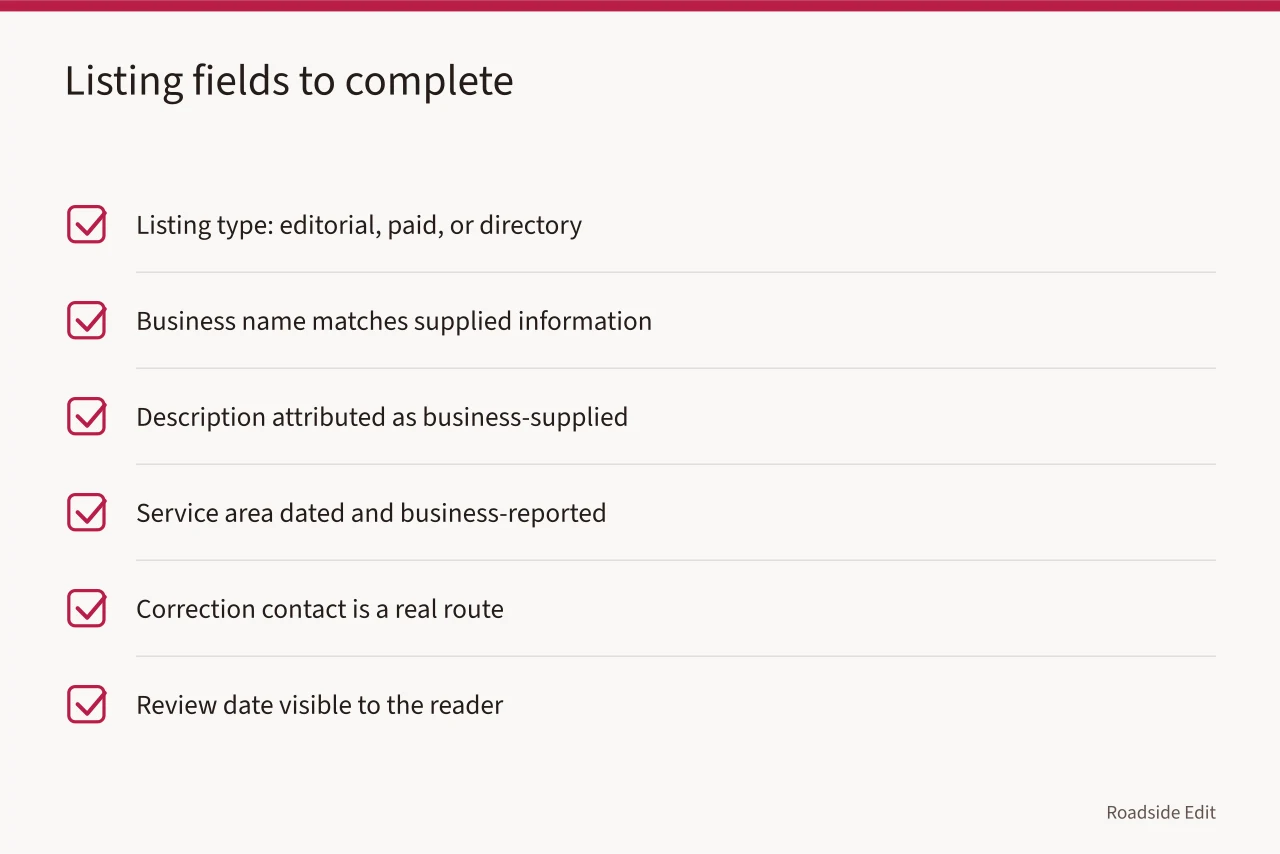
Listing fields to complete
| Field | Publication check |
|---|---|
| Listing type | Editorial profile, paid placement, or clearly named directory entry |
| Business name | Matches the information supplied for publication |
| Description | Attributed as business-supplied where appropriate |
| Service area | Dated and described as reported by the business |
| Correction contact | A real route for factual updates |
| Review date | Visible to the reader |
The FTC's native advertising guide explains that promotional material resembling surrounding editorial material may need clear and prominent identification to avoid misleading readers. Applied here, the label should appear where the reader first encounters the paid listing, not after a long profile or in an unrelated disclosure page.
Questions before publishing
- Does the page explain whether this is editorial coverage, a directory entry, or paid placement?
- Is every business statement identified as a statement by the business when it has not been independently confirmed?
- Is the page free of "best," "approved," "certified," and similar words unless the exact source and meaning are shown?
- Does the photo have a source, credit, and a caption that does not imply a property finding?
- Can a reader tell when the information was last checked?
A simple label system
Use the same short labels across the site. For example: "Editorial profile," "Paid placement," "Business-supplied information," and "Updated [month year]." Consistent language is easier to understand than a different marketing label on every page. A sponsor's logo alone is not a clear explanation of the relationship.
The Federal Trade Commission's endorsement guides address endorsements and testimonials. They do not verify a provider's service claim. They support clear attribution when a testimonial, provider statement, or paid promotion appears on a listing page.
Keep provider details in a dated submission record
Store the submitted description, claimed service area, date received, contact role, listing type, disclosure decision, and final published wording together. Do not change a business claim into editorial language unless you have an independent source that supports the exact statement. If a business updates its information, retain the old version and the reason for the public revision.
The National Archives overview of records explains that records can take many forms, including photographs and electronic material. It is not a commercial-listing policy. It supports retaining the dated source material behind an article or directory update.
Check images used beside a listing
An illustration can make a provider page inviting, but it should not imply that the provider worked on the pictured sign or that the image proves a service outcome. Keep the source page, caption, and rights information with the image. If the photograph is not linked to the business, state that it is visual context only.
The Library of Congress Prints and Photographs collections provide image records with descriptive and rights information. They do not endorse businesses. They support checking image context before a visual is placed beside a provider description.
Use a repeatable listing review
Before publishing or renewing a listing, compare supplied text with current record. Confirm listing type, provider name, disclosure label, stated service area, and image caption. Then confirm correction contact and review date.
Mark each field as supplied, independently sourced, or not confirmed. If a field is not confirmed, either label it as a provider statement or leave it out. This keeps a useful business directory from becoming an untraceable recommendation list.
Save the completed checklist with the published version and review date.
Common questions
Can a paid listing use the same layout as an editorial feature?
It can, but the paid nature of the listing must remain clear where readers first see it and wherever it is repeated.
Should a provider submit marketing copy?
It may submit a description, but the page should identify it as business-supplied and avoid converting it into an independent conclusion.
What if a business does not provide a review date?
Do not present its details as current. Use the date received, request an update, or leave the item unpublished.