Costs
Part of Neon sign restoration provider selection: a 2027 reporting checklist
How neon sign restoration providers should publish 2027 budget ranges
Neon restoration providers can publish 2027 budget ranges with scope, assumptions, exclusions, and change records. Sample bands cover tubes and transformers.
What to take away
- A published range is only readable next to its scope: sign type, size, access, and whether glass bending, electrical work, or painting is in it.
- Name the supplier or shop behind a part figure. Aargon Neon, Franceformer, Transco, EGL, and Voltarc are checkable starting points, not endorsements.
- Label every number as business-supplied unless a public source states it, and date it.
- Do not set two ranges side by side when the scopes differ. "Scope not comparable" is a real answer.
- Keep the submitted wording, the assumptions, the exclusions, and every revision in one record.
What a 2027 range has to state
A range without a work category is noise. A single-face window sign and a rooftop marquee are different trades, different access, and different paperwork.
State the sign type, the face count, the tube diameter, and how a crew reaches it. Say whether the work covers removal, glass bending, electrode replacement, or transformer and GTO cable. Also say whether it covers painting or reinstallation. A reader who cannot tell whether the canopy soffit is in scope cannot use the number.
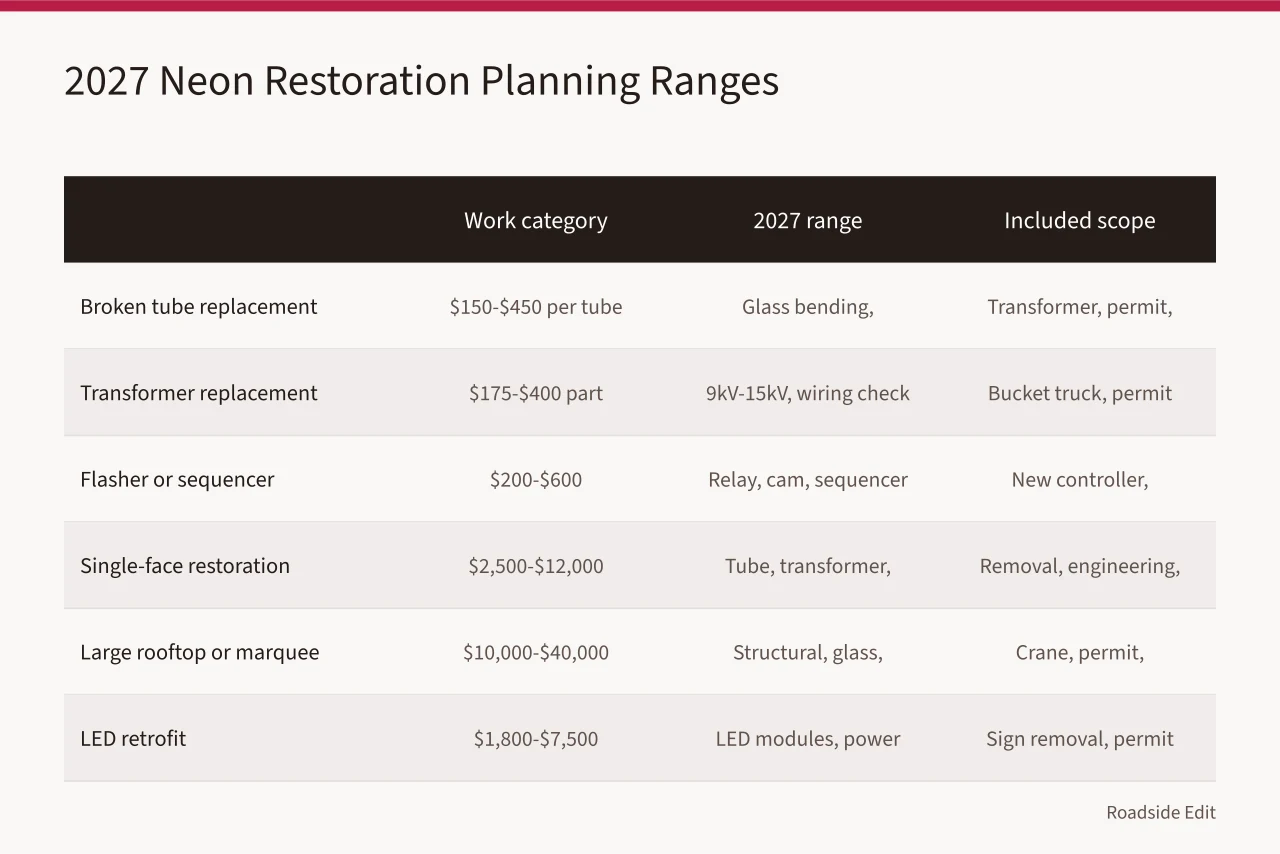
| Work category | 2027 planning range | Included scope | Common exclusions |
|---|---|---|---|
| Broken tube replacement | $150 to $450 per tube | Glass bending, electrode replacement, basic testing | Transformer, flasher, permit, lift |
| Transformer replacement | $175 to $400 part, $150 to $350 labor | 9kV to 15kV transformer, wiring check | Bucket truck, permit, panel upgrade |
| Flasher or sequencer repair | $200 to $600 | Relay, cam, or sequencer repair | New controller, full rewiring |
| Single-face restoration | $2,500 to $12,000 | Tube repair, transformer, paint, mounting | Removal, engineering, permit |
| Large rooftop or marquee | $10,000 to $40,000 | Structural check, glass, electrical, reinstall | Crane, permit, historic review |
| LED retrofit | $1,800 to $7,500 | LED modules, power supply, wiring | Sign removal, permit, neon removal |
| Survey and documentation | $350 to $1,200 | Photos, measurements, written scope | Engineering stamp, permit |
These are planning bands, not quotes. A site survey and a written scope set the final figure. Any structural, electrical, or hazardous-materials question goes to a licensed engineer or a licensed electrician. It also goes to the environmental authority with jurisdiction. The permit itself goes to the local authority having jurisdiction.
Named suppliers and shops
Aargon Neon in Sacramento does neon restoration, service, and in-house glass bending. Neon Works in Oakland restores historic neon and handles maintenance. Both are shops a reader can call and compare against a local one.
Franceformer builds outdoor neon transformers in the 9kV to 15kV range. Transco supplies transformers, electrodes, and GTO cable. EGL sells neon tubing from 8mm to 15mm. Voltarc supplies tubing and electrodes.
Name the supplier beside the part figure so a reader can price the same item. A tube diameter and a transformer rating are the two numbers that move a budget most, and both are checkable.
Assumptions, exclusions, and the record habit
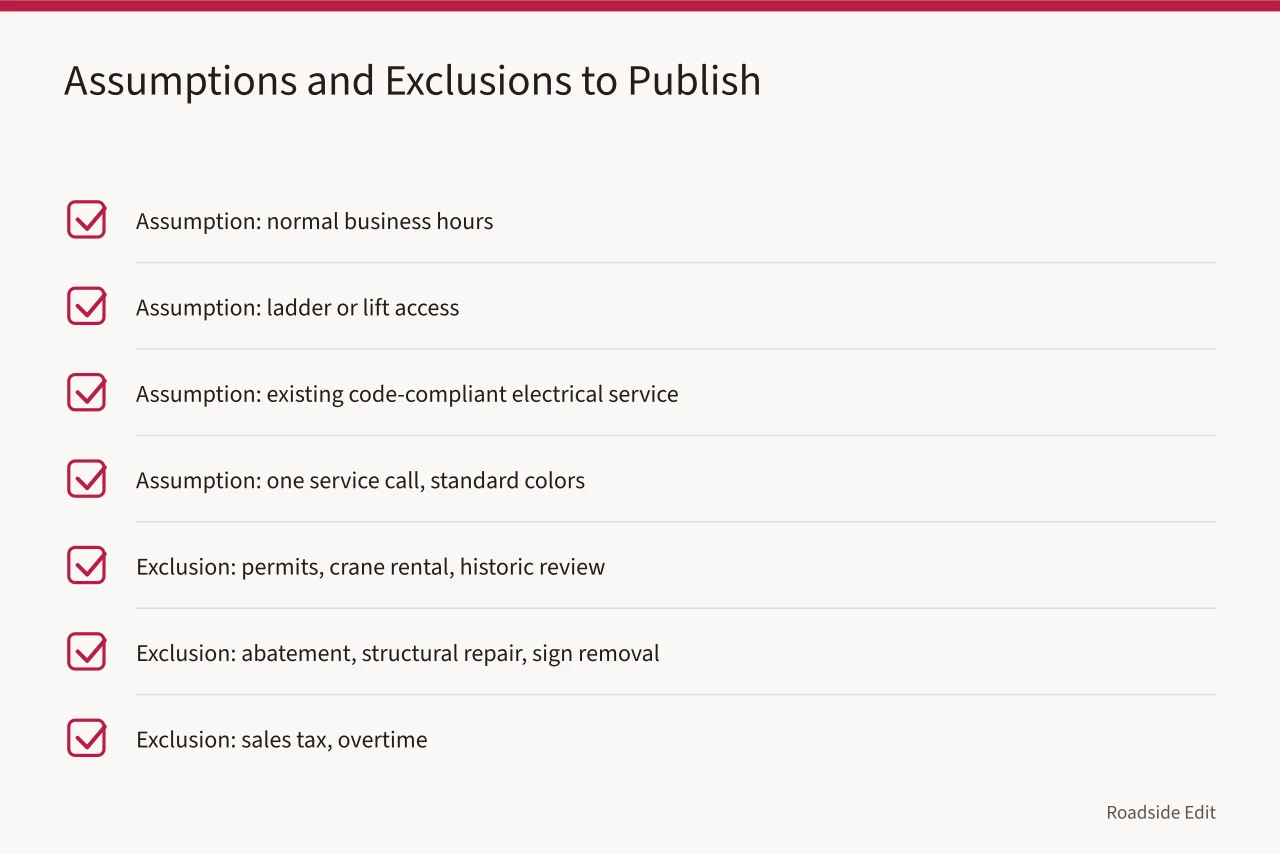
List the exclusions:
- permits
- crane rental
- historic district review
- abatement
- structural repair
- sign removal
- sales tax
- overtime
The OSHA Voluntary Protection Programs manual asks how a site evaluates contractor safety programs and documents its expectations. It sets no price and says nothing about a local shop. Its use here is narrower: write the criteria down instead of acting on an undocumented impression.
Publishing the range
Introduce a submitted range as the business's own statement: "The business supplied this range on [date] for the described category of work; it is not a quote for another property." Put the category beside the number.
When two providers describe different scopes, do not force a comparison. A table row reading "range not supplied," "scope not comparable," or "follow-up needed" is more accurate than a winner invented from partial information.
Paid placement
Paying for placement does not make a number more reliable. Label the paid relationship where a reader first meets the figure, separate from the figure itself, and never let placement imply a preferred price or outcome.
The Federal Trade Commission's native advertising guide explains that promotional material resembling editorial material may need clear and prominent identification. It does not assess prices. It supports putting the label where the number first appears.
Keeping the submission with its terms
Store the date, the provider name, the full submitted wording, the stated service, and the area. Add the assumptions, the exclusions, and the published version. A number copied into a card without its terms cannot be compared with anything.
When a provider revises a range, add a new dated entry. Do not overwrite the old one. The National Archives overview of records notes that records include electronic material and other documentation. It is not a costing method; it supports keeping the source submission and the change trail behind a published range.
Images beside a price card
A photograph next to a figure invites a reader to assume the sign shown was that provider's project, or that it matches the stated scope. Use a captioned contextual image unless the connection is authorized and supportable, and keep the source page and rights information in the record.
The Library of Congress Prints and Photographs collections carry image records with descriptive and rights information. They document no provider pricing. They are a place to check visual context before an image runs beside commercial information.
Reviewing a range at renewal
At renewal, confirm the provider's wording. Check the date, the disclosure, the scope. Also check the exclusions. Check whether the range is still published. Save the reviewer and the decision with the previous record so the next editor inherits the reasoning, not just the number.
Common questions
Can a provider publish a starting price?
It may submit one. The listing should carry the date, the described scope, and a line saying the figure is not a quote for another property.
Are these 2027 ranges quotes?
No. They are planning bands for budgeting. A site survey and a written scope set the final price, and the authority having jurisdiction sets what the permit requires.
Why show exclusions?
Exclusions stop a reader from assuming two figures cover the same work. A crane, a permit, and a historic review can separate two ranges by more than the restoration itself.
How should a change be recorded?
Add a new dated entry with the revised wording, and keep the old record. Note the reviewer and the decision so a revision can be explained without implying a universal market rate.