Guides
Part of Neon sign restoration provider selection: a 2027 reporting checklist
How owners can build neon sign restoration provider records for 2027
Build neon sign provider records for 2027 with dated scopes, source notes, paid-placement labels, correction logs, media credits, and submitted information.
A good provider page can be updated because its records are organized. The goal is not a private dossier on a business. It is a compact editorial file that shows where each public statement came from, when it was checked, and how it can be corrected.
What to take away
- Keep the article claim, source, source date, and claim limit together.
- Store business-supplied text separately from editorial research.
- Record a paid relationship in the same file as the placement label.
- Preserve image credits and captions with the image file.
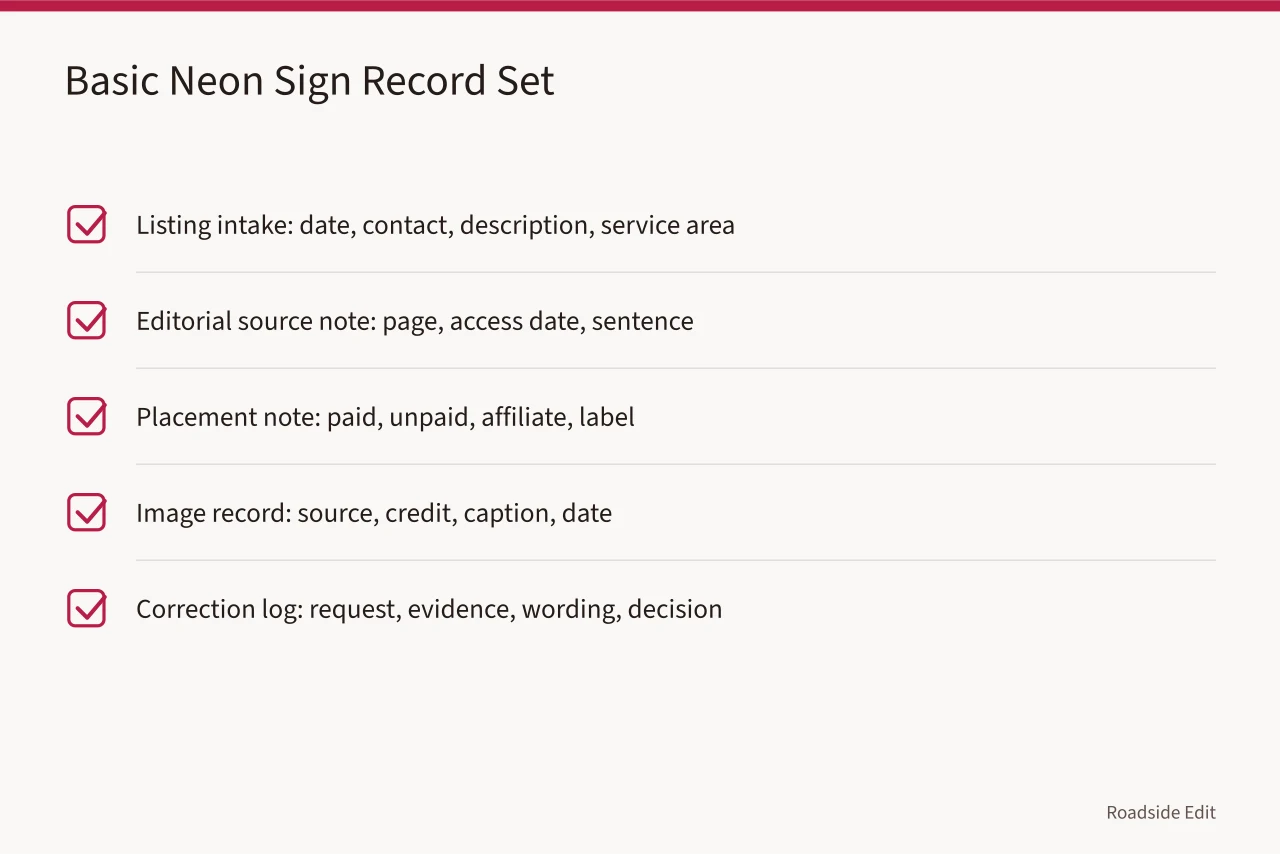
The basic record set
| Record | What to keep |
|---|---|
| Listing intake | Date received, business contact, supplied description, service-area statement |
| Editorial source note | Specific page, access date, supported sentence, and limitations |
| Placement note | Paid, unpaid, affiliate, or other relevant relationship and the public label used |
| Image record | File source, credit page, caption, date when known, and use note |
| Correction log | Request date, evidence received, old and new wording, decision date |
The National Park Service's cultural resource management policy requires a written scope, research design, agreement, proposal, or other work description to be prepared and approved before research.
This article does not apply that policy to a private listing. Its limited reporting lesson is to record a feature's purpose and boundaries before gathering material. That way, a later editor will not mistake a provider profile for a technical evaluation.
Write a claim limit
Every substantive statement should have a limit. "The business reports serving northern Arizona" is different from "The business is available in northern Arizona." The first records what was supplied. The second promises something the article may not know. A claim-limit note helps writers make that distinction quickly.
For a public record, write what the record proves and what it does not. A historic photograph may support a dated historical caption. It does not prove a provider's current role or a sign's current condition. A source file that preserves these limits keeps future updates from overstating old evidence.
Make corrections traceable
When a correction arrives, do not erase the reason for the change. Save the request, its evidence, and the revised public wording. The published note can remain short. The internal record should preserve enough information for a new editor to understand why the page changed.
Keep provider submissions in their own record
Store the business-supplied description, contact role, date received, claimed service area, requested changes, disclosure decision, and published version together. Do not blend that file with independently sourced historical material. A provider may describe its own services, while an editorial source may support a different limited fact. Keeping the files separate shows which statements are supplied and which statements are researched.
The Federal Trade Commission's endorsement guides address endorsements and testimonials in advertising. They do not validate provider claims. They support clear attribution and disclosure when a business relationship affects published copy.
Keep images tied to their item record
For each image, retain the source page, item title, creator when known, stated date and location, rights information, caption, and purpose in the article. If an image is only visual context, say so. Do not let a photograph placed beside a provider profile imply that the business worked on the pictured sign or that the image establishes a project outcome.
The Library of Congress Prints and Photographs collections provide image records with descriptive and rights information. They do not document a provider relationship. They support checking image context before a visual appears with a commercial listing.
Keep the correction handoff short and clear
When responsibility changes, give the next editor an index containing active listings, source notes, provider submissions, paid-label decisions, image records, corrections, and pending questions. Include the last review date and a direct path to the underlying record. This helps an editor correct a factual issue without resurrecting earlier claims that were removed or limited.
The National Archives overview of records explains that records can include material in different forms, including electronic items. It is not a directory-management rule. It supports retaining the dated material that explains a listing's history and corrections.
Common questions
Should the public see every internal note?
No. Publish the source, attribution, date, disclosure, and correction information readers need. Keep working notes organized for editorial continuity.
How long should a correction log remain available?
Keep material correction records long enough to explain current wording and prevent a previously corrected statement from returning.
Can a provider change its own listing directly?
It can request a factual change through the published correction route. The site should preserve the source and date of the update.