Guides
Part of Roadside building fundamentals: how to date claims and credit images
Roadside building basics checklist: verify facts before you publish
Roadside building basics checklist for 2027 helps U.S. readers verify identity, source dates, image credits, historical context, and current-claim limits.
Roadside buildings collect names, stories, business listings, historical images, and local memories. Those pieces are useful, but they do not automatically describe the same place at the same time. This checklist helps a writer, owner, or editor establish the basics before publishing: identity, location, source role, visual credit, and what remains unknown.
It does not determine historic designation, ownership, opening hours, building condition, or a legal requirement. Treat those as separate questions that need a source matched to the current claim.
What to take away
- Copy identity details from the record that actually names the place.
- Give historical context and current information their own dated source lines.
- Use a catalog image for the fact its catalog record supplies, not more.
- Keep submitted business information labeled and separate from editorial evidence.
- Remove a claim if its source cannot support the exact wording.
Set up the basic property card
Create a property card before drafting. It has only one job: show what is known, where it came from, and when it applies. A short card is better than an article assembled from unmarked search results.
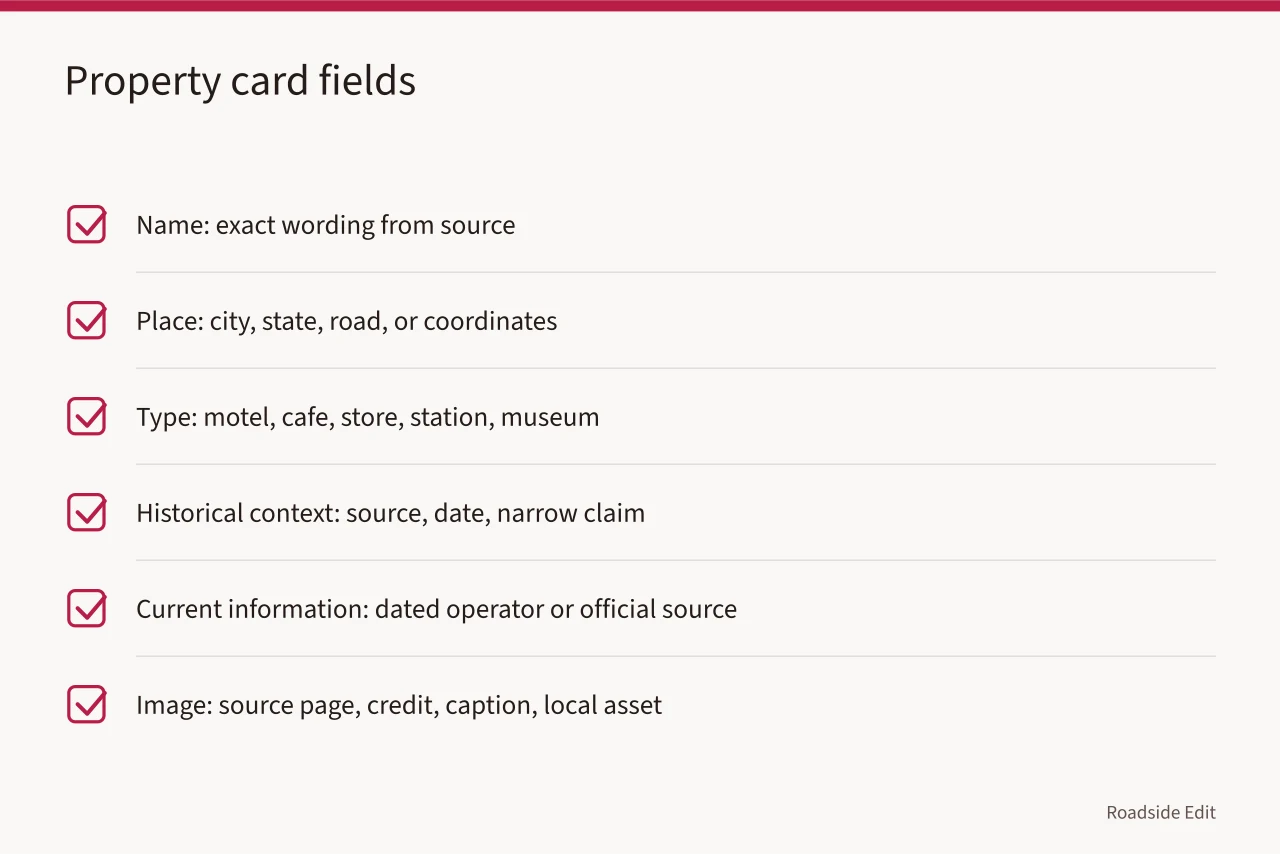
| Field | Record | Limit to state |
|---|---|---|
| Name | Exact wording from source | Alternate names remain attributed |
| Place | City, state, road, or coordinates when sourced | Do not infer a mailing address |
| Type | Motel, cafe, store, station, or museum when source says so | Do not guess from appearance |
| Historical context | Source, date, and narrow claim | Not present-day status |
| Current information | Dated operator or official source | Not historical proof |
| Image | Source page, credit, caption, local asset | Not a condition assessment |
The National Park Service's Route 66 historic building inventories explain that inventories identify existing Route 66-related properties and can help direct preservation efforts. An inventory can support a historical identity or context claim that it actually makes. It does not automatically establish current ownership, business activity, condition, or public access.
Confirm the identity before telling the story
Begin with the strongest source that names the building and location. Record the spelling, place, source title, date, and whether the source is historical or current. If two reliable sources use different names, preserve both with their dates. A name change may reflect a later operator, a colloquial label, or a genuine uncertainty.
Do not solve a mismatch by choosing the more attractive name. Write a simple distinction instead: "A 1980 catalog record calls the site X; a 2027 operator statement uses Y." That lets readers see the evidence without claiming an unconfirmed identity match.
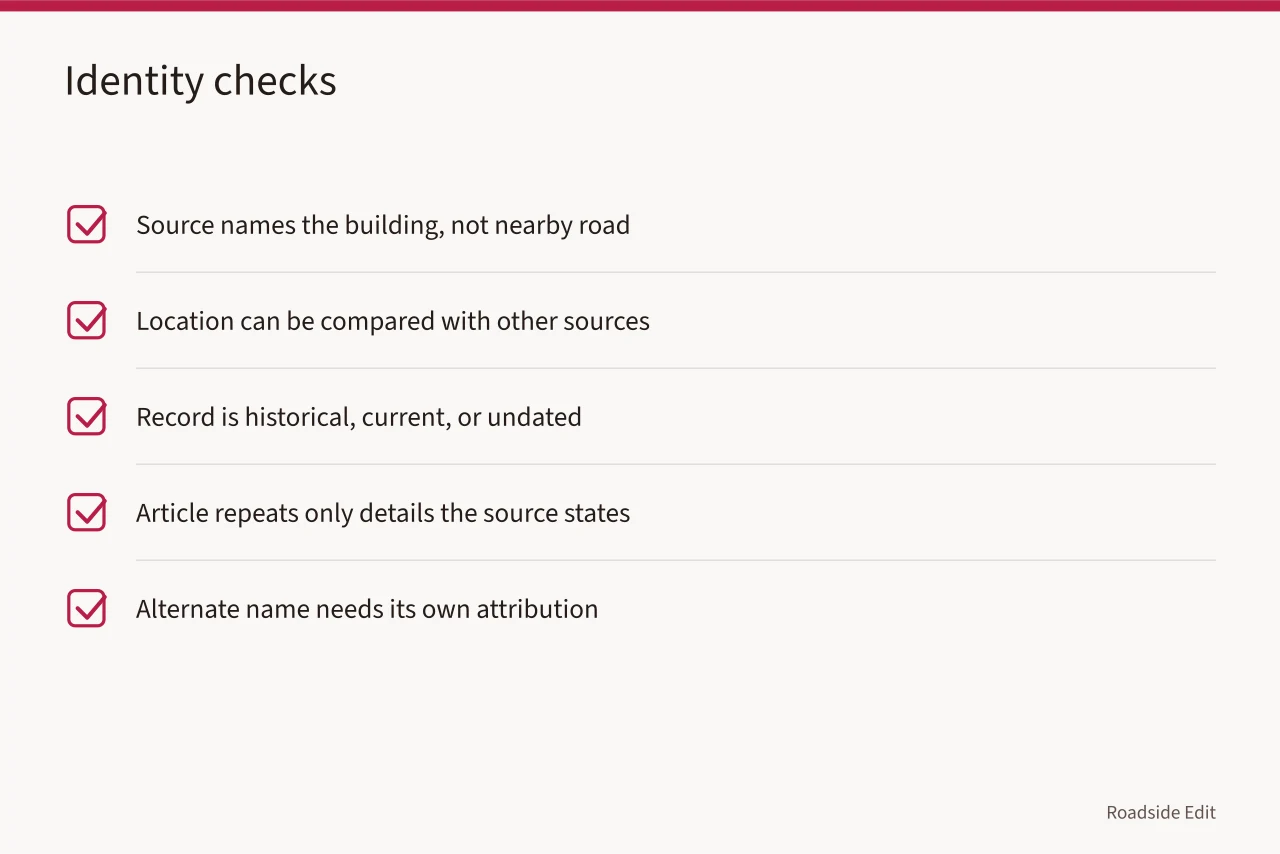
Identity checks
- Does the source name the building, rather than a nearby road or town?
- Does it supply a location that can be compared with other sources?
- Is the record historical, current, or undated?
- Does the article repeat only details the source actually states?
- Does an alternate name need its own attribution?
Separate historical context from a current claim
A historic photograph or inventory can offer strong context. It may establish a title, location, date, creator, or earlier function. It cannot prove a building is still operating, owned by the same person, or in the same physical condition today.
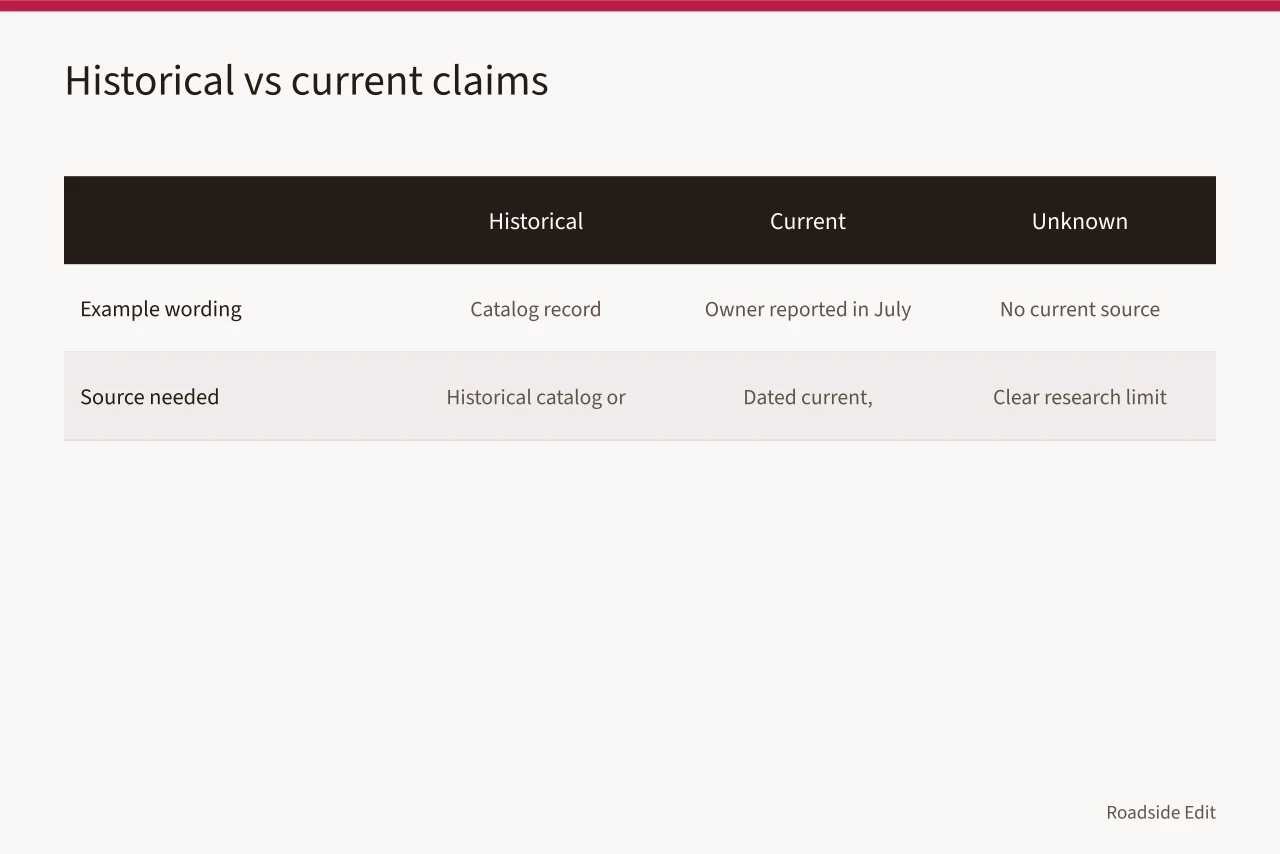
Use two separate record lines:
| Claim type | Example wording | Source needed |
|---|---|---|
| Historical | "The catalog record identifies the photographed site as..." | Historical catalog or archive |
| Current | "The owner reported in July 2027 that..." | Dated current, attributed source |
| Unknown | "This review did not locate a current source confirming..." | Clear research limit |
The Library of Congress explains that its Prints and Photographs Online Catalog includes catalog records and digital images from the Prints and Photographs Division and other units. A record can support the details it lists for that item. Retain its exact page with the photo and do not use it as a substitute for a present-day property report.
Make captions factual and useful
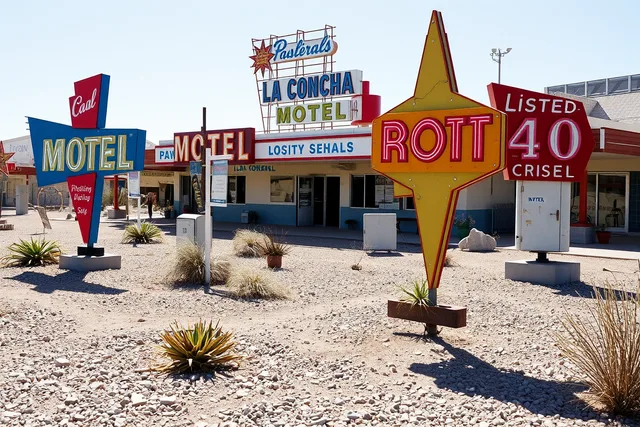
Write a caption that says what the image record identifies, where appropriate. Include the name or description from the source, location, historical time context if provided, and image credit. Do not add loaded words such as "restored," "abandoned," "unsafe," or "original" unless the cited record supports them.
The National Park Service's documentation standards and guidelines emphasize reliable sources and statements of limitation that permit records to be independently checked. They address formal historic documentation, but the practice fits basic roadside reporting: a caption should identify its source and avoid claims the image cannot establish.
Handle current business information with care
Operators, tourism groups, and businesses may provide useful current details. File the message, date, sender role, and wording. Present it as an attributed statement unless an independent official or institutional source confirms the same fact. Do not update a historical entry merely because a business listing uses different language.
If the site sells a placement or accepts a sponsored profile, keep a disclosure record, and the Federal Trade Commission says advertising made to look like independent content should be recognizable as advertising. Read the FTC native-advertising guide.
This is advertising guidance, not a rule about roadside history. It supports clear labeling so readers distinguish submitted commercial material from evidence-led editorial context.
Make a one-page evidence review before publication
Read the draft beside the property card. Check every name, date, current claim, and image caption. For each one, ask whether the source is specific, recent enough for the wording, and close to the claim it supports. A source that describes a 1960s photo should not sit after a sentence about 2027 operating hours.
Use these final checks:
- Every source is a specific page, not a general homepage.
- The property name and location have an attributed record.
- Historical and current claims have separate dates.
- Image credit leads to the exact source page.
- Sponsored or submitted material is labeled.
- Unknown facts are left unknown rather than filled with a guess.
Common questions
Can a historical inventory show a building is open today?
No. It can support historical identity or context. Use a dated current source for operating or ownership information.
What if a photo source and a current listing use different names?
Keep each name with its source and date. Do not claim they are the same current business until appropriate evidence supports that link.
Does a great image make a property card complete?
No. The card also needs source-backed identity, location, historical context, and a clear boundary between known facts and current unanswered questions.