Guides
Part of Roadside building fundamentals: how to date claims and credit images
How to keep roadside building basics records straight and citable
Roadside building basics records guide for 2027 helps U.S. readers retain identity sources, image credits, current claims, submitted updates, and correction history.
A roadside-building record should make a simple article traceable. It needs to show which source identified the place, which source supplied historical context, where an image came from, and whether a current detail came from an official page or an attributed submission. That record protects a useful story from becoming a mix of old captions, modern listings, and unsupported assumptions.
This guide organizes evidence for a basic roadside-building article. It does not establish ownership, operating status, historic designation, safety, or a building's condition.
What to take away
- Keep a source note beside every identity and history claim.
- Save image credit, local filename, caption, and source page as one record.
- Label current claims with their own dates and sources.
- File owner and business updates as attributed submissions.
- Add corrections as dated entries instead of deleting the trail.
Create an identity record before writing
The identity record is the anchor for all other files. It has the source's exact name for the building, the location it supplies, the source type, the source date if shown, and the date you checked it. If sources use different names, enter each one rather than forcing a match that the record does not prove.
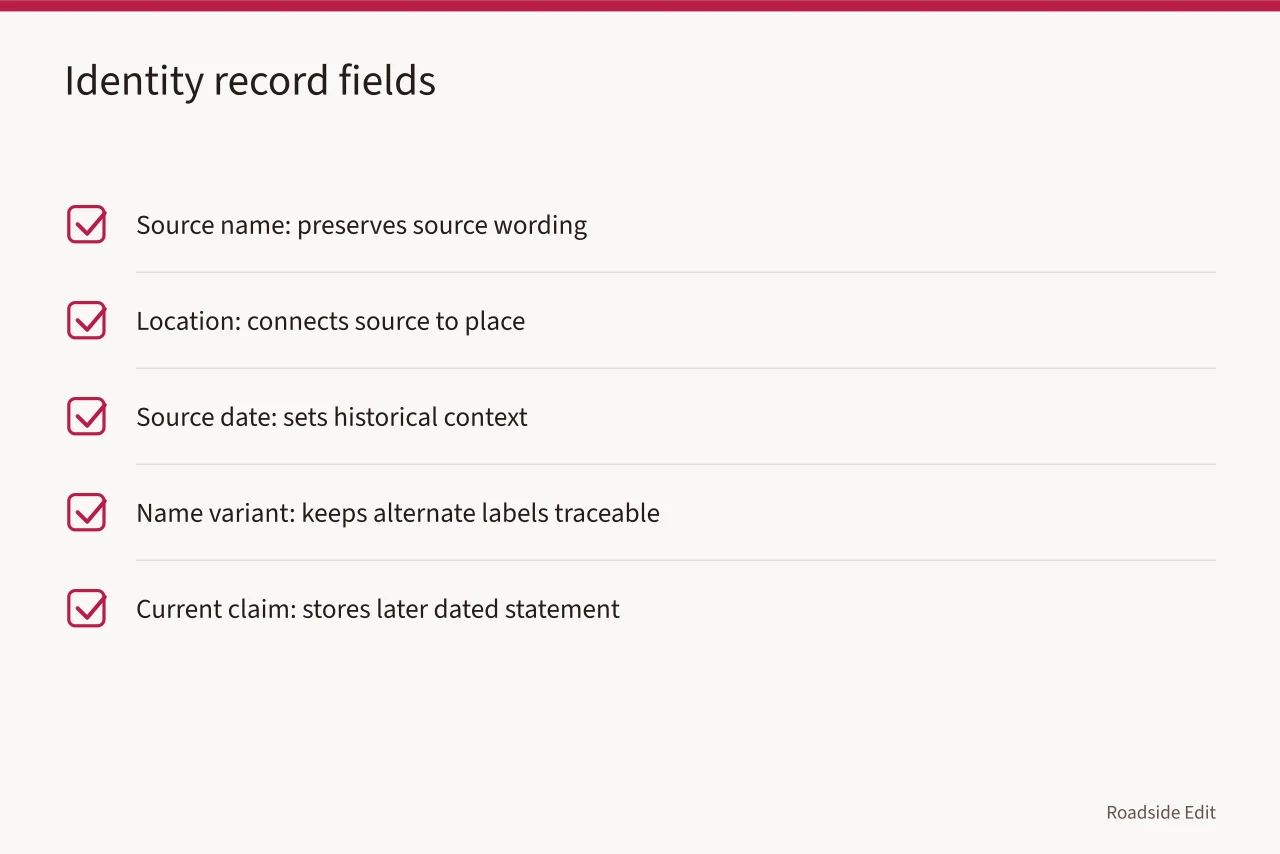
| Identity field | Example purpose | Do not assume |
|---|---|---|
| Source name | Preserves source wording | A current business name is identical |
| Location | Connects the source to a place | A mailing address or parcel boundary |
| Source date | Sets historical context | The fact still applies today |
| Name variant | Keeps alternate labels traceable | The reason for a change |
| Current claim | Stores a later, dated statement | That it revises older history |
The National Park Service's article on Route 66 interpretation in Oklahoma describes a documentation project that includes location, construction dates, descriptions, and photographs of roadbed and related resources. It is not a template for an informal property article. It does support the basic discipline of retaining source, place, date, and description together rather than collecting unmarked facts.
Build a source note that answers two questions
Every source note should answer what the page supports and what it does not. One sentence may say, "This catalog record identifies the photographed structure as the Route 66 Museum in Clinton, Oklahoma."
The next may say it "does not establish the museum's current operator, schedule, or condition"; that limit keeps a historical record from becoming a present-day claim.
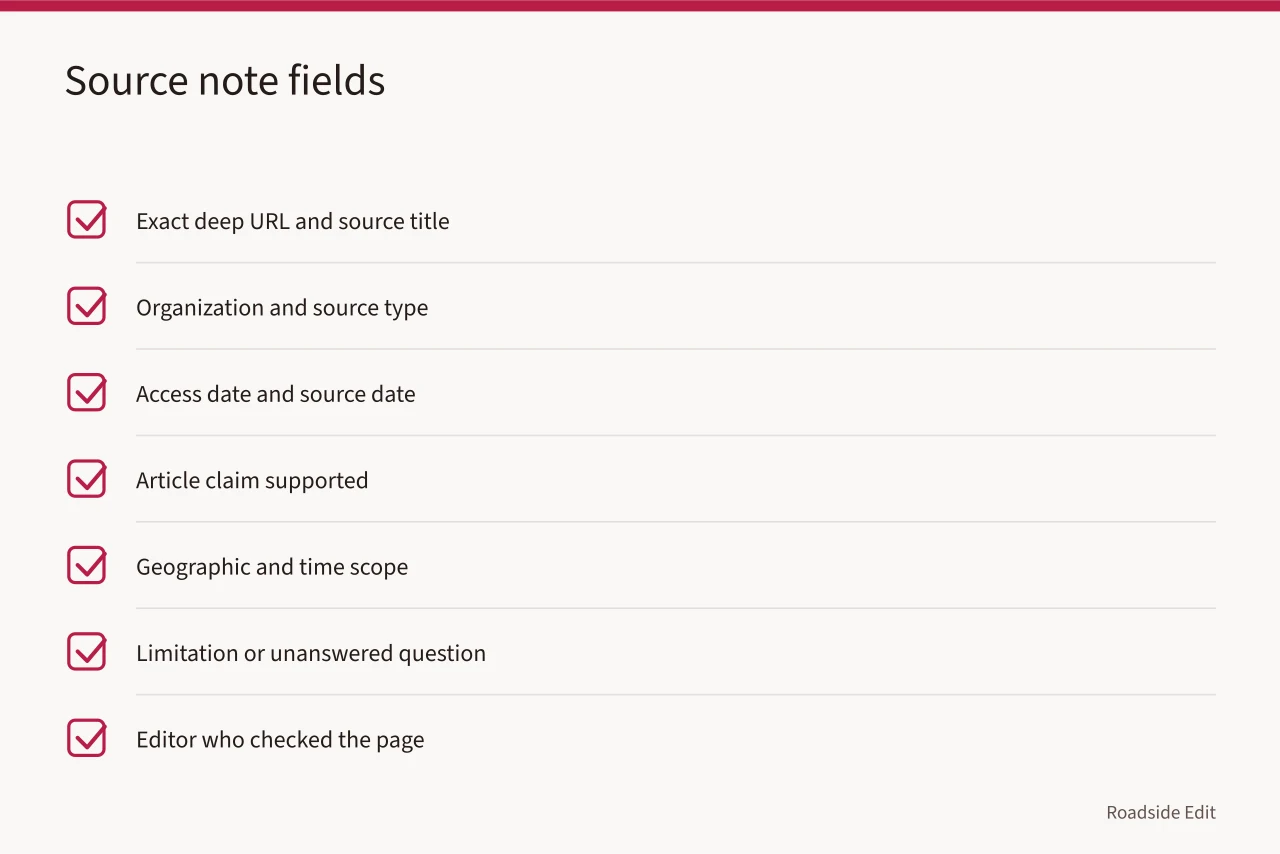
Record these fields:
- Exact deep URL and source title
- Organization and source type
- Access date and source date when available
- Article claim supported
- Geographic and time scope
- Limitation or unanswered question
- Editor who checked the page
The Library of Congress explains that its Prints and Photographs Online Catalog contains catalog records and digital images from its Prints and Photographs Division and other units. The exact record page should remain with any downloaded or locally stored image. A search result or a copied caption is not a complete image provenance record.
Keep image provenance intact
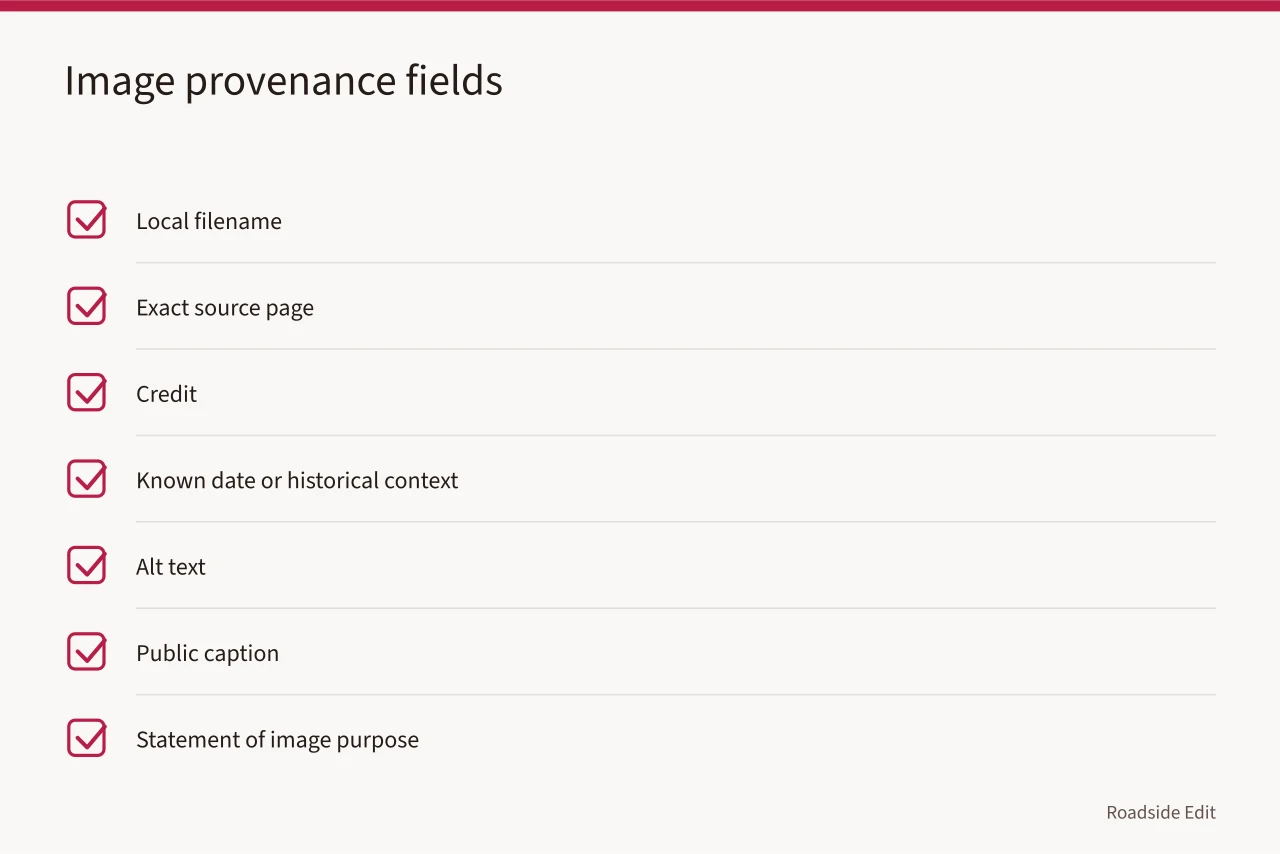
An image file needs a local filename, exact source page, credit, known date or historical context, alt text, public caption, and a statement of the image's purpose. For a roadside-building story, the purpose might be historical context or a sourced visual example. It is not a condition assessment of another building.
Before publication, compare the caption to the record page. Remove words the source does not support. If the page identifies an image as a museum in a named location, write that. Do not infer the image date, current business details, public access, or building history beyond the source.
Separate historical and current files
Use two distinct record lines when an article discusses history and present-day information. Historical records can be old and authoritative in their field. Current claims require a current, dated source. Do not let an operator statement alter an archival fact unless it provides evidence that actually corrects the earlier record.
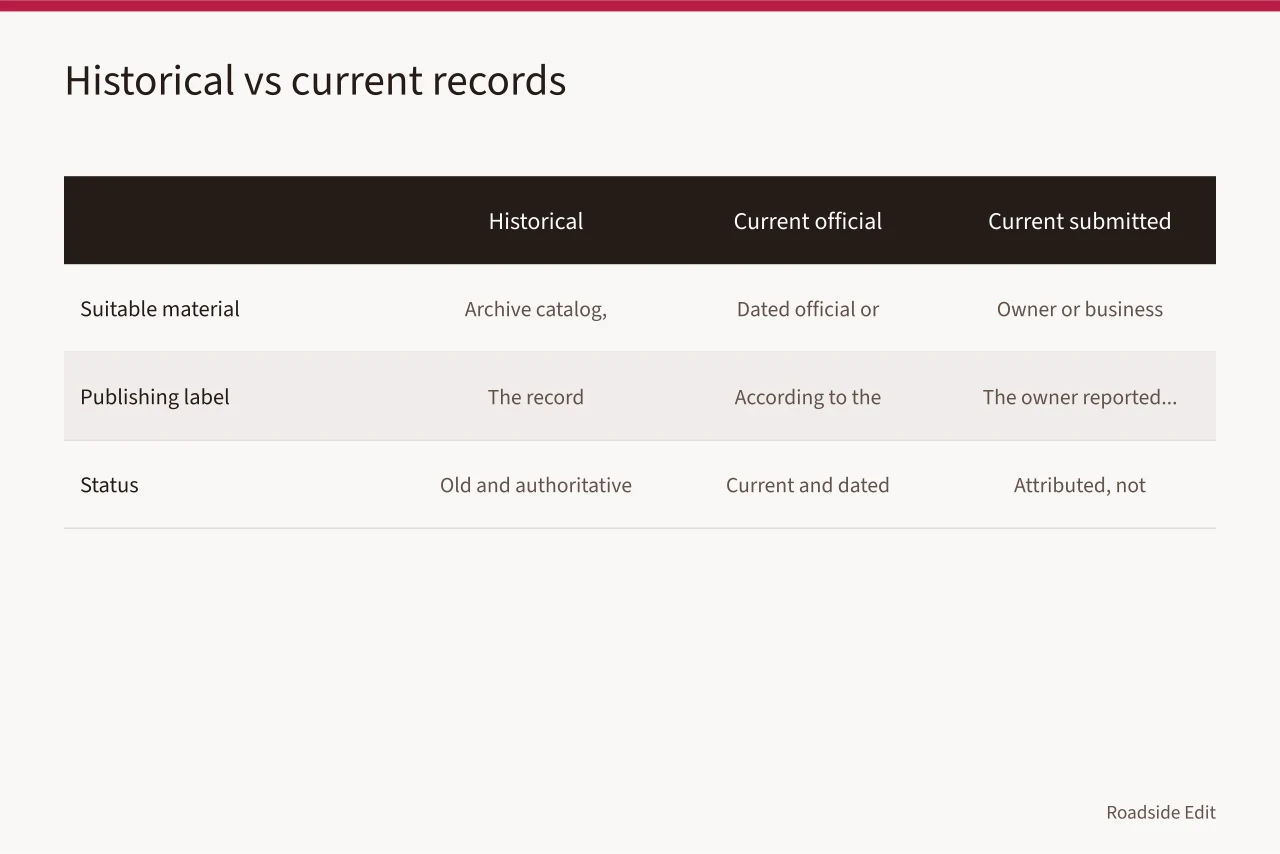
| Record line | Suitable material | Publishing label |
|---|---|---|
| Historical | Archive catalog, inventory, historical report | "The record identifies..." |
| Current official | Dated official or institutional page | "According to the current page..." |
| Current submitted | Owner or business message | "The owner reported..." |
| Unconfirmed | A claim without sufficient source support | Do not publish as fact |
The National Archives says records for the same project, transaction, study, or subject should stay together when their relationship gives context; Read the National Archives recordkeeping requirements. Those requirements govern federal agencies.
For a small editorial file, keep related identity records, current claims, images, and later corrections together, but preserve their different statuses.
Log submissions without turning them into proof
An owner, tourism organization, or roadside business may send a correction or update. Keep the original message, sender role, date, supplied wording, attachments, and relationship to the publisher. A submission can support an attributed statement, but it should not become independent evidence solely because it is specific or favorable.
If a business pays for placement or receives material benefit, keep disclosure with the submission, and the Federal Trade Commission says ads that look like independent content should be recognizable as advertising. Read the FTC native-advertising guide.
This guidance does not determine building fact and supports a distinct commercial file and clear public label for paid or sponsored material.
Correct the record and preserve the reason
If a better source changes a building name, caption, location, or historical statement, correct the article and add a dated correction card. The card should name the original wording, revised wording, new source, reason for the change, and editor role. Do not quietly replace an old fact and make the earlier error invisible.
For a current claim that expires, use a similar process. Note the source date, when it was no longer reliable, and whether the claim was updated or removed. This keeps readers from encountering an old statement with no clue that its support has changed.
Prepare a usable handoff file
When responsibility changes, provide a simple index: identity record, source notes, image records, current claims, submissions, corrections, and review dates. Put private contact information, access details, and security-sensitive information in the restricted owner file, not the public editorial archive.
The next editor should be able to identify every source's role in a few minutes. If a record cannot explain whether a fact is historical, current, submitted, or unknown, it is not ready for handoff.
Common questions
Can an archive image prove a business is open now?
No. It can support the details its catalog record supplies. Operating status needs a current, dated source.
What makes an image credit complete?
The exact source page, credited collection or creator as shown, local filename, caption, and a note on the historical or contextual use of the image.
When is a correction record needed?
Use one whenever published wording changes because of better evidence, a source correction, or a finding that the prior source did not support the claim. Keep the prior wording and reason for revision.