Guides
Part of How a modern roadside design planning workflow keeps 2027 projects on track
Roadside planning budget notes: how to separate scope, assumptions and allowances
Roadside planning budget notes for 2027 split early money four ways so investigation, concept, selected scope and later care never merge into one false total.
A porcelain-enamel station sign and a plastic-faced box sign from the same decade need different survey work, and the budget note has to say so before anyone prices either one. Early roadside money is not one number. It is four, and they move at different speeds.
What to take away
- Split early money four ways: investigation, concept development, selected scope, and care and revision.
- An allowance stays open until its trigger is written down and checked.
- A planning range is an assumption; a bid is a supplier's offer under its own terms.
- Keep the opening phase separate from later phases so the first decision stays readable.
- Every figure carries its date, scope, source, inclusions, exclusions, and status.
Four kinds of money, four speeds
Investigation pays for survey days, records pulls, and travel to read the site:
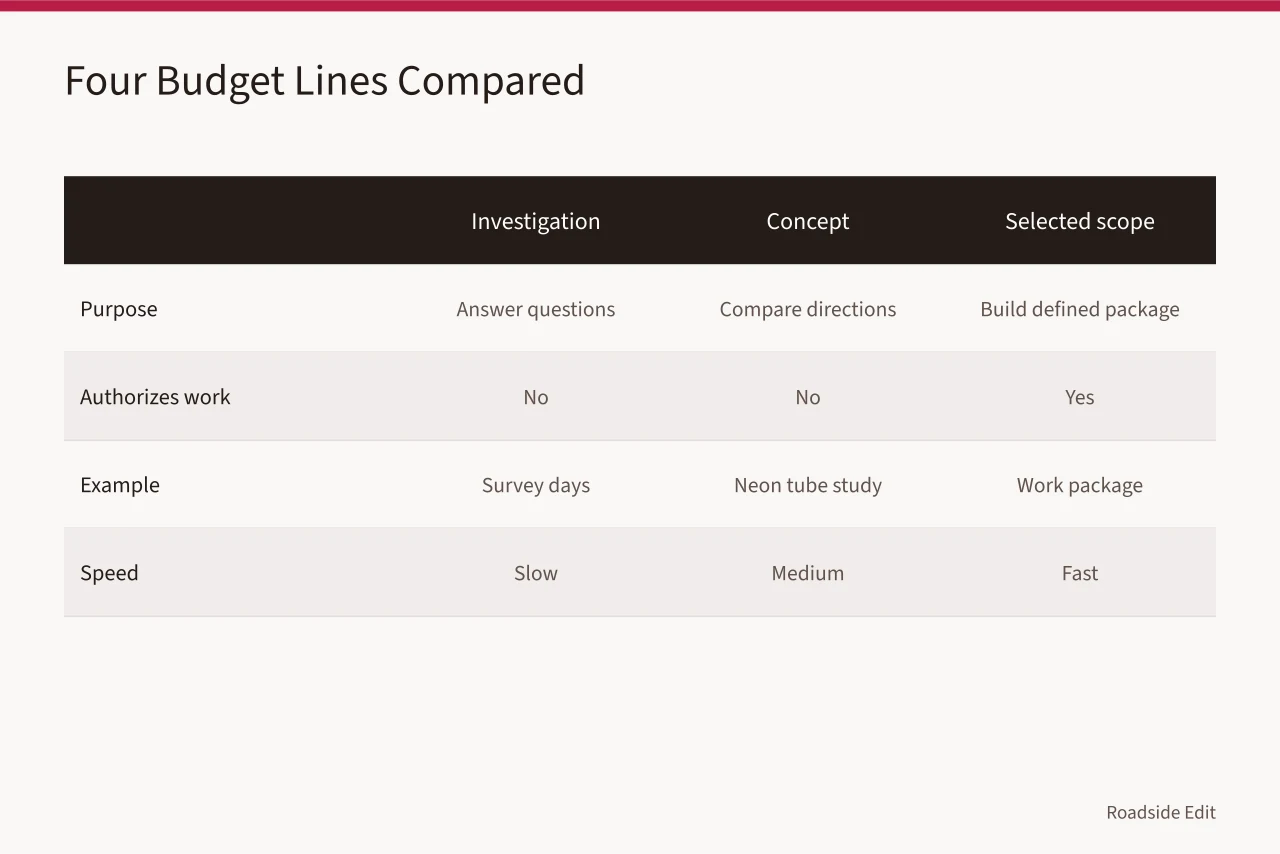
Concept development compares directions without authorizing work. A neon tube diameter study or a laminate and chrome-edge trim sample set lives here.
Selected scope is a defined work package a responsible party has advanced. Care and revision covers inspection, cleaning, replacement, and future correction.
The diner interior budget case notes show how those four lines behave when a booth and counter package moves from concept to selected scope.
Write the scope boundary first
FHWA describes public participation as most useful when it is open, relevant, timely, and appropriate to the goal of the process. FHWA's public-involvement guidance applies the same test to a budget note: say which decision the note informs and who may use it.
| Budget note field | Plain-language meaning |
|---|---|
| Purpose | What decision this estimate or allowance informs |
| Scope item | The investigation, concept, material, or work area under consideration |
| Basis | Record, conversation, quantity, or assumption used |
| Status | Placeholder, planning range, selected scope, or reported expense |
| Exclusion | Work deliberately not included in this line |
| Trigger | Condition that would cause the note to change |
| Owner | Person or role who can revise or approve it |
Do not publish a precise total while the physical condition, permit path, utility location, or maintenance plan is unknown. A narrow-looking number can be less honest than a labeled range.
Give each figure a source and a limit
GSA guidance on managing project costs treats cost work as something that develops as scope becomes clearer. So a line item is a snapshot, not a verdict.
Date it. Name its scope and source. List what it includes and what it excludes. State its status. A product price is not a project estimate.
The NPS documentation standards ask for limitations that permit later verification. Do not calculate a result the cited record does not show.
The NPS preservation-planning overview describes documentation that informs later scope and design work. A cost note supports that process. It does not replace a decision record or prove work occurred.
Planning range or bid?
They are not the same document, and the difference decides what you may publish.
A planning range is a labeled early assumption with a stated trigger. A bid is a supplier's specific offer under its own terms, and it usually stays private.
The motel exterior budget planning notes work through that split on a brick veneer and curtain-wall facade, where the opening phase and the later care phase price very differently.
Keep public copy accurate
Do not publish private bids, individual contact details, negotiation positions, or a vendor's unsupported promise. A public article may explain the difference between a planning allowance and a completed expense. It may not imply that a property spent money or approved work without a reliable record.
If the source changes, make a new entry instead of editing the old amount in place. The record then shows which scope change caused the revision.
Common questions
Is a planning range the same as a bid?
No. A planning range is a labeled early assumption with a written trigger. A bid is a supplier's specific offer under its own terms, and it is normally not public copy.
What belongs in an exclusion field?
Any work, condition, fee, or future phase the note does not include. Naming exclusions is what keeps a reader from adding two lines that were never meant to sit together.
Why list care and revision separately?
Because a feature's ongoing need differs from its first installation. Neon transformers, canopy coatings, and booth laminate each carry a different care rhythm after the opening phase closes.
Who confirms what a note may claim?
The owner of the line, against the dated record behind it. Where a figure touches compliance or eligibility, confirm with the State Historic Preservation Office or local landmarks commission.