Costs
Part of A motel exterior planning workflow, from decision question to next step
How to keep motel exterior planning workflow budget notes before pricing
A motel exterior budget note separates defined work, unknowns, decision points, and change logs so no early number reads as a project quote.
A budget note written before pricing is not a price list. It is a record of four things: what is defined, what is unknown, who decides, and what changed. Keep those four apart and a later estimate stays readable.
What to take away
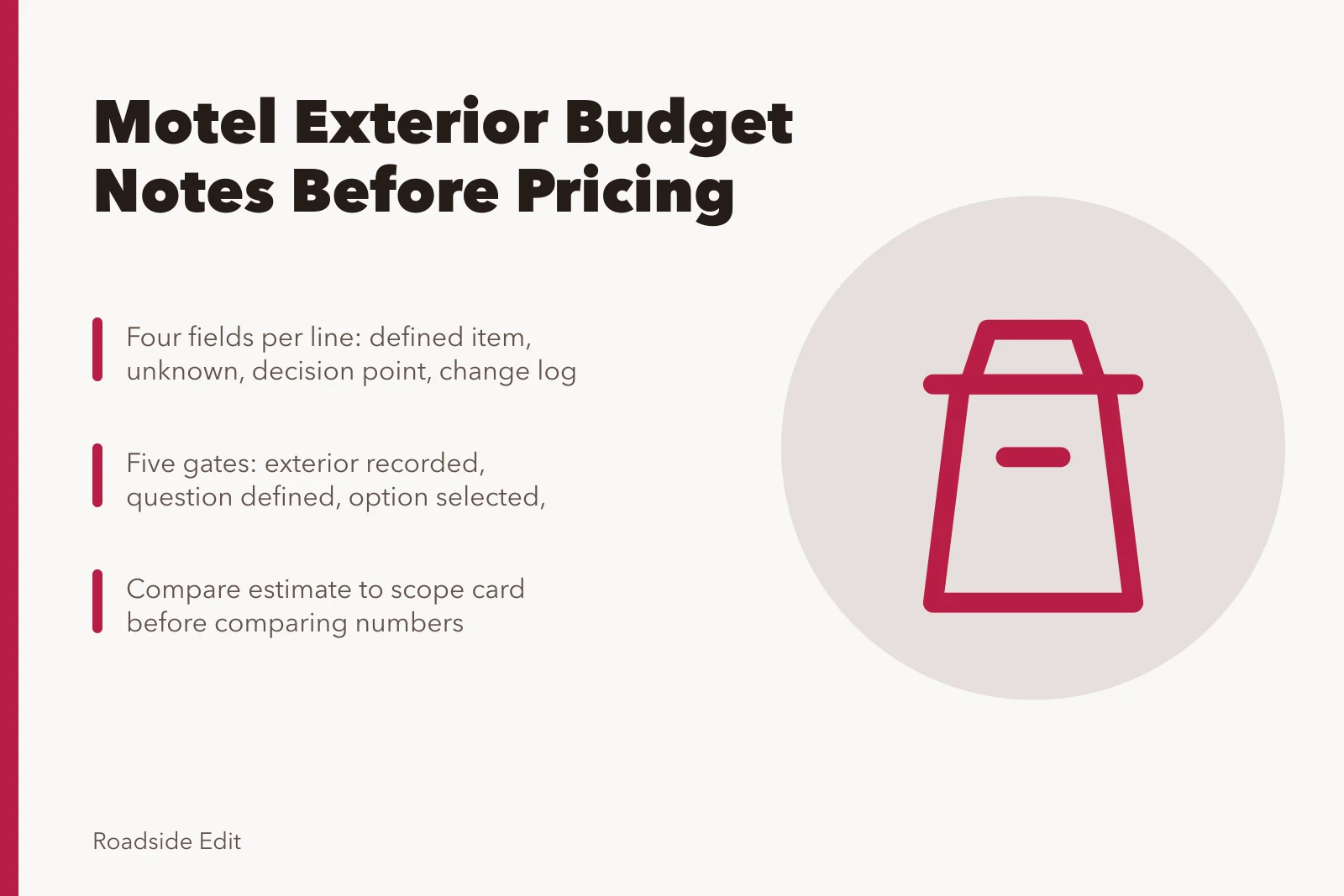
- Write four fields per line item: defined item, unknown, decision point, change log.
- Name the missing record and the person who can resolve it, not a guessed repair method.
- Compare a submitted estimate against the scope card before you compare it against another number.
- Move an item to a new gate only when its evidence exists, never when a date passes.
- Keep the note beside its dated source material so a summary is never mistaken for the original.
The four-field note schema
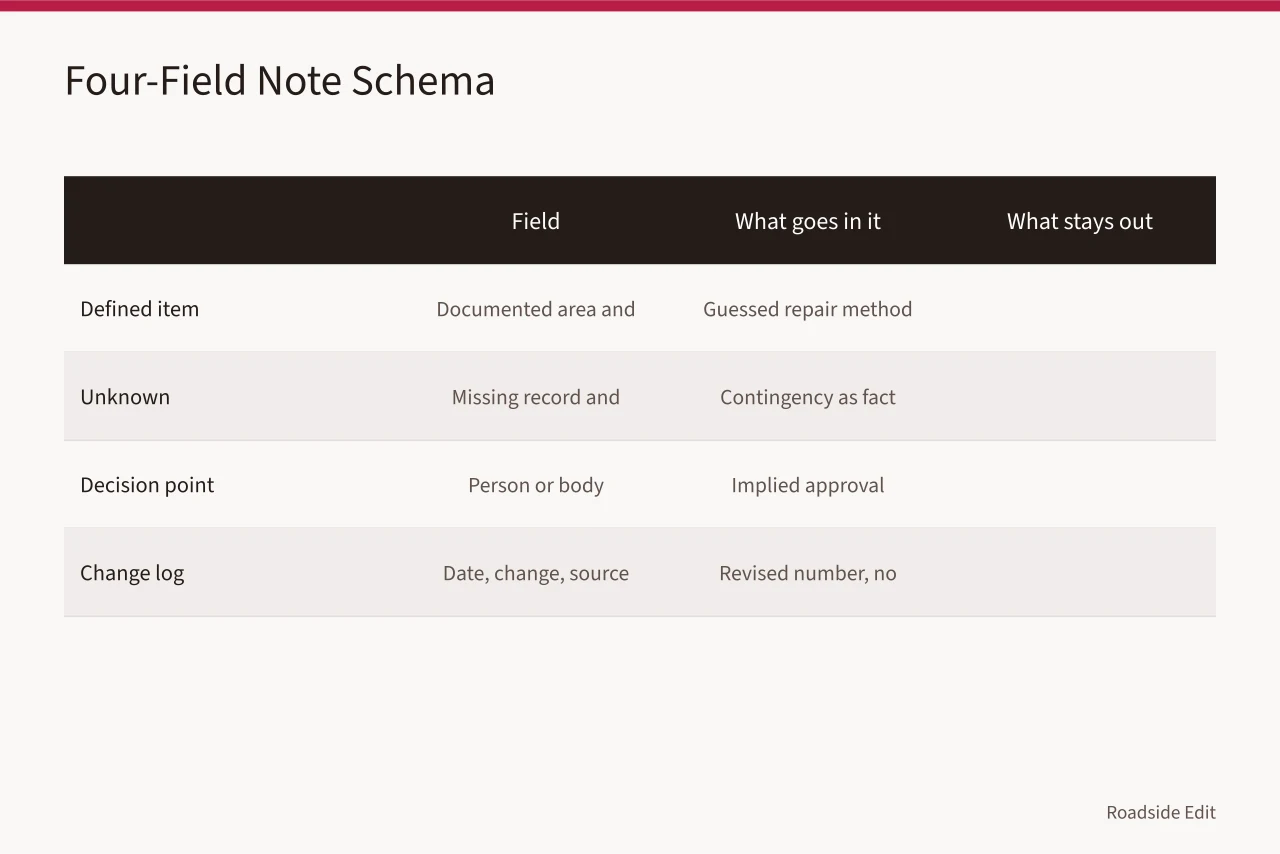
| Field | What goes in it | What stays out |
|---|---|---|
| Defined item | Documented area and the deliverable requested | A guessed repair method |
| Unknown | The record that is missing and who can resolve it | A contingency presented as fact |
| Decision point | The person or body that must decide | An implied approval |
| Change log | Date, what changed, and the source that changed it | A revised number with no context |
A photograph of a wall supports a request to document a visible feature. It does not support a conclusion about the substrate behind the finish. Keep that unknown on the same line as the defined item so a later estimate is not read as a complete scope.
Five gates, and the evidence each one needs
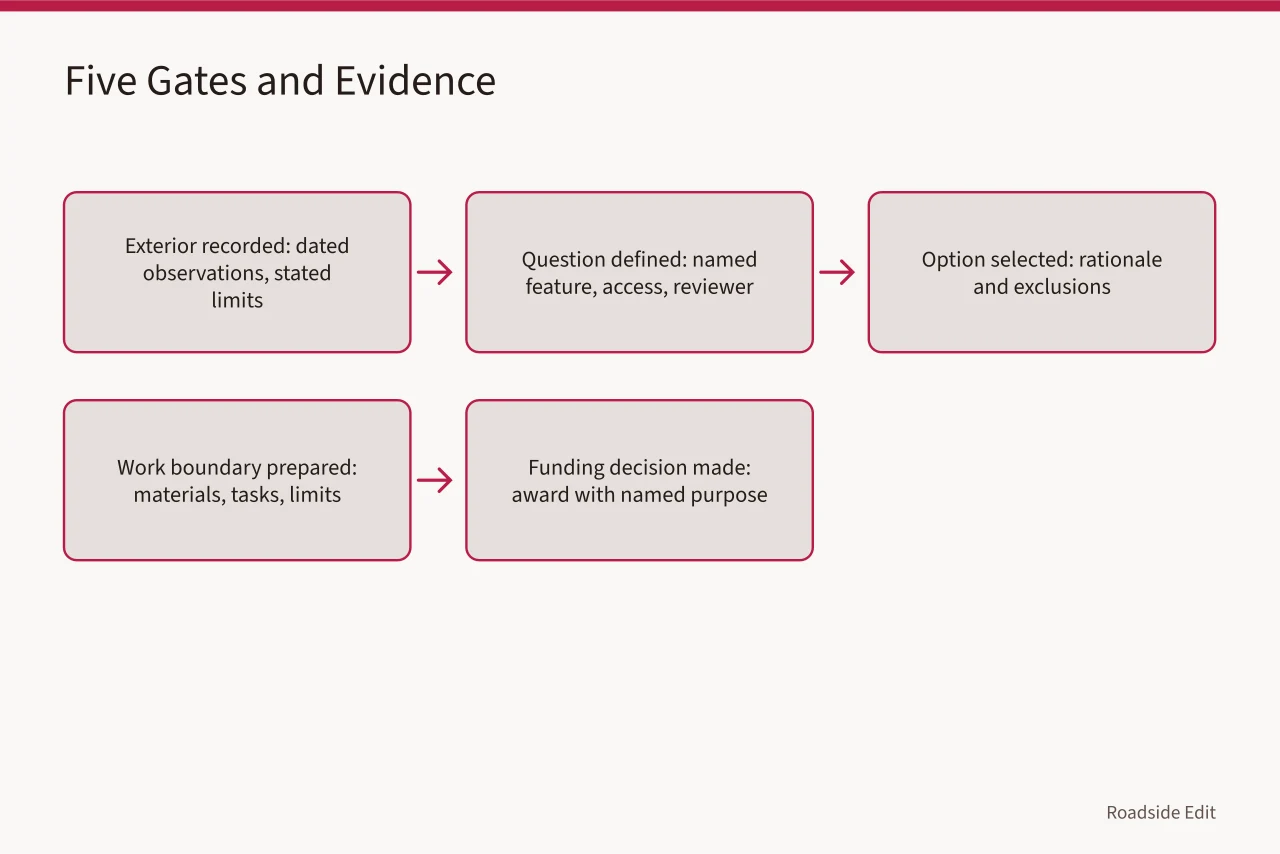
| Gate | Evidence needed | Budget status |
|---|---|---|
| Exterior recorded | Dated observations and stated limits | Documentation work can be scoped |
| Question defined | Named feature, access assumption, responsible reviewer | Study or design work can be requested |
| Option selected for review | Stated rationale and exclusions | A defined design package may be priced |
| Work boundary prepared | Materials, tasks, and limits stated | A provider may submit an estimate |
| Funding decision made | Award or commitment with a named purpose | Only that activity can be called supported |
An unknown condition stays at its gate. Do not move a generic contingency into the public table and call it a known repair. When a new source changes the boundary, add a dated revision note naming the changed item and leave the older scope in place.
Worked example: a 1962 motel, flat canopy and porcelain sign
A survey team documents a two-story 1962 motel: brick veneer, a flat canopy over the office door, and a porcelain-enamel sign on a pole at the curb. The note reads:
- Defined item: canopy soffit, 40 linear feet, photographed and measured 2026-06-14.
- Unknown: whether the soffit finish is original or a later repaint. Resolve by finish analysis, requested from the State Historic Preservation Office reviewer.
- Decision point: whether the sign stays in place or is removed for repair. Owner and local landmarks commission decide.
- Change log: 2026-06-20, survey area extended to the dry-stand pipe after the field notes showed it inside the canopy footprint.
The canopy line sits at gate two. The sign line sits at gate three, because the removal question is open. Neither line has a submitted estimate, and the note says so rather than leaving a blank that a reader fills with a guess.
A note like this is what the motel exterior planning sequence is built on, because each gate holds a decision rather than a total.
Reading a submitted estimate
When a provider sends information, compare the document to the scope card first. Does it name the area? Does it state exclusions? Does it separate site visit, design, materials, and labor? Does it separate permits and allowances? An unclear answer is a question to record, not a gap to fill.
Label the number by its stage: submitted estimate, planning allowance, or design package. A figure can help sequence internal work. It is not proof of value, quality, compliance, or final cost.
The GAO Cost Estimating and Assessment Guide sets out that an estimate needs several things. These are:
- a stated purpose
- scope
- assumptions
- data
- methods
- updates It governs federal estimating rather than a motel exterior, and its structure is the reason to keep each figure tied to the stage that produced it.
Keeping the record
Store the note beside its dated source material. When a scope item changes, revise the note with the date and the reason.
When access, authority, or a technical condition is still unknown, write that plainly. The National Archives records-management resources describe inventory, scheduling, appraisal, and oversight in the federal context.
They do not set private record rules, and they show why a later reader needs to tell an original proposal from a summary.
If a sponsor, designer, or provider supplied a price, keep that submission separate from your own research and state the relationship near any recommendation. The FTC's endorsement guidance says material connections should be disclosed when they could affect how readers weigh an endorsement. A disclosed price is still that source's statement, not an independent market finding.
The NPS guidance on additions asks a proposal to describe its scope, rationale, and design, and treats written description with photographs of existing conditions as baseline documentation. Watch the NPS scope-and-documentation discussion.
It is not a motel estimating manual, and it is the reason to understand the property and the proposed change before treating an early number as a project cost.
Common questions
Is an early estimate a project budget?
Not by itself. Read it with its date, scope, assumptions, exclusions, and open questions. Then place it at the gate that matches its evidence.
Should an article publish exact project costs?
Only when source, date, location, scope, and context can all be stated. A general guide should not manufacture a quote.
What belongs in an allowance note?
The item, its evidence basis, the assumption behind it, the decision owner, and the condition that would change it.