Guides
Part of A motel exterior planning workflow, from decision question to next step
How motel owners can organize exterior planning records before project work
Motel exterior planning records for 2027 help U.S. readers keep source pages, images, scope notes, decisions, and corrections organized before any project work.
Planning records make a roadside exterior article easier to verify and revise. They do not replace a property file, permit record, or professional assessment. Their job is to preserve what was actually observed, sourced, proposed, and decided.
What to take away
- Save the specific source page with each factual claim.
- Keep source records, proposals, and approvals in separate folders or fields.
- Give every photo a date, location description, source page, and stated limit.
- Add corrections instead of silently overwriting changed information.
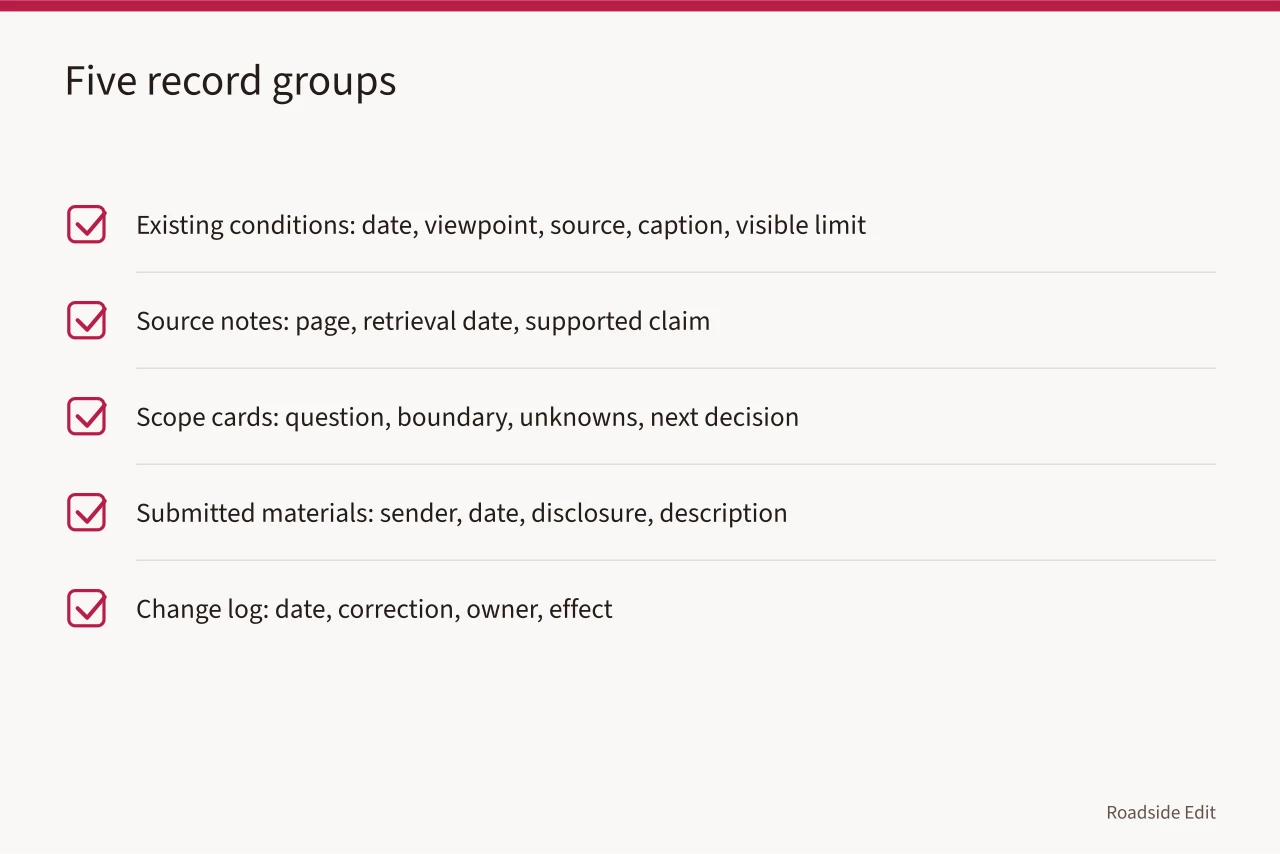
Keep these five record groups
| Record group | Minimum contents | Purpose |
|---|---|---|
| Existing conditions | Date, viewpoint, source, caption, and visible limit | Shows what was observed. |
| Source notes | Specific page, retrieval date, and supported claim | Lets an editor recheck the statement. |
| Scope cards | Question, boundary, unknowns, and next decision | Prevents broad or shifting requests. |
| Submitted materials | Sender, date, disclosure, and exact description | Separates commercial information from evidence. |
| Change log | Date, correction, source or decision owner, effect | Preserves the planning trail. |
Name files so another person can understand them. A practical pattern is date, location or feature, document type, and source. Avoid a filename such as "final-final-new" because it hides which information changed and when.
NPS cultural-resource policy says treatment decisions are based on a property's historical significance, existing conditions, and use. Read the NPS cultural-resource management policy. The source concerns NPS cultural resources, not a universal motel paperwork rule. Its useful lesson is to retain a clear distinction between current conditions and a proposal.
The claim ledger is the page's factual backbone. The National Archives describes records management as control of information created or received in the course of activity; Review National Archives records-management basics.
For each article statement, record the exact source URL, its publication or update date if shown, the sentence it supports, and the limit on that evidence. A later editor can correct one claim without guessing which of several sources was used.
Create a short change log
Each entry needs only five parts: date, item changed, reason, source or decision owner, and effect on scope. For example: "2031-06-13, sign photo caption corrected, source page identifies a different viewpoint, Wikimedia page, remove unsupported placement claim." The entry makes the correction auditable without presenting the old caption as current.
Records for listings and reviews
If a business seeks a listing or review, save the submitted text separately from editorial research. Disclose payment or a material relationship in the published item. Do not let a submission replace an authoritative source for a factual claim, and do not call a listing a review unless the stated editorial process supports that description.
The Federal Trade Commission says advertising made to resemble independent content should be identifiable as advertising. See the FTC native-advertising guide. The record should therefore show whether the content was paid, supplied by a provider, selected by editorial criteria, or independently researched. That label protects the reader and helps the site apply the same treatment to later submissions.
Keep images and treatment questions separate
An exterior image provides one record; a project decision provides another. Do not let a dated photograph stand in for a condition report, access permission, or repair recommendation.
The National Park Service's historical-documentation standards describe the importance of clear and accurate documentation that remains useful over time. Consult the NPS historical-documentation standards.
A concise image record should name the source, date, location, visible feature, and uncertainty, then point the next question to the responsible review.
Use a review rhythm
Records lose value when saved once and never checked by a responsible editor. Set a short review date for active planning pages, especially if they mention ownership, operating status, public access, or a proposed project.
At each review, verify the source page still resolves, confirm the scope statement remains accurate, and remove unsupported claims. A dated review note beats a silent assumption that the earlier record remains current today or tomorrow.
Common questions
What is the most important record to keep?
Keep the specific source page and the exact claim it supports. That makes later checking possible.
Should records include private contact details?
No. Retain only what is appropriate, authorized, and necessary for the editorial or planning purpose.
Can a change log replace an approval record?
No. It documents the article or planning file. Approvals must come from the responsible party or authority.