Guides
Part of A motel exterior planning workflow, from decision question to next step
How to build a motel exterior planning checklist before you pick contractors
A pre-bid motel exterior checklist: fix the scope in writing, record dated conditions, list the authorities, and log every change before contractors price it.
A motel exterior project usually starts with one visible problem: a porcelain-enamel sign panel with a chipped corner, a canopy soffit staining, a dry-stand pipe that no longer reads as original. One problem is not a scope.
Contractors price what they are handed. Hand them a wish and you get three bids for three different jobs, none comparable. The checklist below fixes the scope before anyone prices it.
What to take away
- Write the scope as one decision with a boundary, not a goal like "improve the exterior."
- Photograph and date conditions before you ask for numbers; bids priced off memory are not comparable.
- Name the authority for each open question: SHPO, structural engineer, electrician, environmental authority, attorney, accountant, customs broker.
- Treat a mid-project scope change as a new decision with its own record, not an edit to the old one.
- A rehabilitation done as one system costs less than four trades working four separate contracts.
Write the scope before you call anyone
The scope sentence names the feature, the action, and the boundary. "Repair the 1958 canopy soffit and repaint the fascia in the original color range" is a scope. "Fix up the front" is not.
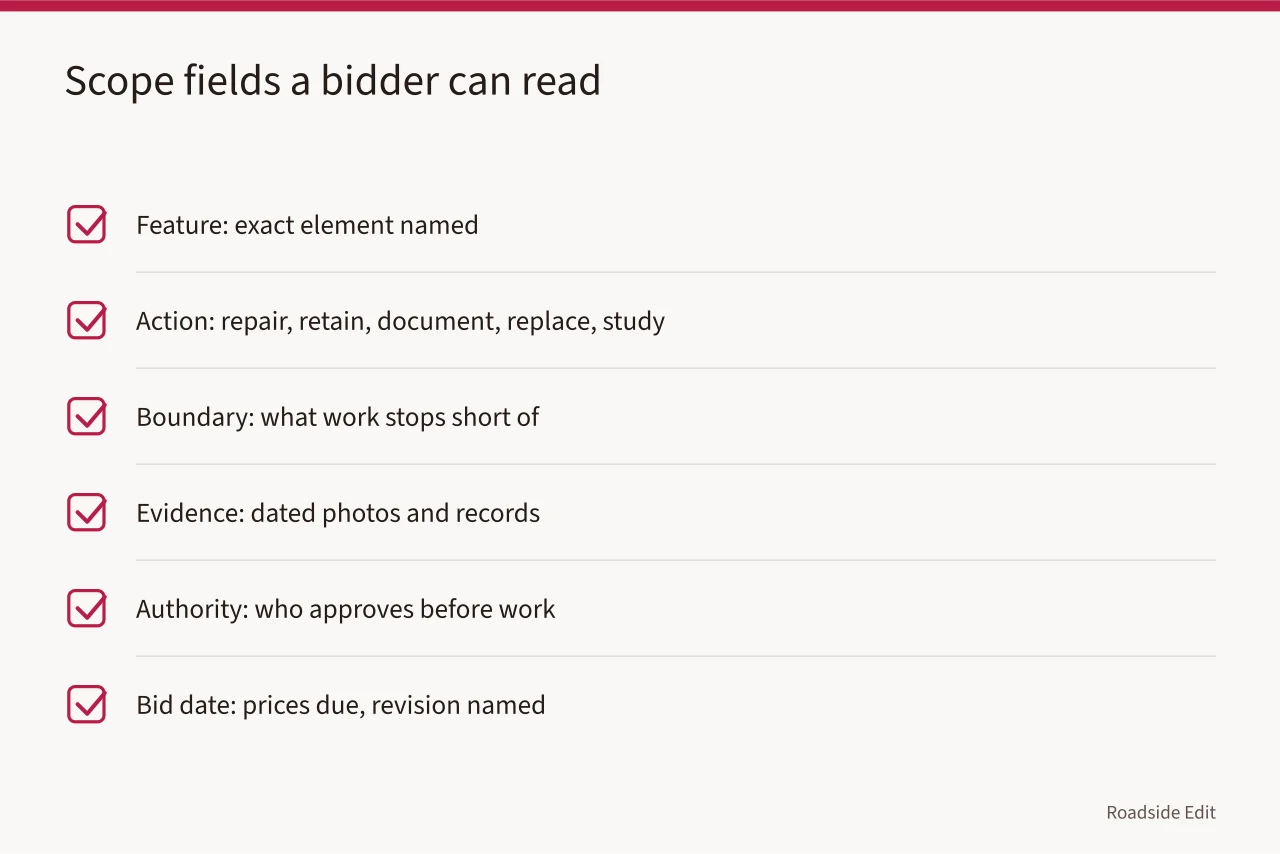
A contractor cannot bid a boundary they cannot see. Write down what is inside the work and what is explicitly outside it.
| Field | What goes in it |
|---|---|
| Feature | The exact element: canopy soffit, sign cabinet, curtain-wall glazing, pump island |
| Action | Repair, retain, document, replace, or study |
| Boundary | What the work stops short of |
| Evidence | Dated photos and records the bidder can check |
| Authority | Who must approve before work starts |
| Bid date | When prices are due and against which revision |
The National Park Service's preservation-planning guidance asks teams to define issues and goals with the people who will use the plan. Read the NPS preservation-planning guidelines. For a motel, that means one page a bidder can read in five minutes.
Record conditions with dates, not adjectives
A bidder who has never seen the property prices risk. Dated photographs remove some of it. Undated ones add to it.
Shoot the frontage, the sign from both faces, the arrival path, and the wall planes. Also shoot the roof edge and the ground at the base of each element. Caption each frame with the property, the date, and the direction.
NPS documentation requirements for rehabilitation applications ask for photographs of existing appearance and condition with numbered captions tied to the view. Review the NPS photo-documentation requirements. Those rules govern federal applications, not your job file. The habit transfers: a photo without a date is an opinion.
Say "porcelain panel, lower left corner chipped, June 2027." Do not write "deteriorated" or "unsafe" unless a named source says so in writing.
Name the authority for each open question
Every unresolved item on a motel exterior belongs to somebody. Write down who, before a bidder assumes the answer.
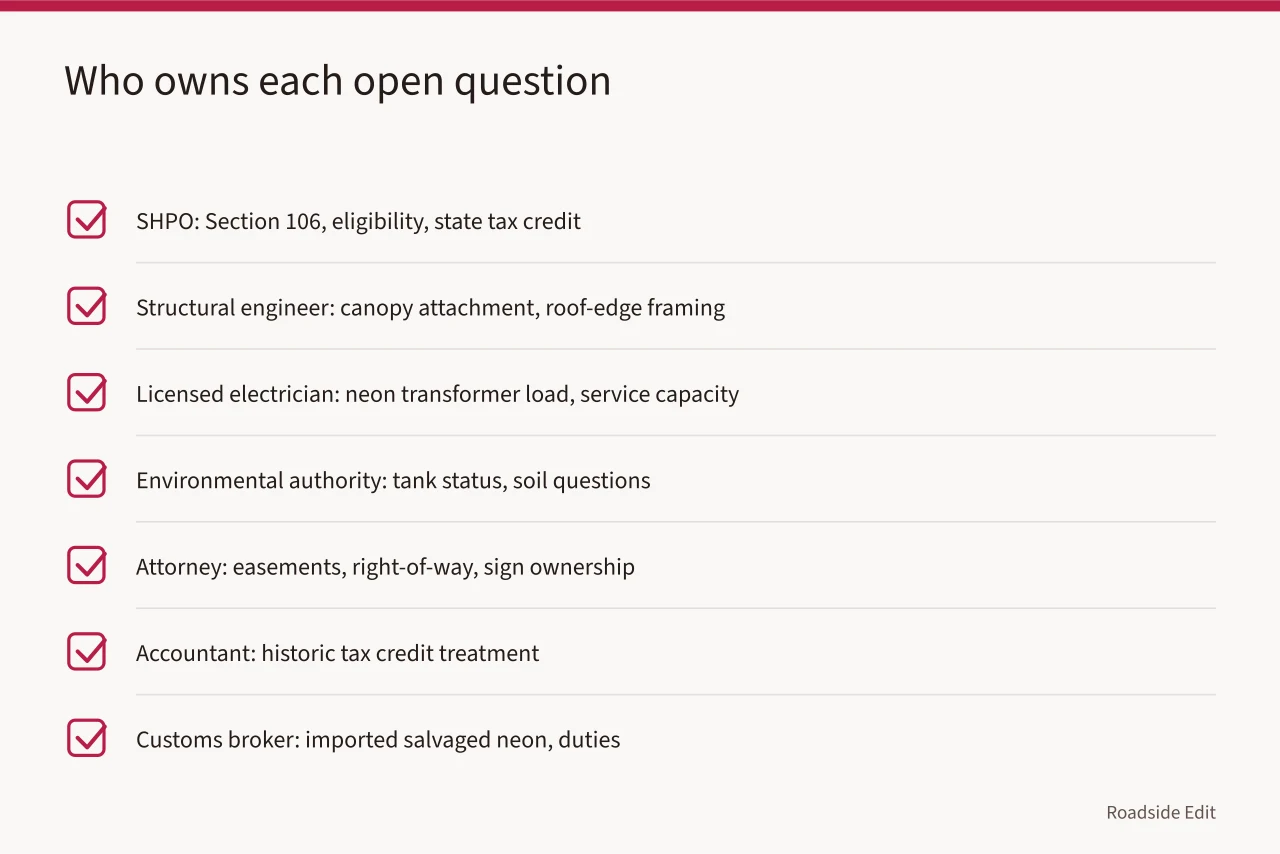
The NPS permitting checklist asks teams to analyze jurisdictions and document how unknowns get resolved. Read the NPS permitting checklist. The same method works on a 40-unit motel: an authority list beats a verbal assurance.
Keep a simple log. Question, likely authority, source checked, date, and whether the answer actually covers your subject. Leave it open if it does not.
The image shows a roadside type, not a condition report. It establishes nothing about ownership, access, or eligibility for any property.
Treat rehabilitation as one system
Bids split by trade hide the cost of coordination. A canopy repair, a sign restoration, and a forecourt drainage fix share scaffolding, access, and a schedule.
Scope them together and one crew holds the site. Scope them apart and you pay three mobe costs and three sets of site protection.
That does not mean one contract. It means one scope document with named interfaces: who lifts the sign, who patches the soffit behind it, who reinstalls the transformer once the electrician signs off.
A broader rehabilitation also changes what the SHPO sees. A single exterior alteration is one review. A coordinated rehabilitation of a contributing roadside property is a different conversation, and the Secretary of the Interior's Standards apply to both.
Review points before you release the bid
Set the points where the team checks the scope against the evidence. Each one produces a dated note.
| Review point | Question | Record |
|---|---|---|
| Conditions complete | Do the photos and records describe the actual subject? | Dated packet, missing-information list |
| Authorities named | Is every open question assigned to a person or office? | Authority log with source dates |
| Scope frozen | Does the bid package match the current revision? | Signed scope page and revision number |
| Bid comparison | Were all bidders pricing the same boundary? | Bid tab with exclusions noted |
| Change review | Did new evidence or a decision alter the scope? | Dated change note |
NPS quality-assurance guidance requires later submissions to answer earlier review comments. Review the NPS quality-assurance guidance. The federal process is heavier than a motel repaint. The pattern is the same: what was reviewed, what changed, what comes next.
Do not hire a contractor to make an unclear project look finished. If the scope is still open, the first paid task is a survey day or a conditions record, not construction.
Log scope changes as new decisions
A new photo, an owner preference, or a denied access changes the job. Write it down instead of quietly editing the scope page.
| Change | Example note |
|---|---|
| New evidence | "July 2027 image added; shows the sign face from a public viewpoint not previously available." |
| Scope limit | "Interior work removed; access not authorized." |
| New decision | "Owner chose to retain the original enamel panels and repair the chipped corner." |
| Correction | "Caption date corrected after the source page showed a different image date." |
Keep the earlier note. A later reader needs to tell a corrected fact from a changed preference, and a bidder needs to know which revision they priced.
Exterior planning is mostly this: deciding what the job is, then keeping the record straight while it moves. Budget the survey days, the travel, and the fabrication separately, because they behave differently when scope shifts, as the common budget mistakes in this work usually show.
Common questions
Can I get bids before the scope is finished?
You can, but you will not be able to compare them. Bidders fill an open scope with their own assumptions, and the cheapest number usually carries the most of them.
Who decides whether my sign is historic?
The State Historic Preservation Office, or the local landmarks commission if the property sits inside a designated district. Neither answer comes from a contractor or a supplier.
What if the scope changes after the bid?
Treat it as a new decision. Write the change, the reason, and the date, then ask bidders to price the revised revision. A verbal change has no record and no price.
Does a rehabilitation have to be done all at once?
No. Phasing is normal. What matters is that the phases share one scope document, so the interfaces between them are named before the first crew mobilizes.