Guides
Part of Historic motel restoration: 8 planning mistakes to avoid before 2027
Historic motel restoration budget notes: how to avoid planning mistakes in 2027
Historic motel restoration budget notes for 2027 show how to document, test and price work like roofing and masonry before full-scale repairs begin.
A motel budget goes wrong when a number loses its source, its date or its scope. The fix is a record that says what each figure is, not a bigger figure.
What to take away
- Document and test a treatment on a small area before full-scale work, as NPS graffiti-removal guidance directs.
- Label every figure as allowance, estimate, approval, invoice, work record, or unknown.
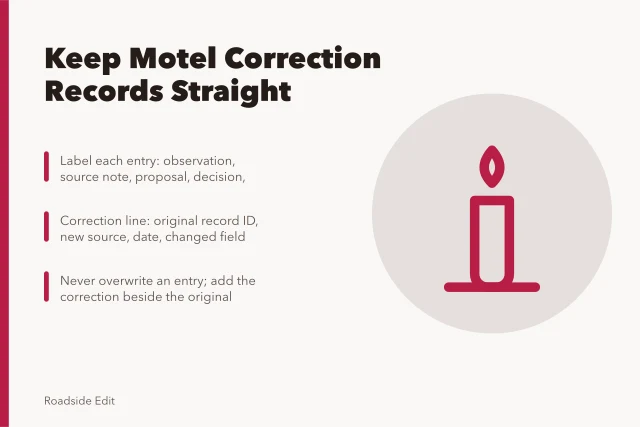
- Never overwrite an old figure. Add a new row with its own date, source and reason.
- Keep property-specific money in controlled records and publish only the status system.
- Name the authority that sets a requirement instead of restating it as universal.
Document and test before the full run
NPS guidance on graffiti removal from historic features sets a sequence: plan the treatment, document existing conditions, test on a small area, then commit to full-scale work. Read the NPS guidance on documenting and testing graffiti removal.
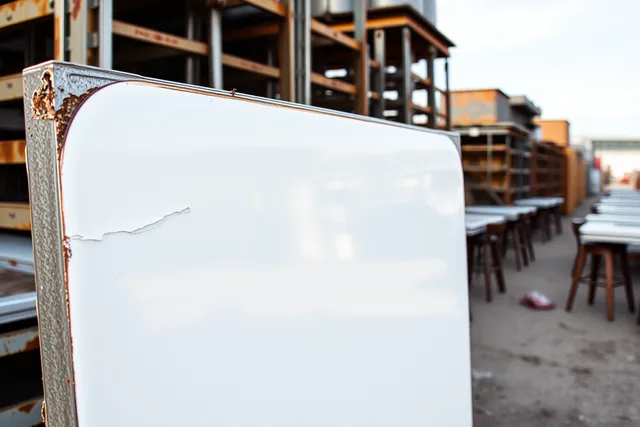
The same sequence fits a motel exterior, where an untested cleaner can strip a porcelain-enamel sign panel or bleach a brick veneer that no reprint will match.
Testing produces a record before it produces a result. Photograph the test patch, note the product, the dwell time and the substrate, and file the date. A later reader can then tell a documented decision from a guess.
| Figure status | Meaning |
|---|---|
| Planning allowance | Early internal placeholder |
| Estimate | Dated figure for a stated scope |
| Approval | Documented authorization |
| Invoice | Billed amount in a record |
| Work record | Reported completed scope |
| Unknown | No reliable figure available |
Add a row, never overwrite
When a figure changes, leave the old entry standing. Add a new row with the new date, source, status and the reason for the change. The reason is often a revised scope, a new test result, or a question still open with the State Historic Preservation Office.
A change log lets a reader separate a fresh estimate from last year's allowance. Overwriting erases that distinction, and the erased version is the one a contractor may still be holding.
Keep scope beside every figure
The GSA guidance for managing project costs treats estimates as figures developed and revised as scope becomes clearer. A motel planning record should show that same link between scope and number.
Write the feature, its location, the source and the date next to any figure that may be reused. Also write the inclusions, the exclusions and the current status next to it. A number without that context is not an estimate. It is a comparison someone will later mistake for one.
| Label | What it records | What it must not become |
|---|---|---|
| Allowance | Early planning placeholder | A vendor estimate |
| Estimate | Dated figure for stated work | An authorization |
| Approval | Documented decision | Proof work occurred |
| Invoice | Billed amount | Evidence of future performance |
The NPS historical documentation guidelines ask writers to identify sources and describe methods. Apply that to a budget line. If a figure came from a phone call, label it an unverified planning note rather than an estimate.
Build the arithmetic from named variables
Where a figure matters and no published number exists, write the arithmetic instead. Use named variables the reader fills in: survey days, daily survey rate, travel days, travel cost per day, and fabrication cost per item. Multiply and add, and the reader supplies current local rates.
The NPS documentation standards call for stated limitations and independent verification. A variable list does both. It shows what the total depends on without pretending to know a price.
Keep private numbers out of published guidance
Published content can say whether an item is a placeholder, an estimate, an approval, an invoice or a completed-work record. It should not print figures that are private, incomplete or likely to be read as a current quote.
Store the full record in the controlled location the team already uses. The article can name a source category and a review date without exposing negotiations or internal assumptions. That separation keeps a number from being reused outside its scope.
Review the register before each meeting. If the scope moved, add a row and leave the old one in place.
Common questions
Is a vendor quote a finished project cost?
No. It is a dated proposal for a stated scope and it can change. Keep it separate from approval, invoice and completed-work records.
Can an article estimate a preservation project?
No. A usable estimate needs a defined scope and current, property-specific information. An article can give the arithmetic and the labels instead.
Why keep cost status separate from the number?
It stops a rough planning figure from being repeated as an approved or completed amount. The label travels with the number, so the reader knows what they are holding.