Guides
Part of Historic motel restoration: 8 planning mistakes to avoid before 2027
Historic motel restoration warning signs to check before you repeat a claim
Warning signs for historic motel restoration writing: material overreach, unverified outcomes, and claims that need a source before they go to print.
A warning sign is a sentence that stops you before you publish. It marks a claim as unverified, not a building as unsound.
What to take away
- A treatment claim with no property source is a draft, not a finding.
- "Maintenance-free" is a manufacturer's phrase, not a condition report. Quote it and date it.
- Keep the evidence, the decision and the finished work in three separate fields.
- Name the authority that sets a local requirement instead of stating the requirement.
- When a better source arrives, publish the correction rather than deleting the old sentence.
Watch for material overreach
The National Park Service guidance on substitute materials asks whether a proposed material fits the specific property, and notes that products sold as maintenance-free still have service lives. Read the NPS guidance on evaluating substitute materials. It sets a test, not an answer for your motel.
That distinction is the whole job. A 1950s porcelain-enamel sign panel and a 1960s plastic-faced box sign fail differently, and a claim that covers both covers neither.
| Warning phrase | What it hides | What to write instead |
|---|---|---|
| "Always use" | A general source wearing a local voice | Name the source, its date and its scope |
| "Problem solved" | No completion record | Describe the documented work and its date |
| "Maintenance-free" | Lifespan and fit left out | Quote the phrase, attribute it, date it |
| "Required upgrade" | No current adopted ordinance | Refer to the local landmarks commission |
| "Safe now" | An assurance nobody signed | State what the record actually shows |
Verify the claim pattern, not just the sentence
Most bad restoration writing fails in a pattern, not a phrase. Match the pattern, then check the thing it needs.
| Claim pattern | What to verify | Result if it holds |
|---|---|---|
| Material promise | Source scope and fit to this property | Claim marked for review |
| Work outcome | Completion record with a date | Description limited to documented work |
| Historic identity | A source for the name, date or material | Identity labeled unconfirmed |
| Local requirement | The current adopted ordinance | Referral to the authority that sets it |
| Cost or schedule | The published figure or your own variables | Arithmetic shown, sources named |
The NPS standards for historical documentation ask for reliable sources, stated limits and information a reader can check independently. Read your draft sentence against that list before anyone else does.
Keep the claim beside its evidence
Put the citation in the sentence it supports. A link parked at the end of a section implies the whole section is verified, and it never is.
When a source supports a general point but not a property fact, split the two sentences and label the property fact unconfirmed. The NPS historical documentation guidelines cover source identification and how a record handles conflicting information. A correction should name the earlier wording, the new source, the date and the specific change.
Separate a warning from a diagnosis
A warning asks for evidence. It does not name a cause and it does not prescribe work. The NPS project documentation overview puts property information ahead of scope and design, and that order belongs in the article too: source, observation, question, then review.
This is where regional preservation warning signs earn their keep. A phrase that is honest in one state can be an overreach in the next, because the ordinance behind it differs.
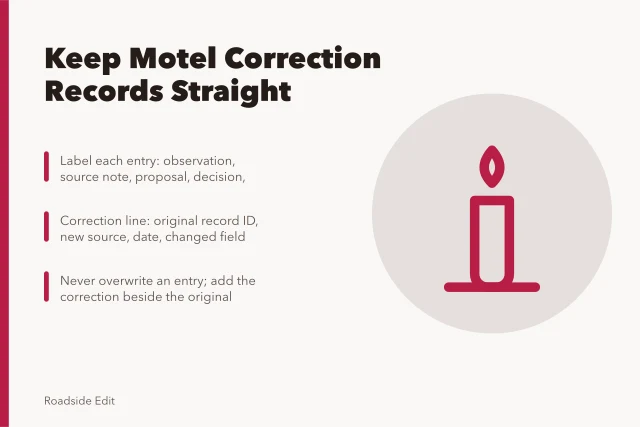
Use a four-line correction format
Keep corrections short enough that people actually file them:
- Earlier record ID and the wording that changed.
- The new source, with its date.
- The date of the correction.
- The question that stays open.
Four lines tell a reader whether the revision touches a location label, a source role, a project status or a claimed outcome. Never repair a weak claim by bolting a vague citation onto the paragraph. Rewrite the claim to match the evidence, or mark it unresolved.
Keep the original source file with the correction entry. The next reviewer can then confirm the change without trusting a summary of a summary. If your draft is weighing modern roadside options, the same four lines apply.
Common questions
Why does source placement matter?
A reader should see which sentence a source confirms. Placement makes the article reviewable, and it makes a wrong claim visible instead of buried.
Can an old source support a current claim?
Only when the article states its date and scope. Older sources usually explain history, not present condition.
What should happen when a source is contradicted?
Correct the article and record the reason in the four-line format. A convenient claim that the evidence no longer supports is the thing warning signs exist to catch.
Does a warning sign establish a treatment?
No. It flags a statement that needs evidence or review by a licensed professional or the authority having jurisdiction.