Guides
Part of How to build a historic motel restoration maintenance plan owners can audit
Historic motel restoration plan warning signs to check before 2027
Historic motel care warning signs for 2027 help readers flag unsupported material claims, unclear scopes, missing evidence, and misleading maintenance language.
Warning signs in a maintenance record are prompts to seek the right evidence. They are not diagnoses, repair orders, or a substitute for a property-specific evaluation. This guide focuses on warning signs in the record itself: language that claims more than the source can support.
What to take away
- Treat broad product promises as claims that need a property-specific check.
- Flag records that describe an action without evidence, scope, or status.
- Separate a visible change from its possible cause.
- Keep material decisions out of generic article copy.
Watch for "maintenance-free" language
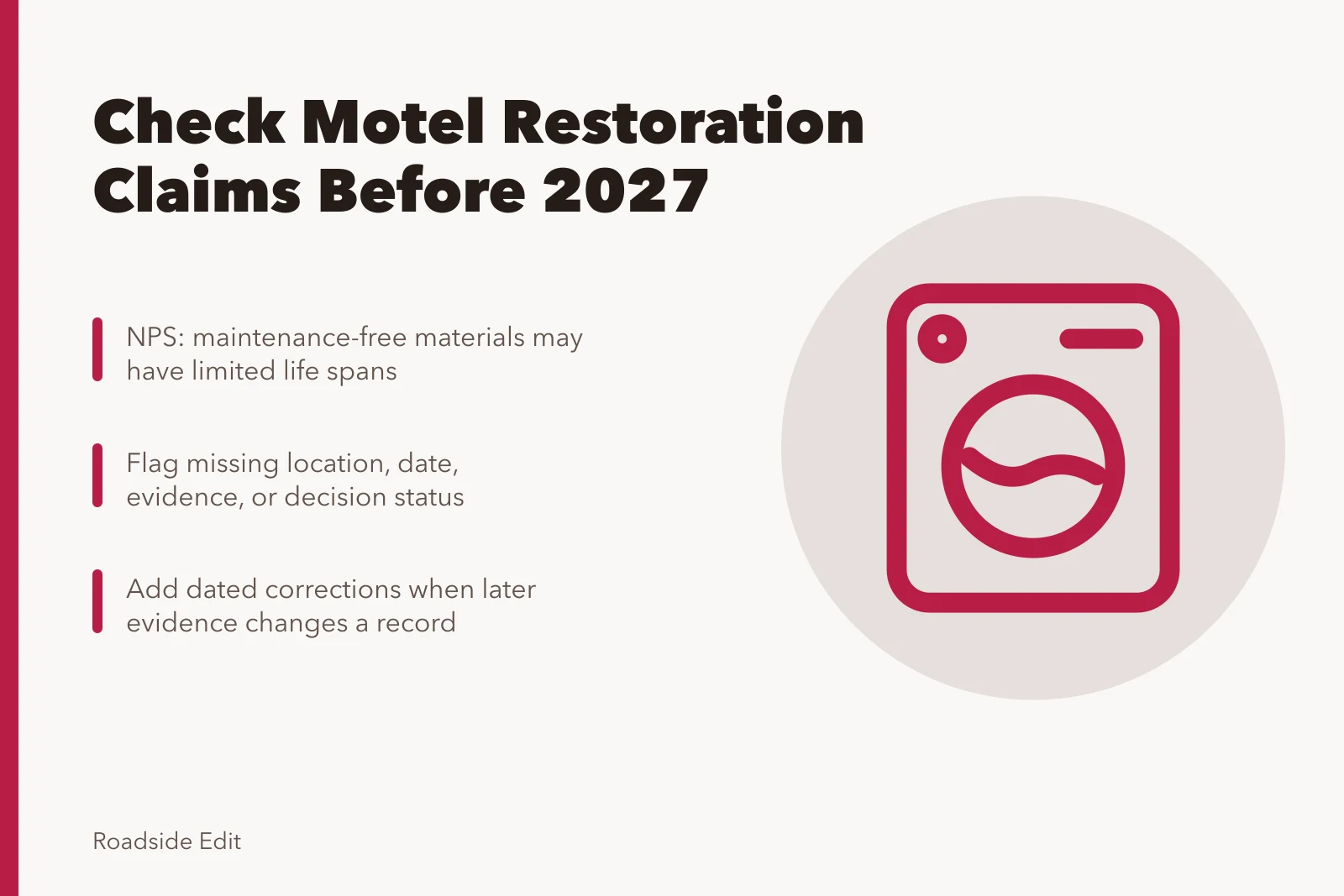
The National Park Service cautions that maintenance-free materials may still have limited life spans. It says substitute materials must be evaluated for their specific applicability. Read the NPS guidance on substitute materials.
That guidance does not choose a material for a motel. It supports a narrower editorial rule: a broad product promise should not be presented as a site-specific solution.
When a record includes product language, log who made the claim, where it appeared, and what evidence would be needed to evaluate it for the property. Do not convert marketing language into maintenance instruction.
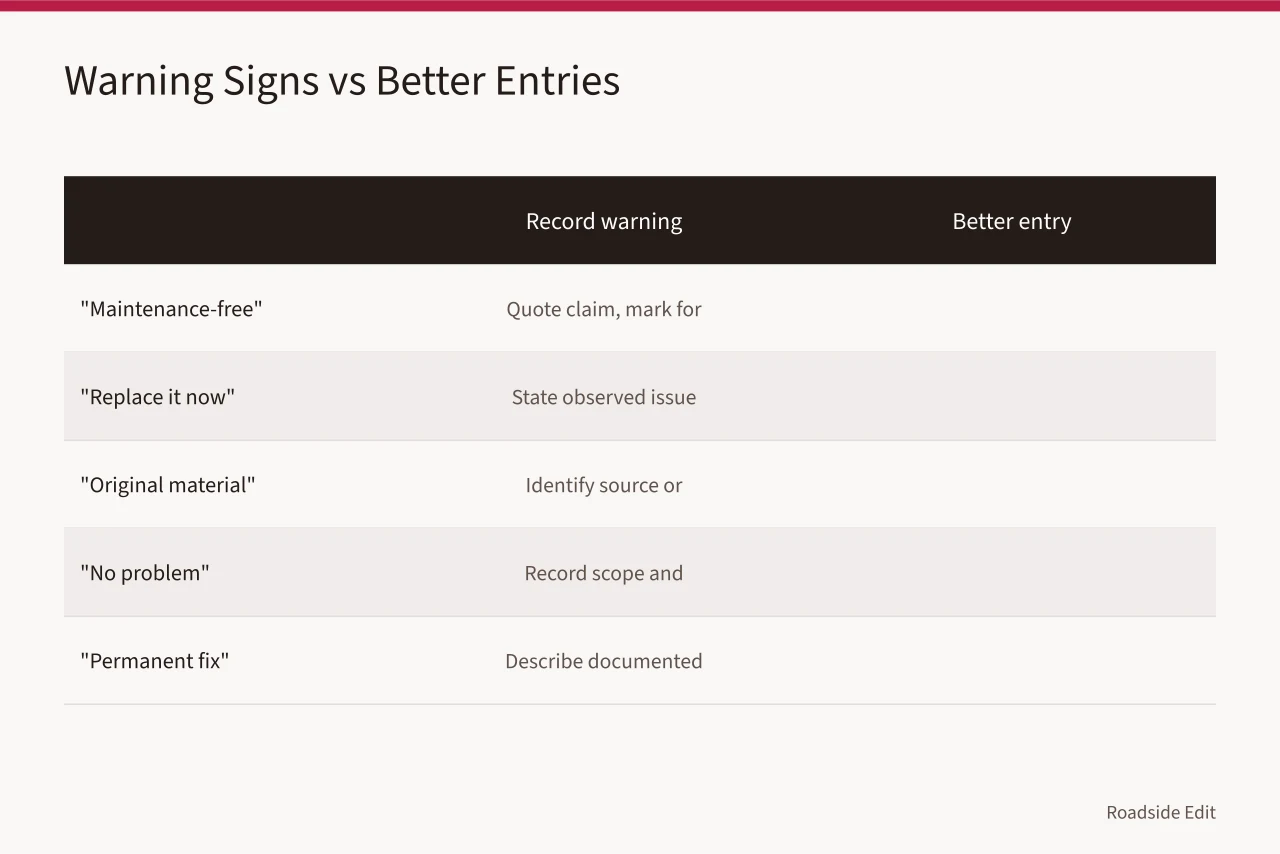
| Record warning sign | Why it matters | Better entry |
|---|
Flag scope drift
Scope drift happens when a small observation grows into a large conclusion as it is repeated. A note about peeling coating can become a claim about an entire wall. A comment about one window can become a statement about all room windows. The warning sign is the missing location boundary.
For each concern, check these basics:
- Does the entry name a precise location?
- Does it say what was observed rather than guessing why?
- Is there a date and a related record?
- Does it identify a decision maker or reviewer if action is proposed?
- Does the public wording match the evidence?
If one answer is no, treat the entry as incomplete, not as proof that a particular treatment is needed. This reduces the risk that a useful blog post becomes a misleading project record.
Do not hide a correction
When later evidence changes an earlier description, add a dated correction. Explain whether the change affects location, status, material identification, or the scope of the observation. Removing the old sentence without explanation makes it hard to understand why the record changed.
Check whether a record says more than its source
The most common warning sign is a sentence that exceeds the evidence beneath it. A photograph can show a visible surface at a date. It cannot by itself establish a hidden cause, predicted service life, or an approved repair. A product brochure can describe a product. It does not settle whether that product fits a particular historic feature.
The NPS documentation standards call for reliable sources and clear treatment of their limits. When a record contains an assertion, add the source, date, location boundary, and status. If one of those pieces is missing, mark the entry for review.
| Warning phrase | Missing fact | Safer record language |
|---|---|---|
| "It is failing" | Basis and scope | "Visible change recorded; cause not determined" |
| "Original fabric" | Source of identification | "Material identity not confirmed" |
| "Permanent fix" | Evidence of future result | "Work recorded as completed on stated date" |
| "Maintenance-free" | Product limits and applicability | "Vendor claim retained for review" |
Record corrections without hiding the history
The NPS historical documentation guidelines discuss identifying sources and resolving or acknowledging conflicting information. A maintenance file can follow the same discipline. Keep the earlier entry, add the new evidence, and state what part of the wording changed.
The Library of Congress primary-source guide encourages questions that arise from close observation. Use that sequence when a note seems too certain. First identify the specific claim. Then ask what record supports it and what information is still absent.
This protects public material from a familiar drift: a brief observation becomes a broad conclusion after it is copied several times. Clear records make the uncertainty visible rather than making the copy sound more confident.
Common questions
Does a warning sign prove a feature is failing?
No. It identifies an observation or a record problem that may need review. A conclusion needs appropriate evidence.
Can an article recommend a substitute material?
Not from generic guidance alone. Applicability needs to be assessed for the specific property, scope, and decision context.
Why record product claims at all?
They may influence a future decision. Capturing the claim, source, and limits helps reviewers evaluate it without treating it as fact.