Guides
How to build a historic motel restoration maintenance plan owners can audit
Historic motel maintenance plan guidance for 2027 helps owners build a clear record of observations, priorities, schedules, decisions, and updates.
A historic motel maintenance plan is a working record, not a repair recipe. It gives an owner, manager, preservation consultant, and future editor the same starting point: what was observed, when it was observed, what evidence supports the record, and which decisions are still open.
This guide is for organizing that record in 2027. It does not diagnose building conditions, set a repair method, establish code compliance, or replace site-specific advice from qualified professionals.
What to take away
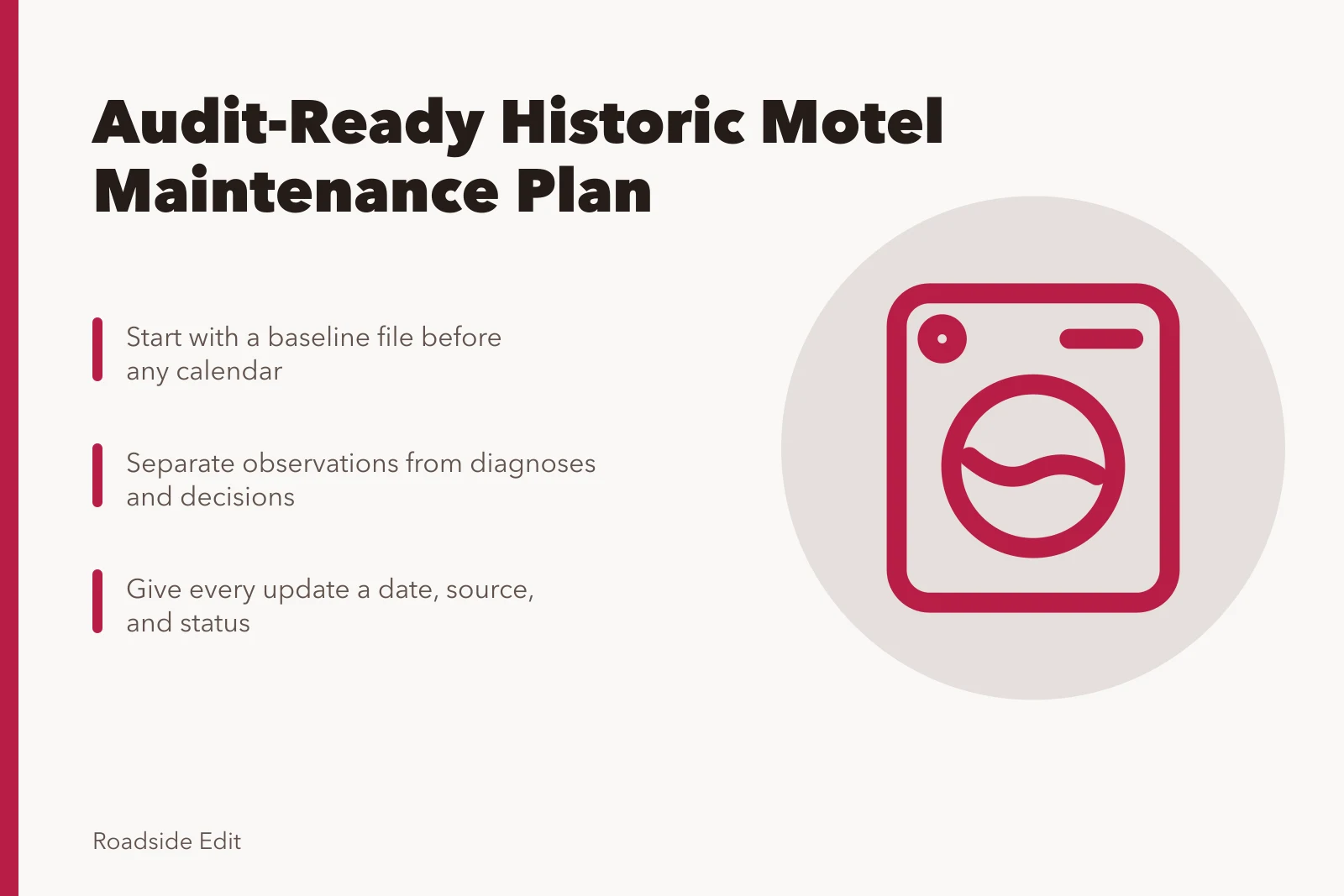
- Start with a baseline file before setting a calendar.
- Separate observed changes from diagnoses, decisions, and completed work.
- Prioritize features by vulnerability and historic importance, using evidence you can show.
- Keep schedules flexible enough to record actual conditions and weather.
- Give every update a date, a source, and a clear status.
Define the plan before you fill it
The phrase maintenance plan can mean many things. For one motel, it may be a binder with photos and inspection notes. For another, it may be a digital log shared by a small team. The format matters less than the boundary between fact and assumption.
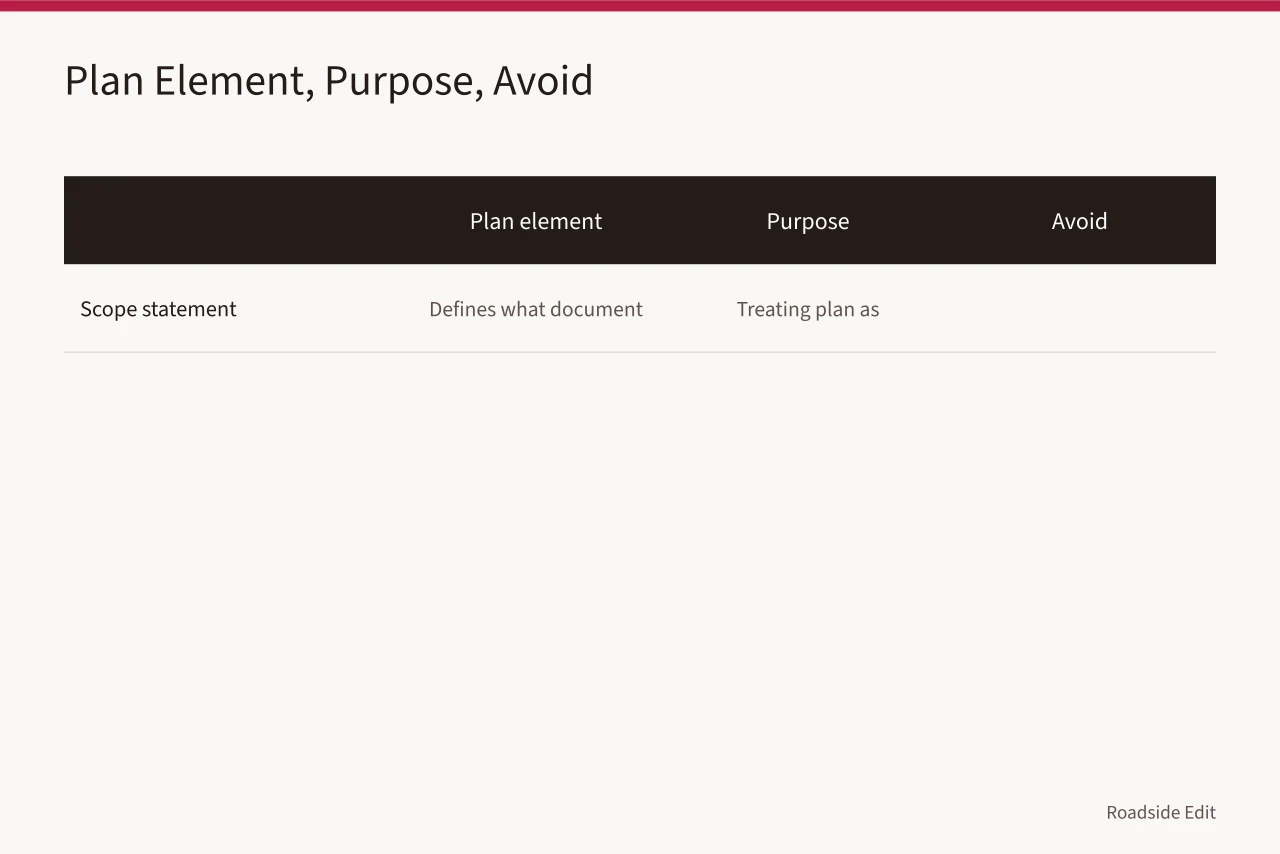
Begin with a one-paragraph scope statement that names the property, the part covered, the intended period, and who can update the record.
It should also say what is outside the plan. For example, a record can cover the public-facing sign, exterior finishes, room blocks, walks, and drainage observations. It need not claim to cover structural engineering, hazardous materials, permits, or a future renovation contract.
The National Park Service describes preservation maintenance plans as tools that prioritize vulnerable and character-defining elements, with schedules, baseline documentation, procedures, and records among their typical components. Read the NPS description of preservation maintenance plans. That description supports a record-based approach. It does not supply a maintenance schedule for a particular motel.
| Plan element | Purpose | Avoid |
|---|---|---|
| Scope statement | Defines what the document covers | Treating the plan as a whole-property diagnosis |
| Baseline file | Preserves a starting description | Relying on memory or undated images |
| Observation log | Records what changed and when | Calling an observation a cause without support |
| Priority register | Explains why an item needs attention | Ranking only by what looks most urgent |
| Decision record | Shows who decided what and why | Rewriting a proposal as completed work |
| Update log | Preserves corrections and later evidence | Silently replacing earlier entries |
Build a usable baseline file
A plan begins with a picture of the present, not a guess about the past. Collect the materials already available: listing documentation, dated photographs, drawings if they exist, prior invoices, correspondence, old inspection notes, and records of previous work. Give each item a simple identifier. A filename such as "west-elevation-2030-03-01-01" is more useful than "outside photo new."
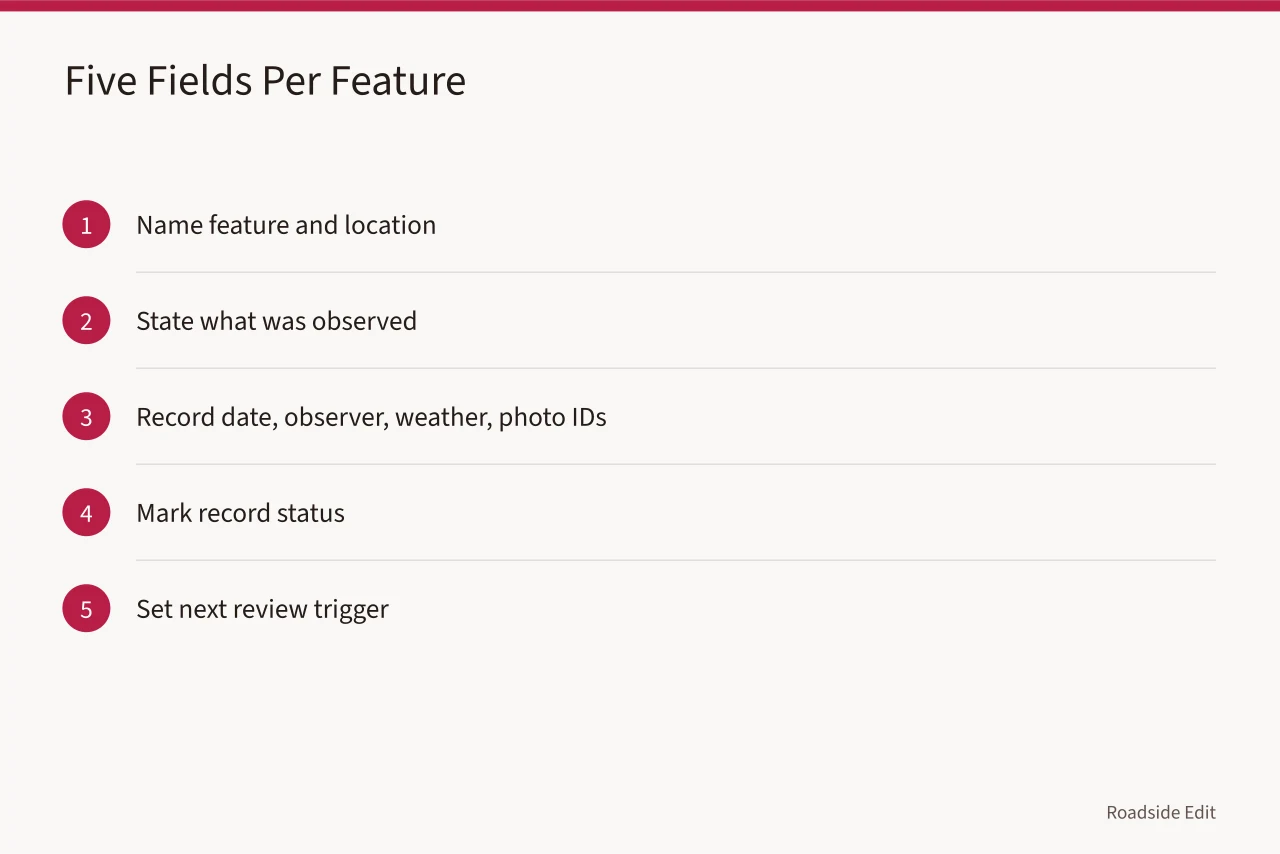
Then describe what each record actually shows. A photograph may show surface staining on a wall at one moment. It does not, by itself, establish moisture movement, material failure, or the reason a previous alteration was made. Preserve that distinction in the caption or log entry. It protects the plan from growing more certain each time it is copied.
Use a consistent location system. A small property may need only building name, elevation, room range, and feature. A larger roadside complex may need a map, a photo key, and a numbering convention.
Choose words a future manager can understand without having worked the site. "North office parapet, east end, viewed from parking area" beats a private shorthand.
Turn observations into a calendar
A calendar is helpful only when it points back to a defined observation. Do not begin with a copied list of monthly tasks. Begin with the features that need periodic attention and the information that makes the interval sensible for this property.
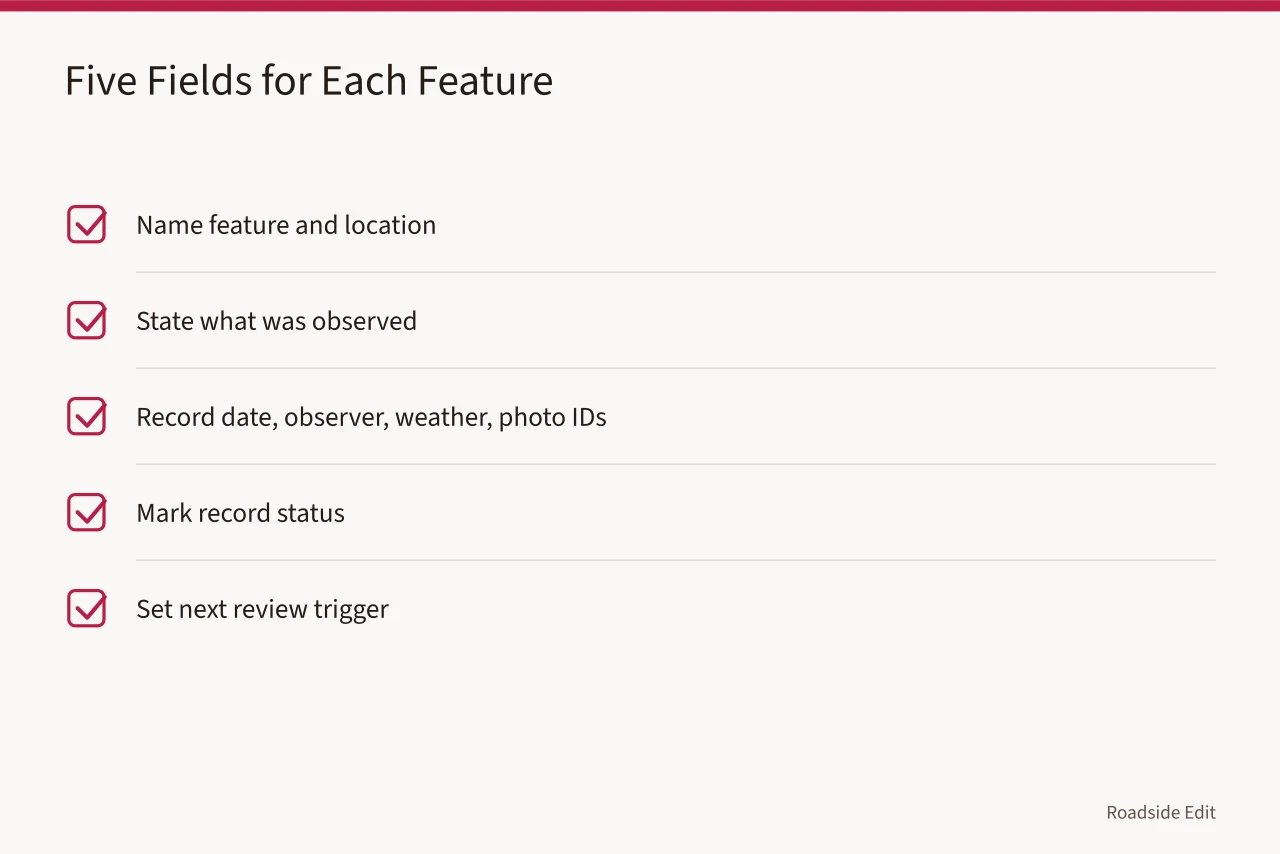
For each feature, use a record with five fields:
- Name the feature and location.
- State what was observed, using plain visible language.
- Record the date, observer, weather context if relevant, and related photo IDs.
- Mark the record status: observed, needs review, decision pending, work authorized, work documented, or closed.
- Set the next review trigger, such as a season, an event, a tenant report, or a known date.
This approach makes a calendar responsive rather than ceremonial. A sign face might be checked after a severe weather event because the plan identifies that trigger. A walk might be reviewed after winter because the record identifies surface change or water collection. The plan should not pretend that every feature requires the same rhythm.
Use "review" rather than "inspect" when the plan is not a formal technical inspection, and match its language to the worker's role.
A manager may record visible changes and report them, while a qualified specialist may assess a condition and recommend a next step. Both records can share one file, but they should not be mistaken for one another.
Prioritize without hiding the reasoning
Historic motels often have more features than a small team can address at once. A priority register makes the choice visible. It should not imply that a low-ranked item is unimportant. It simply records why a feature was reviewed earlier than another.
Consider four questions for every entry:
- Does the feature contribute to the place's recognizable character?
- Is there a documented change, exposure, or recurring concern?
- Would delay make future review harder or erase useful evidence?
- Is there a defined person who can monitor or advance the next action?
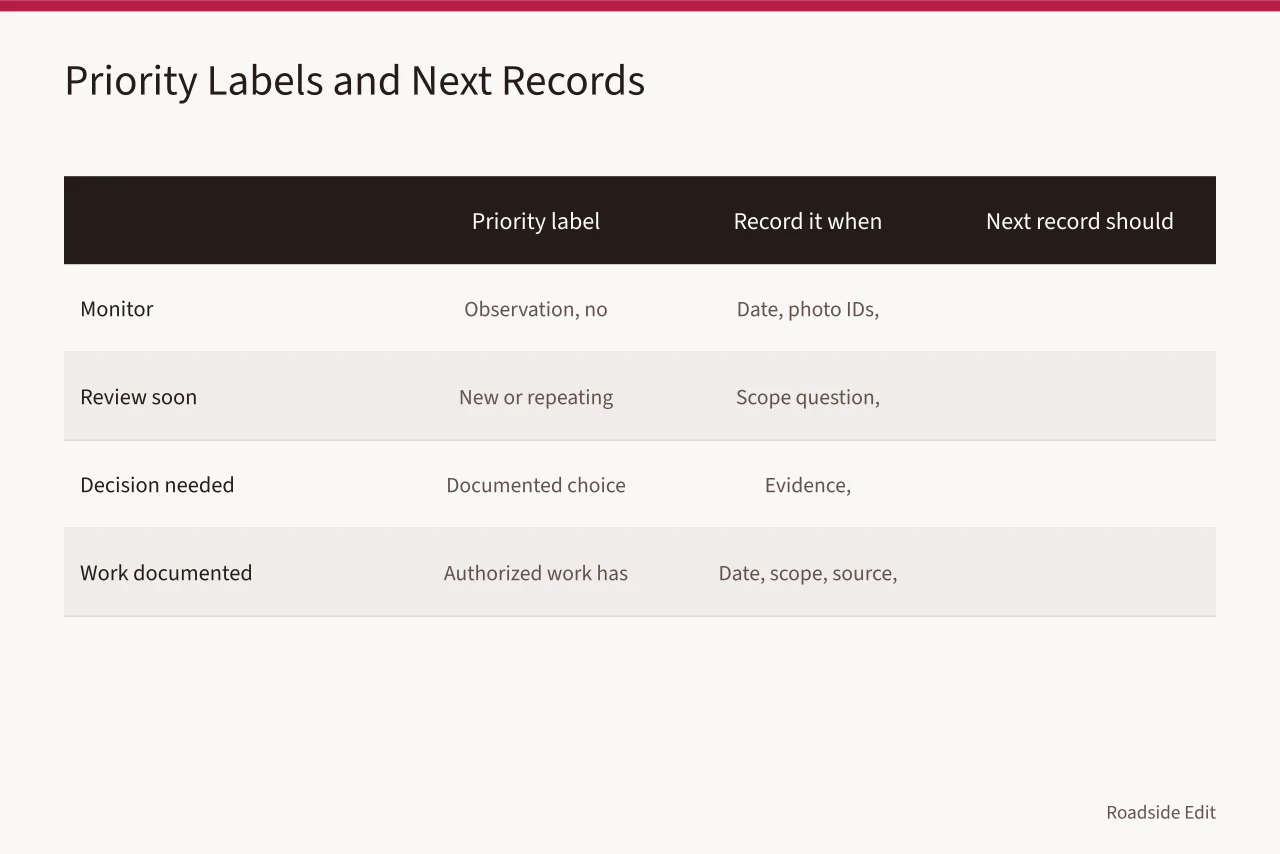
Scorecards can help, but they are not a substitute for explanation. A simple three-level label such as monitor, review soon, or decision needed can be enough when paired with a short narrative. The narrative matters because it tells the next person what the label meant at the time.
| Priority label | Record it when | Next record should include |
|---|---|---|
| Monitor | A feature needs observation but no conclusion | Date, photo IDs, and next trigger |
| Review soon | New or repeating visible change needs assessment | Scope question and responsible role |
| Decision needed | A documented choice is required | Evidence, alternatives, and decision owner |
| Work documented | Authorized work has a record | Date, scope, source, and post-work images |
Avoid words such as "safe," "failing," or "permanent" unless the cited project record supports them and the author has the standing to use them. A maintenance article that overstates a conclusion can become misleading long after its original context is forgotten.
Keep work records separate from plans
Planning, authorization, and completed work are three different stages. A clear file gives each one its own line or field.
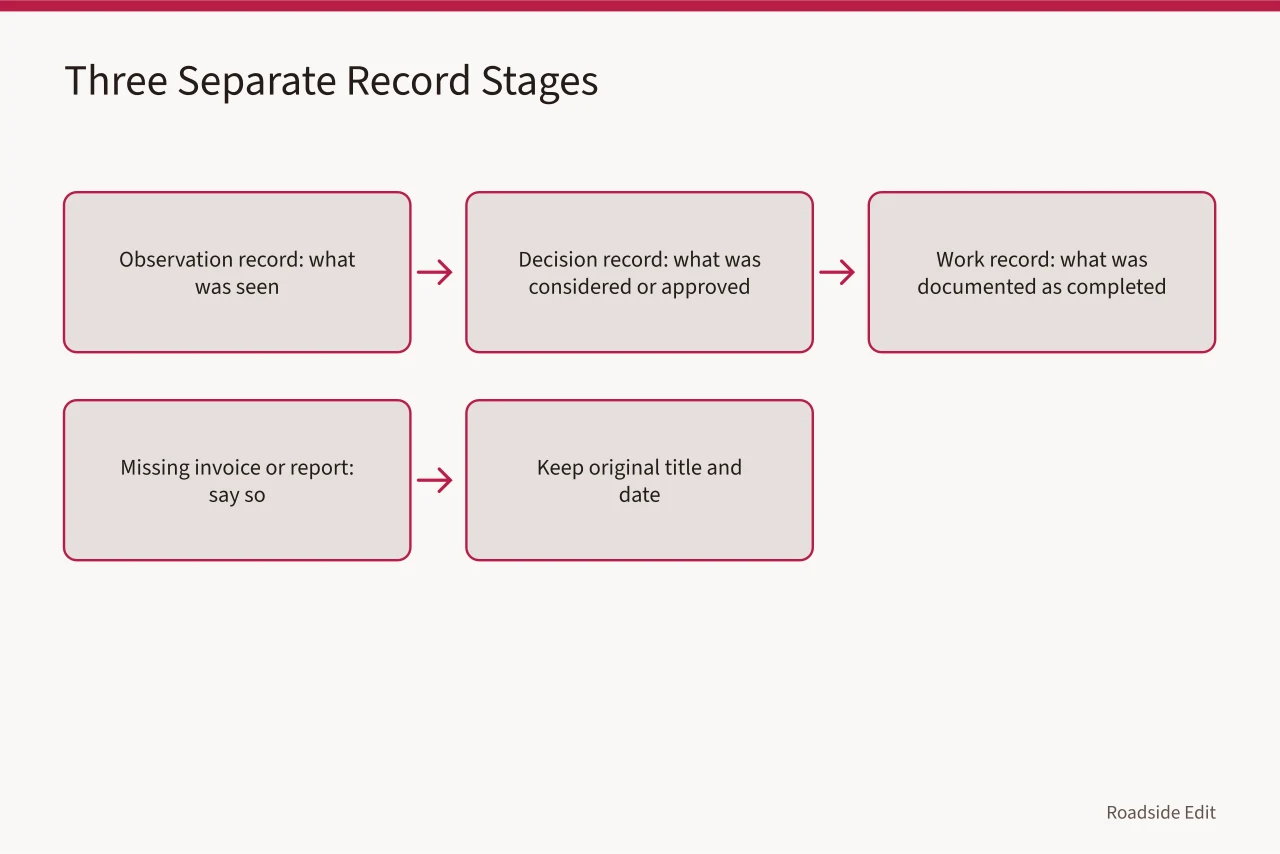
An observation record says what was seen. A decision record says what was considered or approved. A work record says what was documented as completed. If an invoice, report, or owner confirmation is missing, say so. "Work status not confirmed in the available records" is stronger and more useful than filling the gap with a confident sentence.
When a contractor or consultant contributes a document, keep the original title and date. Summarize it in plain language, but do not turn a qualified opinion into a universal rule.
If the plan cites an outside recommendation, name the subject, date, and document location. That lets an editor confirm the summary matches the source before the article is updated or imported elsewhere.
Make updates easy to audit
The plan will change. The goal is not to prevent change; it is to make change traceable. Add a short update note whenever a new photograph, report, decision, or correction enters the record.
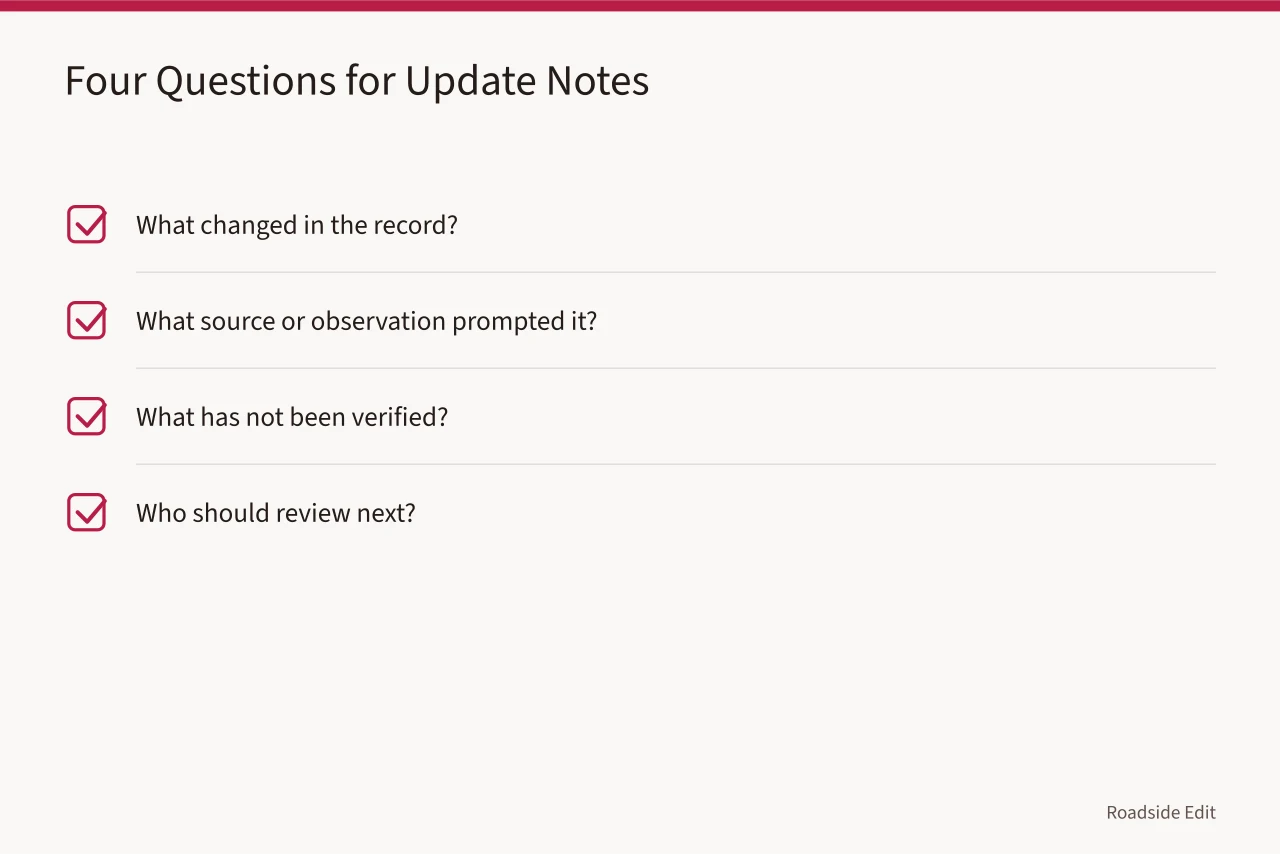
A useful note answers four questions:
- What changed in the record?
- What source or observation prompted the change?
- What has not been verified?
- Who should review the item next, if anyone?
Do not overwrite a previous uncertainty simply because a later entry sounds cleaner. Keep the earlier note, mark it superseded if necessary, and point to the new material. This creates a readable trail for owners, agencies, and potential project partners who need to understand how a conclusion developed.
The same rule applies to online publication: if a source supports a general framework but not a property fact, write the framework as general.
If a photo is only an illustration, credit it as media and do not use it as evidence about the motel. Clean boundaries make a maintenance plan more credible than a crowded page of unsupported detail.
A simple review meeting format
A short recurring meeting can keep the plan alive without turning it into a complicated management system. Bring the current priority register, the new observation log, and any records that need a decision.
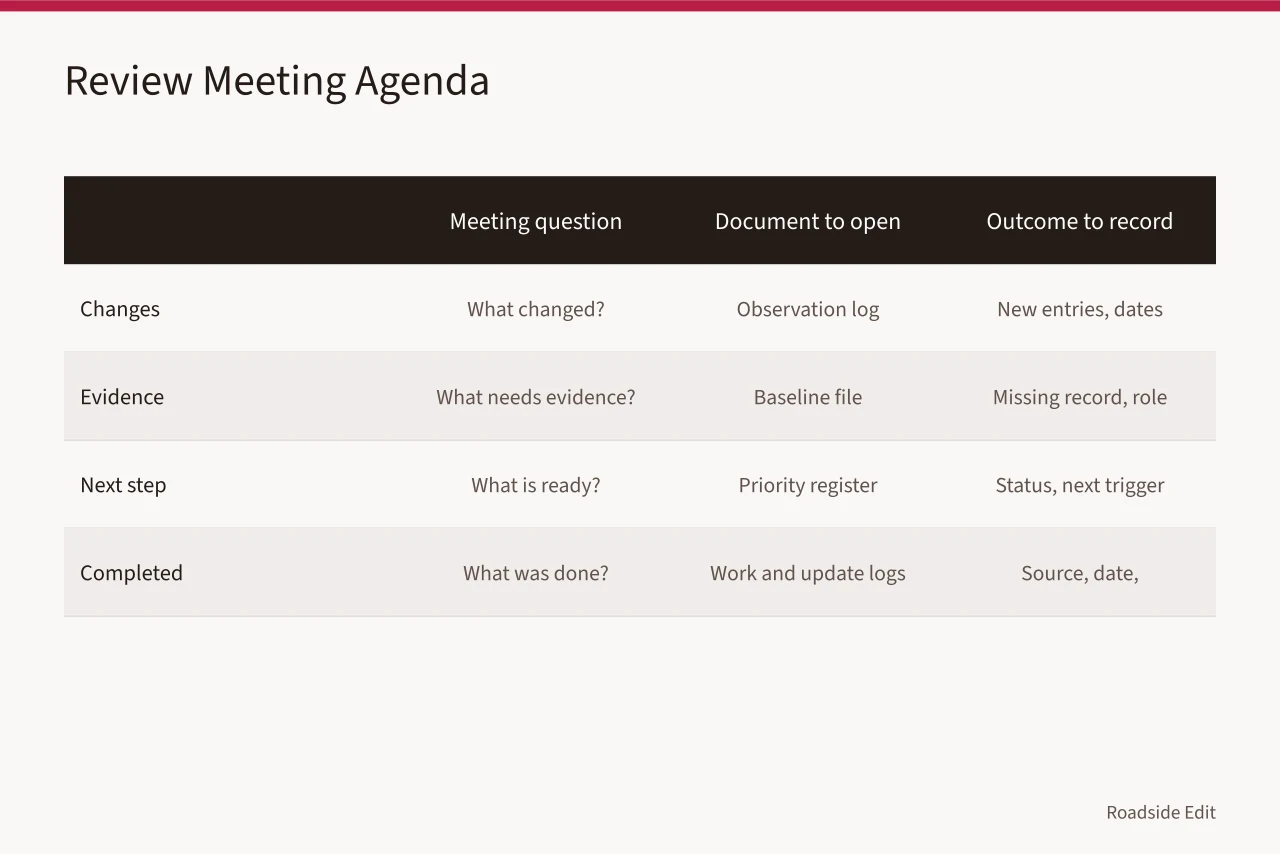
| Meeting question | Document to open | Outcome to record |
|---|---|---|
| What changed since the last review? | Observation log | New entries and dates |
| What needs evidence before a decision? | Baseline file | Missing record or responsible role |
| What is ready for a defined next step? | Priority register | Status and next review trigger |
| What was completed or corrected? | Work and update logs | Source, date, and limitation |
Keep the meeting notes factual. A vague note such as "look into the sign" invites future confusion. A better note is "manager reported peeling paint on south-facing sign panel on March 1; photographs added; condition cause not determined; review needed." It tells the reader what happened without inventing a diagnosis.
Before you publish the plan
An article based on a maintenance plan needs one more pass. Check that every property-specific statement has a source in the file, that image captions do not claim more than the image shows, and that an editorial reader can distinguish advice from a documented fact.
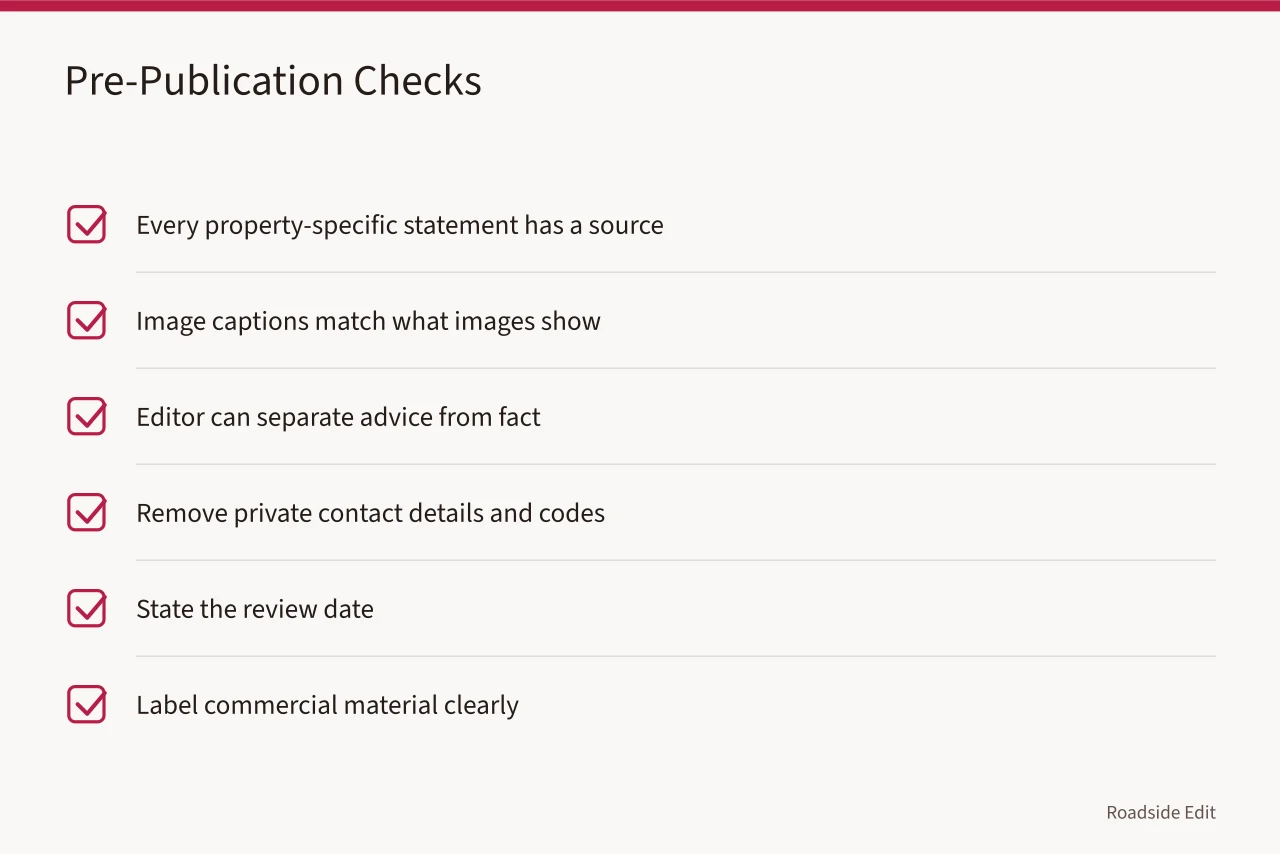
For a public page, remove private contact details, access codes, security details, and unverified complaints. State the date through which the information was reviewed. If the page will later add a recommendation, review, or paid placement, label commercial material clearly and keep it separate from evidence-based maintenance records.
A good maintenance plan is not impressive because it sounds technical. It is useful because a future reader can see what was known, what was observed, and what still needs confirmation.
Use sources without borrowing more authority than they have
The NPS standards for historical documentation ask researchers to identify reliable sources, recognize limitations, and seek verification where appropriate. For a maintenance plan, that means a dated photograph, a historic drawing, and a new report can each remain useful without being treated as interchangeable proof.
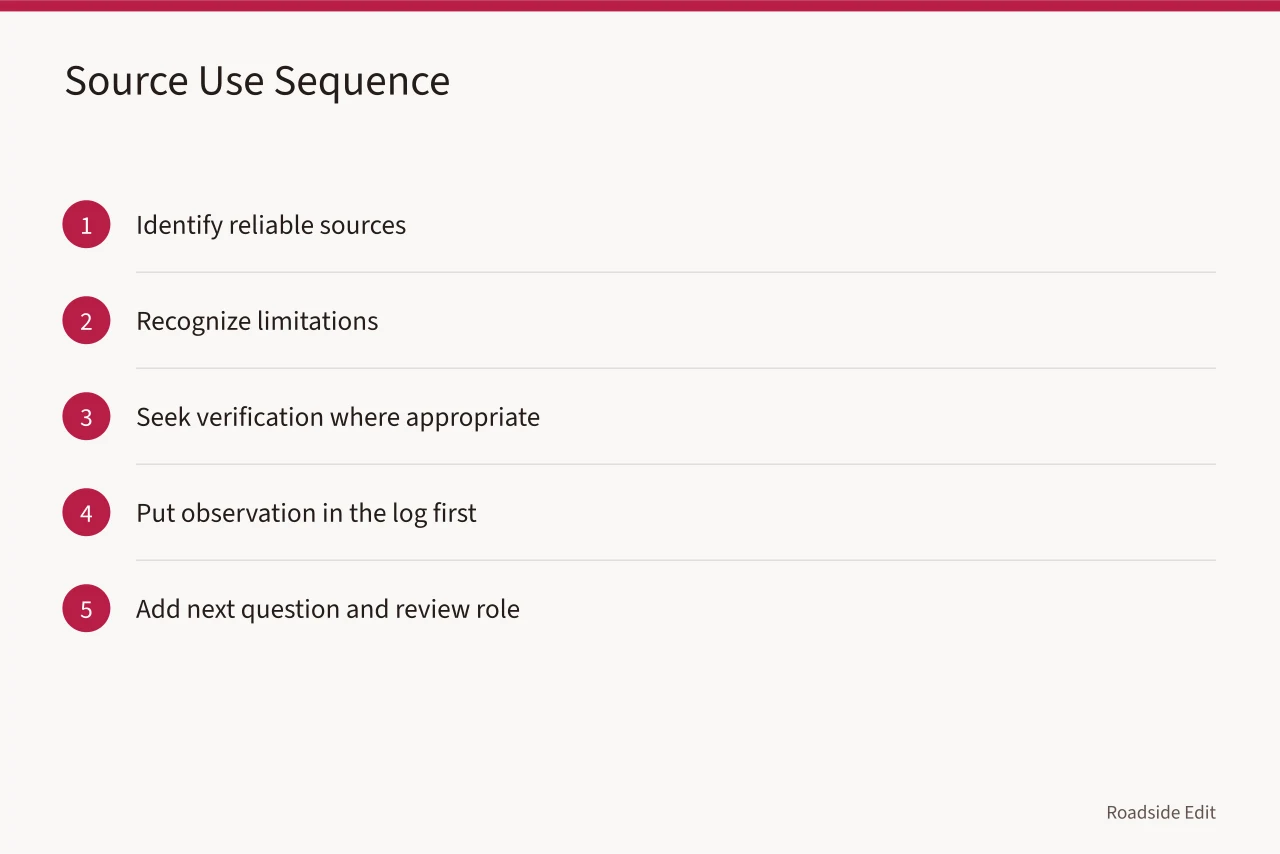
The National Archives guidance on digital photographic records explains the role of unique identifiers and descriptive information in managing photographs. Give every plan image a stable ID, location, date, and a caption that says only what the image can show. A photo credit identifies the image source; it does not support a claim about the motel's condition.
The Library of Congress primary-source analysis guide recommends close observation followed by questions and reflection. That sequence helps a small property team avoid a costly recordkeeping error: writing an explanation before the evidence supports one. Put the observation in the log first. Put the next question and review role beside it.
Common questions
What belongs in a historic motel maintenance plan?
The core record includes scope, baseline documentation, observation logs, priorities, decisions, completed-work records, and dated updates. The exact format should fit the property and the people maintaining it.
Does a maintenance plan tell an owner how to repair a feature?
Not necessarily. This guide organizes evidence and review steps. Property-specific repair methods, diagnoses, permits, and code questions need appropriate qualified review.
How often should the plan be updated?
Update it after a meaningful observation, a documented decision, completed work, a relevant event, or new source material. The record should state why the update was made.