Guides
Part of How a 2027 motel exterior maintenance plan keeps records and repairs on track
How to keep motel exterior maintenance records that hold up all year
Motel exterior maintenance records hold up all year when each observation, decision and correction stays dated, sourced and separate from the work itself.
Maintenance records make a motel exterior legible months later, when the person who saw the condition has moved on. The goal is not a technical report built from a phone photo. It is to preserve what was seen, who owns the next action, and what changed afterward.
This guide gives an owner or authorized manager a file system that survives staff turnover. It does not diagnose a building condition, grant access, or settle a permit question. Record the evidence and route the question to the responsible person.
What to take away
- Keep the original observation and add a dated correction rather than overwriting it.
- Name files
YYYY-MM-DD_area_record-type_sequenceso they sort by date without a legend. - Label every statement Observed, Reported, Proposed, Completed, or Verified, and never let one become another.
- Open a decision card for each unresolved item, with a responsible role and a response deadline.
- Build the handoff packet before the manager leaves, not after the files have scattered.
Build one record set for each exterior area
Do not start with a folder called "maintenance." Create a record set for a named area:
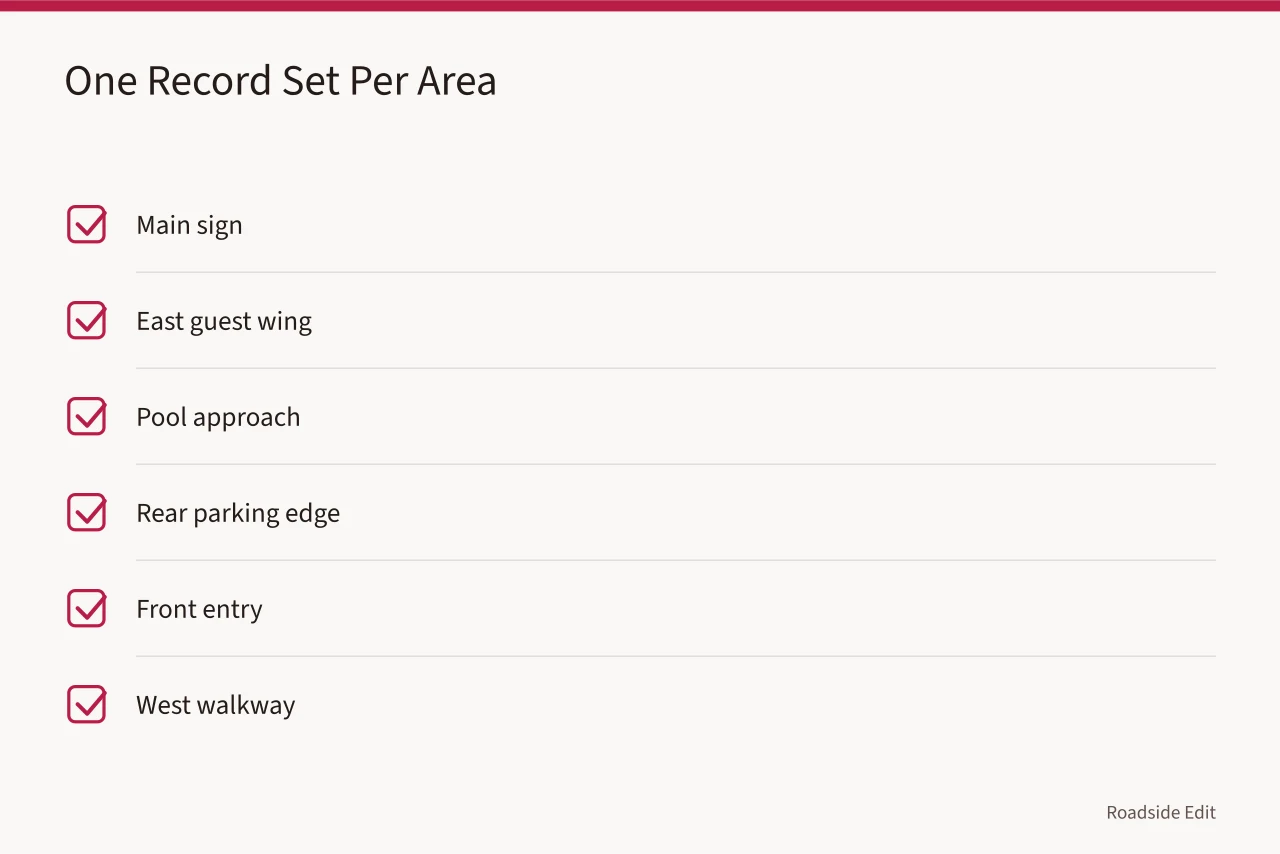
The name should outlast the person who chose it. "North elevation, rooms 120 to 128" beats "outside wall." If a renovation renames an area, add that fact to the record instead of renaming the older files.
The National Archives holds records about the same project, transaction, study or subject together when the relationship supplies context. Read the National Archives recordkeeping requirements.
That policy governs federal agencies, not private motels. The transferable lesson: keep the dated image, the note, the service documentation and the later decision in one place when they describe one exterior area.
| Record group | Minimum contents | Keep separate from it |
|---|---|---|
| Baseline | Date, viewpoint, area, source | Later conclusions about hidden conditions |
| Observation | Visible fact, date, recorder, access limit | An unverified repair recommendation |
| Service report | Provider or owner report, date, scope described | A claim of independent verification |
| Decision | Responsible role, decision date, open question | Sales copy or paid placement material |
| Correction | Original item, new evidence, reason, date | A rewritten past note with no history |
Give every image enough context to survive
An image explains nothing after six months. A useful image record answers what it shows, where the camera stood, when it was taken, who supplied it, and what it cannot establish. Write those answers when the file enters the record.
An accurate note might read: "South entrance canopy, viewed from the accessible sidewalk on April 8, 2027. Visible: peeling paint on the lower left corner. Not established: condition behind the finish." Less dramatic than a diagnosis, and far more defensible.
Keep original files. If a version is cropped for a public article, retain the original and label the published copy. Guest images, access codes, invoices carrying personal details, and internal security information stay out of any public folder.
Use a naming system people can read
File names should sort by date and identify the area without leaning on anyone's memory. Avoid special symbols and names like final-final2.jpg. This pattern works:
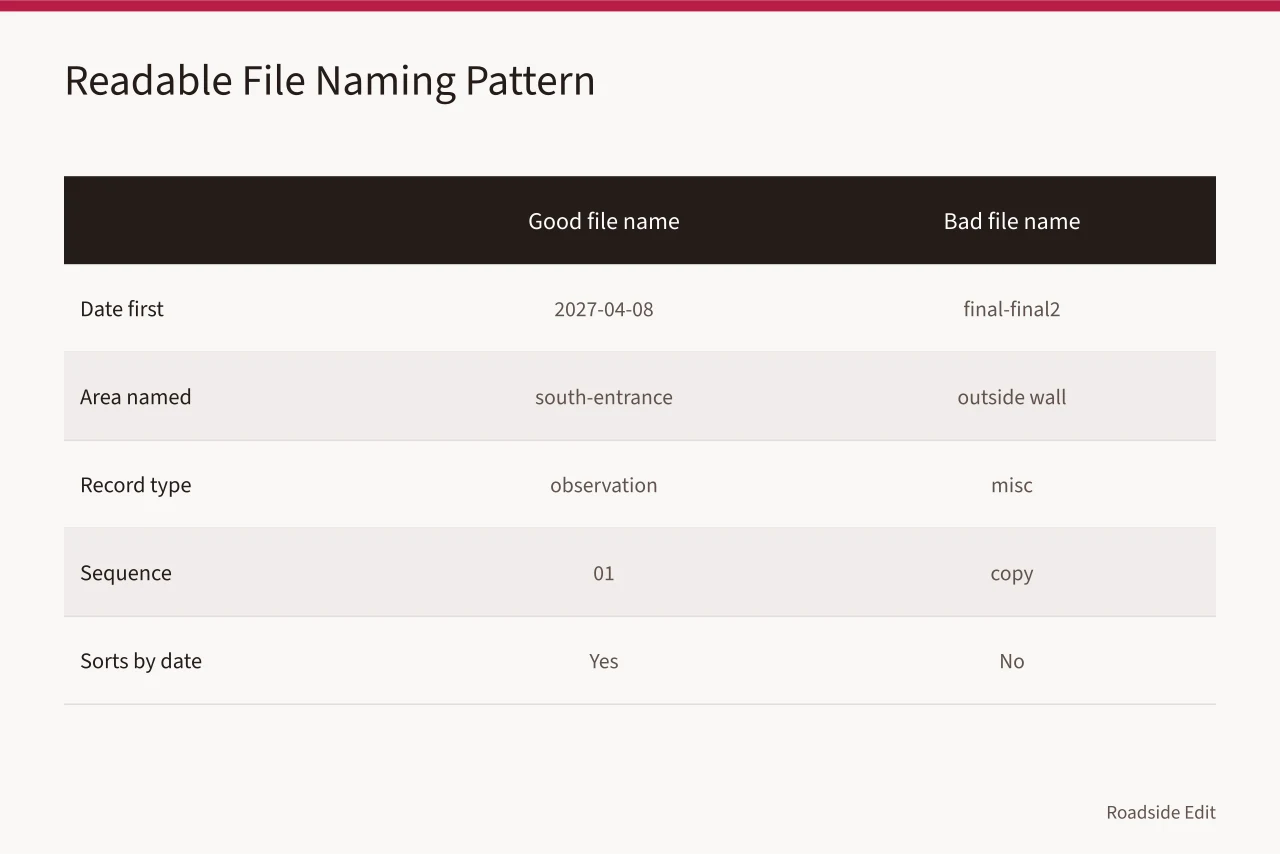
YYYY-MM-DD_area_record-type_sequence
2027-04-08_south-entrance_observation_01.jpg2027-04-08_south-entrance_note_01.md2027-04-18_south-entrance_service-report_01.pdf2027-04-20_south-entrance_decision-log_01.md
The sequence number keeps same-day records in order. It is not a quality grade. Add a short index note listing which files belong to an open item, and decide who may add, edit and view material on any cloud platform. A file system fails when anyone can quietly overwrite a source record.
Keep four kinds of statements apart
The common records failure is letting one kind of statement become another. A staff note turns into a repair claim. A proposal reads as completed work. Label each entry and leave the label alone.
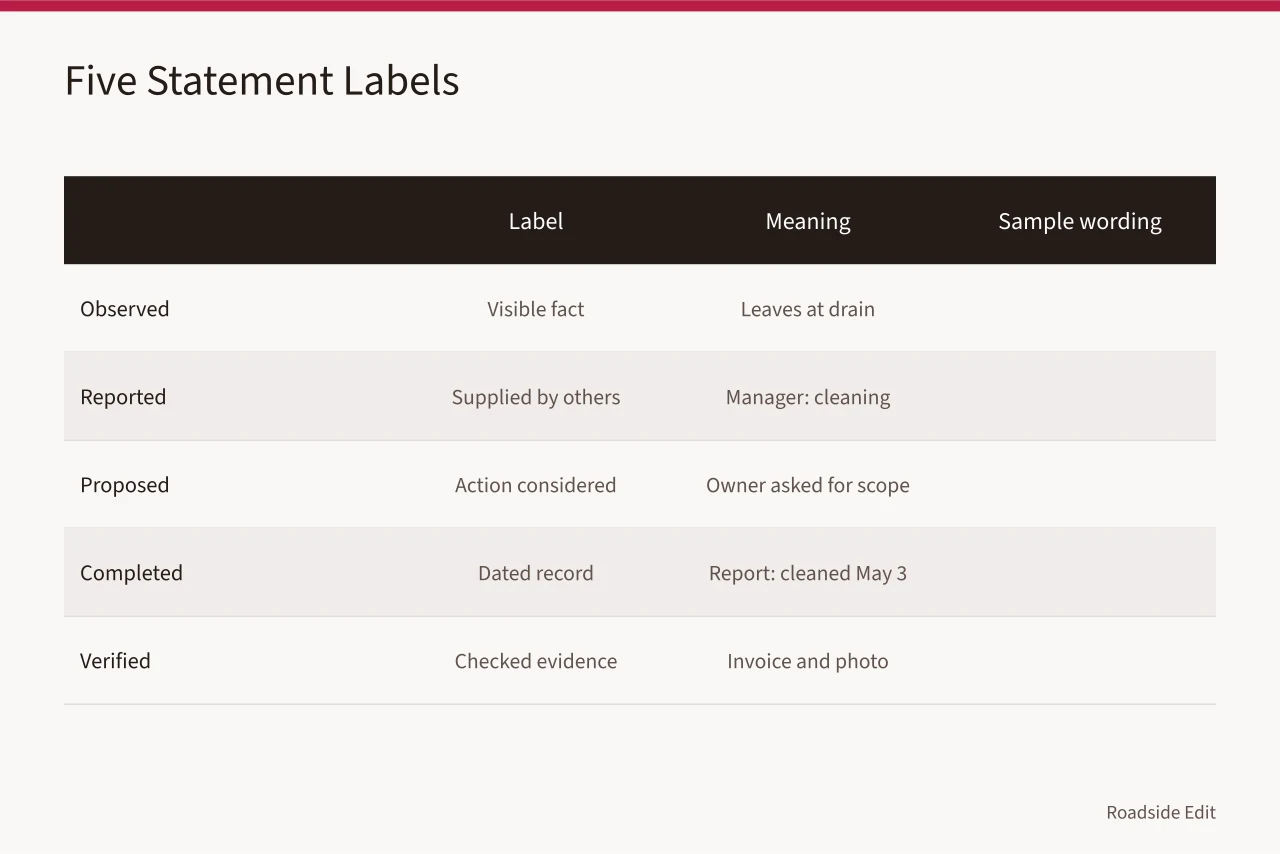
| Label | Meaning | Sample wording |
|---|---|---|
| Observed | Visible or directly documented fact | "Leaves are visible at the drain opening." |
| Reported | Information supplied by someone else | "Manager reported that cleaning was scheduled." |
| Proposed | Action being considered | "Owner asked for a scope of work." |
| Completed | Work reported complete with a dated record | "Provider's report says cleaning was completed May 3." |
| Verified | Fact checked against appropriate evidence | "Invoice date and post-work photo were reviewed." |
The National Park Service's documentation standards and guidelines call for reliable sources and clearly stated limitations, enough for independent verification. They address historic-property documentation rather than routine motel files. The principle carries: separate what an image or report supports from what remains unconfirmed.
Add a decision card for every open item
An observation is not a decision. Open a small decision card when an item needs review. It carries the location, the source files, the question, and the responsible role. It also carries the response deadline and the current state. The card is what stops the file from becoming a pile of images with no next step.
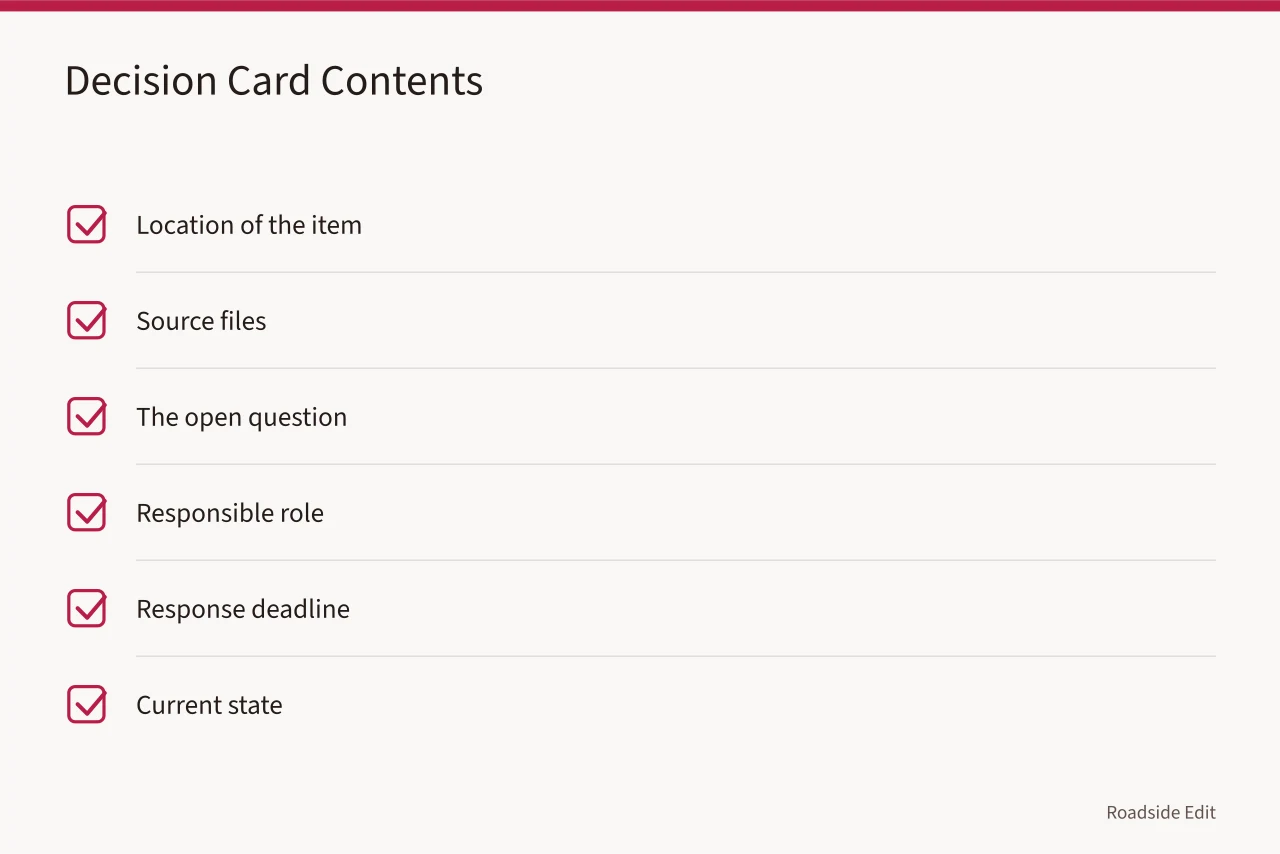
Use roles rather than names where turnover is likely: owner, authorized manager, facilities contact, qualified reviewer, local authority contact. A card can read "awaiting owner direction" without pretending approval happened.
For historic-property agreements, the National Park Service has asked for maintenance plans with inspection procedures, timelines, cyclic schedules and basic maintenance detail. Review the Gettysburg historic-properties maintenance-plan requirement.
That document sets no rule for a private motel. It shows why a care record states the procedure, the timing and the responsible party instead of leaving an undated note.
Correct the record without erasing its history
A better photo may show that an earlier location label was wrong. A provider may send documentation after an entry said the work was only proposed. Write a correction note; do not replace the entry.
- Identify the earlier file or entry.
- State the limited fact that changed.
- Name the new source that supports the correction.
- Add the correction date and the responsible role.
- Keep the original note available with a status label.
The National Archives' information-quality guidelines describe correction procedures that identify the affected information and document the response. Those guidelines bind agency information, not a motel care log. The parallel: a useful correction explains what changed and why, and the earlier version stays findable.
Prepare the handoff packet before a change in staff
A handoff packet is a compact copy of the active record, not every historical file. Build it when an owner, manager or maintenance contact changes. Include the following:
- the area index
- the last baseline images
- open decision cards
- the latest service reports
- the review calendar
- a list of access limits or missing information
Strip what the recipient does not need. A vendor quote may serve an owner and not an editor. A public article can describe a recordkeeping method without exposing private property records. Commercial material stays disclosed and outside the evidence file.
Run a short monthly records review
Once a month, look for unnamed images, notes with no area, open cards with no owner, and completed tasks with no closeout record. Mark a file "not reviewed" when that is the truth. Better than assuming an old item is closed.
The review is also the moment to ask whether records are being made from safe, authorized viewpoints. A file note grants no access.
Where a question touches electrical equipment, roof access, structural performance or a possible hazard, stop routine recordkeeping and contact the responsible party or a qualified professional.
Electrical work, roof access and hazardous materials go to a licensed electrician, engineer or the authority having jurisdiction. Any easement, tax-credit or import question goes to an attorney, accountant or customs broker.
Common questions
How long should motel exterior records be retained?
Follow the owner's policy and any requirement that applies to the property. Retain a record long enough to support comparison, correction and handoff. No universal retention period applies without a rule that names the property.
Can a vendor report be treated as verified fact?
Treat it as a provider report until the responsible party checks it against suitable evidence. The file should name the source and avoid implying verification that did not occur.
What is the fastest useful closeout note?
Record the location, date, work reported, source document, responsible role. Also record any open question. Add a new image only if it helps compare the area and was taken from a safe, authorized location.