Guides
Part of How a roadside architecture maintenance plan keeps observation separate from repair work
How to keep roadside architecture maintenance records that stay useful
Roadside architecture maintenance records for 2027 give U.S. editors a durable system for photos, observations, completed work, and source limits.
What to take away
- A usable record keeps the date, evidence, feature name, and limitation together.
- Preserve original photos and identify any cropped or edited publication version separately.
- Keep observation notes, work records, historical claims, and open questions in different places.
- Remove private contacts, security details, and access instructions before publishing a record.
Build four small record types
You do not need a formal historic structure report to keep better information about a roadside place. A simple system works when it is consistent and a later editor can understand it. The aim is not to prove every fact at once. The aim is to prevent a dated question from turning into an unsupported article claim.
| Record | Minimum fields |
|---|
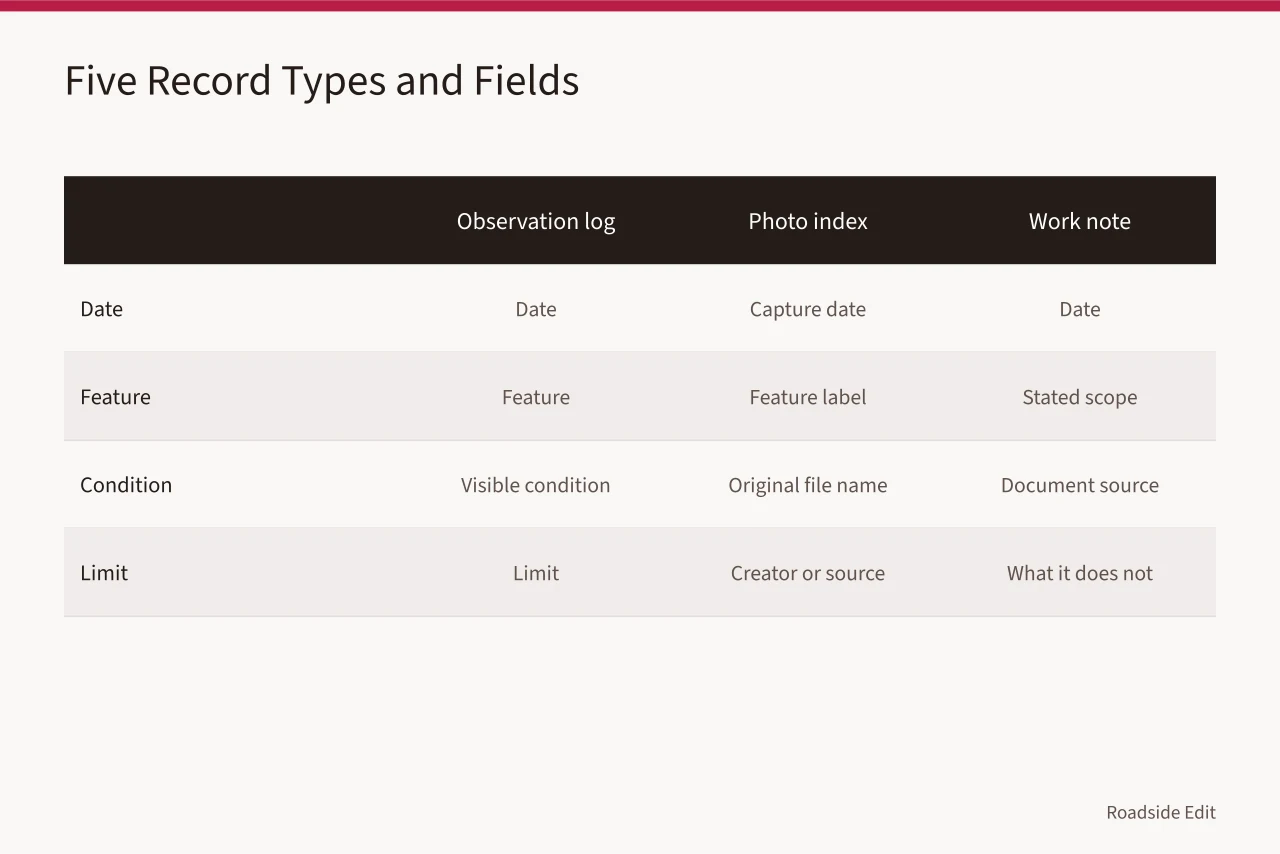
NPS defines field records as notes of measurements, field photographs, and other recorded information intended for documentation. Review NPS architectural documentation guidance. A roadside maintenance file can use the same basic discipline without pretending to meet the full standards for a national archive.
Name and preserve image files
Choose a file name that tells a later reader what it contains without making a conclusion. A pattern such as 2029-02-02_north-sign_public-road_01.jpg is clear because it gives the date, the feature, and the viewpoint. Do not name a file unsafe-building or original-sign unless a suitable source supports that claim.
Keep the camera original. If you crop, brighten, annotate, or resize a copy for publication, add a suffix that identifies it as a derivative. Store the original's file name in the photo index. This modest separation helps a later editor see what was captured and what was prepared for a page.
The Library of Congress describes the HABS, HAER, and HALS collection as including drawings, photographs, written data, and original field notes. See the NPS overview of the documentation collection. A small local file will not have that archive's scale, but it benefits from the same habit of keeping records identifiable and retrievable.
Make work notes specific
A work note should say what a document states. It should not fill in an unstated method, purpose, cost, or outcome. If an owner provides an invoice saying "repainted north sign face," record that wording and date. Do not write that a sign was restored or preserved unless a reliable project source makes that claim.
| Work-note field | Example |
|---|---|
| Document type | Owner-provided invoice |
| Feature | North sign face |
| Stated work | Repainting |
| Date | Date shown on the supplied document |
| Limitation | No claim about electrical work, structure, or rear face |
NPS Preservation Brief 43 says that a post-project record can include annotated drawings, photographs, and other documentation of work performed. Read the NPS historic-structure-report brief. That source supports keeping a record of actual work, not using a casual observation to describe work that has not been documented.
Keep history in a separate source register
Historical claims need their own row. A vintage photo, newspaper entry, archive record, or formal designation may establish a particular date or past use. It may not establish current condition, ownership, or the exact fabric visible today. Write down what the source says, where it appears, when it was checked, and what it leaves unanswered.
NPS historical documentation standards say research follows a design tied to planning needs, and results should be shared while protecting sensitive information when disclosure could damage a property. Read NPS historical documentation standards.
That rule works for public editorial records: share supported context, but do not publish material that exposes a site or private person to harm.
Review the file before publication
Make a short pre-publication check. Confirm that every visible-condition statement points to a dated record. Check that a historic claim names its source. Remove image metadata or captions that disclose a private address when it is not needed. Keep a note of corrections so an outdated caption does not return in a later update.
- Check that the feature label matches the image and log.
- Check that the date refers to the record, not an assumed date of change.
- State any viewpoint or access limit in plain language.
- Separate a reported question from a confirmed fact.
- Remove private material that does not belong in a public article.
The NPS QA checklist includes field reports, material data, correspondence, contract summaries, and a record of treatment among the documentation used in preservation projects. Consult the NPS preservation QA checklist. A published guide should use only the part of that record that is relevant, supported, and safe to share.
Common questions
Do I need professional equipment to keep a maintenance record?
No. A consistent date, clear file name, lawful viewpoint, and short description are more useful than an elaborate system that is not maintained.
Should I edit the original image before filing it?
No. Preserve the original file. Label any crop or adjustment made for publication as a separate version.
Can a work note say that a project preserved a building?
Only if the project record supports that term. Otherwise describe the work exactly as the document states it.