Guides
Neon sign restoration planning: build a project record before you set a scope
Neon sign restoration planning workflow for 2027 helps U.S. owners organize evidence, define decisions, set safe boundaries, and prepare a clear project record.
A planning workflow for a historic neon sign is a way to organize evidence and decisions before anyone describes a result, promises a treatment, or funds a project. It is not a do-it-yourself repair sequence. A good record makes clear what is visible, what is documented, what is unknown, who can make a decision, and which questions need qualified review.
What to take away
- Begin with dated evidence, not a preferred outcome.
- Keep observations, historical claims, and decisions in separate fields.
- Define the project boundary before discussing a provider, budget, or schedule.
- Name the person or organization that can approve each next step.
- Treat safety, electrical work, access, permits, and local rules as site-specific matters.
Start with a practical project record
The first planning deliverable should fit on a page or two. It is a starting record, not a nomination, condition report, or technical scope. Its purpose is to prevent a team from treating an attractive photograph, a business memory, or a supplier estimate as if it settled every historical and practical question.
The National Park Service's overview of how Route 66 communities preserve signs points readers to preservation resources developed by communities and specialists. That is useful context for a planning workflow: a historic sign can have more than one value, and a local source or preservation office may know material that a general web search misses.
Use a dated record with these fields.
| Field | What to capture | What it does not prove |
|---|---|---|
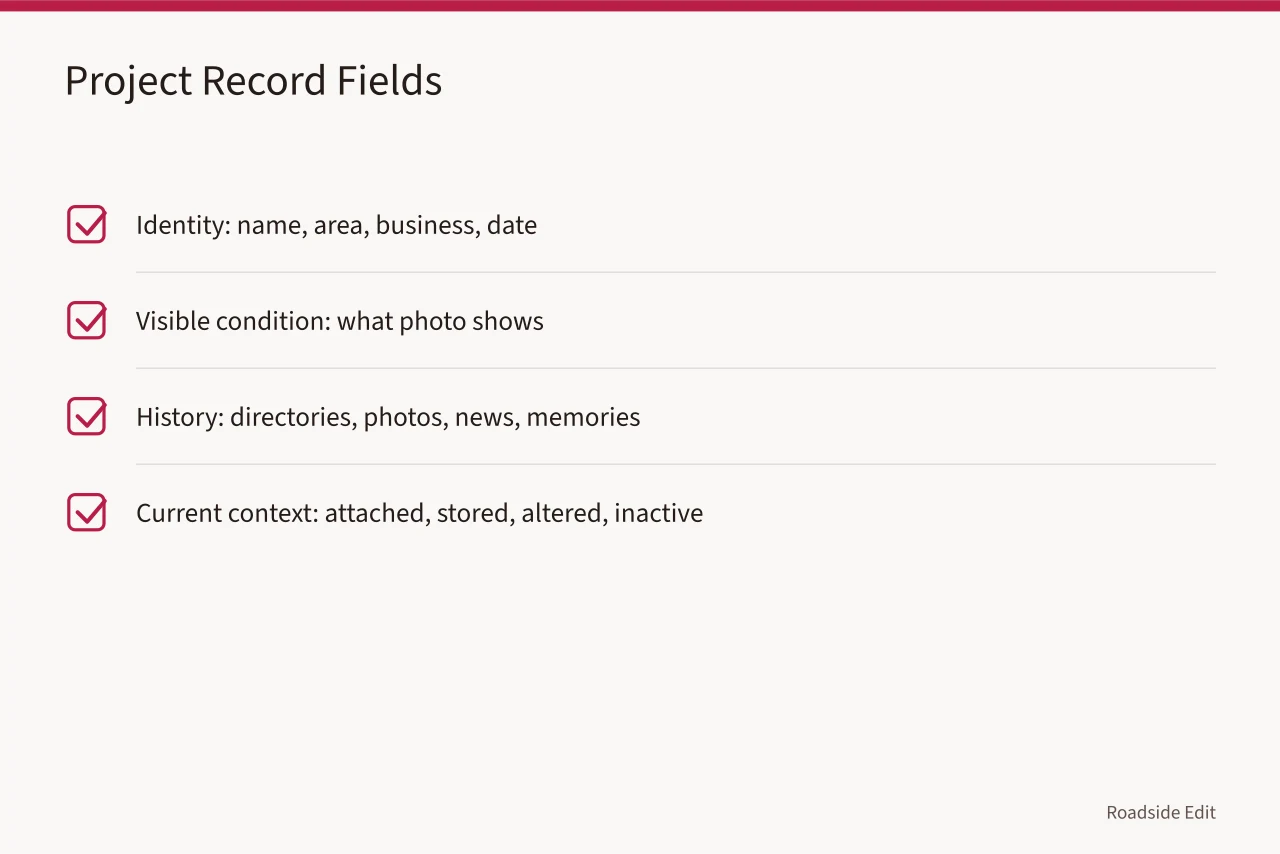
| Identity | Sign name, address or general area, business association, date of record | Ownership, landmark status, or original date |
| Visible condition | What a photograph or site observer can see at that time | Cause of a condition or safe response |
| History | Attributed directories, photographs, news coverage, public records, and memories | A complete chronology or original appearance |
| Current context | Whether the sign is attached, stored, altered, inactive, or associated with a business | Permission to enter, change, or remove it |
| Open questions | Questions about authority, materials, history, access, funding, and professional review | An implied answer |
The language matters. Write "a 2026 photo shows" rather than "the sign has failed." Write "the owner reports" rather than "the original color was." This is not timid wording. It is a reliable way to preserve the difference between evidence and an inference that might later prove wrong.
Define the planning question before building a scope
Many weak projects begin with a broad instruction: "restore the sign." That phrase hides different tasks: historical research, photography, permissions, conservation planning, and a funding application.
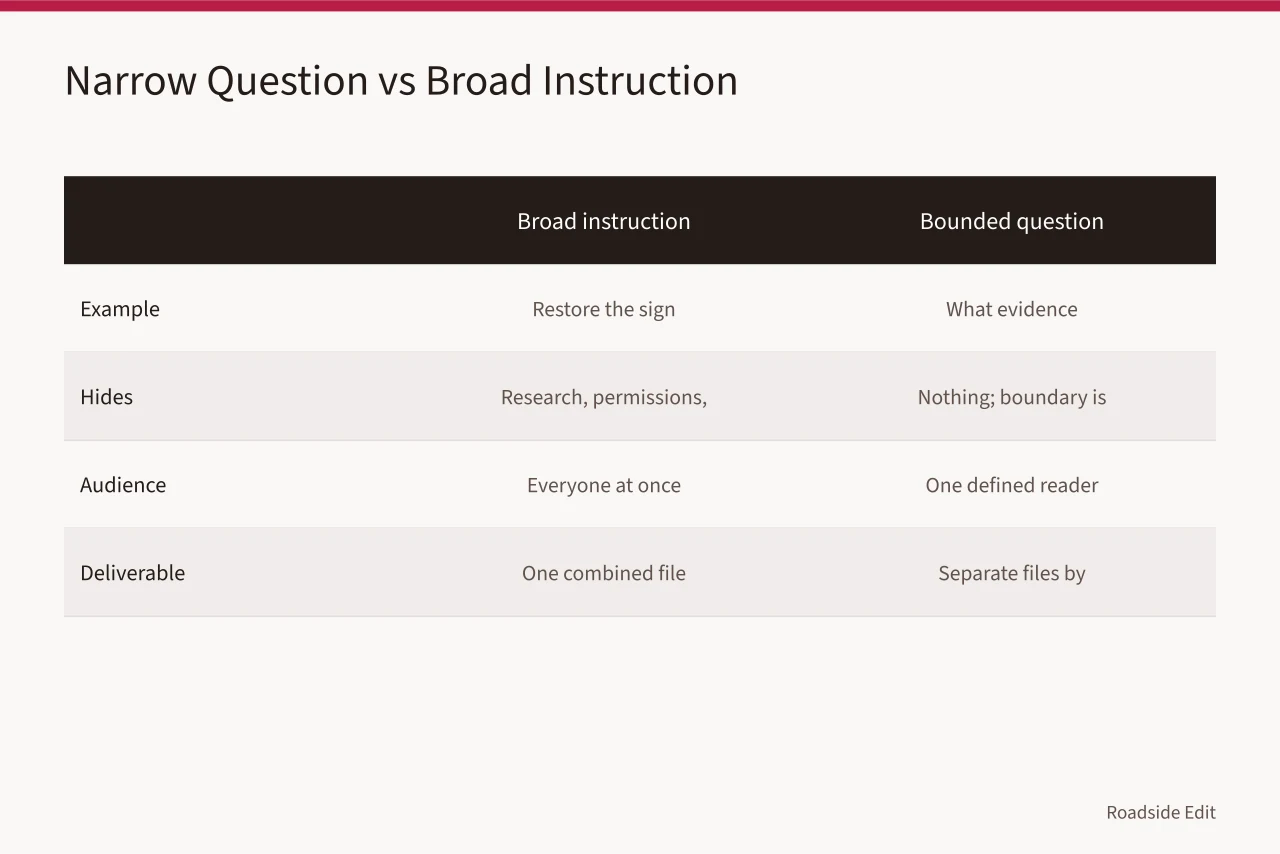
It can also hide a public story, a professional assessment, or work outside a publisher's or owner's authority.
Frame the planning question in a form that has a boundary. Examples include:
- What evidence identifies the sign, its location, and its known business history?
- What information would an owner need before choosing a qualified professional?
- Which changes are being considered, and which questions must remain open until review?
- What public-facing description can be published without overstating the record?
- Which documents, photos, decisions, and disclosures need to stay together?
Do not combine every question into one deliverable. A history article, a funding file, and a technical assessment have different audiences and standards. A narrower question makes it easier to tell readers what the work covers and what it deliberately does not cover.
Separate roles from endorsements
An article, preservation group, owner, donor, photographer, engineer, electrician, sign specialist, local official, and funder can all contribute something different. The planning record should say what each person supplied, not assign unearned authority.
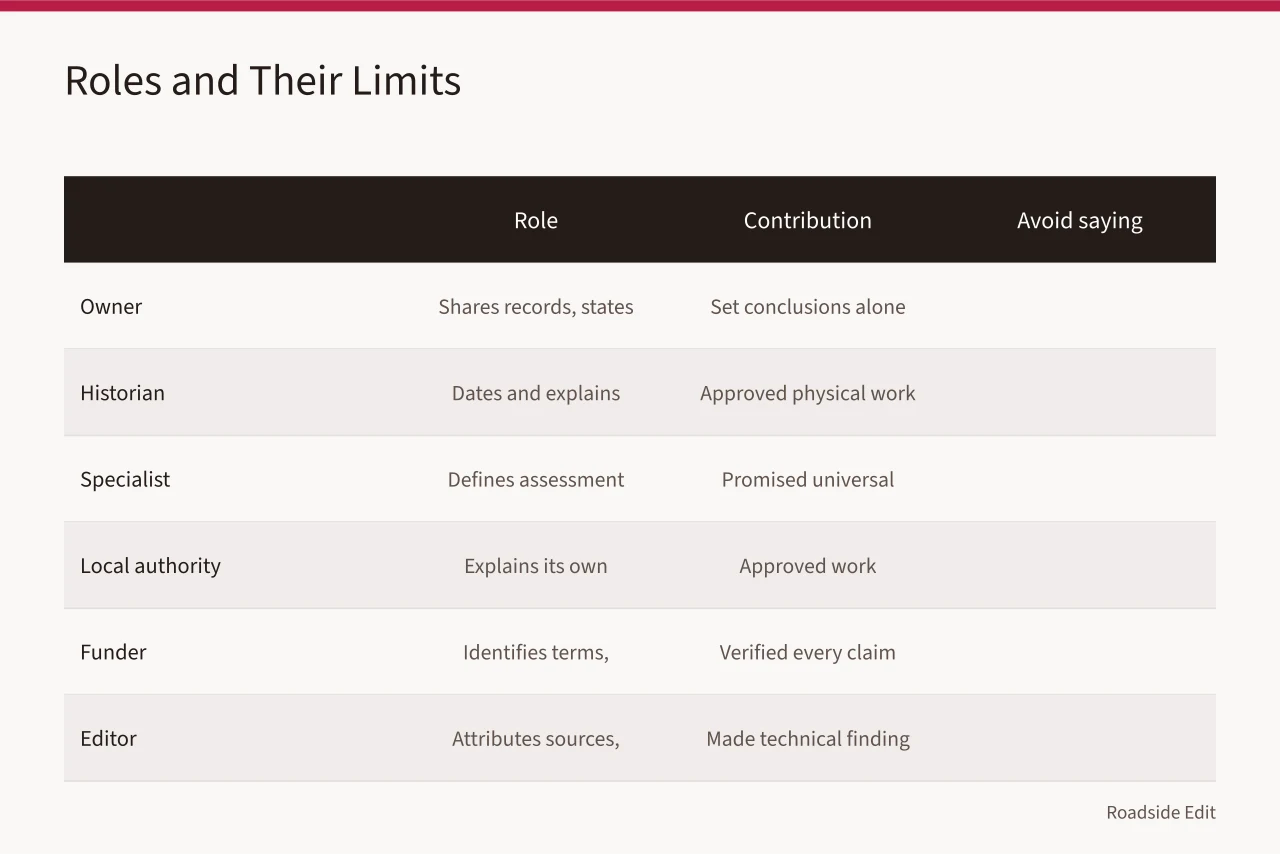
| Role | Appropriate contribution to record | Avoid saying |
|---|---|---|
| Owner or manager | Shares records, states decisions, identifies access limits | Has established historical or technical conclusions alone |
| Historian or archivist | Locates, dates, and explains documentary sources | Has approved physical work |
| Qualified specialist | Defines the limits of a professional assessment | Has promised a universal result |
| Local authority | Explains its own process or requirement | Has approved work before a formal decision |
| Funder or sponsor | Identifies funding terms and disclosure needs | Has independently verified every claim |
| Editor or publisher | Attributes sources and labels uncertainty | Has made a technical or legal finding |
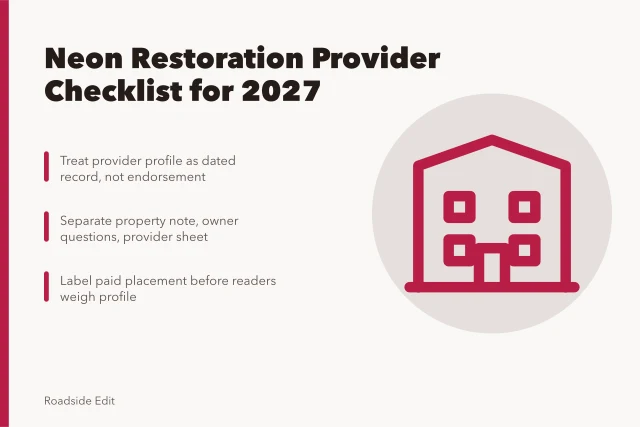
This distinction also protects the integrity of paid placements. If a business, sponsor, or service provider appears in a story, identify the relationship plainly. A paid profile can explain its own services. It should not be allowed to turn a historical uncertainty into a marketing claim or make a safety promise that the record cannot support.
Build an evidence packet that can be reviewed
An evidence packet is a small, orderly collection, not a folder filled with repeated images. Include the source, date, creator when known, a brief note about what it shows, and any limit on its use. Keep a list of which version is current. If an image has been cropped, enhanced, recolored, or used only as an illustration, say so.
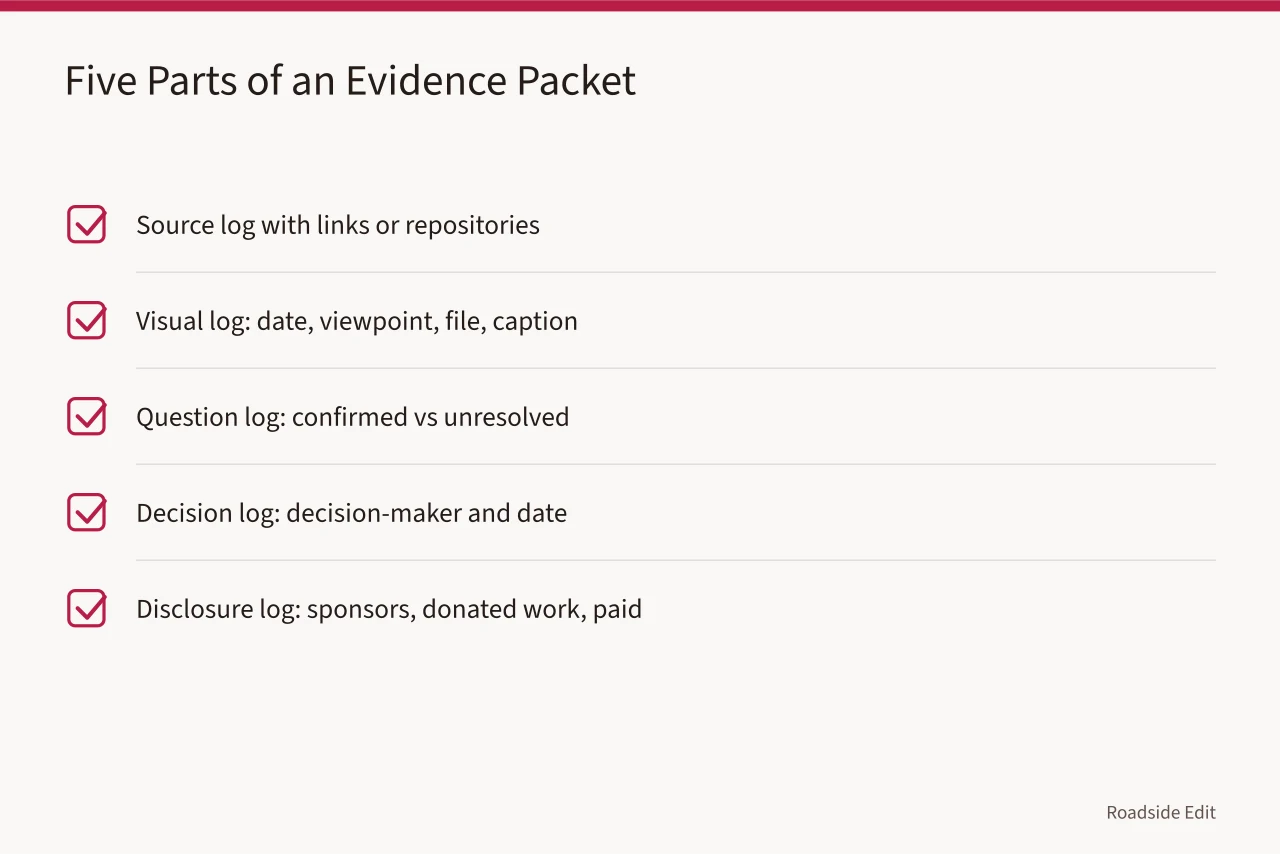
A useful packet normally has five parts:
- A source log with links or repository references.
- A visual log with date, viewpoint, file name, and caption.
- A question log that separates confirmed items from unresolved items.
- A decision log naming the decision-maker and date.
- A disclosure log for sponsors, providers, donated work, or paid publication.
This structure does not require a museum-grade archive. It gives a reviewer enough context to locate a claim, understand its source, and see what changed between early notes and a later article. A simple naming pattern helps: YYYY-MM-DD_subject_view_or_source_v01. The name should describe a file, not pretend it is proof.
The National Archives digital-photo documentation guidance identifies information such as file formats, metadata, captions, naming conventions, and associated documentation. It does not set a neon-sign project workflow. It supports the limited recordkeeping practice of preserving a photo's source and context alongside the publication version.
Make a sequence that leaves room for review
The safest planning sequence is not the fastest one. It moves from information to decisions without turning a general guide into field direction.
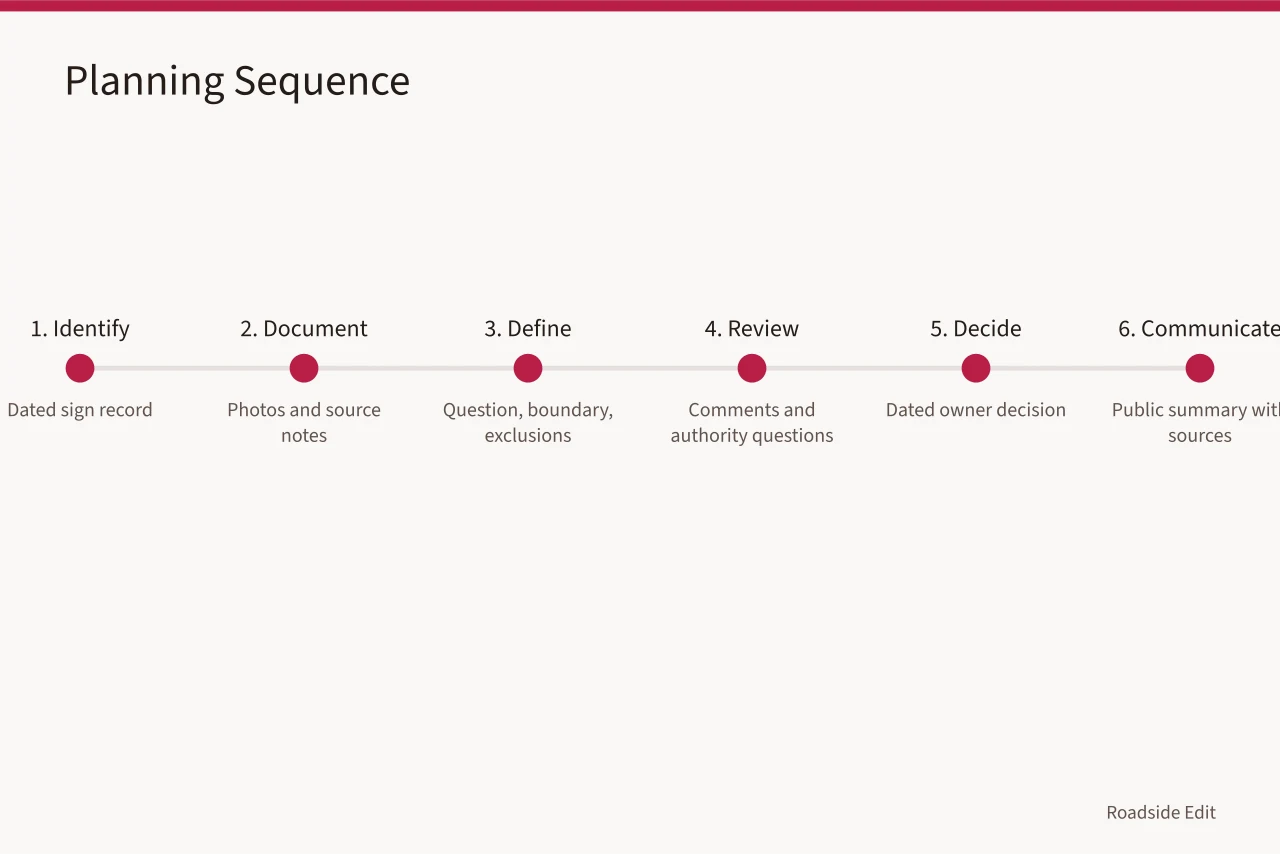
| Phase | Planning result | Decision that can follow |
|---|---|---|
| 1. Identify | A dated sign record and list of known associations | Whether more history is needed |
| 2. Document | Organized photographs and source notes | Whether the record supports a public description |
| 3. Define | A short question, boundary, and exclusions | Which type of professional or review is relevant |
| 4. Review | Comments, authority questions, and documented limits | Whether a proposed scope is ready to evaluate |
| 5. Decide | A dated owner or organization decision | Whether to pursue funding, consultation, or publication |
| 6. Communicate | A public summary with sources and disclosures | What can be said without overstating the record |
There is no universal timeline. A private sign with clear ownership may move through its planning questions quickly. A sign with contested history, shared ownership, public funding, a historic district, or federal involvement may require a different path. The right response is to record the condition, consult the appropriate party, and keep the article's claims within what the sources support.
Use budgets as categories, not promises
At planning stage, budget notes work best when they describe categories instead of pretending to price a future result. Categories can include research, photography and documentation, permissions, professional review, project coordination, communication, grant administration, contingencies, and records management. They may also include site-specific needs that should only be identified by the relevant qualified professional or authority.
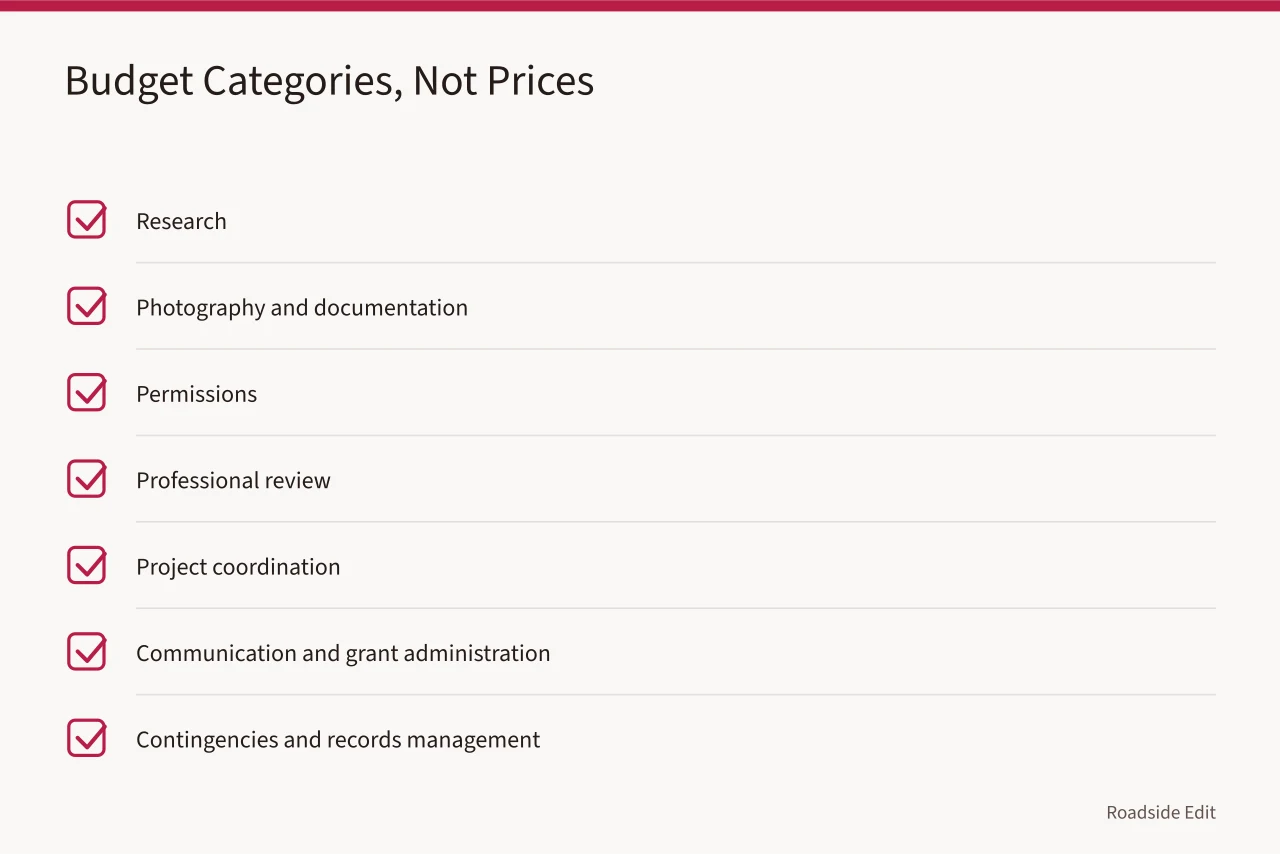
Do not publish a single price as if it fits every sign. Location, access, historical evidence, ownership, local requirements, materials, conditions, and the actual project boundary can change both the work and the cost. A responsible article can help readers ask better questions without presenting a quote as a forecast.
Flag the questions that must leave the editorial workflow
Some concerns cannot be resolved by a planning article. They belong with the person, office, or professional responsible for the actual property and work. These include electrical safety, energized equipment, structural supports, lifting, access to high-mounted signs, local permits, utility coordination, accessibility, public right-of-way requirements, and hazardous conditions.
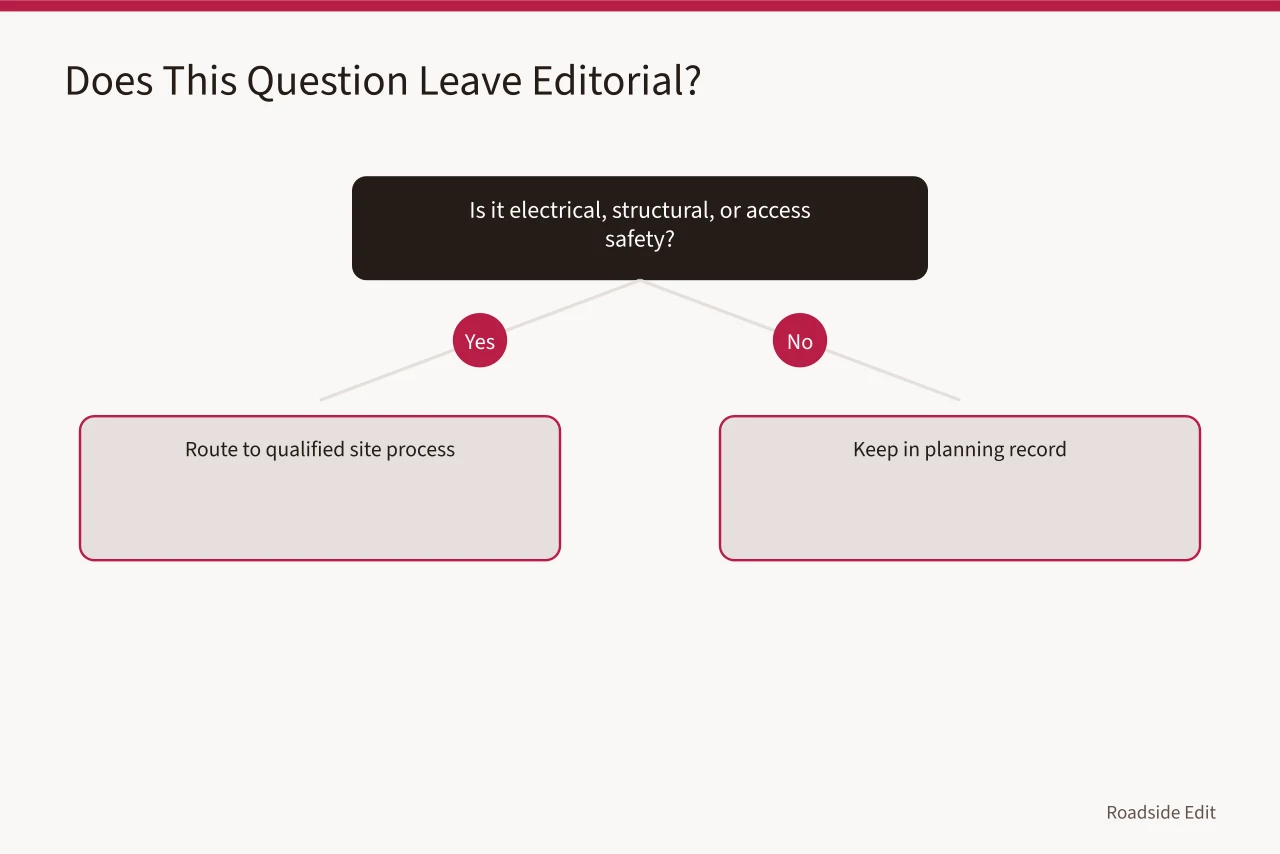
An editorial workflow should not tell readers to inspect, test, disconnect, repair, or energize sign components. It should not tell them to remove or install sign components.
It should identify the question, document why it matters, and direct readers to a qualified site process. The owner gets a record more useful than false certainty for the right conversation.
The OSHA electrical eTool for Subpart S covers electrical-installation topics including qualified-person considerations. It is not a site-specific sign plan. It supports the safety boundary in this article: published planning content should not be used as electrical-work direction.
Publish only what the record can carry
Before publishing, compare every major sentence with the evidence packet. Can the sentence be linked to a source? Is the source being described accurately? Does the sentence confuse a visible condition with a cause, a local process with a universal rule, or a sponsor's statement with an independent finding? If so, revise or remove it.
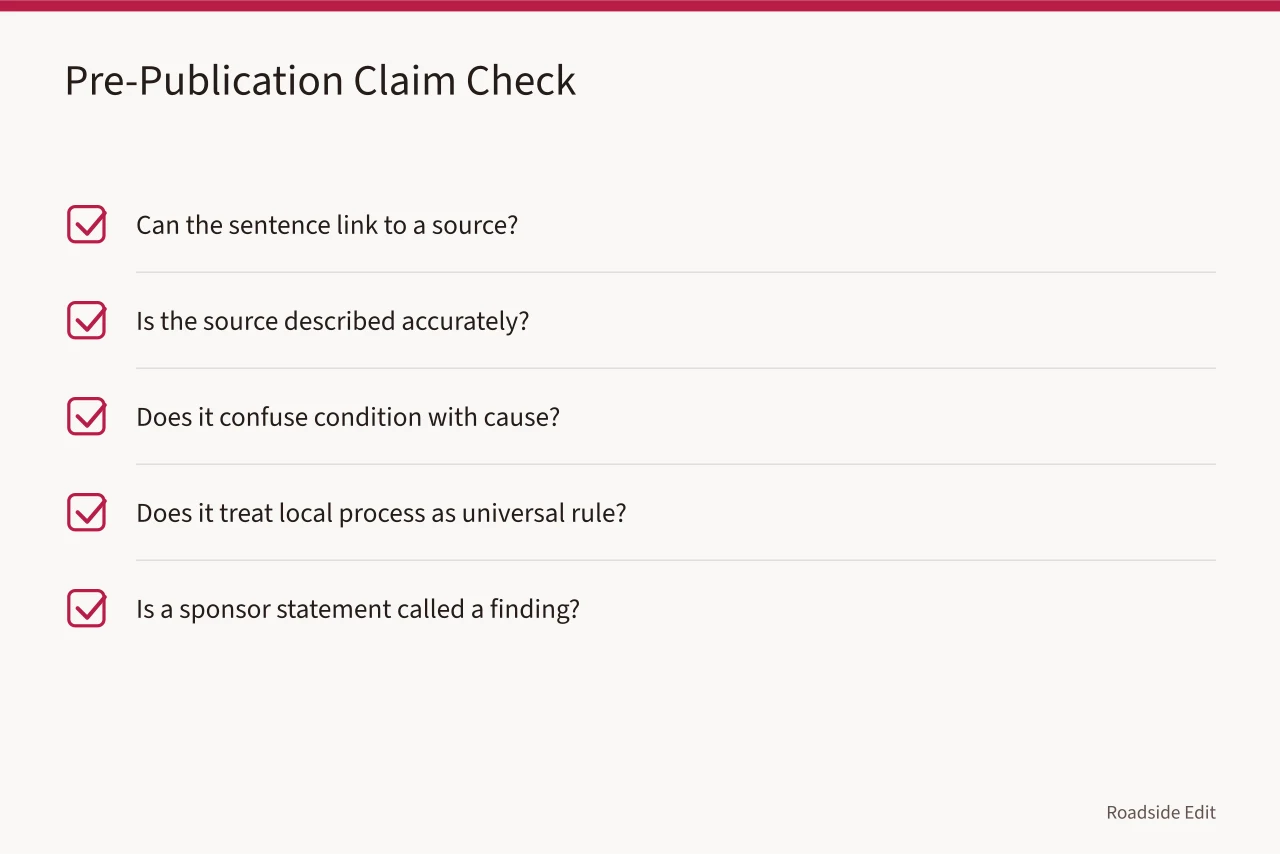
For a listicle or provider profile, use transparent labels such as "submitted information," "sponsor statement," "public record," or "editorial observation." Explain how companies were selected and whether payment affected inclusion. A clear method makes a publication more credible to readers and to businesses considering a placement.
The Federal Trade Commission's endorsement guides address endorsements and testimonials in advertising. They are not historic-preservation guidance. They are relevant when a listicle, profile, or case study includes a paid relationship or testimonial that readers may need to evaluate.
Common questions
Is a planning workflow the same as a restoration plan?
No. A planning workflow organizes evidence, questions, decisions, and roles. A property-specific restoration or technical plan requires the appropriate qualified review and authority for the actual site.
What should be documented first?
Start with a dated record of the sign's identity, visible features, known context, sources, and unanswered questions. Keep observations separate from conclusions.
Can an article recommend a restoration company?
It can publish a clearly disclosed directory or profile with a stated selection method. It should not imply that a paid placement, advertiser, or general article has made a site-specific technical recommendation.
When should a public article be delayed?
Delay it when a key claim cannot be supported, authority is unclear, a sponsor relationship is undisclosed, or the draft would be mistaken for repair, safety, legal, or permit advice.