Guides
Part of Historic motel restoration planning: build the 2027 workflow before treatment talk
Historic motel restoration planning questions to settle before 2027 claims
Planning questions for a historic motel sort what a nomination record identifies from what it does not, so no 2027 claim outruns its evidence.
Five question types carry a motel article: identity, place, time, feature, change. Each one asks what a record identifies, never what should be done to the building.
What to take away
- Ask which property and which feature a source names before you ask anything else.
- Keep identity, place, time, feature and change as separate questions, because one record rarely answers two.
- Write "not established" when the file stops short. It is a result, not a failure.
- Date every entry in the question log so a later record can overturn it.
- Send structural, ownership, accessibility and code questions to the engineer, the owner or the local authority.
The five question types
A 1962 postcard of the Blackhawk Motel in The Pines, Indiana shows a roadside sign and a parking court. It does not show the room wing behind the office, and it does not date the brick veneer under the paint.
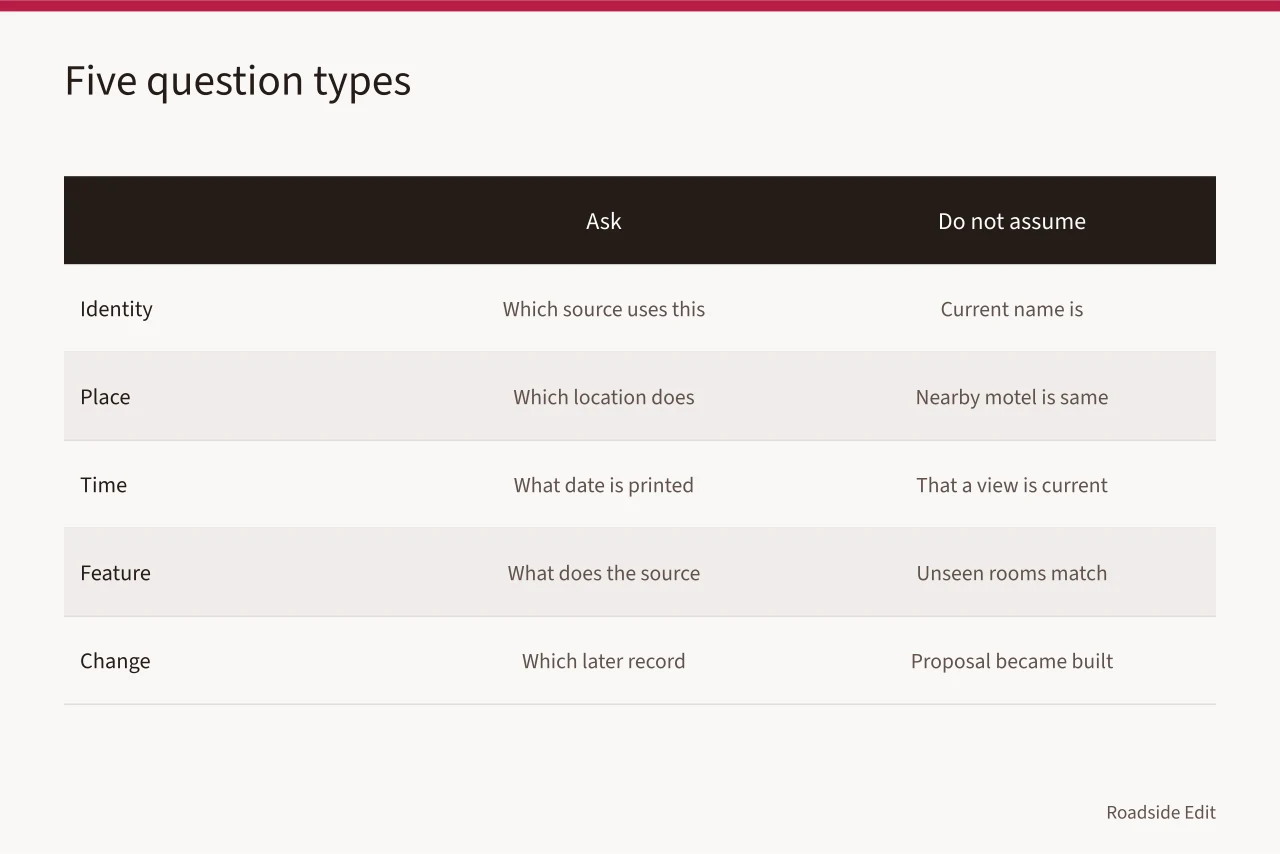
| Type | Ask | Do not assume |
|---|---|---|
| Identity | Which source uses this property name? | That the current name is the historic one |
| Place | Which location does the record identify? | That a nearby motel is the same property |
| Time | What date is printed, postmarked or stamped on the item? | That a view is current |
| Feature | What does the source actually show? | That unseen rooms match the visible wing |
| Change | Which later record modifies the earlier account? | That a proposal became built work |
National Park Service planning guidance groups related properties by theme, geography and chronology, and treats planning documents as records that need updating when information changes. Read the NPS preservation planning guidance. That is the frame for the five types, not a ruling on any one motel.
Keep a question log
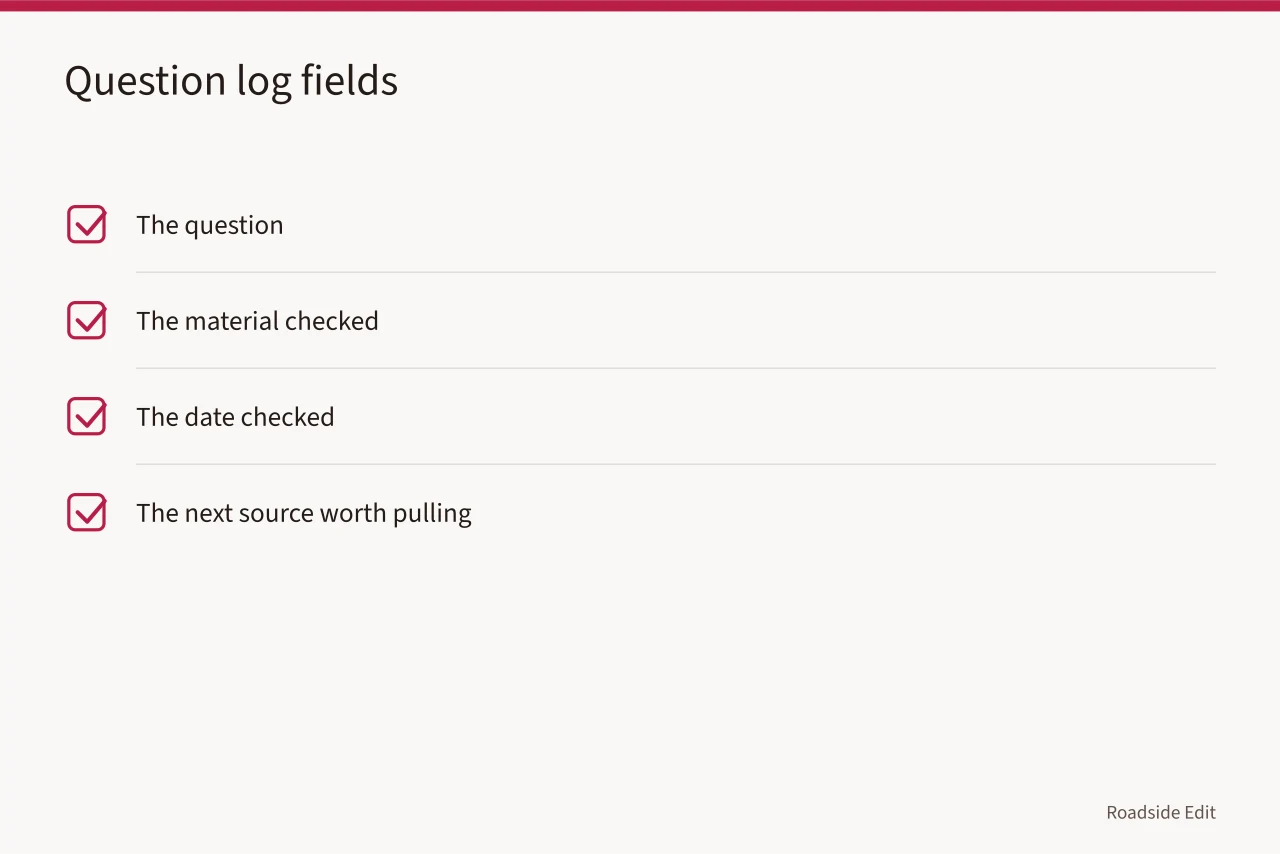
For each open point, write four fields: the question, the material checked, the date checked, and the next source worth pulling. A log entry reads "Sign cabinet: is the porcelain enamel original or a later reface? Checked 1962 postcard and 1978 tax photo, 12 March. Next: state historic preservation office photo survey."
The log turns uncertainty into a research task. It also marks which questions sit outside an article's authority. These include canopy soffit condition, dry-stand pipe inspection, and transformer load. They also include underground tank status, easements, and ownership. Those go to a licensed engineer, electrician, environmental authority or attorney, and to the adopted local ordinance.
Phrase questions so they can come back negative. "What did this source record about the sign?" leaves room for a mixed or partial record. "Why is the sign original?" assumes the point that needs evidence.
Test each question against the record
The NPS documentation standard asks for reliable sources and stated limits, so a second person can check the work. Check the NPS documentation standard. Apply it one question at a time.
If an image carries no date, ask what it shows, not when a change happened. If a city directory lists an address but no building detail, take the address and stop there. A 1950s porcelain-enamel station sign and a 1960s plastic-faced box sign photograph differently under the same light; that difference is a feature question, not a date.
The Library of Congress suggests observing a primary source before reflecting on it. Follow the Library of Congress analysis process. Write down visible wording, material, viewpoint and date clues before drafting any interpretation. The order matters, because a theory formed early changes what the source appears to say.
Decide whether the question belongs in the article
Some questions lead to reporting. Others need a different kind of review.
| If the question asks about | Keep it in the article when | Send it elsewhere when |
|---|---|---|
| A dated name or address | A record identifies it | Records conflict, or the property cannot be identified |
| A visible feature | The image or document shows it clearly | The claim rests on an unseen condition |
| A project decision | Public material states a decision | The answer needs owner, code or professional review |
| A change over time | Dated material supports the comparison | The sequence rests on an undated image |
The NPS Historic Property Project Documentation process links property information to scope and design decisions. Review the NPS documentation overview. An editorial question can flag a missing record. It cannot stand in for a scope or treatment recommendation, and it cannot settle a Section 106 review.
Write the smallest answer the record supports
"The postcard labels the property Blackhawk Motel" and "the building operated under that name in 1962" are different claims. The first is visible on the item. The second needs a reliable date and a link between the name and the property.
When records disagree, show the disagreement. Name which record uses each name or date, describe the gap, and leave the conclusion open if the file cannot close it. A later editor can build on that. A confident sentence has to be reversed, and the reversal is the part readers remember.
Common questions
What is the most useful first question?
Ask which property and which feature the record actually identifies. That boundary controls every statement that follows, including the ones about the sign.
Can an article answer a question with uncertainty?
Yes. Saying the available file does not establish a fact is more accurate than treating an inference as proof, and it tells the next researcher where to look.
Should planning questions be published?
They can be, when the article labels them as questions and keeps them clear of technical findings or instructions. A published question log also invites corrections from people holding better records.
How does this fit a larger restoration plan?
The question log feeds the survey and scope stages tracked in the historic motel restoration planning workflow. Broader corridor and site questions sit in the modern roadside planning questions set.