Guides
Part of Historic motel restoration planning: build the 2027 workflow before treatment talk
Historic motel restoration planning budget notes: how to set a work plan boundary
A work-plan boundary keeps research effort, planning tasks and physical property work apart so no reader mistakes one figure for a restoration cost.
A porcelain-enamel sign panel and a 1960s plastic-faced box sign fail in different ways, and the repair bills land in different columns. The same split governs a budget note. Say which kind of effort a figure describes before you print it.
What to take away
- Label every amount as research effort, planning task, or property work, and never add the three together.
- A work-plan boundary is a written statement of what the note covers and what it hands off.
- Keep a source's own date on the record, not the date you found it.
- When a published figure changes, revise the sentence and keep the original publication date visible.
- Name the licensed engineer, electrician, or environmental authority for anything on a canopy, a neon transformer, or a tank.
Draw the boundary before you draw the table
A work-plan boundary is one paragraph that names the covered scope, the period it describes, and the decision it feeds. National Park Service guidance on statewide plans expects a plan to state its work process, its timing, and how it connects to the larger plan.
The NPS work-plan requirements govern state plans, not a motor court owner's books, but the reporting habit travels.
Write the boundary first. Every later figure either fits inside it or gets cut.
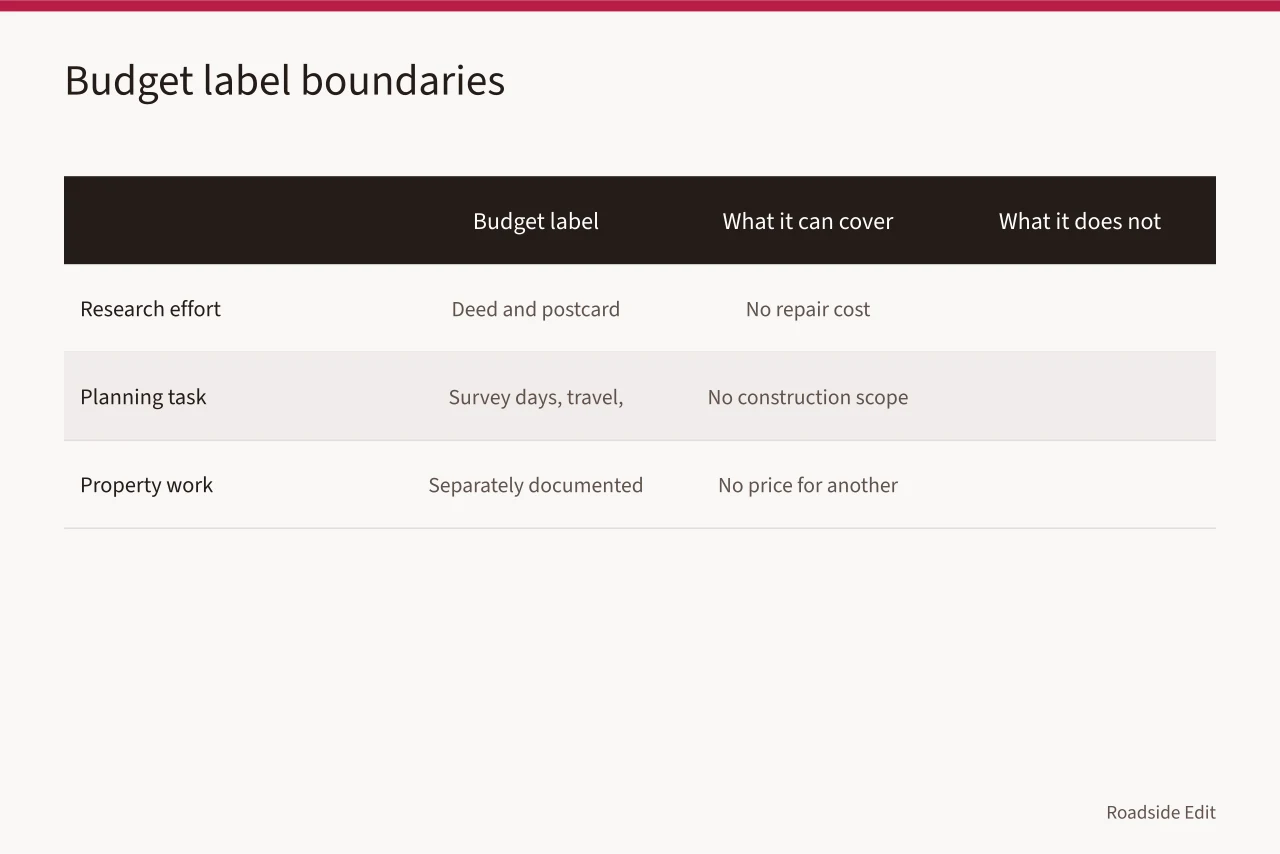
| Budget label | What it can cover | What it does not establish |
|---|---|---|
| Research effort | Deed and postcard research, SHPO file requests, photo dating | Any repair cost |
| Planning task | Survey days, travel, condition notes, decision gates | A construction scope |
| Property work | A separately documented project scope | A price for another motel |
A survey day and a fabrication hour are not comparable units. Keep them in separate rows and the reader can still use both.
Date the record, not the discovery
A grant announcement, a vendor estimate, and a planning target are three different objects. None becomes a project budget until the source names the scope, the date, and the role of that number.
The General Services Administration's cost guidance notes that estimates move as scope and requirements sharpen. GSA's cost-management guidance covers federal reimbursable work, not a roadside motel. Yet the field list applies anywhere:
- number
- source date
- scope named by the source
- comparability
- editorial use
A 2019 award for exterior signage tells you nothing about a 2027 canopy soffit. Say so in one line and move on.
Preserve the original publication date
When a figure changes, do not overwrite the old sentence. Keep the original publication date, add the new record with its own date, and state which one changed: the evidence, the scope, or both.
Silent replacement destroys the audit trail. A reader comparing your note to a cached copy needs to see what moved and why.
The Secretary of the Interior's Standards for documentation ask for reliable sources and stated limitations that let a stranger check the work. The NPS documentation standards apply to recorded drawings and histories, and a one-line limitation meets the same bar: the available source names an award but describes no work.
That sentence is the whole protection. It stops an award amount from reading as a restoration budget.
Stay out of the approval chain
A writer can flag a record worth reading. A writer cannot decide that a property needs a particular repair, a particular amount, or a particular approval path.
The Historic Property Project Documentation process ties existing property information to project scope and design decisions. The NPS documentation overview shows where that handoff sits: after the record, before the work.
Anything structural, electrical, or underground belongs to a licensed engineer, electrician, or environmental authority. It also belongs to the authority having jurisdiction. Anything on easements, tax credits, or import duties on salvaged booths and neon parts belongs to an attorney, an accountant, or a customs broker. Name them and stop.
A note that follows a restoration planning workflow ends with the open decision, the record that would close it, and who sets the real scope. That is a complete note. A planning budget built the same way survives the first real estimate.
Common questions
Can a planning note give a restoration cost?
Only when a dated source supports a defined scope and the note states that scope and its limits. This note gives none.
Is a survey day the same as a fabrication hour?
No. A survey day buys condition evidence and travel; a fabrication hour buys shop time on a named assembly. Keep them in separate rows.
What goes in the boundary paragraph?
The covered scope, the period described, the decision the note feeds, and the authority that sets the real scope.