Guides
Historic motel restoration planning: build the 2027 workflow before treatment talk
Historic motel restoration planning workflow for 2027 explains how to set a study boundary, organize records, and sequence early questions before work.
Planning a historic motel restoration is not the same as choosing a treatment, getting a bid, or announcing a reopening. It is the work of making the property, question, records, and decision limits clear enough that later readers can see what is known and what remains open. A planning workflow is useful even when no project has been authorized.
This guide is for writers, owners, local researchers, and preservation-minded organizations. It describes an orderly way to build a planning file. It does not diagnose a building, approve a project, state legal requirements, or recommend work on a particular motel.
What to take away
- Begin with one named property and one bounded planning question.
- Separate historic evidence from a current observation or future proposal.
- Put the source date, source type, and limitation beside every important claim.
- Use a written decision log so a later correction does not erase the earlier question.
- Do not turn a planning sequence into a schedule, scope, or cost promise.
Start with the decision that needs support
The first useful question is not "How should this motel be restored?"; it is too broad.
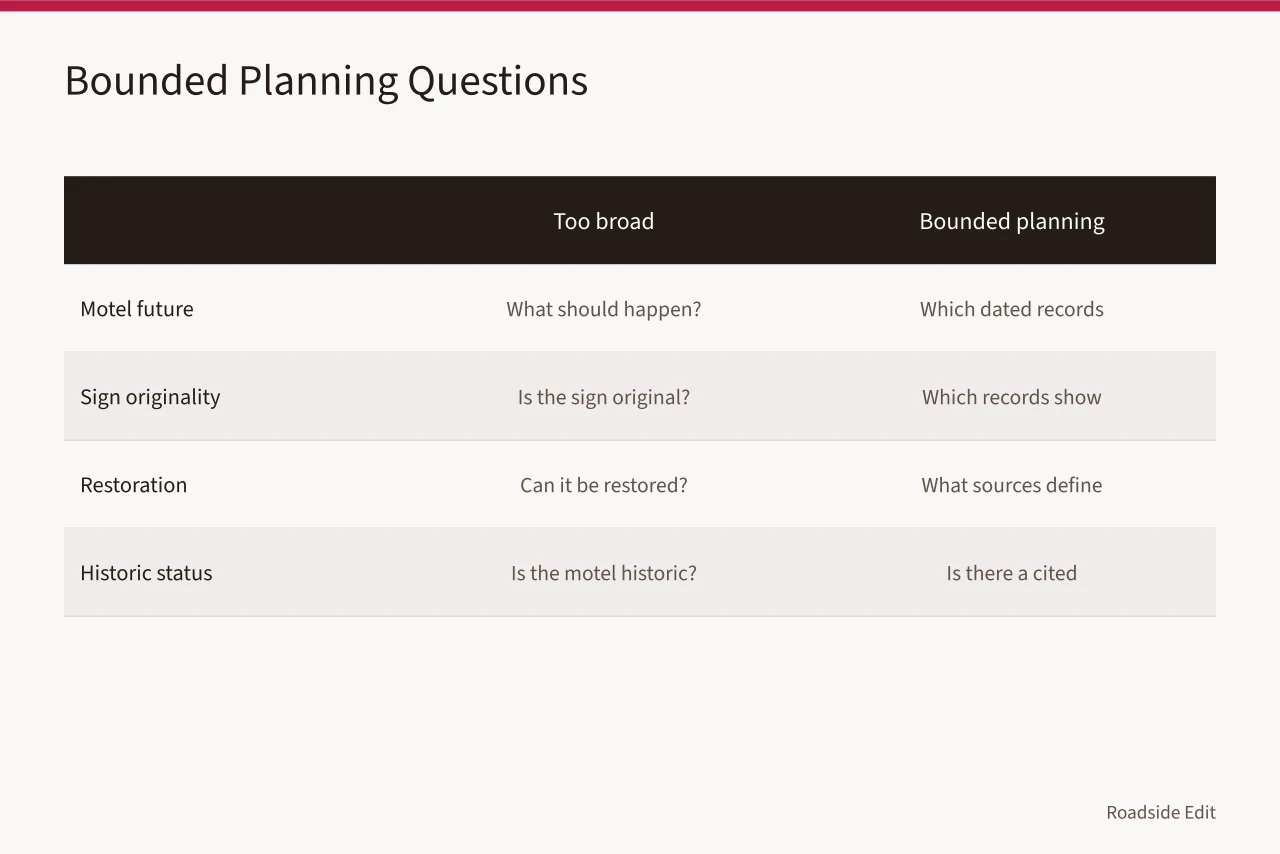
A planning file should state the decision research informs. It might ask whether an article can identify a neon sign accurately, whether a room wing fits a defined story, or whether enough information exists to describe a proposed project without claiming work occurs.
Write the question in a form that can be checked later:
| Too broad | Bounded planning question |
|---|---|
| What should happen to the motel? | What dated records identify the office building and its known changes? |
| Is the sign original? | Which records describe or show this sign, and what dates do they carry? |
| Can the property be restored? | What sources define the feature being discussed, and what do they not establish? |
| Is the motel historic? | Is there a cited designation, inventory, or historical account that uses that description? |
The boundary matters because a motel is rarely a single, unchanged object. It may include separate structures, additions, paving, signs, landscaping, furnishings, and a current operating business. A source about one portion does not automatically speak for another. A planning note should name the feature, location, and time period before it draws a conclusion.
Establish a working record before writing prose
Create a short property record that travels with the project. It is not a substitute for a survey, a technical report, or a public designation record. It simply keeps the work from merging similar names, adjacent buildings, or images taken decades apart.
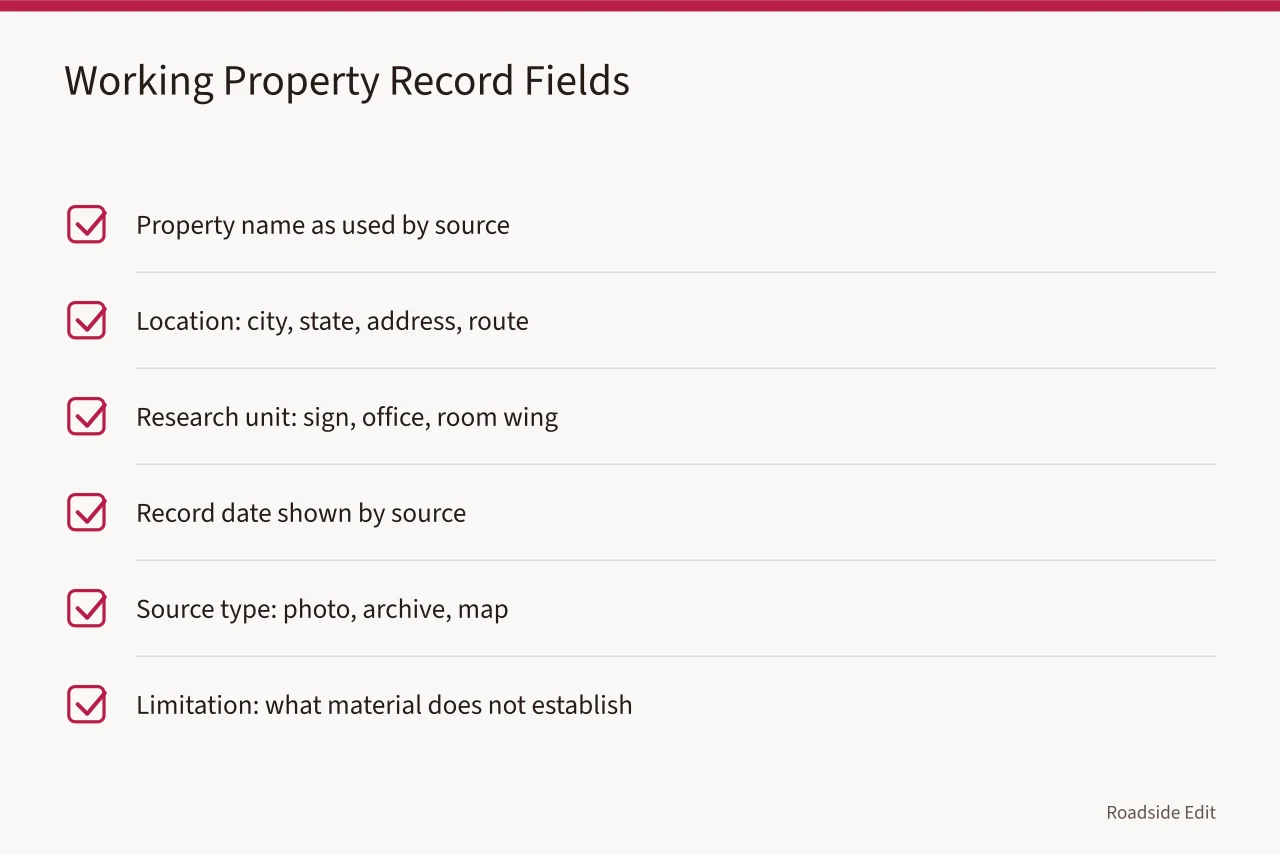
| Field | What to record | Why it helps |
|---|---|---|
| Property name | The form used by the source | Keeps current branding separate from older names |
| Location | City, state, address, route, or mapped reference | Distinguishes similar properties |
| Research unit | Sign, office, room wing, parking court, or document set | Prevents site-wide claims from a narrow source |
| Record date | Date shown by the source or observation | Separates historic evidence from current facts |
| Source type | Photograph, archive record, article, map, or public listing | Explains what kind of support is available |
| Limitation | What the material does not establish | Makes uncertainty visible |
Use exact wording where it matters. If a postcard labels a place "motor court," record that label instead of silently replacing it with a current name. If a photograph has no verified date, say that its date is not established in the working file. Plain limits make a later update easier.
The National Park Service documentation standard calls for reliable source material and clear limitations that let another person verify the work. Read the NPS documentation standard. A property record makes that principle usable in an editorial file because every claim has both a source role and a stated boundary.
Set the workflow before the treatment conversation
The National Park Service describes a historic structure report as a planning document. It can bring together research, investigation, observed conditions, and a record of physical work. See the NPS overview of historic structure reports.
That description does not require every motel project to prepare one. It does show why a planning sequence should keep history, observations, proposed action, and completed work distinct.
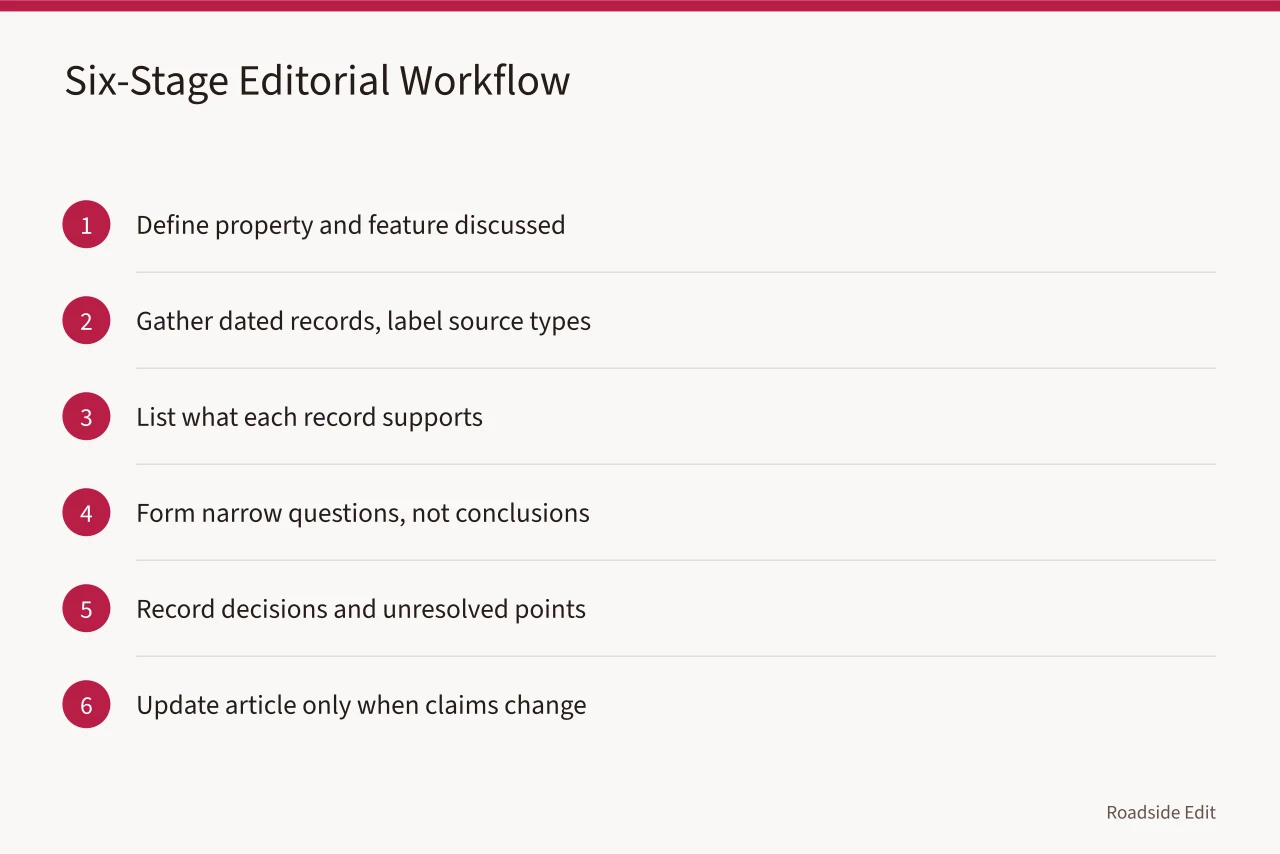
A practical editorial workflow can use six stages:
- Define the property and feature being discussed.
- Gather dated records and label each source type.
- List what each record supports and what it cannot prove.
- Form narrow questions rather than general treatment conclusions.
- Record decisions, unresolved points, and the reason for each change.
- Update the article only when new material actually changes the claim.
The order can loop. A newly found image may narrow the name, date, or feature description. It should not be treated as proof of condition, ownership, or planned work unless it directly supports those facts.
Divide the site into research units
Planning becomes manageable when the topic is smaller than "the whole motel." A research unit is the smallest area or evidence set discussed without borrowing certainty from another part of the property.
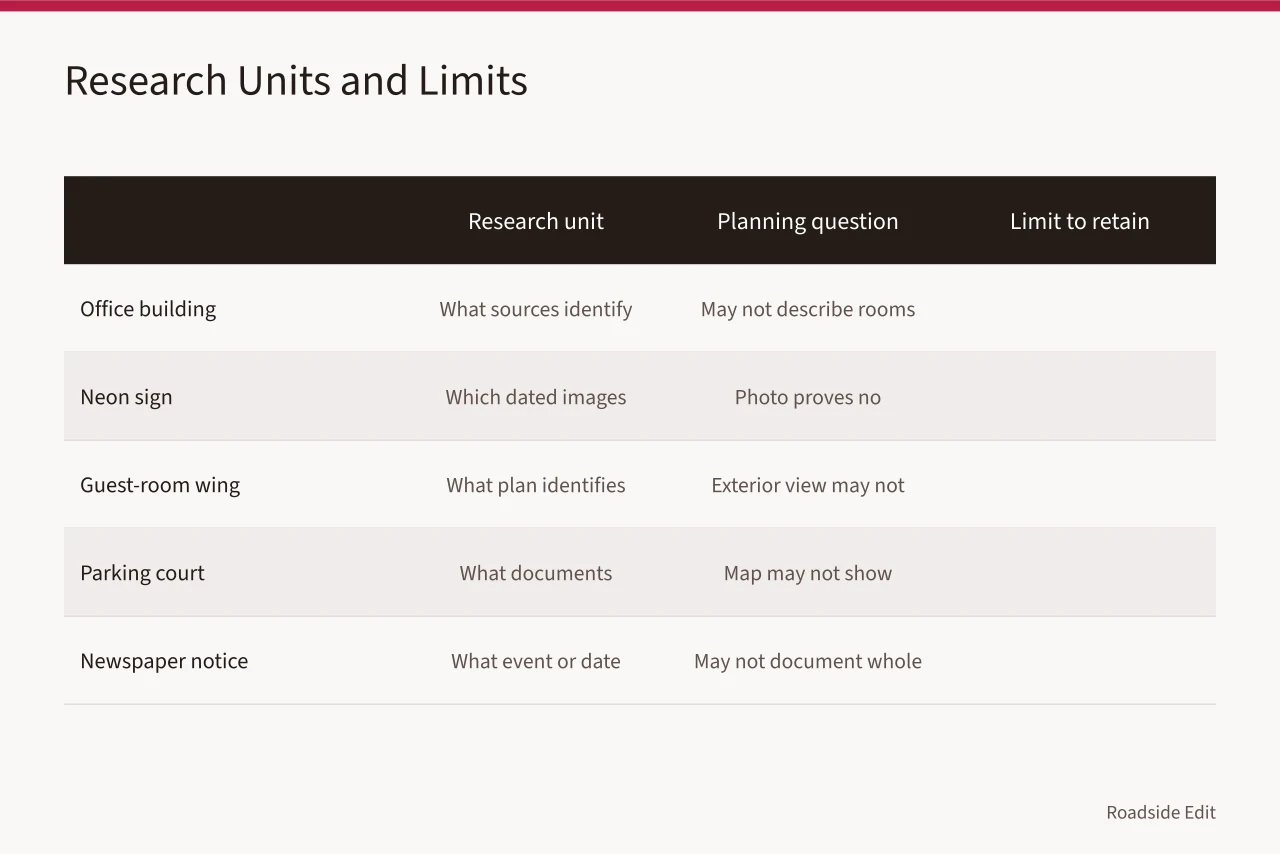
Units include an entrance sign, the main office, an individual room block, a parking court, and a circulation path. Others are a historic view or a set of public records.
| Research unit | Useful planning question | Limit to retain |
|---|---|---|
| Office building | What sources identify the building and its use? | A source may not describe rooms behind it |
| Neon sign | Which dated images show the wording or placement? | A photo does not prove current electrical condition |
| Guest-room wing | What plan or image identifies the wing? | One exterior view may not show interiors |
| Parking court | What record documents circulation or paving? | A map may not show current access rules |
| Newspaper notice | What event or date does it report? | A notice may not document the whole property |
When a source spans several units, note that explicitly. A nomination, directory, or newspaper story may be useful context without being a room-by-room inventory. An article can say what source was consulted without assigning it a scope it does not have.
Create a source ladder, not a source pile
Sources have different jobs. A historical photo may identify appearance at a moment in time. A public record may identify a designation or project event. A current observation can describe what was visible from a lawful viewpoint on a stated date. Each should have a separate label.
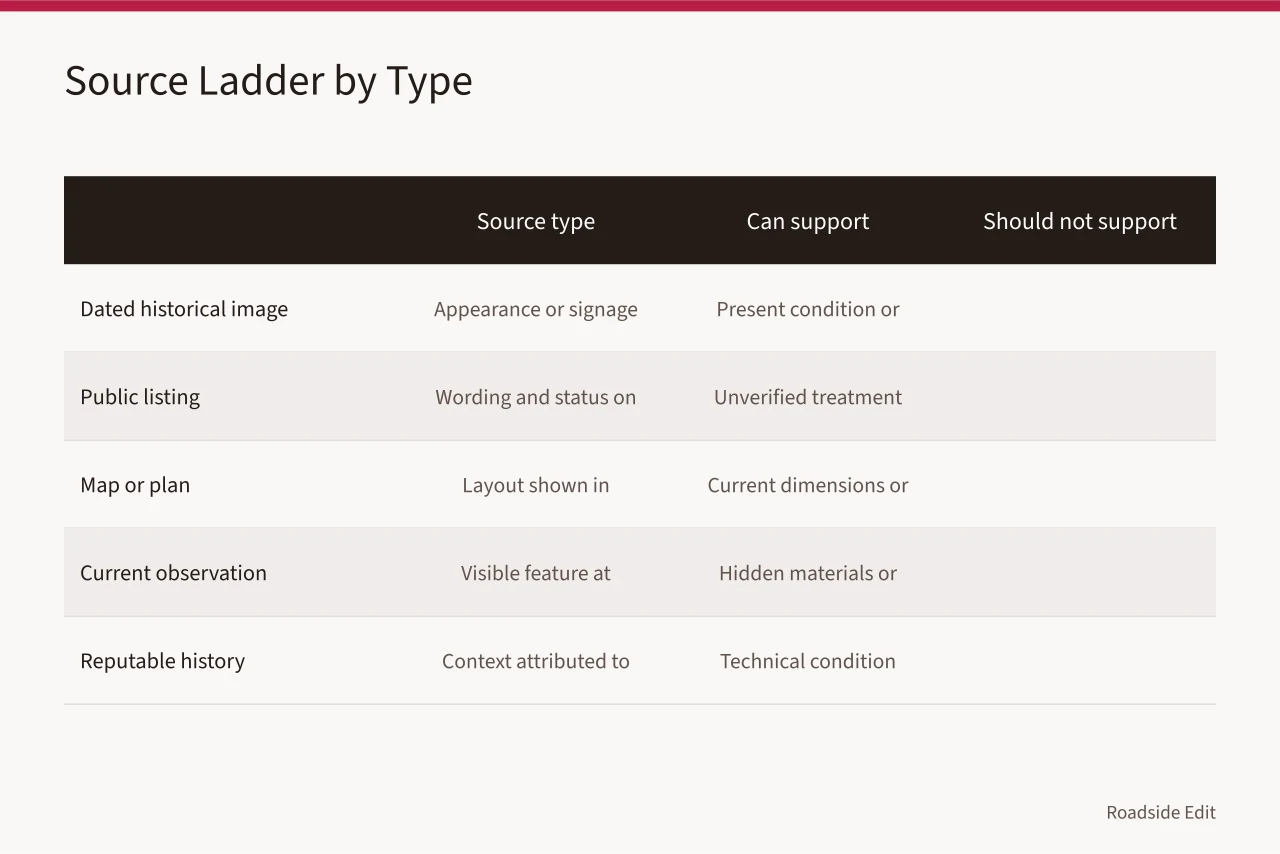
| Source type | Can reasonably support | Should not be stretched to support |
|---|---|---|
| Dated historical image | Appearance or signage visible in that view | Present condition or unpictured features |
| Public listing or inventory | The wording and status on that record | An unverified treatment recommendation |
| Map or plan | Layout shown in that document | Current dimensions or access conditions |
| Current lawful observation | A visible feature at a stated time | Hidden materials, causes, or safety conclusions |
| Reputable history | Context attributed to that source | A technical condition finding |
Keep the original link, record identifier, title, and access date when available. Then write a one-sentence note explaining the source's use. That small step prevents a later writer from assuming a picture, caption, and formal inventory all make the same claim.
The Library of Congress primary-source process begins with observation before reflection and questions. Use the Library of Congress analysis guide. That order is especially helpful with historic images: first describe the visible item, then identify what remains unknown, and only then decide whether a broader question is justified.
Turn evidence into planning questions
Good planning questions are answerable, narrow, and reversible. They make room for the answer "the present file does not establish this." They do not pretend that an unverified answer is a recommendation.
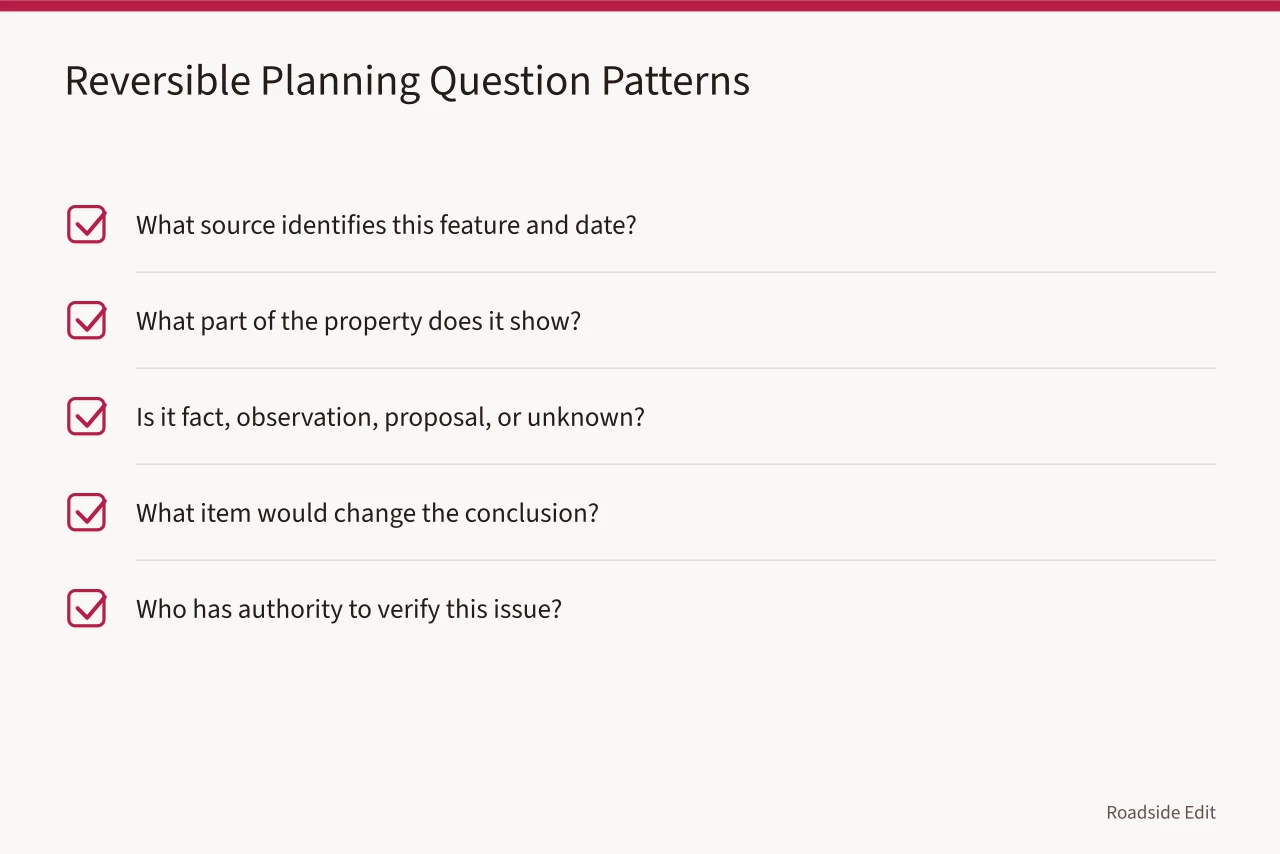
Try these question patterns:
- What source identifies this feature, and what date does it carry?
- What part of the property does the material actually show or describe?
- Is the statement a historic fact, a current observation, a proposal, or an unknown?
- What item would change the conclusion if it were found?
- Who has authority to verify a legal, technical, or site-specific issue?
Questions are also an editorial safeguard. They help an article say "the available file does not establish the original finish" instead of guessing from a color photograph. They help distinguish "an owner described a future plan" from "work was completed."
Use decision gates to avoid premature certainty
A decision gate is a brief pause before an article moves from research to a stronger statement. It does not need a committee or formal meeting. It can be a checklist in the working file.
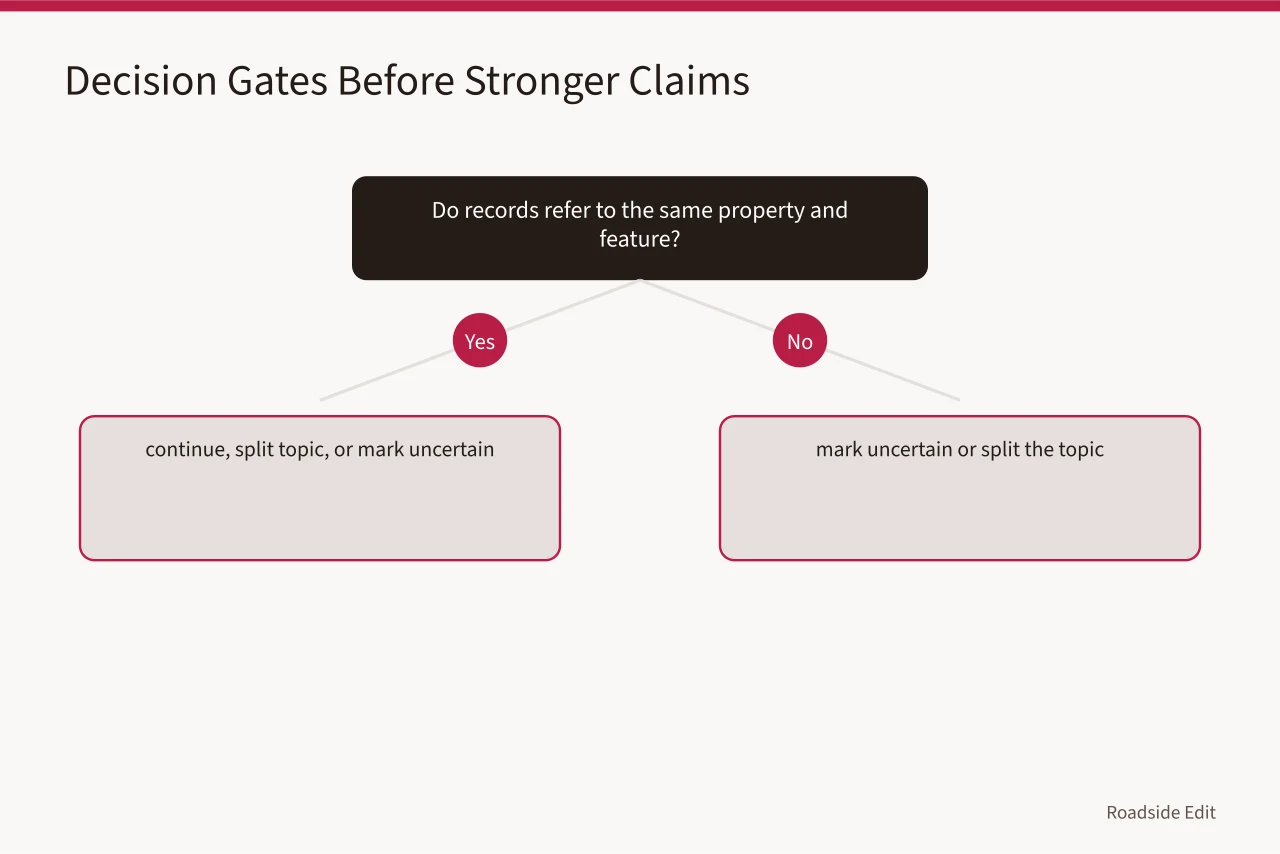
| Gate | Ask before proceeding | Possible outcome |
|---|---|---|
| Identity | Do the records refer to the same property and feature? | Continue, split the topic, or mark uncertain |
| Date | Is the date stated, inferred, or unknown? | Use the stated date or qualify the wording |
| Scope | Does the source cover the whole property or one unit? | Narrow the sentence |
| Authority | Does the source support this kind of claim? | Find a better source or remove the claim |
| Change | Has new evidence altered a published statement? | Update with a dated correction note |
The goal is not to slow every article. It is to keep a neat story from outrunning the records. A small gate can prevent an old photograph from being treated as a current inspection or a grant announcement from being treated as evidence of completed work.
The NPS Historic Property Project Documentation process connects existing property information with scope and design decisions. Review the NPS documentation overview. A publication workflow should stop before that project-decision stage unless a specific, reliable source documents the decision being described.
Plan for unknowns and later work
Unknowns belong in a planning file. Record the question, the source searched, the date, and the reason the file remains incomplete. Do not add a guessed answer to make the article sound finished.
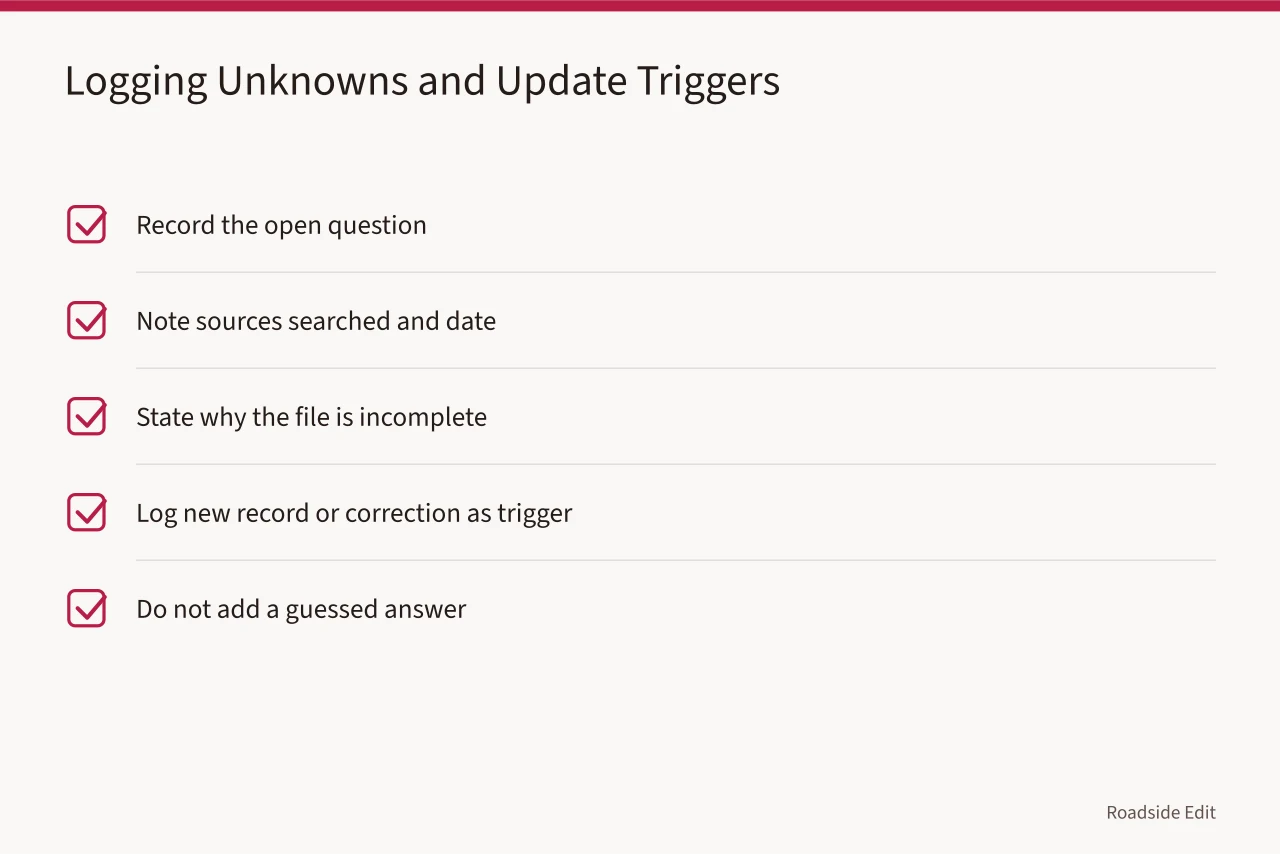
An update should have a clear trigger. A cited new record, a correction from a source holder, or a verified public decision may justify a revision. A casual description, a marketing claim, or an image without context may be worth logging but not enough to rewrite a factual statement.
A compact workflow for publication teams
Before approving an article, the writer can hand over a six-line record:
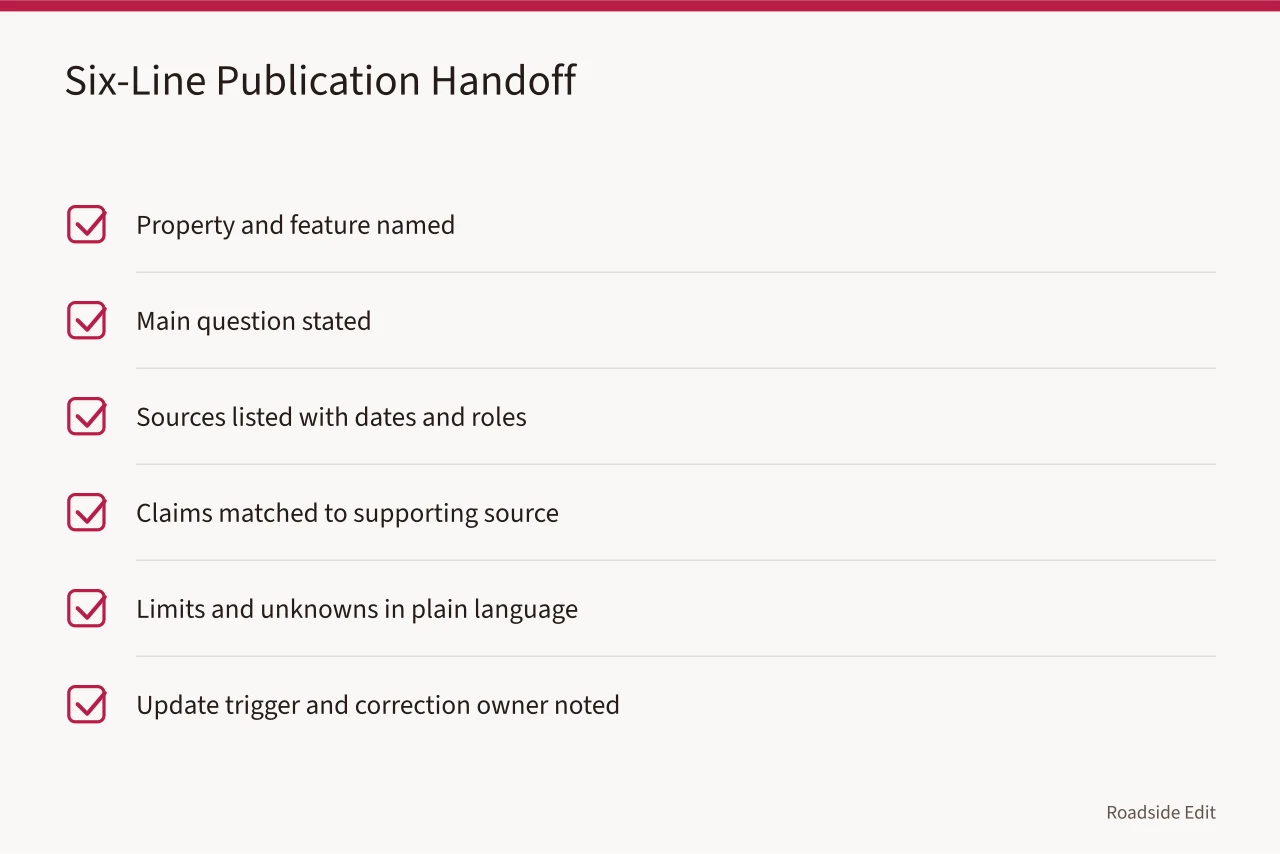
- Property and feature named.
- Main question stated.
- Sources listed with dates and roles.
- Claims matched to the source that supports them.
- Limits and unknowns written in plain language.
- Update trigger and correction owner noted.
This handoff gives an editor something concrete to check. It also lets a future contributor understand why an earlier article stopped short of a treatment, price, or condition claim.
Common questions
Does a planning workflow decide how a motel should be restored?
No. It organizes questions and records before a treatment decision. A workflow can clarify what information is missing without choosing work for a specific property.
Can one historic photograph prove a feature is original?
Usually not by itself. It can document what is visible in that image and at its recorded date. The article should not extend that evidence beyond the feature and time the photograph supports.
When should an article be updated?
Update when a cited new record materially changes a stated fact, and note what changed. Do not update merely to make an uncertain point sound more complete.
In this guide
- How to build a historic motel restoration planning checklist before you commitHistoric motel restoration planning checklist for 2027 helps readers define a study area, collect records, set questions, and label open decisions.
- Historic motel restoration planning questions to settle before 2027 claimsPlanning questions for a historic motel sort what a nomination record identifies from what it does not, so no 2027 claim outruns its evidence.
- Historic motel restoration planning budget notes: how to set a work plan boundaryA work-plan boundary keeps research effort, planning tasks and physical property work apart so no reader mistakes one figure for a restoration cost.
- Historic motel restoration planning: 4 warning signs your article mixes research with decisionsHistoric motel restoration planning warning signs for 2027 show when an article has confused research, observation, proposed work, or a final decision.
- How to keep historic motel restoration planning records traceable for 2027Historic motel restoration planning records stay traceable when each claim carries its source, date, role and document limit in one dated project file.