Guides
Part of Historic motel restoration planning: build the 2027 workflow before treatment talk
How to build a historic motel restoration planning checklist before you commit
Historic motel restoration planning checklist for 2027 helps readers define a study area, collect records, set questions, and label open decisions.
Use this checklist to assemble an article planning file, not to determine a motel's condition, code status, treatment, or cost. It makes the boundary of a piece of research visible before publication.
What to take away
- Define one property, feature, and research question.
- Record the date and role of every important source.
- Keep observations, historic records, and proposals in different fields.
- State what the file cannot establish.
Build the file in three parts
The National Park Service's predesign workflow separates contextual analysis, project programming, and an integrated design narrative. Review the NPS predesign sequence. That is an NPS project process, not a required workflow for a privately owned motel. Its separation still helps editorial planning: document the setting first, then state the question, then explain the proposed discussion.
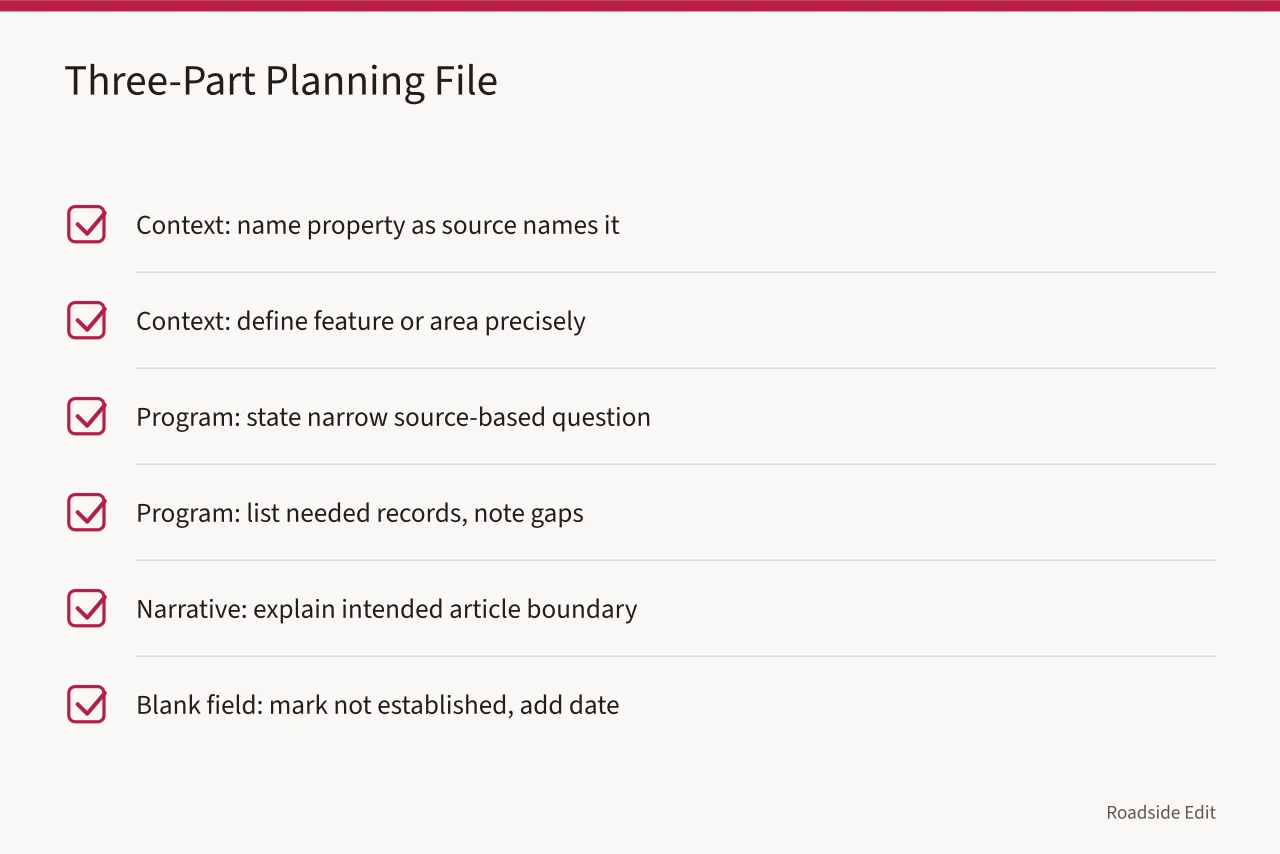
| Part | Checklist item | Completion note |
|---|---|---|
| Context | Name the property as the source names it | Add location and source date |
| Context | Define the feature or area | Do not use "the motel" if the source shows only a sign |
| Program | State the question the article can answer | Keep it narrow and source-based |
| Program | List needed records | Note missing records rather than inventing them |
| Narrative | Explain the intended article boundary | Separate facts from possible future work |
A blank field is useful information. Do not replace an unverified date, feature name, or project status with a smooth sentence just because the checklist looks incomplete. Mark the field "not established in the reviewed material," add the research date, and name the kind of record that could resolve it.
Final review questions
- Does every major sentence identify its source role?
- Does an historic image stay tied to its date and viewpoint?
- Are current observations marked as observations rather than findings?
- Does the outline avoid a recommendation that the records cannot support?
- Is there a dated note explaining any later correction?
NPS documentation standards require reliable sources and stated limitations that permit independent verification. See the NPS documentation quality standard. The limitation field is where an article planning file makes that standard practical.
Separate planning from a project decision
The NPS Historic Property Project Documentation tool ties property information to project scope and design decisions. Read the NPS project-documentation overview. A planning file may identify missing evidence, but it does not create a restoration scope, cost, or approval.
Use a source table before drafting. List the source title, date, feature covered, claim supported, and limit. The Library of Congress primary-source guide recommends examining a source before drawing conclusions from it. Use the Library of Congress primary-source analysis guide. This table helps writers stop a postcard, current photo, and proposal from becoming one unsupported story.
Set a useful research boundary
Start with a question that can be checked against a record. "What does the 1956 postcard show at the office frontage?" is workable. "What was the motel really like?" is too broad for a single article. A narrow question also tells a reader which details are outside the file.
Keep a short decision log beside the source table. For each meaningful editorial choice, record the date, material reviewed, and reason. Examples: using a historic name instead of a modern nickname, omitting a room count from one undated listing, or treating a visible addition as observation, not construction date.
The log is not public-facing research. It lets you correct the article later without reconstructing the writer's reasoning.
Before assigning the draft, decide what evidence would change it. A dated permit, a city directory, an architect's drawing, or a clear sequence of photographs can resolve different questions. Write that need in the handoff note. It keeps future reporting from quietly converting a possibility into a fact.
Complete the handoff note
End the planning file with the working title, planned publication date, open questions, and reason for any claim removed. Another editor should understand the research boundary without reopening every source.
Common questions
Is a planning checklist a construction scope?
No. It organizes research and editorial questions. A construction scope requires project-specific professional and owner decisions that this checklist cannot provide.
What belongs in the limitation field?
Write what the source does not establish, such as current condition, an unseen interior, exact ownership, or a work recommendation.
Can a short article use this checklist?
Yes. Even a brief article benefits from a clear property name, source date, feature boundary, and stated unknown.