Guides
Part of Neon sign restoration planning: build a project record before you set a scope
How to build a neon sign restoration scope checklist before work starts
Neon sign restoration scope checklist for 2027 helps U.S. owners organize evidence, assign decisions, define exclusions, and prepare a clear project handoff.
This scope checklist helps an owner or editor organize the questions that belong in a neon-sign planning file. It is not a repair list or a direction to inspect or handle equipment. Its job is to make the handoff clear: what is known, what is needed, who decides, and what the project does not include.
What to take away
- Capture the sign, source, date, and decision-maker first.
- State exclusions before anyone assumes a quote or article covers them.
- Preserve original files and a simple file log.
- Keep a final decision record with disclosure details.
Build the scope file
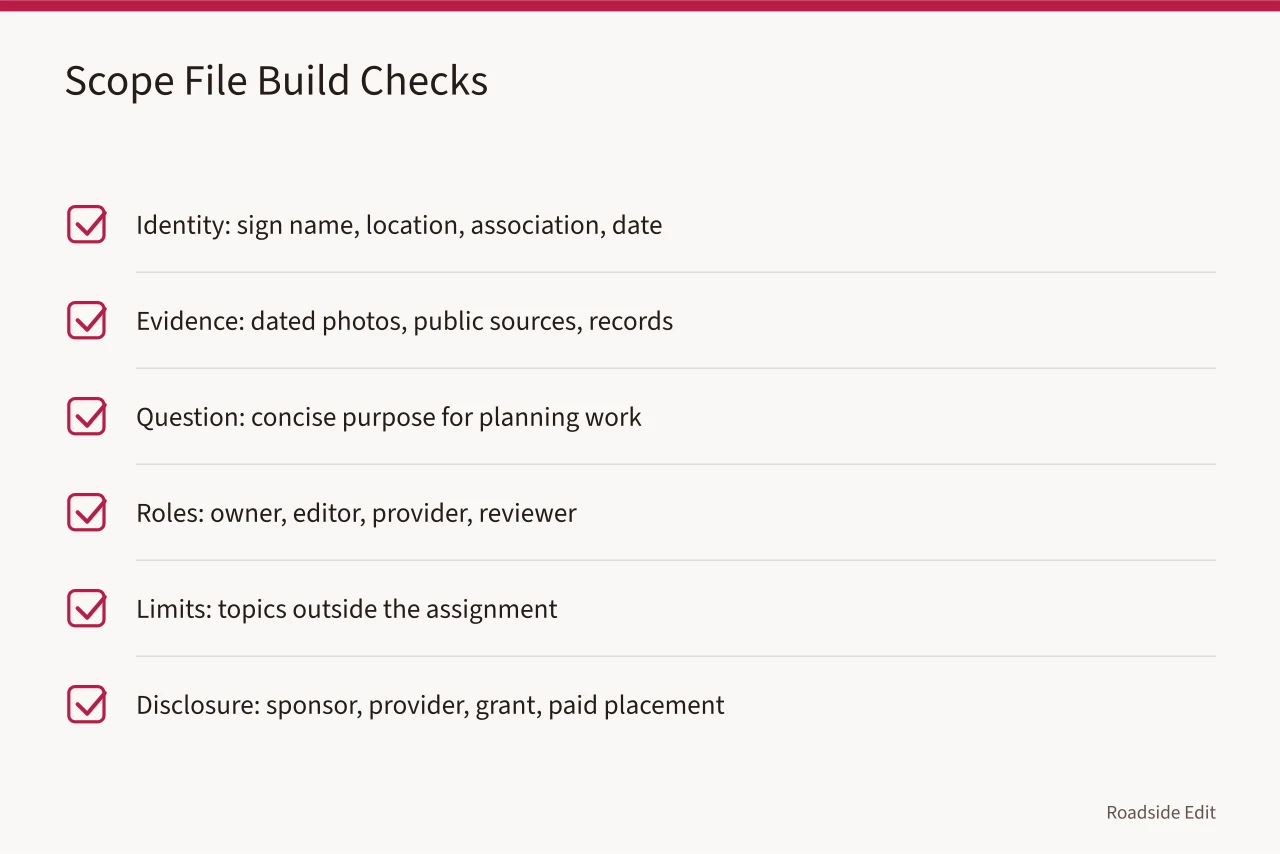
| Check | Include | Do not assume |
|---|---|---|
| Identity | Sign name, location, business association, and record date | Current ownership or historical status |
| Evidence | Dated photos, public sources, supplied records, and source notes | That one image proves original details |
| Question | A concise purpose for the planning work | A promised physical result |
| Roles | Owner, editor, source provider, and needed reviewer | That any contributor has every authority |
| Limits | Topics outside the assignment | That omitted work is included |
| Disclosure | Sponsor, provider, grant, or paid-placement relationship | That readers will infer a relationship |
Write the exclusions plainly
Useful exclusions are specific. Examples include electrical assessment, lifting, site access, permitting, structural analysis, materials testing, removal, installation, and work inside a public right-of-way. The list is not meant to make a project sound difficult. It prevents an editorial, historical, or documentation assignment from being mistaken for a site-specific professional service.
Assign each decision before requesting work
Assign a name or role to every open decision. An owner or authorized manager may decide whether to proceed with a defined scope, while a content editor decides how to describe available records.
A qualified professional or relevant authority may be needed for technical, structural, electrical, access, or permit questions, so the planning file should not leave them implied.
The OSHA electrical eTool for Subpart S covers electrical-installation topics including qualified-person considerations. It is not a planning method for a particular sign. It supports the boundary used in this checklist: a content or documentation file should not direct readers to perform electrical work or make equipment decisions.
Make the handoff package complete
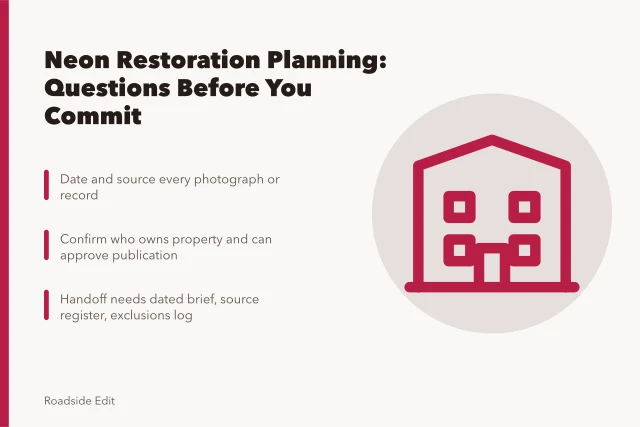
Before passing the file to another role, check it contains the current brief, source register, dated images, statement of exclusions, and role map. Confirm the decision log and list of open questions.
If a source came from an owner, provider, or sponsor, mark that origin; if an image is illustrative, say so in the caption, not as project evidence.
The National Park Service documentation standards and guidelines concern recording historic properties. They do not create a sign-project scope. They support recording the source and scope of materials used to describe a historic feature.
Keep publication relationships visible
If a business, provider, association, or sponsor pays for a profile or placement, add that information to the handoff note. The payment should not decide what the record says or turn a defined service into an outcome claim. Keep the disclosure record separate from factual source notes.
The Federal Trade Commission's endorsement guides address endorsements and testimonials in advertising. They are not project-planning rules. They are relevant when a public placement includes a commercial relationship that readers may need to evaluate.
Keep records usable
The National Archives guidance on technical documentation for digital photographic records identifies file formats, camera details, metadata, captions, and naming conventions. It also covers associated documentation.
For a modest sign project, that principle becomes a simple log. Retain the original image where possible, name a working copy clearly, record its source and date, and do not overwrite the file that supports a claim.
Close with a handoff note
End the checklist with the next decision, the person responsible for it, the evidence supplied, unresolved questions, and the date. If a detail has not been confirmed, write that it remains open. That is better than filling a gap with a confident guess.
Common questions
Does this checklist authorize restoration work?
No. It organizes information for planning and review. Site-specific work belongs with the appropriate qualified process.
Why keep the original photos?
Original files may retain context and metadata that a cropped or reposted copy does not show.
Should a sponsor appear in the scope file?
Yes. A sponsor, provider, grant, or paid-placement relationship should be stated clearly so readers can assess the context.