Guides
Part of Neon sign restoration planning: build a project record before you set a scope
How neon sign restoration owners should keep planning records
Five working folders, dated version numbers, and a retention call for every neon sign restoration record an owner will need to answer for later.
A neon sign restoration generates paper long before anyone touches a tube: a survey day, a salvage invoice, a landlord's reply, a photograph of a broken transformer. Filed by date, that pile answers questions. Filed by nothing, it becomes a box.
This guide covers the folder structure, the numbering, and the retention call. For the cost-side records that sit alongside it, see the regional records guide.
What to take away
- Five folders carry a project: Sources, Visual log, Decisions, Public copy, Project correspondence.
- Every file gets a date and a version number, and one person owns edit access.
- Keep the original photograph or scan untouched; edits live in a separate working copy.
- Retention follows the longest obligation attached to the file, not the shortest.
- Email that explains a decision is a record. Email that only schedules a call is not.
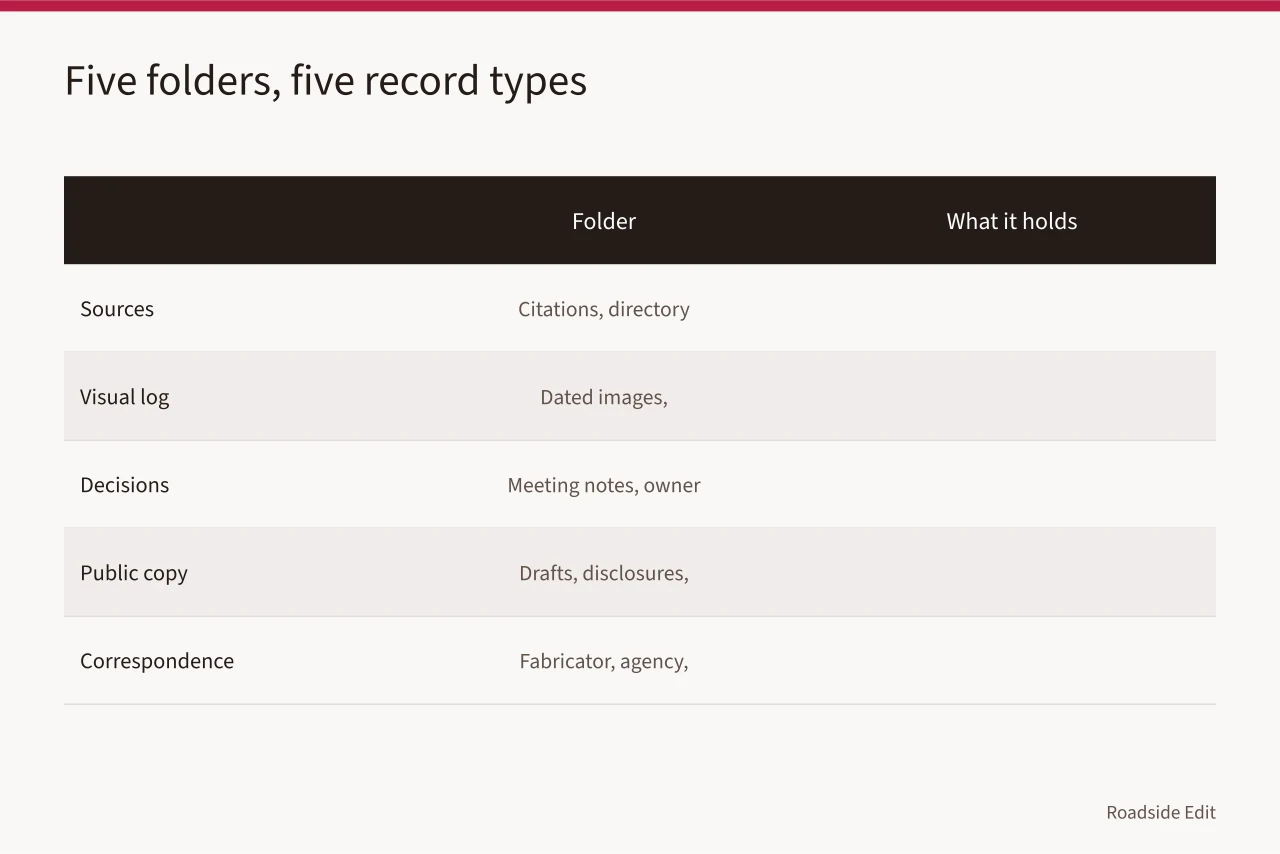
Five folders, and what goes in each
| Folder | What it holds |
|---|---|
| Sources | Repository citations, directory pages, clippings, attribution notes |
| Visual log | Dated images, viewpoints, captions, edit history |
| Decisions | Meeting notes, owner calls, open questions, pending items |
| Public copy | Drafts, disclosures, corrections, publication dates |
| Project correspondence | Fabricator, agency, sponsor, grant, and reviewer messages |
The split matters because the folders age differently. A source citation may stay valid for decades. A draft caption is obsolete the day it is published.
Number versions, do not overwrite them
Give every brief, caption sheet, and draft a date plus a version number: 2026-09-11_v03_canopy-caption. When a caption, date, or claim changes, the old file stays and a one-line note records what changed and why.
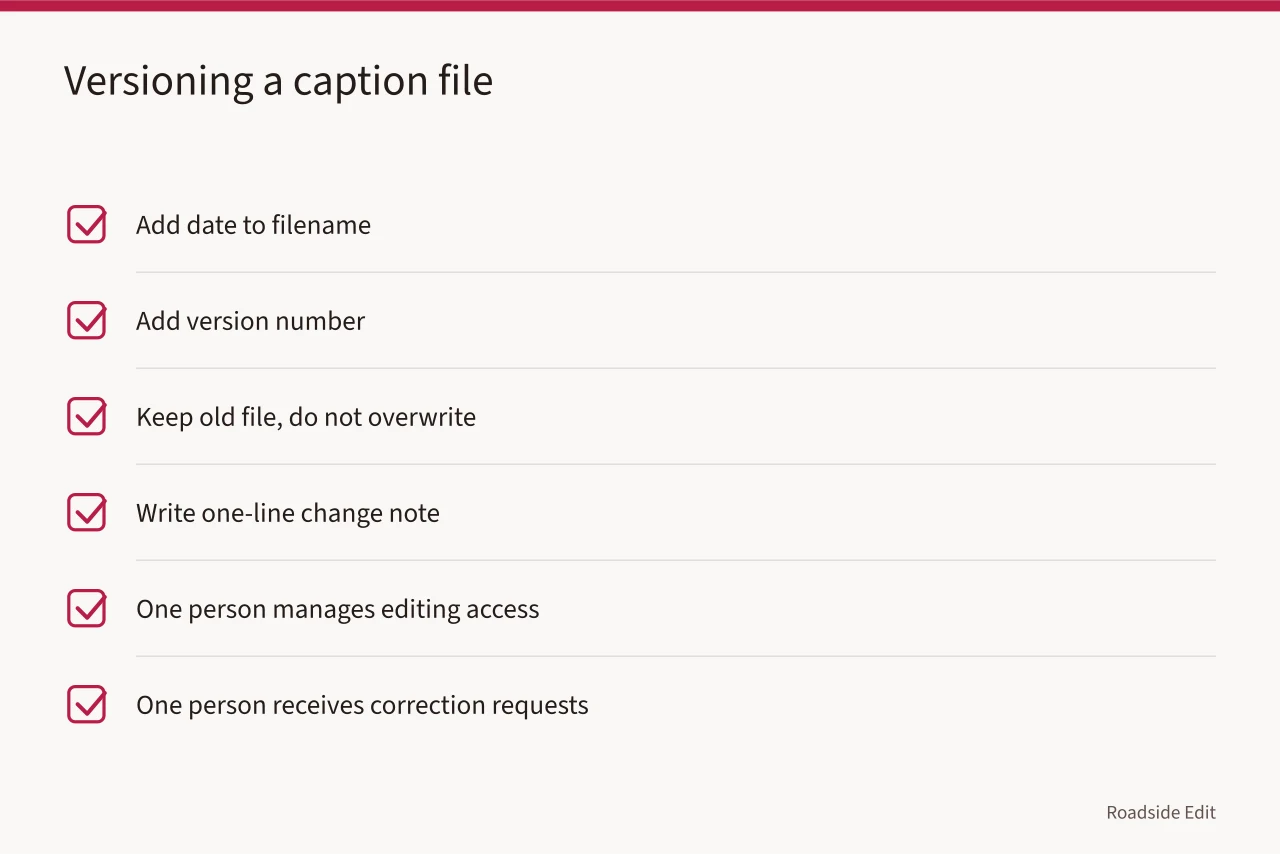
Two people, two roles. One manages editing access. Another receives correction requests, so a fix does not arrive as a silent edit to a file nobody reviewed.
Keep originals separate from published files
Store the original scan or photograph apart from the cropped, color-corrected version that goes online. Record the source page, the creator if known, the date if known, and whether the image documents the project or merely illustrates it.
The Library of Congress guide to photographic evidence walks researchers through dating a photo and reading its context. It is written for researchers, not sign owners, but the discipline transfers: an enhanced file that hides its own cropping has lost the context that made it evidence.
Source notes belong with the claim
For each load-bearing statement, record the source page or file, its date, the date you checked it, and what it cannot tell you.
A photograph supports a visible observation. A city directory supports a business at an address on a date. A former employee's recollection supports an attributed memory, nothing wider. Keep the categories apart so a later writer cannot stretch a narrow source into a broad conclusion.
The National Archives guidance on agency recordkeeping covers federal agencies, not private sign projects. It is useful for one idea: keep the record that explains a decision, because that is the record someone will ask for.
How long to keep things
Retention follows the longest obligation attached to a file. A grant agreement, a landmark designation, a lease, or a state historic preservation office covenant can each set its own clock, and the longest one governs.
Where no agreement applies, keep the record while the sign stands and the owner can still be asked about it. A provenance file that documents a salvaged porcelain panel or a Canadian-sourced transformer is the only thing separating a restored sign from a replaced one.
Email is a record when it decides something
Sort correspondence by what it does. A message that approves a scope change, names a fabricator, confirms a salvage price, or corrects a published claim belongs in Project correspondence. A message that only proposes a time to talk does not.
Export the deciding messages as PDFs. Mailboxes get closed, and a decision that exists only in a deleted thread is a decision with no record.
Disclosures sit apart from facts
A sponsor, a paid placement, a donated transformer, or a grant relationship goes in the publication record so readers can weigh it. It does not verify anything about the sign's history or condition.
The Federal Trade Commission's endorsement guides govern endorsements and testimonials in advertising. They are not preservation guidance, but they apply the moment a public page carries a commercial relationship a reader would want to know about.
If a Historic Preservation Fund grant touches the project, read the agreement itself. The National Park Service notes that some fund projects require a reviewed draft sign and photo documentation. That is a program term, not a rule for every private restoration.
Common questions
How long should owner records be kept?
Keep them as long as the longest applicable obligation runs: a grant term, a designation, a lease, or the life of the sign.
Where nothing sets a term, keep the provenance file indefinitely, since it is the only proof of what was original. For a full method of building a vintage diner interiors regional checklist for source notes, work through the regional checklist method before the next survey day.
Should email be part of the record?
Yes, when the message decides something: a scope approval, a fabricator quote, a correction. Export those as PDFs into Project correspondence. Scheduling chatter can stay in the inbox.
Can a file log be simple?
A date, a filename, a source, a one-line description, and a status column are enough. The log earns its keep when someone else can find the file without asking you.