Guides
Part of How to build a neon sign restoration guide around regional climate and records
How neon sign owners can keep regional restoration records for 2027
A neon sign record for 2027 separates local sources from regional context, so a later editor can verify a claim without re-reading the whole file.
A neon sign record is not one file. It is a local layer, a regional layer, and a set of images that never get mixed together. Keep them apart and a later editor can re-check one claim without reading the whole folder.
What to take away
- Split every entry into local scope (the sign, the block, the parcel) and regional scope (the corridor, the state, the manufacturer's territory).
- Date each entry and name the claim it supports, so a 2027 note cannot be read as a 1955 fact.
- Store images with creator, collection, date and rights; a regional photo is never evidence about a specific sign.
- Keep provider and sponsor material in its own file, separate from the research record.
- Hand off with a one-page index, not a summary of every claim.
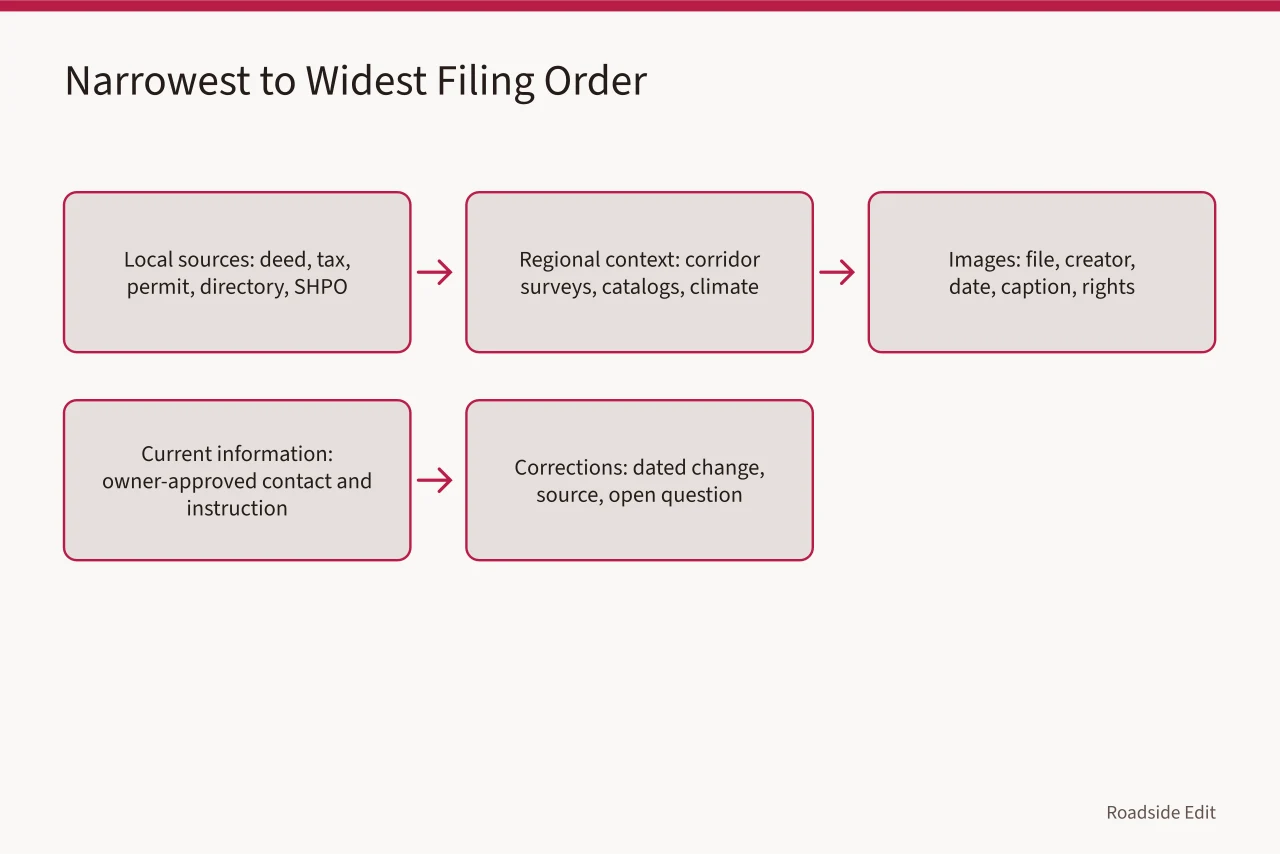
Five sections, in this order
| Section | What belongs there | What must not |
|---|---|---|
| Local sources | Deed, tax, permit, city directory, SHPO file for this parcel | Corridor-wide surveys |
| Regional context | Route 66 or state corridor surveys, manufacturer catalogs, climate and coastal data | Anything used as proof about one sign |
| Images | Original file, creator, collection, date, caption, credit, rights | Uncredited crops |
| Current information | Owner-approved public contact and visitor instruction | Historic claims |
| Corrections | Dated wording change, source that forced it, unresolved question | Silent overwrites |
The order matters because it runs from narrowest to widest. An editor who reads the local section first will not mistake a corridor survey for a fact about one blade sign.
Read the sign before you file it
A porcelain-enamel station sign and a plastic-faced box sign of the 1960s fail in different ways and date from different decades. Record which one you are looking at, the tube diameter if you can measure it safely from the ground, and the transformer location only as the licensed electrician reports it.
Do not open a canopy, a raceway or a transformer enclosure to check a date. Name the electrician and the authority having jurisdiction, and file their written finding in the local section.
The same applies to a motel exterior. Brick veneer, curtain-wall glazing and a butterfly roof each point to a different construction period, and each is a dated observation, not a conclusion. Record the observation and who made it.
Keep local scope and regional scope in separate lines
A regional source can be accurate and still too broad for a local claim. Write the scope on the entry itself: "state corridor survey, 1998, covers all of Route 66 in the state" is a different entry from "city permit, 1954, 1420 East Route 66".
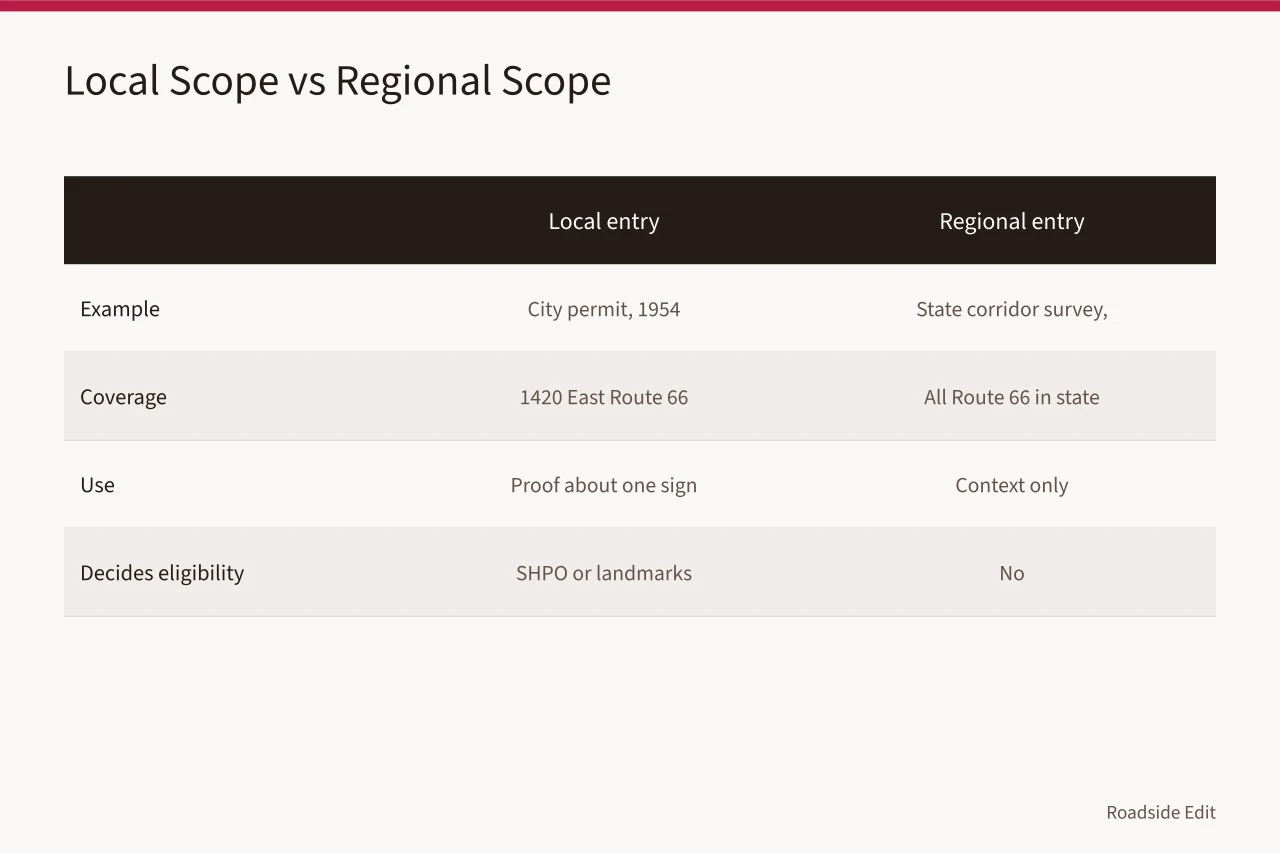
The National Park Service's criteria bulletin explains how significance and integrity are weighed from documented information. It is not a finding about any particular sign, and a State Historic Preservation Office or local landmarks commission decides eligibility under the adopted ordinance.
File images so they can be checked
Name each file with date, location label, view and version. Pair it with a caption that says what is visible and a credit line that says where it came from. Do not write "original" or "restored" in a filename unless a dated source supports those exact words.
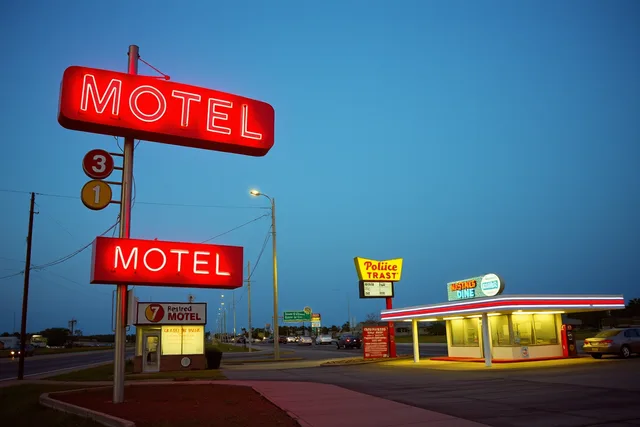
If a photo is not of the subject sign, label it regional or general illustration. Visual resemblance is not evidence that two signs share a history, a fabricator or a current owner.
The Library of Congress Prints and Photographs collections publish item records with descriptive and rights information. Use them to check what context exists for an image before it goes into editorial copy.
Record the fabricator, not just the sign
Neon work is documented by maker. Record the fabricator's name, the shop city, and the pattern or template number if it survives. Salvage parts sourced from Canada or elsewhere carry customs paperwork, and that paperwork is part of the record, not a shipping detail.
Costs split into survey days, travel and fabrication. Keep those as named variables the reader substitutes, never as a quoted figure.
Keep provider material in its own file
Provider profiles, paid placements and supplied service-area claims get a dated file of their own. Retain the submitted version, the disclosure decision and the published wording.
The Federal Trade Commission's endorsement guides cover endorsements and testimonials in advertising. They do not verify a service claim, and a paid placement is not editorial certification of a project.
Preserve a change history
When a caption is corrected, add a dated entry. When a city page moves, add a dated entry. When an owner changes a public instruction, add a dated entry. Each entry states what changed, why, and which source forced it. That gives the publication a defensible record without pretending the earlier version never ran.
Hand off with a one-page index
Give the next editor one page listing current items. Include local sources and regional context. Include active notices, image folders, provider files, corrections and open questions. Include the last review date and the next. For teams tracking signs across multiple states, keeping historic motel records straight across regions depends on exactly this kind of split index.
A regional source that is accurate can still be too broad for a local claim, and the index is where that distinction survives a handoff. Without it, a dated regional note gets copied forward as a current local assertion.
Common questions
Should a regional survey sit in the local file?
No. Keep it in the regional section with its geographic and time scope written on the entry. It can inform a local claim, but it cannot prove one.
What if two sources disagree about a sign's date?
Keep both entries, note the conflict, and leave the public statement open until a dated primary record resolves it.
Can a supplied photo run without a credit?
No. Caption and credit tell the reader whether an image is the actual sign, a regional example, or an illustration.
Who decides whether a sign is eligible for listing?
The State Historic Preservation Office or the local landmarks commission, under the adopted ordinance and the National Park Service documentation standards and guidelines. A record supports that review; it does not replace it.