Guides
Choosing help for a motel exterior: questions to settle before you hire
Choosing help for a motel exterior in 2027 helps U.S. owners separate repair, preservation, access, code, and documentation questions before hiring.
Choosing help for a motel exterior in 2027 starts with the question, not a name from a search result. A dark sign, loose cladding, damaged trim, a roof concern, or a renovation can each require different review.
The first person you contact should fit the work you know. Keep unknown conditions labeled as unknown.
What to take away
- Define the visible issue and the work you want documented before requesting a proposal.
- Separate electrical, structural, preservation, code, access, and ordinary maintenance questions.
- Ask each provider what they can confirm, what they cannot inspect, and what the proposal excludes.
- Keep records of site access, photos, quotes, communications, and any change to the scope.
- A historic or locally regulated property may need information from an owner, local office, or preservation resource before work begins.
Start with a narrow description of the need
"Fix the motel exterior" is not a useful hiring request. It leaves the provider to guess the feature, desired result, access conditions, schedule, and evidence available. A narrow request does the opposite. It names the location, visible feature, whether the concern is observation or planned work, and who can grant access.
A request might state a roadside sign is dark in a recent photo. It might add the owner has not yet confirmed the cause and the editor needs a description of available assessment services.
That wording does not call the sign unsafe, diagnose a failed component, or promise a repair. It gives a qualified provider enough context to decide whether to respond.
Use a separate request for each materially different question. Roof water entry, electrical access, historic paint, and a new sign location should not be buried in one broad message. A single quote may still cover related work, but the record should show what each portion means.
Match the question to the right kind of help
| Question | The first useful contact | What to ask for |
|---|---|---|
| Can the public description be confirmed? | Owner, manager, or public agency | Source, date, and permission to publish. |
| Is there an electrical concern? | Appropriate qualified electrical professional | Assessment scope, access needs, and safety limits. |
| Does a support, wall, roof, or attachment need assessment? | Professional with the relevant scope and authorization | What can be examined and what requires further review. |
| Is a feature historic or subject to review? | Local preservation office, State Historic Preservation Office, or qualified preservation adviser | Applicable process, record needs, and sources. |
| Is the request routine upkeep? | Provider whose stated service matches the documented task | Written scope, materials, exclusions, and schedule. |
This table is a routing tool. It does not certify a provider, decide whether a permit is required, or replace an on-site assessment. Local rules and a particular property's history can change the next step.
Ask whether history or review changes the job
Some motel exteriors have a documented history, appear in a local district, or include signs and materials that a community wants to retain. In that situation, a general repair request may be incomplete. It may be sensible to collect photos, earlier records, and a clear description of the proposed work before asking for a detailed scope.
National Park Service lists State Historic Preservation Offices as sources of technical assistance, nominations, grant information, and preservation resources for Route 66 properties. Read the NPS overview of Route 66 State Historic Preservation Offices.
The page does not decide any motel's status. It supports one limited point: a property owner can consult a public preservation resource before treating a historically sensitive exterior issue as ordinary maintenance.
An editorial article should not imply historic status applies because a building looks old or has a neon sign. Use a source that identifies the status, or state it is unconfirmed.
The same restraint applies to local review. A provider may explain a service, but an article should not promise approval, funding, or eligibility based on a general webpage.
Build a request that can receive a useful answer
Providers can only price and plan what they understand. The request does not need to be long, but it should include the information that keeps a reply comparable.
Include these points:
- Property location and the person authorized to discuss the work.
- The specific feature, such as a freestanding sign, entry canopy, roof edge, exterior wall, or parking-lot fixture.
- Recent photos with dates and captions that say what is visible.
- Known access limits, including whether the area is open to the public or behind a locked gate.
- The desired outcome, such as inspection, repair proposal, preservation advice, maintenance, or a provider listing.
- The records already available, including prior work, permits, public design guidance, or owner statements.
- The date by which a response is useful and whether an on-site visit is expected.
Do not ask a provider to certify a condition from a distant image. Do not ask an editor to identify a material or fault that the source record does not establish. Those shortcuts make a post sound definite, but they leave readers and providers with the wrong task.
Compare scopes before comparing prices
The most tempting comparison is the total at the bottom of a proposal. It is rarely the first comparison worth making. Read the scope and exclusions first. One proposal may include an inspection, access equipment, removal, disposal, permits, or testing. Another may not. A lower number can describe less work rather than better value.
Use a simple comparison record:
| Proposal item | Record it as written |
|---|---|
| Provider and date | Name, contact path, and date received. |
| Work included | Exact feature and stated task. |
| Materials or parts | Only what the proposal names. |
| Access assumptions | Ladders, lift, road closure, owner access, or other stated limits. |
| Exclusions | Work, permits, repairs, or conditions not included. |
| Change process | How additional conditions or costs will be handled. |
If the scope changes after access is granted, record the new information and request an updated document. Do not silently use an old quote to describe a different job. A provider listing can state services and location, while a proposal is a time-bound document for a defined scope.
Treat electrical work as a separate safety question
A neon sign, exterior lighting, and related equipment can involve electrical hazards. An article can document that a sign appears dark or that a cabinet is visible. It should not tell a reader to open equipment, bypass a cover, or test a circuit. The appropriate professional should decide what access, controls, and qualifications are necessary.
Keep the published wording modest: "The sign is not illuminated in the image dated June 2" is a photo observation. "The transformer failed" is a diagnosis and needs a reliable, specific source. "The sign is safe" is a conclusion a public image cannot provide.
If an owner, authority, or qualified reviewer supplies a statement, identify it as such and preserve the date.
Decide what belongs in a paid placement
Paid placements can be useful when they make their limits clear. A provider may state its service area, offered services, public contact method, licensing information supplied by the provider, and a short description of completed or available services. Avoid unsupported superlatives, rankings, guarantees, or claims about a particular property.
Put promotional material under a clear label. Keep it separate from the editorial photo record and the source-supported discussion. If a provider asks to change an editorial finding, require a source or a clearly attributed correction. Payment alone is not evidence.
Keep a small project file
You do not need a complicated system for every inquiry. A folder with a consistent name and a short log will usually do more than a long email thread. Save the original photos, caption text, provider messages, quotes, relevant public records, and a dated note when an article changes.
The file should also state its limits. If the article relies on a photo taken from a public street, say that it does not document concealed conditions or access-controlled areas. If the work is proposed rather than complete, state that status. A reader can then understand what the article knows and what remains with the owner or the appropriate professional.
For federal negotiated procurements, the Federal Acquisition Regulation requires stated evaluation factors. See the FAR rule on evaluation factors. It does not govern a private motel selection. It supports setting comparison factors before reading proposals.
The Federal Trade Commission advises consumers to check a contractor's license with state or county government, request proof of insurance, and get a written contract. Read the FTC contractor-scam consumer alert. This consumer guidance is not a ranking system. It supports keeping consequential claims and documents available for appropriate verification.
OSHA's construction standard includes accident-prevention responsibilities for covered construction work. Consult OSHA's accident-prevention provision. It does not determine a provider's performance at a specific motel. It supports identifying responsibility for the relevant work-site process.
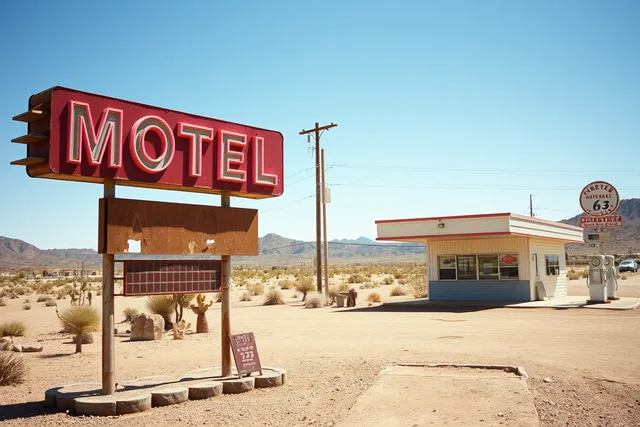
The image is illustrative. It does not establish a motel's current condition, ownership, safety, provider qualification, or project result.
Common questions
Should I ask several providers for the same type of work?
You can, as long as every provider receives the same basic description and access assumptions. Compare the written scope as well as the price.
Can a photograph prove the cause of a dark sign?
No. A photo can record that a sign was not illuminated at a particular time. It does not identify the cause.
Does an older motel automatically need preservation review?
No. Confirm the property's status and any local process with a relevant source or office.
What should a provider listing disclose?
Disclose paid placement or a provider-supplied submission, and keep that material distinct from editorial findings.