Guides
Part of Before you write about roadside architecture, check the local record
How roadside architecture regional records keep local sources straight
Roadside architecture regional records for 2027 give U.S. editors a clear system for local sources, context data, photo limits, and review dates.
What to take away
- Regional research stays usable when local property evidence and broader context remain separate.
- Every record needs a date, geography, source, supported claim, and limitation.
- Preserve original images and label any edited publication copy.
- A review date is part of the record because public sources, project pages, and local facts can change.
Use five connected logs
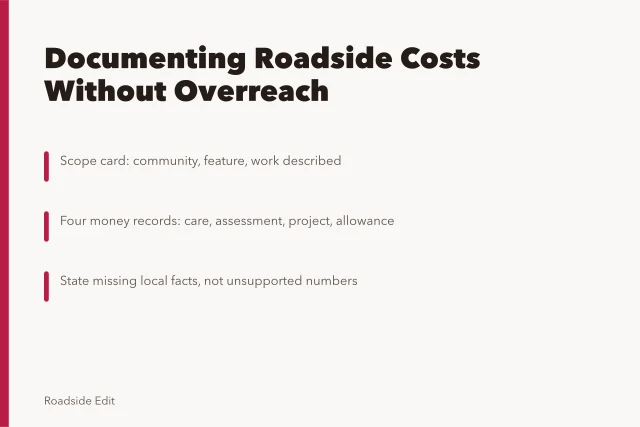
Regional work often fails in the handoff. A writer finds a local archive record, a wider context source, and a current photo, then combines them in a note that does not preserve their boundaries. A simple set of logs prevents that.
| Log | Minimum content |
|---|
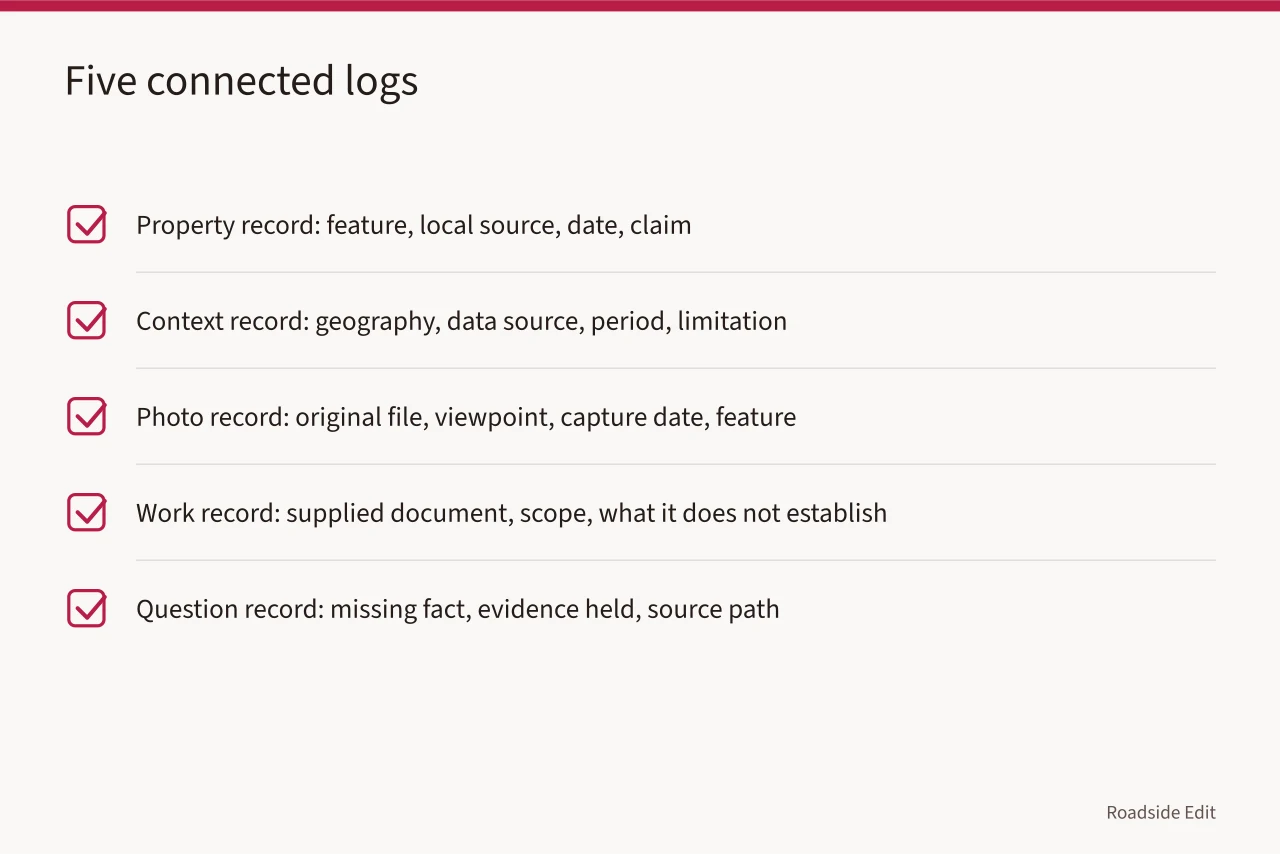
NPS documentation standards call for accurate records from reliable sources with limitations stated for independent checking. Review NPS documentation standards. The five logs apply that requirement to an editorial file without treating it as a formal professional survey.
File each record by geography
Put the community, county, state, and feature name in every relevant record. Then state whether a source is property-specific, local, county, state, regional, or national. This stops a good general source from being misquoted as direct evidence about a particular building.
- Record the named property and feature.
- Save the exact source URL and the date you checked it.
- Identify the source's geography and time period.
- Write the narrow claim the source supports.
- Add one limit before publishing or handing off the file.
NOAA Climate Data Online offers station and location searches for historical weather and climate records. Use NOAA Climate Data Online. A station result belongs in a context record with its stated location and period. It should not be stored as a finding about the property.
| Record phrase | Why it is useful |
|---|---|
| "County context only" | Stops county data from being called site-specific |
| "Photo taken from public road" | States the observation boundary |
| "Project record not located" | Makes the evidence gap visible |
| "Source checked on this date" | Shows when a web page was reviewed |
Preserve photos and their limits
Keep the original image file when you have the right; if you crop, resize, or adjust a publication version, label it separately.
The photo index should state the feature shown, where the image was taken, and what stays outside the frame. Avoid file names that conclude, such as unsafe-building or original-sign, unless a reliable source supports it.
The NPS Heritage Documentation Programs collection includes drawings, photographs, written data, and original field notes. See the NPS collection overview. A local editorial record is smaller, but the lesson is useful: clear labels and preserved originals make information easier to review later.
Keep adaptation and project records narrow
A wider source may describe planning approaches for cultural resources facing changing conditions. It does not identify a property-specific decision. When a local project does exist, record the document's precise date, sponsor, feature, and stated scope. Do not claim a project was completed, successful, or protective unless the supplied evidence says so.
Do not present a broad planning topic as a design solution for an individual roadside place. A local project record must identify the actual decision and scope.
Set a review date and correction rule
Every article record needs a review date. Recheck a local page before publishing if it concerns an active project, current owner statement, public access, or data set that may be updated. When a source changes, retain the earlier check date in the file and revise the article only when the replacement source supports the new wording.
NPS historical documentation standards say that research results should be made available while balancing access against the need to protect information when disclosure could damage a property. Read NPS historical documentation standards. That supports a careful publication rule: share enough source detail for verification, but remove private contacts, security notes, and access details that do not belong in public.
Common questions
Why separate regional context from a property record?
They support different claims. A broader source frames context, while a property record supports a local statement.
Should a record include a source limitation?
Yes. It helps an editor avoid extending a source beyond its evidence.
Can an old photo be used without its original file?
Use it only with a reliable source record and label the date and scope clearly. Do not treat it as current evidence.