Guides
Part of Before you write about roadside architecture, check the local record
Roadside architecture regional warning signs: keep climate context out of property findings
Roadside architecture regional warning signs for 2027 help U.S. writers stop broad climate context from becoming a local property finding or repair claim.
What to take away
- Broad evidence becomes unreliable when it is used to diagnose one unassessed property.
- A photograph records what appears in its frame, not cause, material, safety, or treatment need.
- Local records should lead property claims. Regional sources should remain clearly labeled context.
- Stop before a repair recommendation when the article lacks a qualified scope or project record.
Spot the unsupported leap
Writers often make a claim sound stronger by putting a climate phrase next to a roadside image. The pairing may look convincing while proving very little. A regional source can describe a trend, a data category, or a planning concern. It cannot identify why paint is worn, why a wall is stained, or what work a particular structure needs.
The NPS cultural-resources impacts table links recorded trends, observable phenomena, and possible resource sensitivities. Review the NPS cultural-resources impacts table. It provides broad planning context. It does not assess any one roadside feature.
Separate material evidence from regional context
Material names and treatment language need particular care. A photo may suggest a surface, but it cannot reliably identify every layer, past alteration, or condition behind it. Use a local project record, survey, owner document, or qualified report when the article must name a material or describe a method.
NPS research on adobe work describes testing approaches in a specific park setting to inform preservation methods. Read NPS research on adobe treatments. That research does not create a universal treatment for every adobe structure, much less every roadside building with a similar appearance.
- Confirm the property, feature, and source.
- Label weather, climate, or hazard information as context.
- Write down what the image and source cannot show.
- Remove an implied cause unless a suitable local record supports it.
- Remove a treatment recommendation unless an appropriate project scope supports it.
Do not turn a category into a property finding
Risk categories and climate data can help writers decide where to look for further records. They are not inspections. Their geography, timing, methodology, and purpose need to remain visible in the article.
FEMA says its National Risk Index supports community decision-making and can point to a need for more refined assessment. Read FEMA National Risk Index documentation. Use that limit directly. A category cannot show the condition, maintenance history, or future of one roadside property.
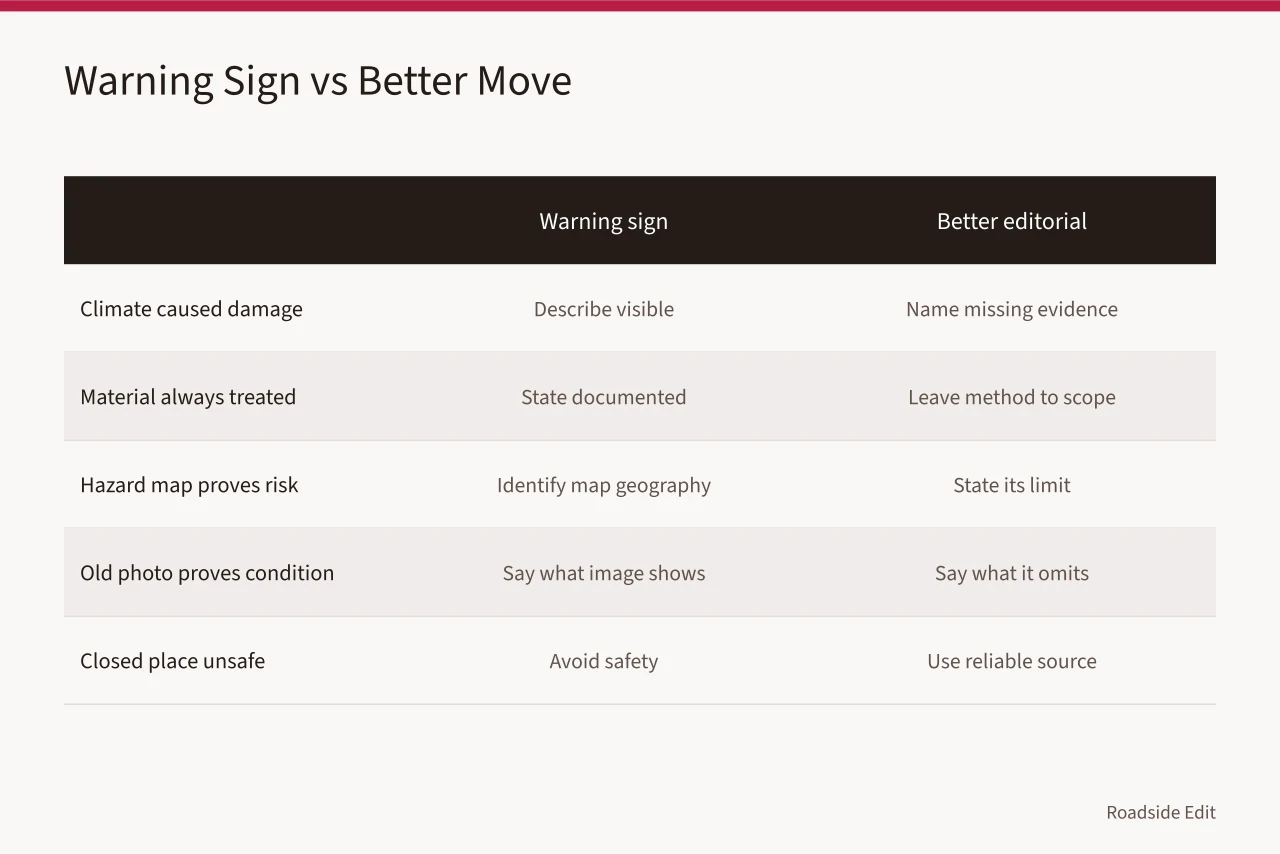
| Context record says | A property article may say | It may not say |
|---|---|---|
| A county has a stated data category | The source reports that county category | The source proves a site condition |
| A station records weather data | The station's stated data are available | The station caused a building change |
| A planning tool calls for assessment | More local review may be appropriate | A project decision has been made |
Keep readers and properties safe
Do not use a regional story to send readers toward a vacant or closed place. Omit private contact details, entry paths, unpublicized access points, and descriptions that could make a site easier to enter. If a visible concern appears to affect public access, remain at a safe, lawful distance and use the reporting path that applies to that location.
NPS guidance on mothballing historic buildings places documentation and condition assessment before stabilization decisions. Review NPS Preservation Brief 31. The source is not a field instruction for passersby. It supports the basic caution that a preservation response follows evidence and appropriate assessment.
This caution also improves captions. A caption can identify the place, date, photographer or source, and the feature shown. It should not quietly add a conclusion that the body of the article could not support.
Common questions
Does a regional climate article prove a local repair need?
No. It can offer context, but a repair need requires evidence about the actual property.
Can a material be identified from a photo?
Only when a reliable source supports the identification. A visual impression should remain an observation.
Why keep treatment advice out of a regional article?
Treatment depends on property evidence, project scope, and qualified judgment that a broad article does not have.