Guides
Part of Before you write about roadside architecture, check the local record
Roadside architecture regional questions before you trust a property claim
A question log for roadside architecture separates what a photo shows, what a record proves, and what only a local preservation board can decide.
What to take away
- A question earns its place in a draft only when it names a place, a feature, a date range, and the source that would settle it.
- Four groups cover the work: observation, context, record, decision. Keep them apart, because each needs different evidence.
- Every log entry carries a trigger, the evidence in hand, its limit, and the publication choice that follows.
- A national dataset sets regional context. It never dates a canopy, a sign face, or a roof.
- When nothing answers the question, keep it in the research file and strip the implied answer from the draft.
Ask what place the sentence concerns
A phrase like "desert roadside architecture" or "coastal motel" hides its subject. Name the property or community, then name the feature. A canopy soffit, a dry-stand pipe, a pump island footprint and a neon tube each need different evidence.
| Question | Why it matters |
|---|
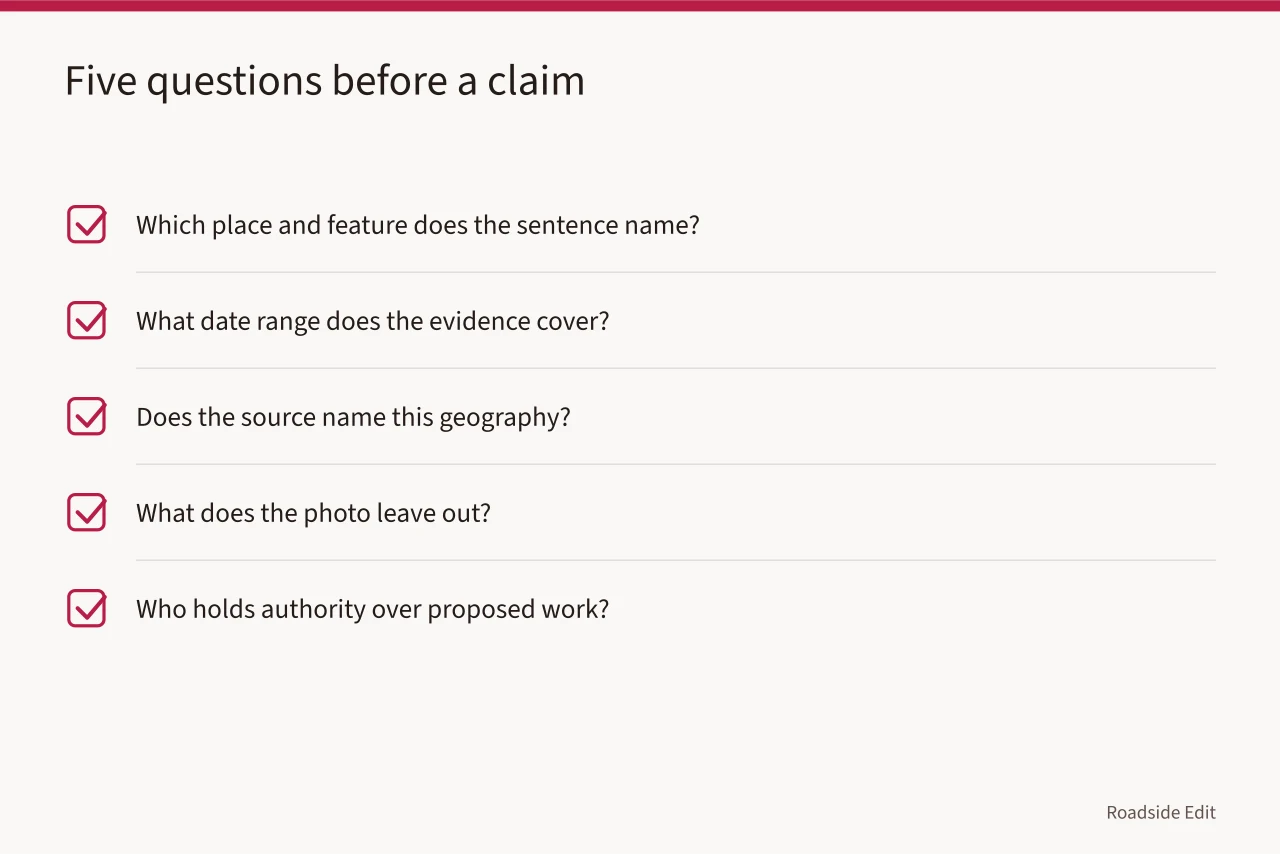
The National Park Service notes that changing weather patterns add pressure on cultural resources, historic buildings among them. Read NPS on climate and cultural resources. That is regional context. It does not explain why one station sign face or motel brick veneer looks the way it does.
Put questions in four groups
Grouping shows which questions are answerable today and which need another kind of evidence.
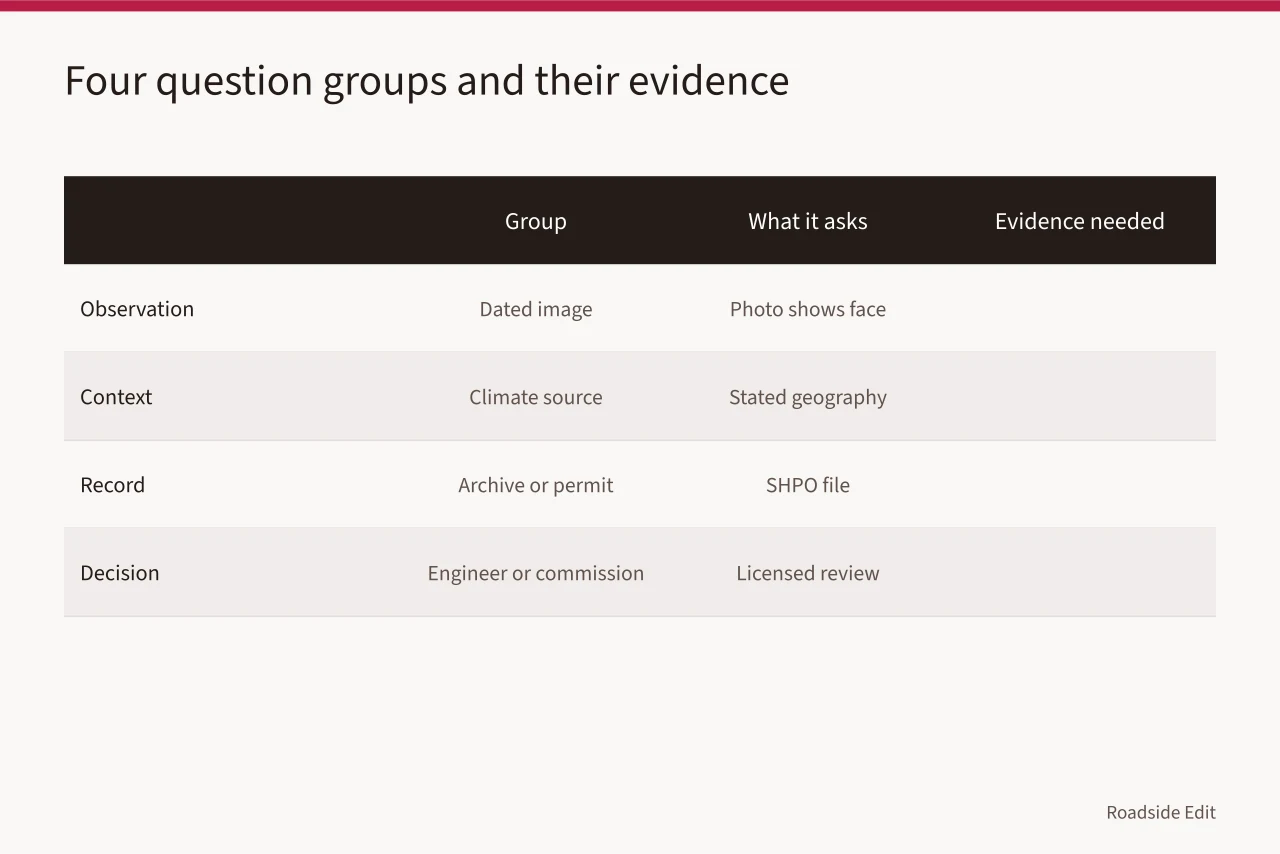
- Observation. What does a dated, lawful image show? Is the porcelain-enamel face intact, or has it been over-painted?
- Context. What does a climate or hazard source say about its stated geography and period?
- Record. What does an archive, permit, SHPO file, or owner statement actually say about the property?
- Decision. What work should occur? That needs the licensed engineer, the electrician, or the local landmarks commission, not a public observation.
NOAA Climate Data Online searches historical observations and climate normals by station and location. Check NOAA Climate Data Online. Use it to fill a context question, never to diagnose a wall, a roof, or a foundation.
Build the log so another editor can use it
Each line states why the question exists. The trigger might be a current photo, a dated historic image, a public notice, or two records that disagree. Evidence and gap sit in the same entry, so nobody later lifts the question into a caption as fact.
| Log field | Example |
|---|---|
| Question | "Does a local record date this box sign's installation?" |
| Trigger | "An undated caption conflicts with a dated photo." |
| Evidence | Archive item, local exterior image |
| Limit | "No permit or owner statement located." |
| Publication choice | "Describe the sign without stating its age." |
The Secretary of the Interior's Standards for heritage documentation call for reliable sources and stated limitations, so a record can be checked independently. Review NPS documentation standards. Treat that as a writing rule: the log makes uncertainty visible instead of burying it under confident language.
Decide what goes in print
A draft can note a missing permit or an unresolved installation date when readers need that limit to follow the story. It should not raise a question just to make a place seem mysterious. Leave out private contact details, entry instructions, and speculation about a closed property.
FEMA describes its National Risk Index as a way for communities to communicate risk and decide where finer assessment is needed. Read FEMA's National Risk Index documentation. It cannot say whether one canopy or one dry-stand pipe needs work. That question still needs local records and review by the authority having jurisdiction.
A 1950s porcelain-enamel station sign with chipped lettering raises an observation question about the face and a record question about the fabricator; the repair scope belongs to a decision question.
A motel with brick veneer and a butterfly roof raises a context question about the decade and a record question about the original drawings.
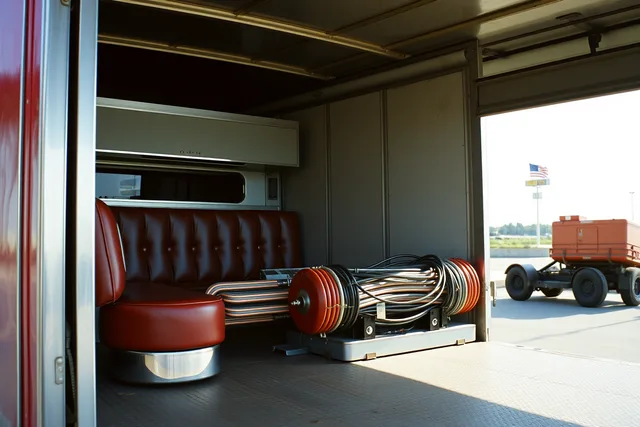
Salvage sourcing adds its own column. A booth or a set of neon tubes bought from Canada carries customs paperwork, and the duty figure is set by the customs broker and the applicable tariff, not by the article. Record the source, the date, and the paperwork in the log.
The regional question set for historic motel exteriors follows the same four groups. A neon sign restoration plan turns the decision group into survey days, travel, and fabrication line items.
When no suitable answer exists, keep the question in the research file and cut the implied answer from the draft. Later captions and updates stay honest that way.
Common questions
What if a national source sounds relevant but names no local area?
Use it as labeled general context and nothing more. It cannot support a finding about one property.
Can a historic photo answer a climate question?
It may show past appearance. It does not establish weather history, exposure, or cause.
Should an unresolved question appear in the article?
Only when the uncertainty matters to the reader, and only when the article says so plainly. Otherwise it stays in the research file.