Guides
Part of How a modern roadside design planning workflow keeps 2027 projects on track
Roadside design planning questions to ask before 2027 projects advance
Modern roadside planning questions for 2027 help U.S. teams ask about site context, routes, water, utilities, operations, and evidence before advancing ideas.
The right early question can prevent a polished concept from hiding a basic gap. Use these prompts to collect information, not to make a site finding. A public article should retain the question and its evidence boundary while keeping private operational details in the project file.
What to take away
- Questions should identify an information need, not imply an answer.
- Ask what is documented before asking what should be purchased.
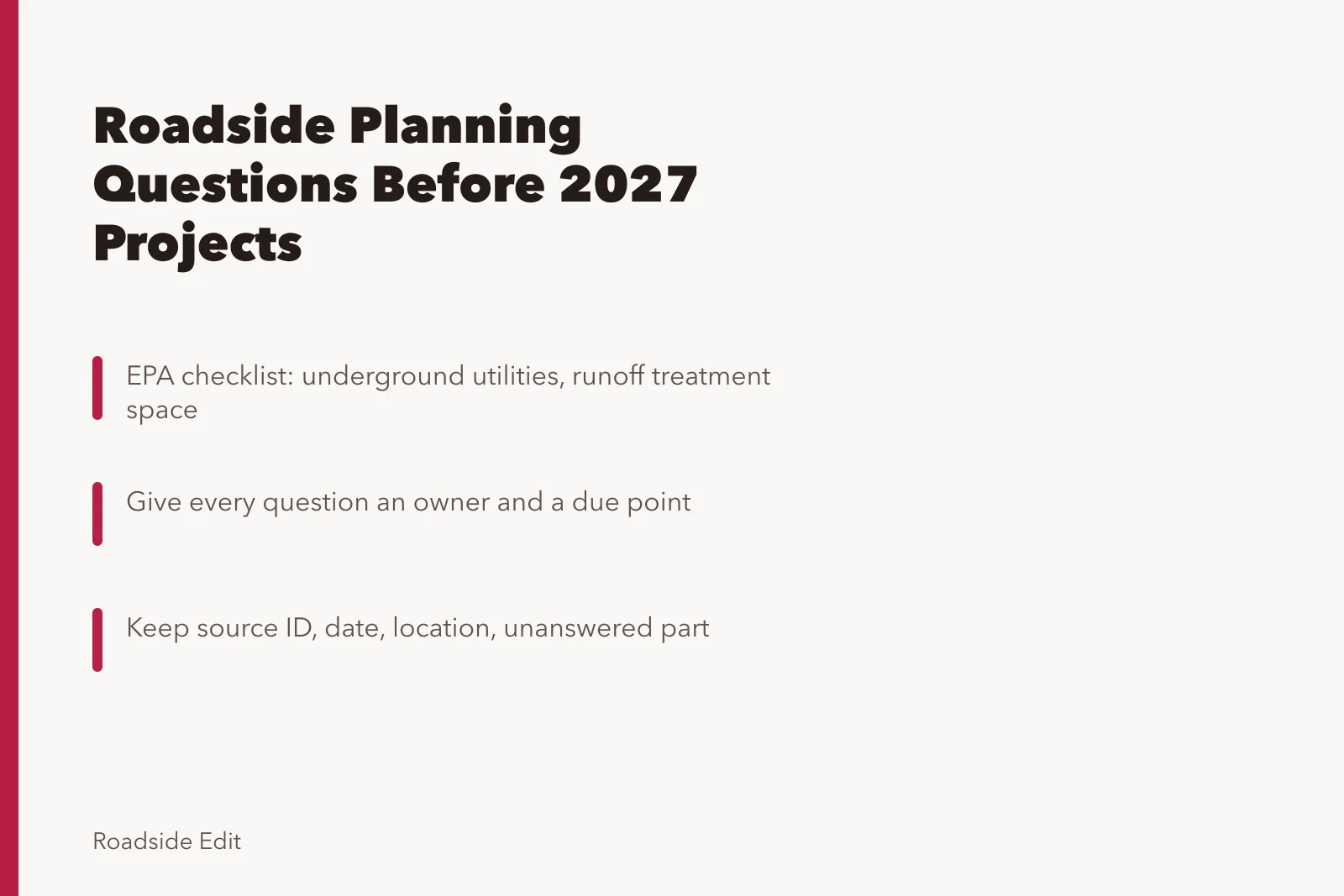
- Give every question an owner and a due point.
- Record unanswered questions rather than treating silence as confirmation.
Ask about the physical setting
EPA's Green Streets Handbook includes a site-design checklist that asks planners to consider conditions such as underground utilities, runoff treatment space, and early community participation. Review the EPA planning checklist. It is not a universal design prescription, but it offers useful categories for a preliminary question list.
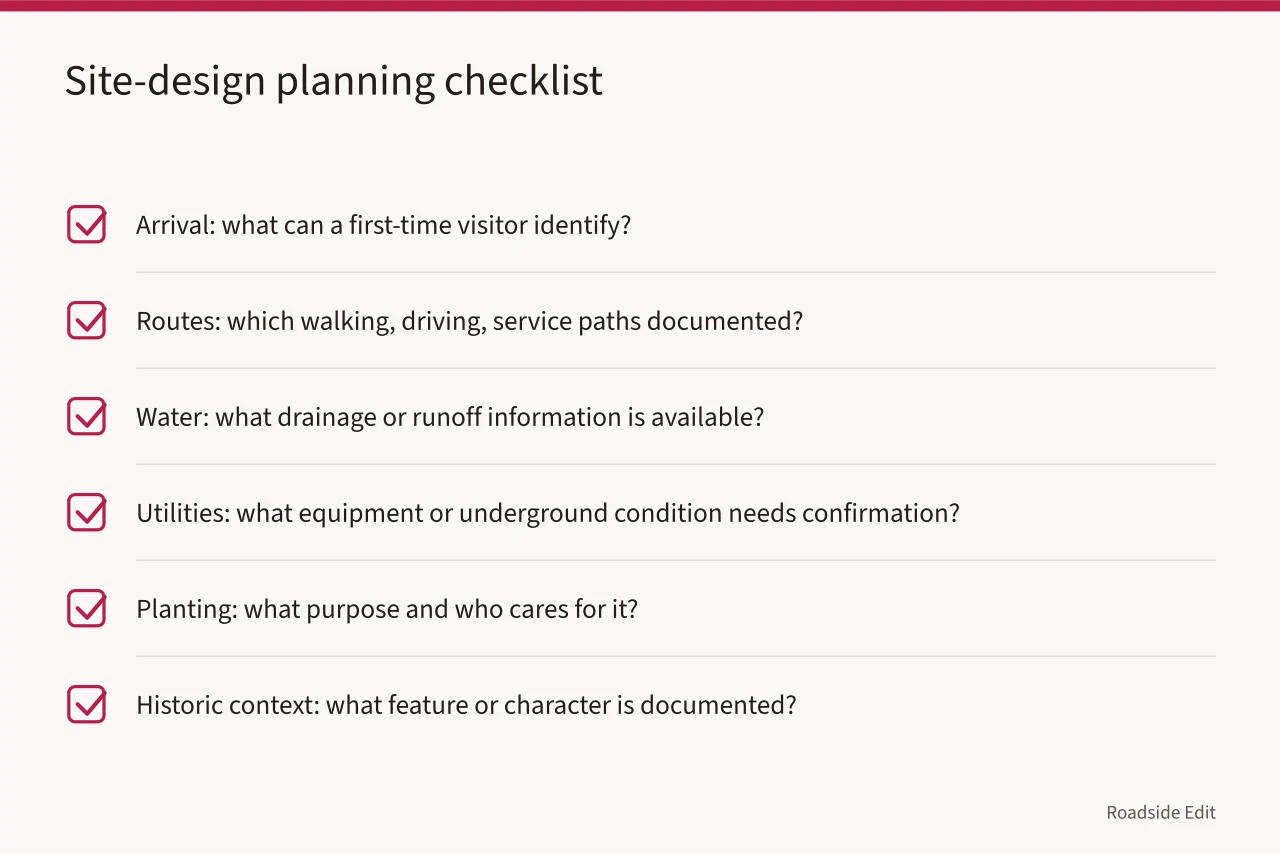
| Topic | Planning question | Helpful record |
|---|---|---|
| Arrival | What can a first-time visitor identify from the approach? | Dated street and entry photos |
| Routes | Which walking, driving, and service paths are documented? | Route sketch with unknowns marked |
| Water | What drainage or runoff information is available? | Existing plan, observation, or referral note |
| Utilities | What equipment or underground condition needs confirmation? | Current record or explicit information gap |
| Planting | What purpose would planting serve and who would care for it? | Maintenance responsibility note |
| Historic context | What feature or character is actually documented? | Specific source, not a style label |
Ask about decisions and people
Questions about a site need an owner. "Who can confirm this?" is not bureaucracy. It prevents a public statement from becoming more certain than the record allows.
- Who may authorize the next investigation or concept?
- Who can describe current operations at the relevant time of day?
- Who should be consulted before a route, sign, plant, or surface is represented as a change?
- What business, vendor, or sponsor has an interest that requires a clear label?
- Which question belongs to an outside reviewer rather than to an article writer?
Keep personal contact details, access protocols, security procedures, and unverified cost statements out of a public question list. The public version can say that a matter requires confirmation without revealing sensitive facts.
Test the question itself
A good question is narrow enough to answer from a named record or to assign for review. Replace "Is the site safe?" with "What documented condition, route, or hazard question requires the next review?" Replace "Will a new sign fix the entrance?" with "What action must a visitor recognize, and what evidence shows the current cue is unclear?"
Preserve sources and limits with the question
The NPS documentation standards require reliable sources and clear limits. Keep the source ID, date, location, and unanswered part with every question. A concept image can identify an idea. It does not settle a site finding.
The Federal Highway Administration pedestrian and bicyclist safety-audit guide describes an approach for reviewing conditions for people who walk and bike. It is general guidance, not a local site finding.
The National Archives digital-photo guidance supports retaining identifying information with a photograph. Describe it as an image of appearance at a date, not as proof of current performance.
When later evidence answers a question, add a dated response rather than overwriting the first gap.
Write questions in the order a reviewer can answer them. Identify the feature, location, and existing record first. Then ask what needs confirmation. End with the decision role. This sequence keeps a design preference from controlling the way later evidence is read.
Use one version date for the entire question set. When a source becomes stale or is replaced, add a note that identifies the update and its reason. A corrected question remains useful when the earlier wording and evidence boundary are visible.
Keep the original source file with the question ID for retrieval.
The next reviewer should be able to find the file without relying on a personal inbox, shared-memory note, or temporary link. This prevents a valid question from becoming an unsupported conclusion after the source is lost.
Common questions
Is an unanswered question a problem?
Not if it is recorded honestly with the person or process responsible for answering it.
Can a vendor answer every question?
No. A vendor may describe its offering, but site conditions and approvals require their own evidence and review.
Should questions appear in a public article?
Yes, when they help readers understand the limits of a planning discussion without exposing private details.