Guides
Part of How a modern roadside design planning workflow keeps 2027 projects on track
How to keep modern roadside design planning records clear in 2027
Modern roadside planning records guide for 2027 helps U.S. teams keep evidence, concepts, decisions, corrections, responsibilities, and public-content limits clear.
A planning record should help the next person understand what happened without reopening every conversation. It should show the source of a statement, its date, its status, its limit, and the person or role responsible for the next action. That is more useful than a folder full of images and file names with no context.
What to take away
- Keep evidence, proposals, decisions, and completed work in separate records.
- Date every observation and identify its source.
- Give corrections a visible log instead of silently changing the story.
- Maintain a public version that removes sensitive details and labels commercial roles.
Use a simple record register
The National Archives describes its Universal Electronic Records Management Requirements as high-level business needs and says final requirements should be tailored with records-management, acquisition, and IT personnel. Review NARA's records-management requirements. A small roadside project does not need a federal system, but it does benefit from clear fields and an agreed method for keeping the current record.
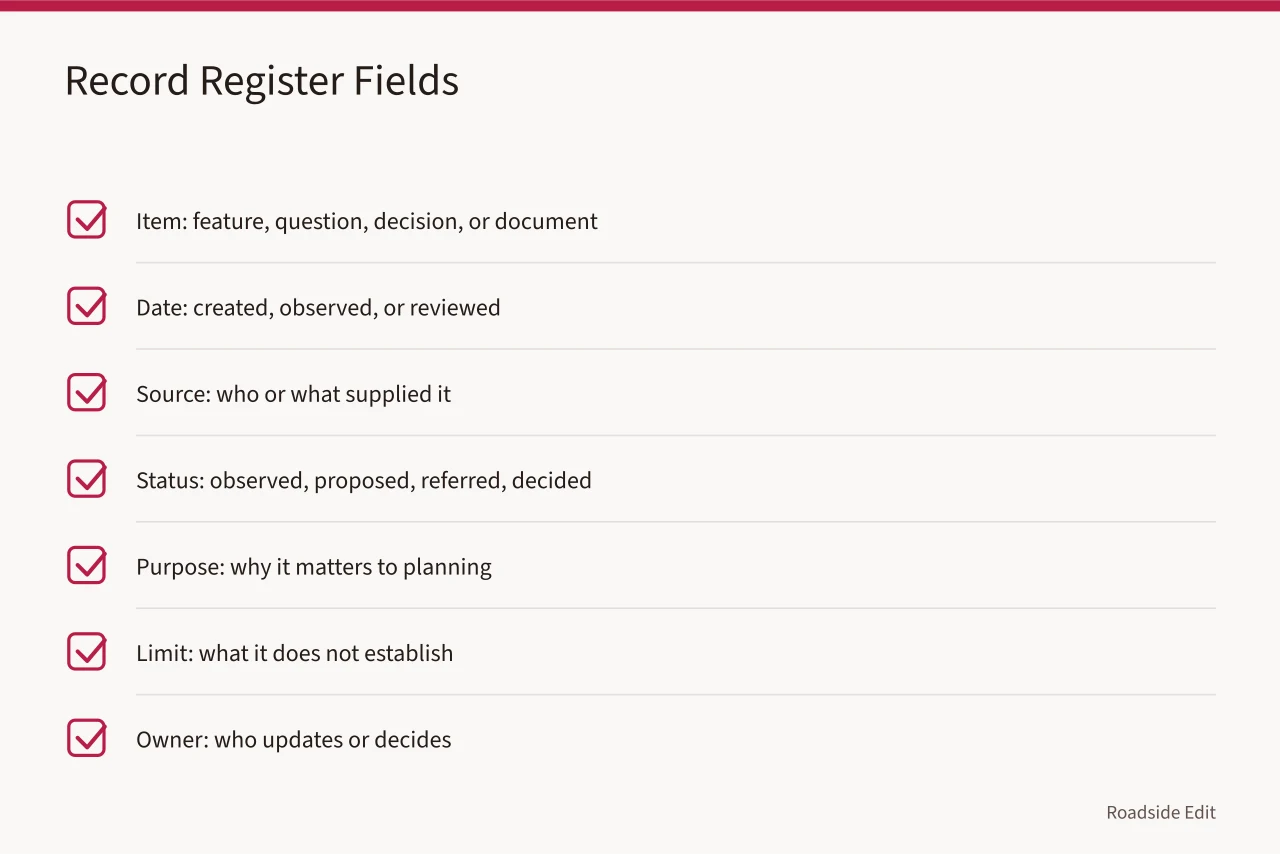
| Record field | What it answers |
|---|---|
| Item | What feature, question, decision, or document is this? |
| Date | When was it created, observed, or reviewed? |
| Source | Who or what supplied the information? |
| Status | Observed, proposed, referred, decided, corrected, or reported complete |
| Purpose | Why does the record matter to the planning task? |
| Limit | What does this record not establish? |
| Owner | Who updates it or decides the next action? |
| Public use | Can it be published, summarized, or kept restricted? |
Keep four folders, even if they are digital
Existing conditions holds dated observations, drawings, source material, and unanswered questions. It should not include a proposed change as if it already exists.
Concepts and options holds sketches, alternatives, and the purpose each option is meant to serve. Every concept needs a status label and an evidence limit.
Decisions and revisions holds decision notes, responsible roles, dates, reasons, and corrections. A change should be added as a revision rather than erasing the old decision.
Public material holds the article-ready explanation, image credits, editorial disclosures, and source links. Remove personal information, security details, confidential terms, and claims that have not been verified for publication.
Make corrections routine
A record may change because a better photo, a current survey, an owner decision, or a reviewer correction becomes available. Add the corrected statement, date, source, and scope of the change.
If a source is withdrawn or a business requests a factual correction, preserve the reason for the update. This makes public articles easier to maintain and paid placements easier to label without confusing them with the site record.
Preserve source roles in the register
The National Archives guidance for digital photographic records explains why photographs need identifying and descriptive information. Keep the source page, record ID, date, depicted location, and caption. A media credit identifies image origin. It is not evidence of an unrelated current condition.
The NPS documentation standards require sources and limitations that allow later verification. Identify whether each item is an observation, concept, decision, reported completion, correction, or media credit. The role determines what the item can support.
The NPS historical documentation guidelines discuss reporting results and identifying records. A correction entry should name the old statement, new source, date, and exact change.
Before a handoff, compare the draft with the register. Confirm that every image has its correct credit and that private details are absent from public copy.
Use stable IDs throughout the draft, source register, image folder, and correction log. This reduces a common handoff mistake: a correct citation or credit becomes attached to the wrong feature after a file is renamed or replaced.
Keep a brief update note at the top of the register. It should say which records were added, changed, or withdrawn and the date of the review. This helps the next editor find the current material without treating an earlier source as current evidence.
Record the name or role of the reviewer.
Common questions
What is the most important record field?
Status. It tells a reader whether the item is an observation, an idea, a decision, or a reported completion.
Can a vendor brochure be an evidence source?
It can document what the vendor says about its offering. It does not prove a product is suitable, approved, or installed at a particular site.
Who should own the record register?
Use a named person or role with authority to update the file and route questions to the appropriate reviewer.