Guides
Part of How a modern roadside design planning workflow keeps 2027 projects on track
How modern roadside planning workflow warning signs catch weak evidence
Warning signs in a roadside planning file mark missing routes, unsourced claims and untraceable decisions before they harden into construction documents.
A porcelain-enamel station sign and a plastic-faced box sign from the same decade photograph almost alike in a survey shot. The enamel carries its maker's mark and a firing date in the flange.
The plastic face carries a screen-printed logo and nothing else. A planning file works the same way: the claim that looks finished is often the one with no record behind it.
What to take away
- A rendering is a proposal, not a survey. Record the existing route separately from the drawn one.
- The FHWA Roadside Design Guide supplies state-of-practice method, never a finding about your site.
- A cited source that explains a general method does not certify a local result.
- Give every claim a status: approved, under review, or held for a source.
- When a correction lands, date it and keep the earlier wording visible.
The clear-zone reference is a method, not a verdict
The FHWA clear-zone overview describes policy approaches for hazards: relocate, modify, shield, or delineate. Read FHWA's clear-zone overview. That is a menu of treatments, not a determination about a specific shoulder, culvert end or utility pole. Site-specific safety decisions belong with the licensed engineer and the authority having jurisdiction, working from the current adopted standard.
The same limit applies to any source you paste beside a claim. A guide can tell a reader how clear zones are normally measured. It cannot tell a reader what the clear zone is at your property.
Warning signs that a claim has outrun its record
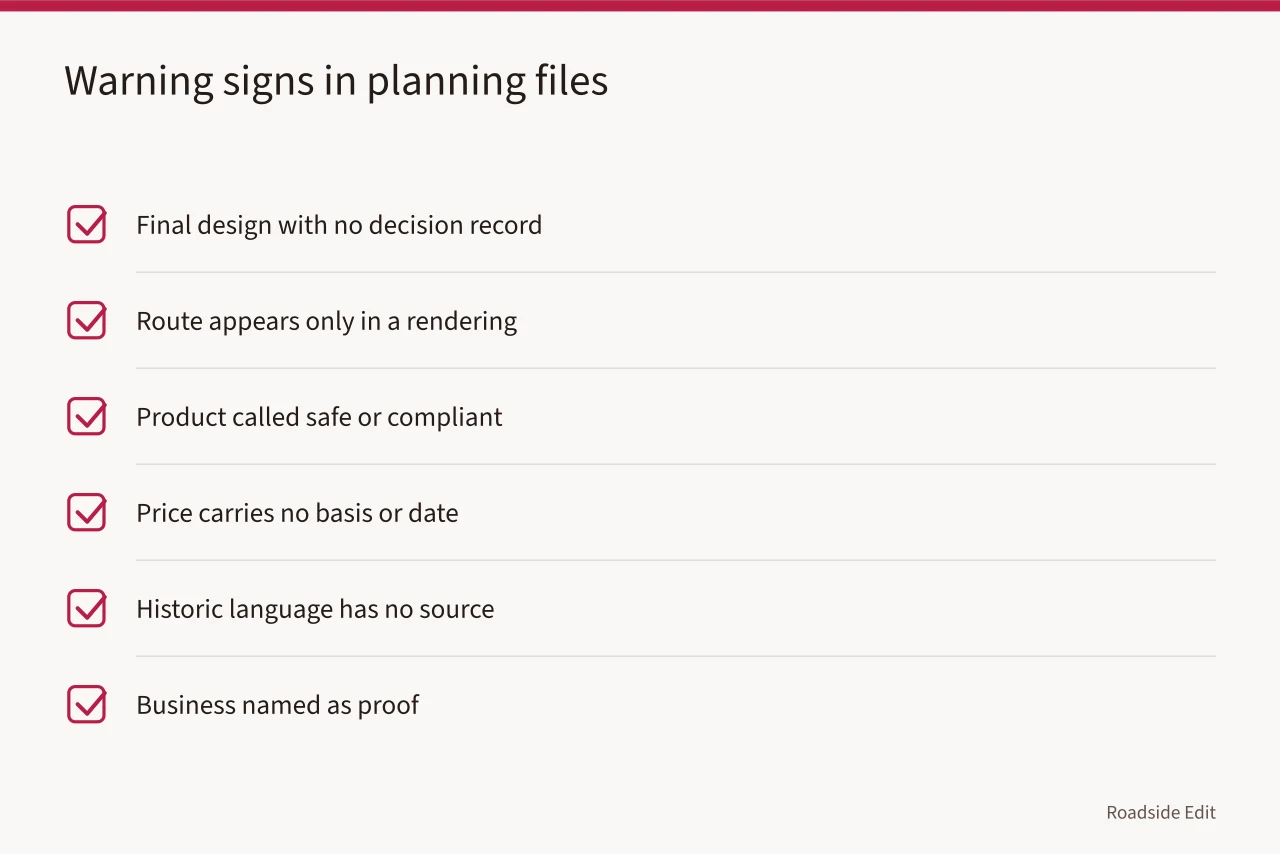
| Warning sign | Why it matters | Better next step |
|---|---|---|
| "The design is final" with no decision record | A concept gets mistaken for an approval | Label the status and name the open review |
| A route appears only in a rendering | The drawing may omit barriers or conflicts that exist | Survey and record the existing route separately |
| A product is called safe or compliant | The claim exceeds what the file supports | Describe the feature and refer the question to the AHJ |
| A price carries no basis or date | Readers treat a placeholder as a current commitment | Add basis, status and a change trigger |
| Historic language has no source | Style language hardens into a false preservation finding | Cite a specific record or cut the claim |
| A business is named as proof | A vendor role is not site evidence | Identify it as provider, source or paid listing |
Dating the evidence the way you date a sign
Preservation work already has the habit this file needs. You date a motel exterior by its brick veneer, its curtain-wall glazing or its butterfly roof, and you write the date down with the feature that produced it.
Do the same with a planning claim. The NPS documentation standards ask for reliable sources with limitations stated clearly enough for someone else to review.
A source that explains a general method sits beside the general statement. The local question stays open.
The EPA Green Streets Handbook covers site design and green infrastructure for roads, alleys and parking lots. It does not approve an individual site or promise a performance result, and a planning article should say so.
The NPS historical documentation guidelines treat source identification and reported results as one record. Keep the prior source ID visible in the working file even after a correction.
Hold the sentence, not the project
An unsupported claim goes on hold. The hold names the source or reviewer needed before the wording can advance, and it lives in the private review file with a date.
Example: "The project file identifies an entrance-orientation question for further review." That sentence states an open question. It does not say the entrance is unsafe, noncompliant or approved.
When evidence arrives, publish a correction that says what changed. Do not quietly swap the wording where a reader may have relied on the earlier version.
Then re-read the whole article: one new source often unsettles several sections, particularly when an early concept or cost note was reused.
The gas station regional preservation warning signs file shows how far a single uncorrected claim can travel.
Keep a correction log
Four fields carry the whole system: date, the changed statement, the source of the correction, and who owns the update. Keep it with the source register and hand it to the next editor.
That log is also the cheapest defense against scope drift, where added requests change the work with no new decision or stated boundary. A dated line showing what was agreed, and when, settles most of those arguments without a meeting. For the design side of the same problem, see thoughtful approaches to modern roadside design.
Common questions
Does a warning sign mean the project should stop?
Not necessarily. It means the issue needs clearer evidence, a named owner or a review before any claim advances.
Can a photograph establish a route condition?
It documents what was visible when the shutter opened. It rarely shows dimensions, operations or current conditions, so pair it with a dated survey.
What is scope drift?
Added requests that change the work without a new decision, record or stated boundary. A dated correction log catches most of it early.
Who decides whether a claim is safe to publish?
The editor holding the file, advised by the licensed engineer, the State Historic Preservation Office or the local landmarks commission as the question requires.