Guides
Part of Roadside architecture cost plan: how to document every estimate version
How to build a roadside architecture funding file that tracks the whole grant lifecycle
Roadside architecture funding file guide for 2027 shows how to separate possible grants, applications, awards, payments, conditions, and reporting records.
A funding file prevents a common error in public project writing: treating an idea, application, award, payment, and completed grant as if they were the same thing. They are not. A clear file shows what has been requested, what has been approved, what conditions apply, and which part of the scope the money can support.
What to take away
- Give every funding item a status and date.
- Retain the notice, agreement, approved purpose, and reporting requirements together.
- Do not describe an application as funding or an award as unrestricted cash.
- Compare each award with the current scope before publishing a funding claim.
Track the grant lifecycle, not just the amount
Grants.gov separates the grant lifecycle into pre-award, award, and post-award phases.
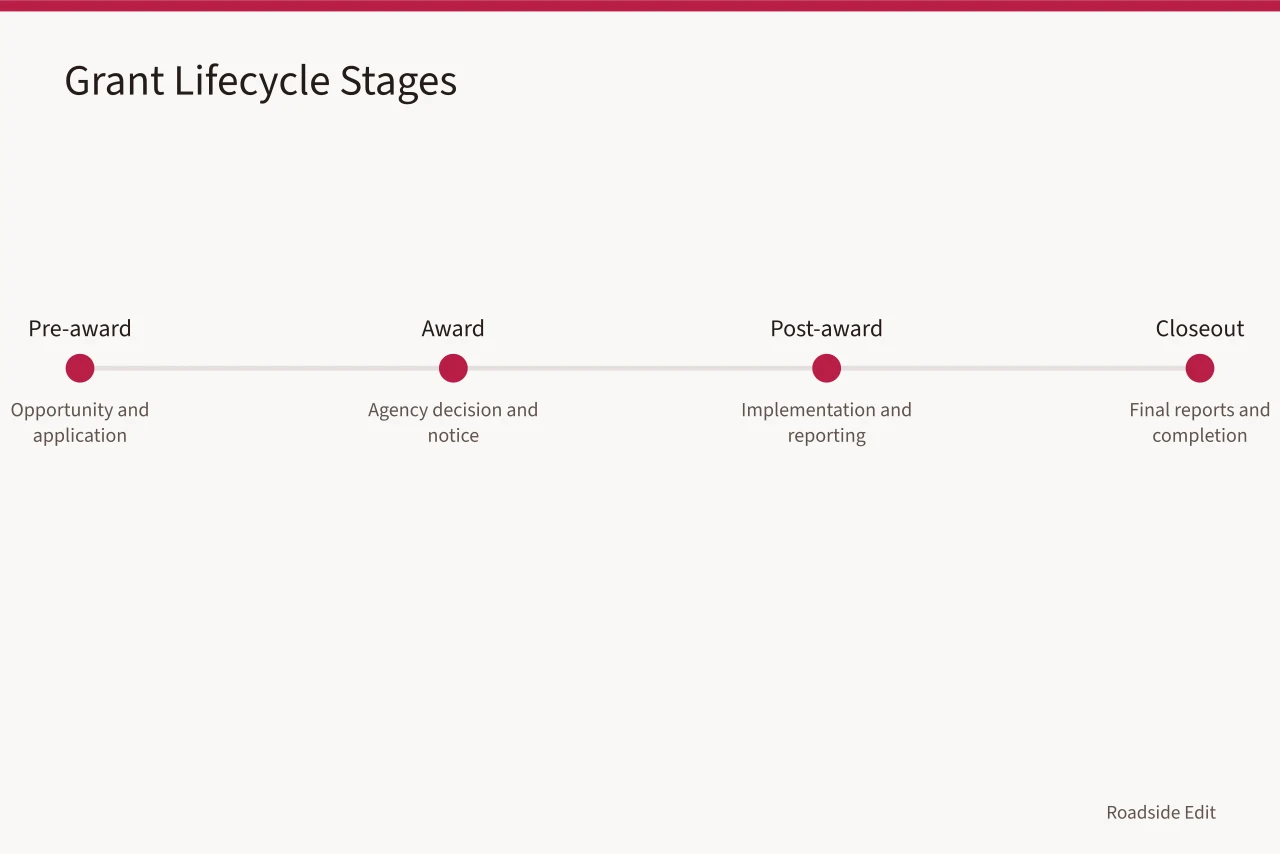
The process starts with an opportunity and application. It then moves through agency decision, implementation, reporting, and closeout. Read the Grants.gov overview of the grant lifecycle. A funding file should show these stages so readers know if a project has only applied, received an award notice, or completed funded work.
Use plain status labels. They make public wording much safer.
| Status | Meaning in the file | Safe public wording |
|---|---|---|
| Possible | A program or donor may fit the project | "The team is reviewing possible funding sources." |
| Submitted | An application was sent | "The team applied for the program." |
| Awarded | An official award notice or agreement exists | "The award notice approves funding subject to its terms." |
| Received | Funds have been made available under the agreement | "The project received funds for the approved purpose." |
| Closed | Required work and closeout steps are complete | "The grant period has closed." |
The official Notice of Award is the legally binding issuance of a federal grant, according to Grants.gov. See Grants.gov's explanation of an award notice. A news release, a congratulatory post, or a successful application screen is not the same document. Keep the actual notice or agreement in the project file before you make a public funding statement.
Connect each funding item to an approved purpose
Money has a purpose. An award may cover research, survey work, design, construction, documentation, staffing, or another defined activity. The funding file should quote or summarize the approved purpose without stretching it to cover later work.
The National Park Service explains that Historic Preservation Fund application materials identify activities and eligible applicant organizations. Full details are in the notice of funding opportunity. Review NPS guidance on applying for Historic Preservation Fund grants.
A general program description is not enough for an individual site. The current opportunity and its award documents control the claim.
| File field | What to record |
|---|---|
| Funder and program | Exact program name and link to the specific opportunity |
| Status date | Date of application, notice, payment, or closeout |
| Approved purpose | The work described in the notice or agreement |
| Amount | Award amount, payment amount, or planning range, labeled correctly |
| Conditions | Match, review, procurement, access, reporting, or deadline requirements |
| Evidence | Notice, agreement, public allocation record, or authorized statement |
Do not combine awards with different terms into a single "project funded" figure. A survey award and a repair award may be related, yet one may not pay for the other. Keep separate rows, then add a total only when the rows describe the same approved scope.
Keep conditions with the award record
Conditions often determine when a project can proceed. The National Park Service notes that grant agreements can require periodic financial and progress reports, draft products, plans, specifications, and approvals before a project moves forward. Read the NPS grant-requirements guidance. Record these conditions in the funding file rather than leaving them in an email thread.
Before any public update, reconcile the file against the latest scope. If a grant supports documentation but the article says repairs are funded, correct the article. If matching funds are pending, say that they are pending. If a donor's name is private, do not expose it in a public source log.
Prepare for reporting and closeout early
Federal grant closeout can require final financial, performance, and other reports. See Grants.gov's overview of post-award reporting and closeout. The exact duties depend on the agreement, but the working habit is universal: save the source documents, record deadlines, and keep the approved scope beside each report.
That organization also helps editorial work. A writer can state a funding fact in one sentence, with the correct status and purpose, instead of repeating an old announcement after terms have changed.
Review the file before publishing a funding claim
Open the source document again and confirm the named recipient, program, amount, status date, and approved use. Then compare the article sentence with the source.
A grant claim should answer four reader questions: who received it, what the record calls it, what work it covers, and whether the agreement still has conditions. If the record cannot answer those questions, reduce the statement or wait for an authorized public record.
For private support, publish only what the donor and project lead have approved. The source file may contain contact details, banking information, or restrictions that have no place in an article. Keep a public-ready summary separate from the full working record.
Common questions
Does a submitted application mean a project is funded?
No. It means an application has been submitted. A project is awarded only after the funding agency issues its official decision and award documentation.
Can one grant pay for all project work?
Only if the agreement and approved scope say so. Many awards limit eligible costs, require approvals, or set a specific period of performance.
What should happen when funding terms change?
Add a dated file entry, update the project status, and review any public statement that relied on the earlier terms. Keep the new document with the original award record.