Guides
Part of Roadside architecture cost plan: how to document every estimate version
How to write a roadside architecture budget narrative that holds up
Roadside architecture budget narrative for 2027 explains how to connect a defined scope, evidence, cost categories, assumptions, and public funding language.
A budget narrative explains why a defined project needs each requested cost category. It is not an advertisement, and it is not proof that a proposal will receive funding. A sound narrative connects the place, planned task, amount, evidence, and limits in language that a reviewer can compare with the scope and estimate.
What to take away
- Describe the place, task, and project stage before discussing money.
- Connect each cost category to a deliverable or documented need.
- State assumptions and exclusions where they affect the request.
- Call a request proposed until its official award record says otherwise.
Start with the project, not a slogan
Write a short factual description first. Identify the road-facing feature, building, sign, or corridor; the location; the evidence behind the need; and the work the request would support. Do not call a place an "icon," claim urgency, or promise a complete restoration unless a source supports those statements.
The National Park Service advises Historic Preservation Fund applicants to identify the resource, explain the proposed accomplishment, connect budget items to the narrative, and use a realistic timeline. Read NPS application guidance for preservation-fund projects.
A local narrative need not use an agency template, but it should give a reader the same connection between requested work and requested amount.
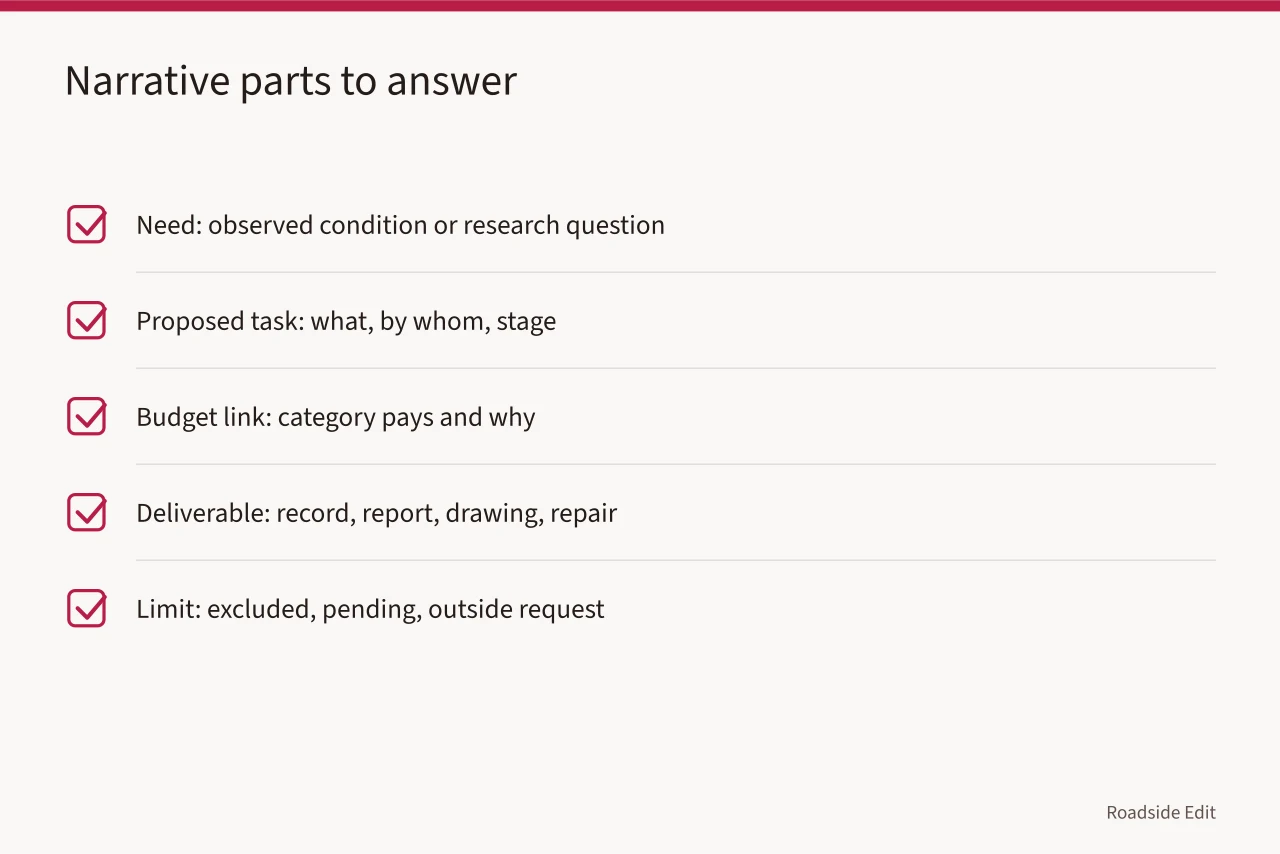
| Narrative part | What it should answer |
|---|---|
| Need | What observed condition or research question requires work? |
| Proposed task | What will be done, by whom, and at what project stage? |
| Budget link | Which category pays for that task and why? |
| Deliverable | What record, report, drawing, repair, or other result will exist? |
| Limit | What is excluded, pending, or outside the request? |
Make each amount traceable
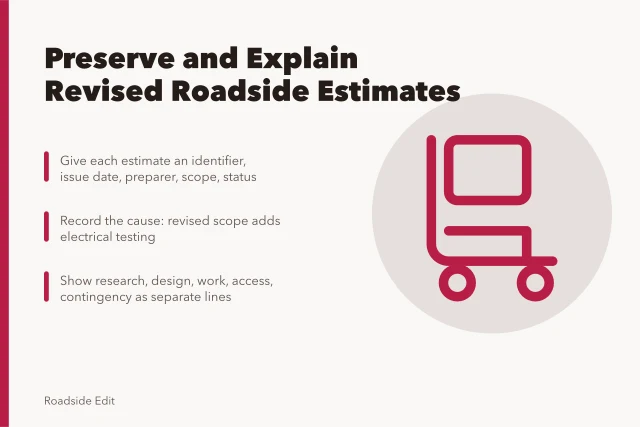
A reviewer should be able to move from a sentence in the narrative to a scope item and then to the estimate. If a narrative asks for access equipment, explain which task needs access. If it asks for research or design, identify the question or document the work will produce. If it contains contingency, state the uncertainty it addresses.
The Government Accountability Office's cost-estimating guide calls for a purpose, scope, technical baseline, assumptions, data, risk analysis, and documented results. See the GAO guidance on reliable cost estimates. It is broader than a roadside funding request, but the connection is direct: the narrative should not use a number that has lost its scope and assumptions.
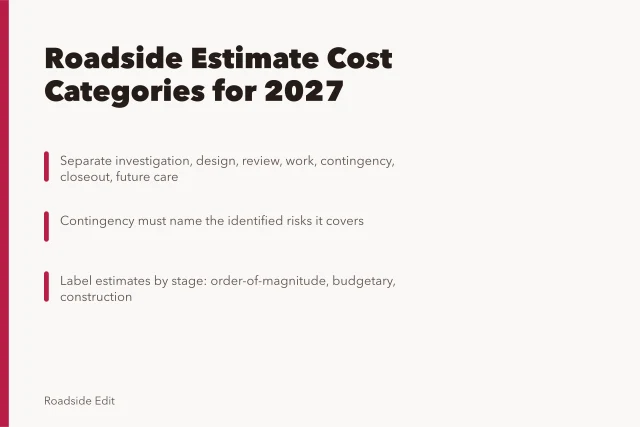
| Budget category | Narrative link |
|---|---|
| Investigation | Supports measurements, condition review, or research needed to define later work |
| Design and review | Produces drawings, specifications, alternatives, or required coordination |
| Implementation | Covers only the authorized work described in the current scope |
| Documentation | Keeps final images, reports, or change records for later reference |
| Contingency | Addresses named uncertainty that remains after available review |
Do not write "the project costs $X" if $X is only one phase. Write "the request seeks $X for the defined assessment phase" or "the estimate covers the listed sign work and excludes electrical work." Those sentences are more useful because they carry their limit with them.
Be accurate about applications, awards, and terms
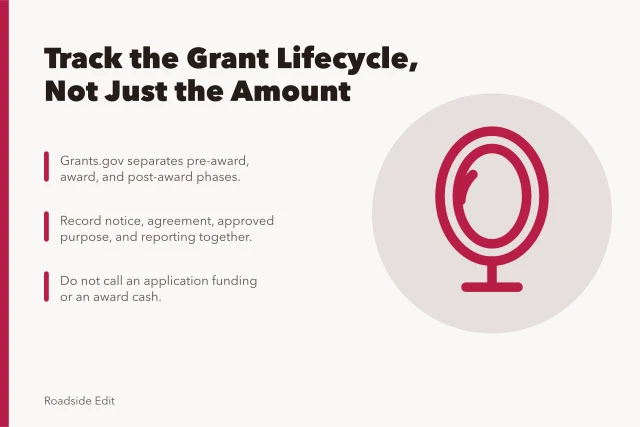
An application is an application. It is not a commitment by the funder. Grants.gov explains that a federal award begins when the awarding agency issues its official notice after completing the review process. See Grants.gov's award-phase guidance. Use that distinction in every public narrative.
The narrative should also match the current agreement when an award exists. NPS notes that grant agreements can require reporting, draft work products, plans, specifications, and approvals before a project proceeds. Review the NPS grant-requirements guidance. Do not write that work is funded and ready to start when the agreement still requires a review or approval.
Review the narrative against the file
Before release, compare every material claim with the current scope, funding record, estimate version, and permissions log. Check the recipient name, status date, approved purpose, public amount, and exclusions. Remove private contact details and nonpublic terms from the public version.
If the scope changes, change the narrative. Do not leave a previous explanation online because it reads smoothly. A short update that accurately states the current phase is more credible than a complete-sounding paragraph built on an older estimate.
Common questions
Does a budget narrative need every line-item price?
It needs enough detail to connect categories to real work. Follow the requirements of the actual funding source if one applies, and keep the complete estimate in the project file.
Can a narrative include a future funding request?
Yes. Label it as proposed and identify the work it would cover. Do not describe proposed money as an award or a received payment.
What if the project scope is still changing?
State the current scope version and its limits. Revise the narrative when that version changes rather than leaving an older explanation in circulation.