Guides
Part of Roadside architecture cost plan: how to document every estimate version
How roadside architecture cost categories shape a cleaner estimate
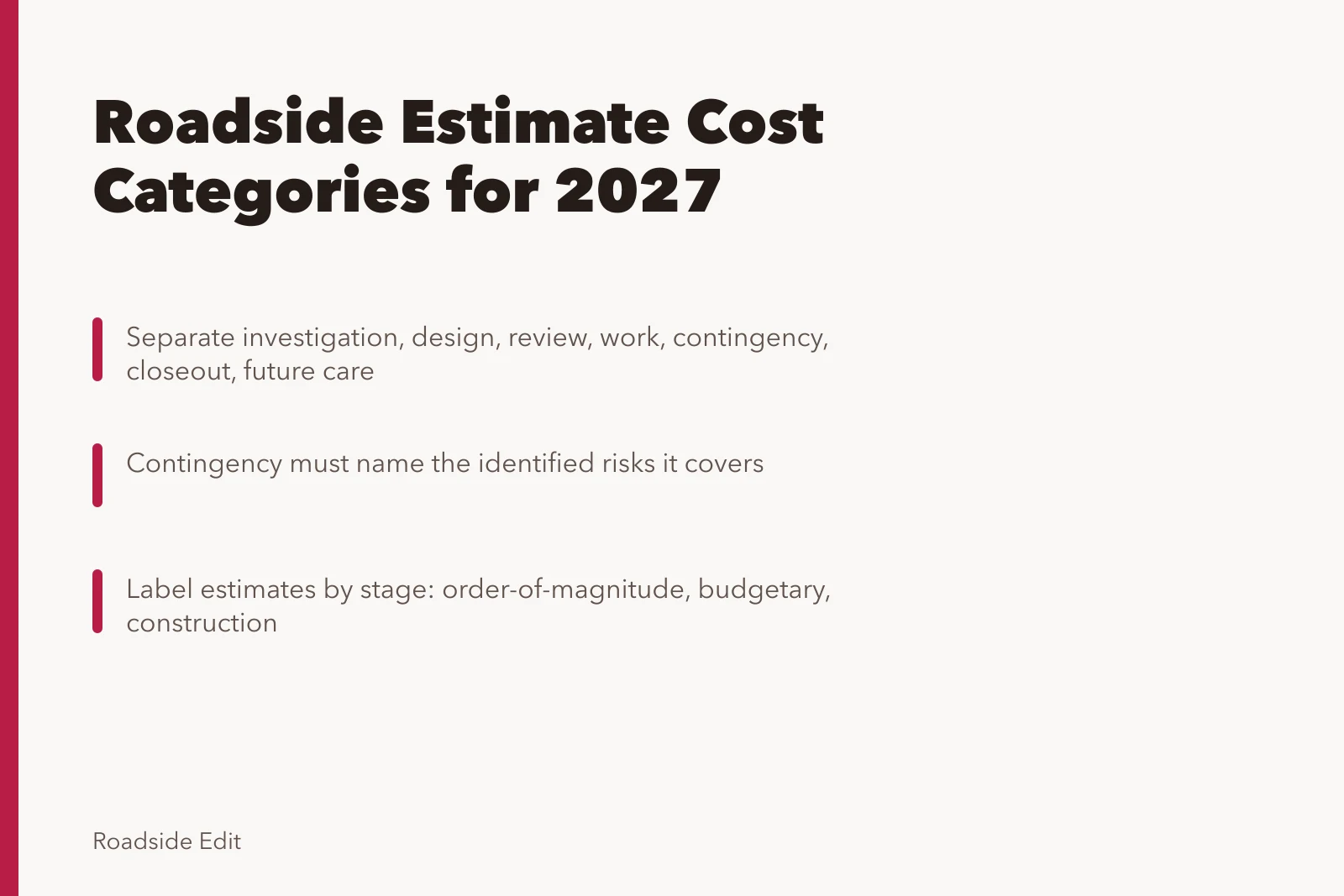
Roadside architecture cost categories for 2027 help teams separate investigation, design, review, work, contingency, closeout, and future care in a clear estimate.
A project total is only useful when readers can see what it contains. A visible repair may be one line in a larger effort that also needs research, access, design, review, permits, administration, documentation, and later care. Cost categories make those distinctions visible and keep a small construction subtotal from being mistaken for the full project cost.
What to take away
- Use category names that describe actual work and match the current scope.
- Separate work already spent, proposed work, and future care.
- Show contingency as a stated allowance for uncertainty, not as an unexplained extra.
- Keep the assumptions and date beside every estimate version.
Build the estimate around the work
The National Park Service says total project cost can include compliance actions, pre-design, final design, project management, contingency, and other project-related costs. Read NPS guidance on total project cost. That guidance is for a specific federal program, but it illustrates a useful editorial rule: a credible total should state whether non-construction work is included.
Start with categories that the team can explain in a sentence.
| Category | Typical use | Scope note to keep |
|---|
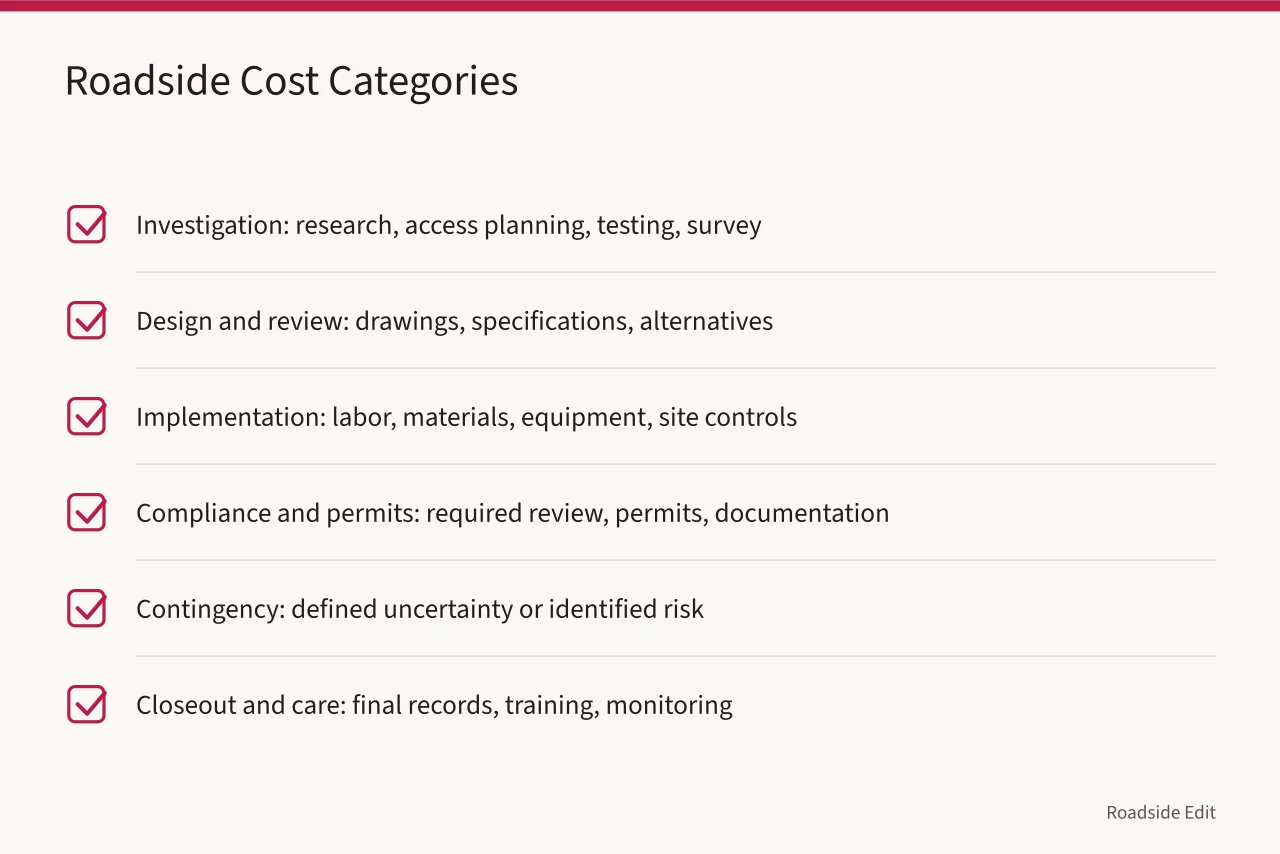
Do not move an uncertain item into construction merely to make the estimate look finished. If access is unconfirmed, if a material has not been tested, or if a design detail is incomplete, name that limit where the figure appears.
Treat contingency as a record of risk
Contingency is not a spare spending category. The Federal Highway Administration says a risk-allocated cost contingency should address identified risks. Construction estimates should show major elements, not one lump sum. See FHWA guidance on contingency management.
A roadside project may be smaller than those discussed there, but the principle holds: a contingency entry should tell the team what uncertainty it covers.
Use a risk note such as "allowance for concealed substrate condition; public-view survey only" rather than "miscellaneous." When more information arrives, update or remove the allowance and record why. That history explains a changing estimate better than a revised total with no notes.
Match the estimate stage to its confidence
Early figures need early-stage labels. GSA notes project estimates evolve as scope and available information become clearer, with distinct uses for order-of-magnitude, budgetary, conceptual-design, construction, and change-order estimates.
Review GSA guidance on how estimates change by project phase; the guidance gives a writer a practical test: Does the article call an estimate more precise than the available scope permits?
Keep a short basis-of-estimate note with every total.
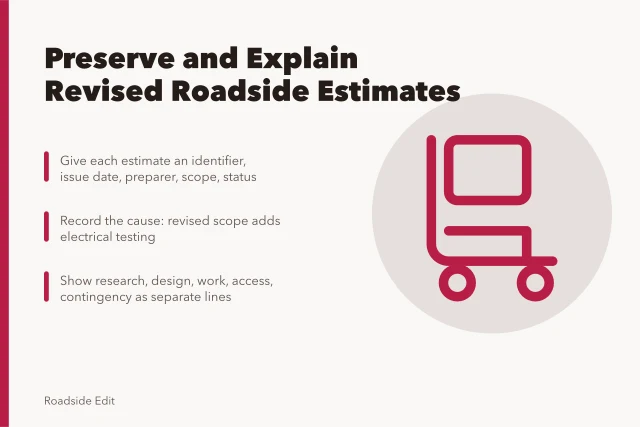
| Estimate note | Example |
|---|---|
| Date | September 2027 |
| Scope version | Public-facing sign repair concept, version 2 |
| Information used | Field photos, dimensions supplied by owner, no interior inspection |
| Exclusions | Electrical work, permits, tax, and future maintenance |
| Contingency basis | Unconfirmed backing material and access equipment |
This format also makes year-to-year comparisons honest. A 2027 "design" line and a 2028 "design" line may cover different tasks. Compare the scope notes before presenting a change as an increase or decrease.
Keep closeout and care out of the blind spot
The estimate should not end when physical work ends, and the NPS architectural-preservation checklist records treatment intent, approach, time and cost, field reports, and contract summaries. Read the NPS preservation review checklist.
For a small project, the file can be simpler, but it should still preserve dated final photos, approved changes, and a note of remaining care.
Before publishing a project total, ask four questions. Which scope version created it? Which categories are included? What does the contingency cover? What future responsibility is outside the number? If the file cannot answer them, present a narrower statement or wait for a revised estimate.
Common questions
Is contingency an unused pool of money?
No. It should be tied to uncertainty or risk documented in the estimate. It may change as the team learns more about the work.
Should maintenance appear in the first budget?
If future care is foreseeable, list it separately even when a first contract will not fund it. Readers should not assume that the contract covers all future needs.
Can two estimates use different categories?
Yes. Compare the scope, date, exclusions, and assumptions before comparing their totals. Category names alone do not make two estimates equivalent.