Guides
Roadside architecture cost plan: how to document every estimate version
Roadside architecture cost plan for 2027 explains how to define a scope, track estimate versions, manage uncertainty, document funding, and publish costs honestly.
A roadside architecture cost plan is a working record, not a universal price guide. It helps a team explain what a project number covers for a diner, motel, sign, filling station, or storefront.
The plan covers bridges and other road-facing places and connects the physical subject, proposed work, estimate stage, funding status, and unanswered questions. Without those connections, a number can look more definite than it is.
This guide covers editorial and project-record practices. It does not assess a building's safety, set a construction price, grant access rights, or replace advice from qualified project professionals.
What to take away
- Define the place and planned work before seeking or comparing a cost.
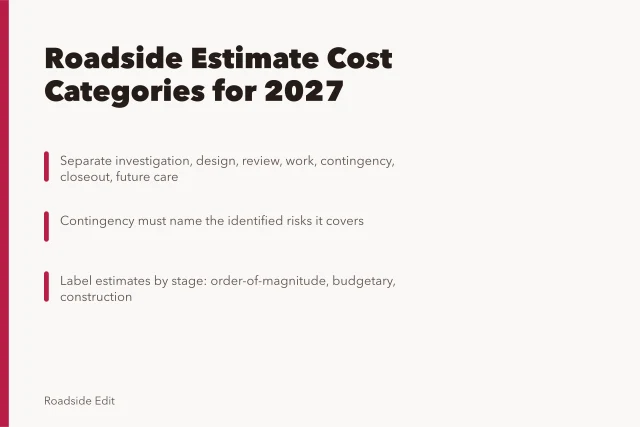
- Keep research, design, review, authorized work, contingency, and closeout in separate categories.
- Preserve earlier estimate versions with their scope, date, author, assumptions, and exclusions.
- State whether funding is possible, requested, awarded, received, or closed.
- Publish a cost figure only when the source, purpose, and limits can travel with it.
Start with a scope that describes real work
The first line of a cost plan should describe the subject and the task. "Prepare a condition assessment for the roadside neon sign from public and permitted viewpoints" is a scope. "Restore the landmark" is a slogan. The first sentence lets a reviewer ask what materials, access, records, and deliverables the work needs. The second leaves too much unsaid.
The National Park Service tells project teams to gather enough information to understand a project's components, identify the affected historic property, and define the area needing a current-condition assessment. Read the NPS historic-property project documentation guidance.
Its process is for NPS projects, but the basic sequence works at any scale: identify the subject, write the intended work, and list unknowns before calculating a total.
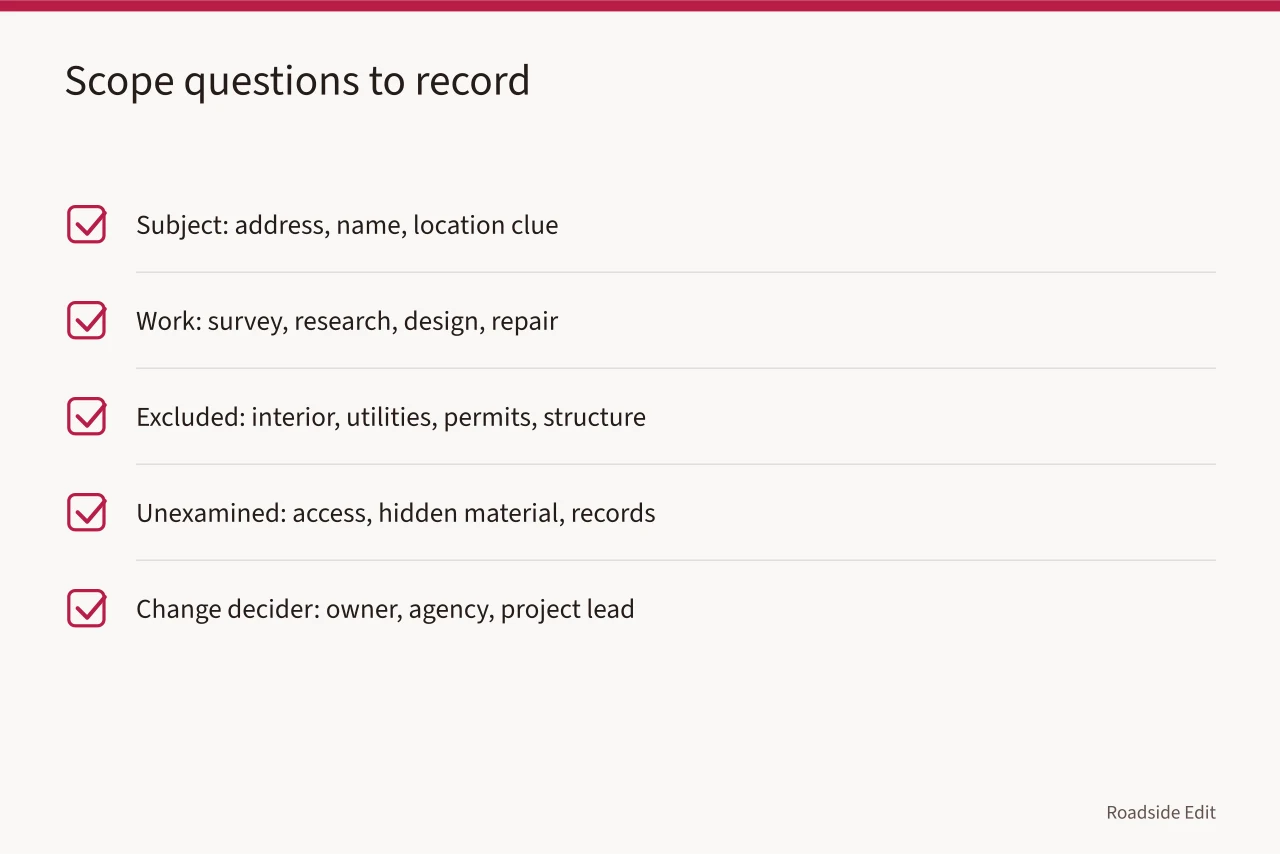
| Scope question | Record before estimating |
|---|---|
| What is the subject? | Address or coordinates, current name, and a stable location clue |
| What work is proposed? | Survey, research, design, repair, documentation, or another limited task |
| What is excluded? | Interior work, utilities, permits, structural work, or unapproved additions |
| What has not been examined? | Access limits, hidden material, measurements, or records still needed |
| Who decides a change? | Owner, agency, project lead, or another named role |
A clear exclusion is as useful as an inclusion. If a plan is for paint preparation on a sign face, it should not imply that it covers wiring, foundation work, traffic control, or future maintenance. Writers need that boundary before they use a project number in an article.
Separate the stages before combining the costs
Projects often move through discovery, assessment, options, review, authorized work, and closeout. The stages can overlap, but they should not be confused. A site visit is not a construction scope. A proposal is not an award. A contractor bid is not a completed cost.
The National Park Service describes preservation planning as an ordered process for identification, evaluation, registration, and treatment. It also says the scope should be defined so the activity can be completed with available resources. See the NPS preservation planning standards. A roadside team can apply this in plain language by giving each stage a separate deliverable and decision.
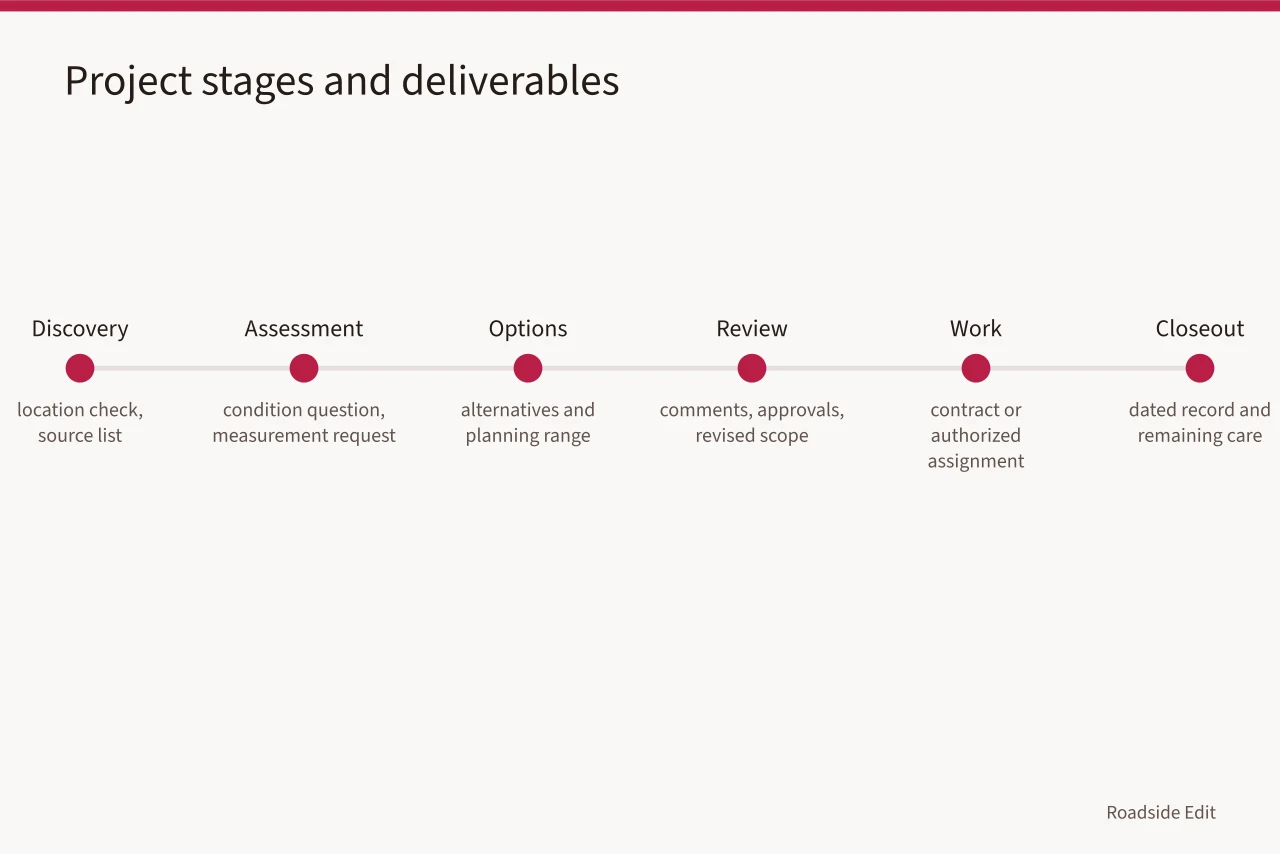
| Stage | Typical result | Cost-plan use |
|---|---|---|
| Discovery | Location check, source list, public-view images | Sets the initial information boundary |
| Assessment | Condition question, research task, or measurement request | Defines what more evidence will cost |
| Options | Alternatives and planning range | Compares approaches without treating one as authorized |
| Review | Comments, approvals, or revised scope | Records why the plan changed |
| Work | Contract, work order, or authorized assignment | Identifies what spending is approved |
| Closeout | Dated record of work and remaining care | Separates completed work from future needs |
At every handoff, write a one-paragraph note: what was completed, what remains unknown, what estimate version is current, and who makes the next decision. That note keeps later public copy from treating an early planning range as an all-in budget.
Create an estimate register that does not erase history
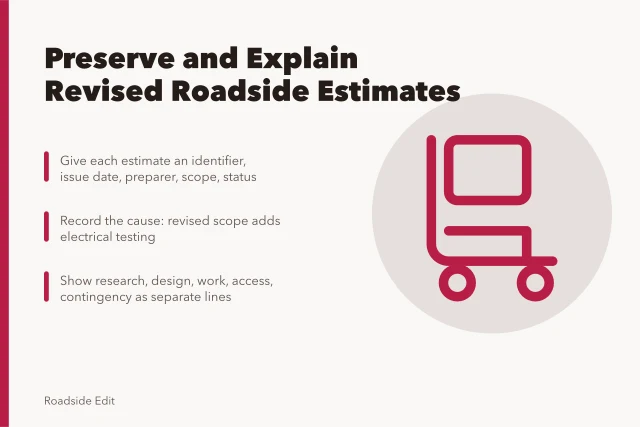
Use one row for each estimate or cost statement. Give it a stable ID and retain the source file. Do not overwrite an early total with a later one. If the figure changes, the difference is part of the project's record.
GSA explains that cost estimates change through project phases as the available scope and information become clearer. Review GSA guidance on estimate stages. In editorial work, that means a writer should label the stage: order-of-magnitude range, budgetary estimate, design estimate, bid, contract amount, or completion record.
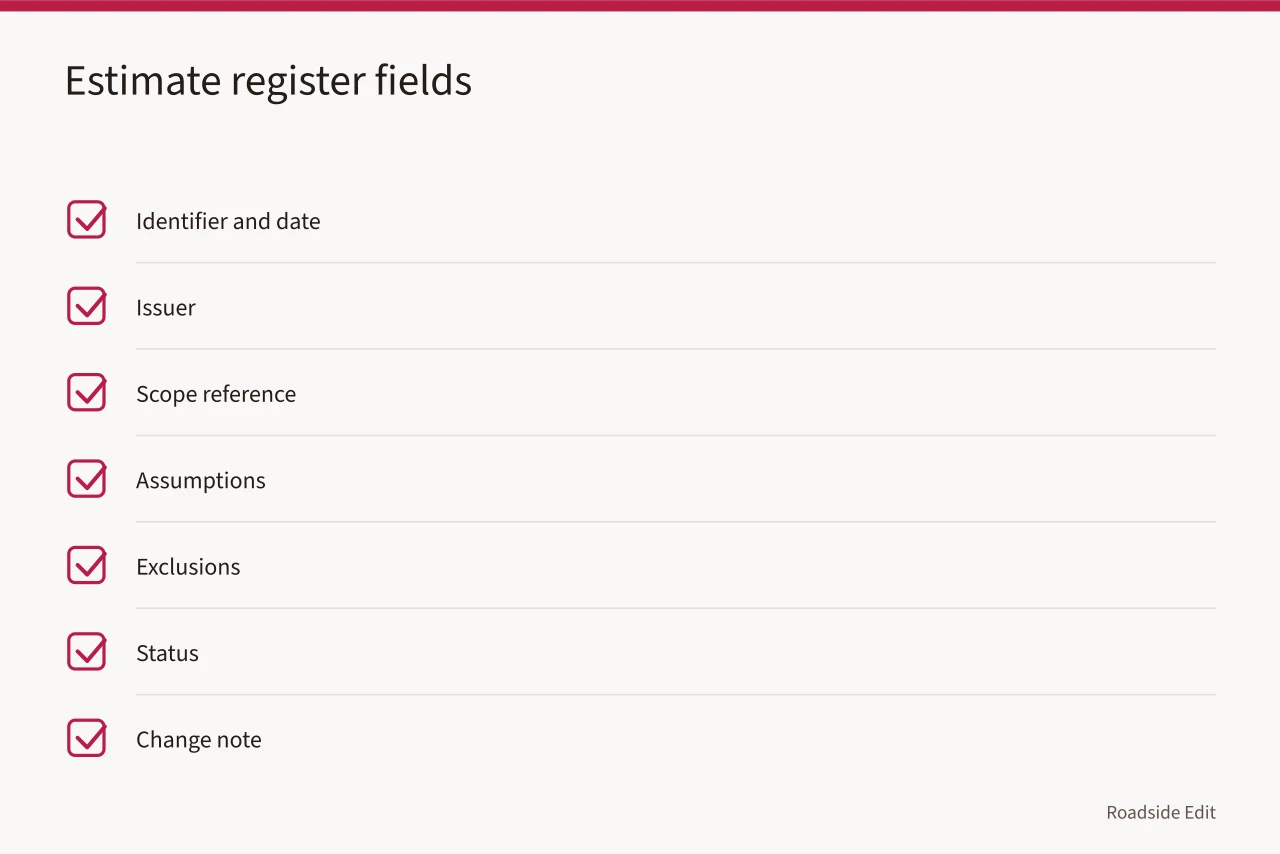
| Register field | Why it matters |
|---|---|
| Identifier and date | Lets readers distinguish versions |
| Issuer | Records who supplied the figure |
| Scope reference | Ties the figure to real work |
| Assumptions | Explains conditions the figure relies on |
| Exclusions | Prevents missing work from being read into the total |
| Status | Stops a proposal from sounding like a contract |
| Change note | States what caused the revision |
For example, a note might read: "E-04 adds access equipment after a permitted site review; electrical work remains outside the scope." That sentence carries much more value than a revised total without an explanation.
Use categories that tell the reader where the money goes
Cost categories should reflect the work, not hide it. A single line called "project total" cannot explain whether it includes research, design, permits, labor, materials, future maintenance, or an allowance for uncertain conditions.
The National Park Service says that total project cost can include pre-design, final design, project management, contingency, compliance actions, and other project-related costs. Read NPS guidance on identifying total project cost. The exact categories for a local project will differ, but the plan should make non-construction work visible.
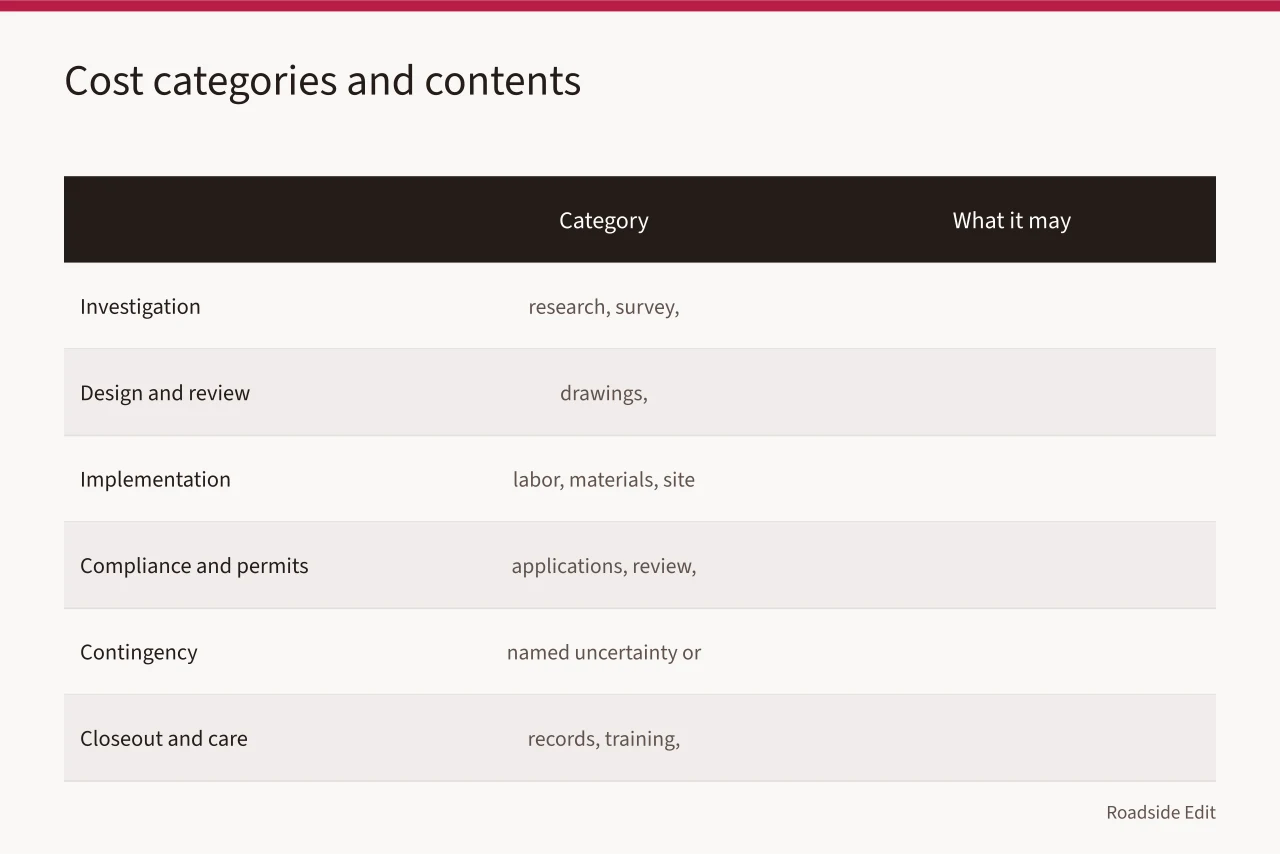
| Category | What it may include |
|---|---|
| Investigation | Research, survey, measurement, testing, or access planning |
| Design and review | Drawings, specifications, alternatives, coordination, or comments |
| Implementation | Authorized labor, materials, equipment, and site controls |
| Compliance and permits | Required application, review, permit, or project documentation |
| Contingency | Named remaining uncertainty or risk |
| Closeout and care | Final records, training, monitoring, or later maintenance needs |
Keep past costs, current costs, and future needs in separate columns. A prior survey expense does not mean a repair is funded. A planned maintenance figure does not mean it belongs in a current repair contract. The categories should make those distinctions easy to see.
Make uncertainty visible instead of burying it
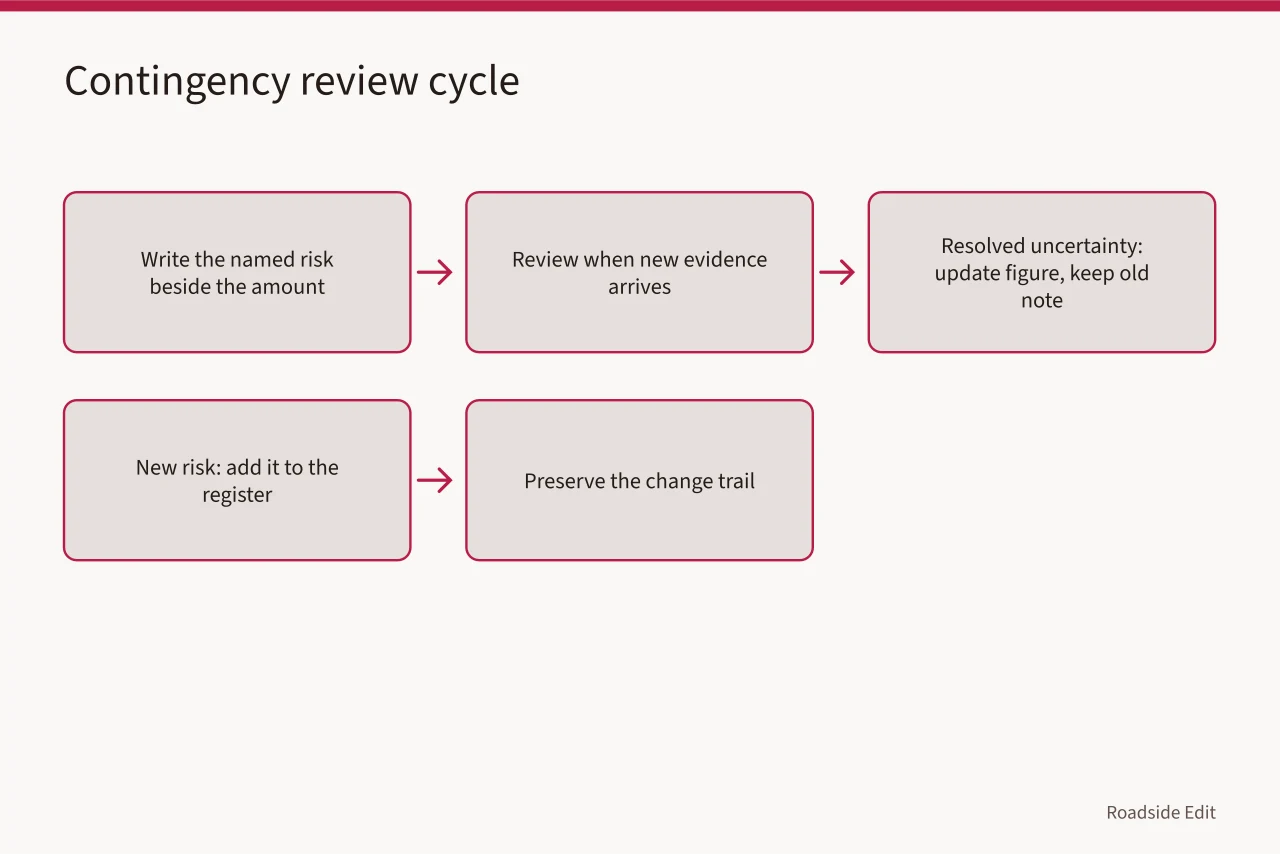
Contingency is an allowance for uncertainty. It is not an unexplained percentage added to make an early total feel safer. Write the risk beside the amount: unconfirmed substrate condition, access equipment not yet selected, or additional review after a pending record check.
The Federal Highway Administration advises showing estimates by major cost element and identifying contingency separately. Its guidance describes contingency as a tool for managing documented risks, not simply increasing a total. See FHWA guidance on contingency management. That principle applies to modest roadside work as well. A reader should know what the contingency is intended to address.
Review it when new evidence arrives. If a permitted inspection resolves an uncertainty, update the figure and preserve the old note. If a new risk appears, add it to the register. This change trail is what makes an evolving estimate understandable.
Keep funding claims beside their source records
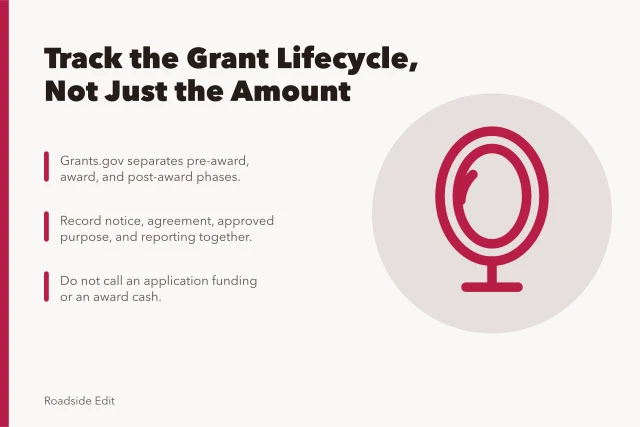
Funding terms need their own file. Track the program or donor, status, approved use, public amount, date, conditions, and source document. Do not state that a project is funded when it has only identified a possible grant or filed an application.
Grants.gov distinguishes the application process from the award phase, when the funding agency makes its official decision and issues award documentation. Read Grants.gov's explanation of the award phase. In public copy, use precise verbs: "applied for," "received an award notice," "received funds for the approved purpose," or "completed grant closeout." Each describes a different status.
Before publishing a funding figure, compare it with the current scope. If an award supports research, do not write that repair work is funded. If a match or approval is pending, say that it is pending. Keep private contact details, banking information, and nonpublic terms out of the article file.
Review every public cost statement
Before a number appears on a page, run a short check.
- Does the source identify the issuer, date, and actual scope?
- Does the statement distinguish an estimate, bid, contract, payment, and final cost?
- Are the material assumptions and exclusions close enough to the number to prevent misunderstanding?
- Has the scope changed since this version was issued?
- Does any funding statement match the current award or application record?
If the answer is unclear, do not use the number as a benchmark. Explain the planning method or wait for a record that supports the statement. A small amount of restraint keeps an article useful longer than a precise-looking figure that cannot be checked.
Preserve the record through closeout
Closeout is the point where the team compares the final work with the authorized scope. Keep dated completion photos, an approved change log, final records, and a note of remaining care. If the project will need maintenance, list that need separately instead of implying that the completed contract solved it forever.
The plan should also say who owns future updates. When a reader asks why a number changed, that person should be able to locate the estimate version, scope note, and related source without recreating the project history.
Common questions
Can an online price guide set a roadside project budget?
No. It may suggest questions, but it cannot replace a property-specific scope, current condition information, and a dated estimate with stated assumptions.
Is contingency the same as a change order?
No. Contingency is an allowance for defined uncertainty. A change order is a documented modification to authorized work and needs its own record.
Should an article include an exact budget number?
Only when a specific source supports it and the article explains the figure's date, scope, and limits. Otherwise, publish the planning method rather than a number readers may misapply.
In this guide
- Roadside architecture scope stages: how to keep early estimates from reading as finalRoadside architecture scope stages for 2027 separate discovery, assessment, design, approval, work, and closeout so early estimates are not presented as final.
- How to build a roadside architecture funding file that tracks the whole grant lifecycleRoadside architecture funding file guide for 2027 shows how to separate possible grants, applications, awards, payments, conditions, and reporting records.
- How roadside architecture cost categories shape a cleaner estimateRoadside architecture cost categories for 2027 help teams separate investigation, design, review, work, contingency, closeout, and future care in a clear estimate.
- Roadside architecture estimate updates: how to preserve versions and explain revised figuresRoadside architecture estimate updates for 2027 show how to preserve versions, record changed assumptions, compare scopes, and explain revised figures honestly.
- How to write a roadside architecture budget narrative that holds upRoadside architecture budget narrative for 2027 explains how to connect a defined scope, evidence, cost categories, assumptions, and public funding language.