Guides
Part of How to plan historic motel restoration costs for 2027 without guessing a price
Historic motel restoration cost estimates: why stages and scope decide the number
Historic motel restoration cost estimates vary because each figure reflects its own construction scope, project stage, site conditions and pricing date.
Historic motel restoration cost estimates look like one series of numbers until you read the labels. A number from a 2027 courthouse-square motel job and a number from a 2019 one are not the same kind of number.
One may be a survey allowance written before anyone opened the roof; the other may be a signed subcontract. Stage and scope decide what the figure means, and the stage label keeps a reader from reading the second as proof of the first.
What to take away
- Write the stage, scope and date beside every figure before you publish it.
- Never add a planning allowance to a bid or an award to produce one total.
- Treat a later, larger number as a wider scope until the record proves otherwise.
- Name the source and its date; if the stage is unknown, say so.
- Keep the original record title in your working file so the next editor can check it.
What the figures look like at each stage
The dollar amounts below are illustrative planning ranges as of 2026 for a 20-unit 1950s courtyard motel, not quotes and not survey results. Substitute your own quantities.
| Stage | Typical line items | Illustrative range |
|---|---|---|
| Reconnaissance survey | Two field days, one architectural historian, photo log, condition report | $3,500 to $9,000 |
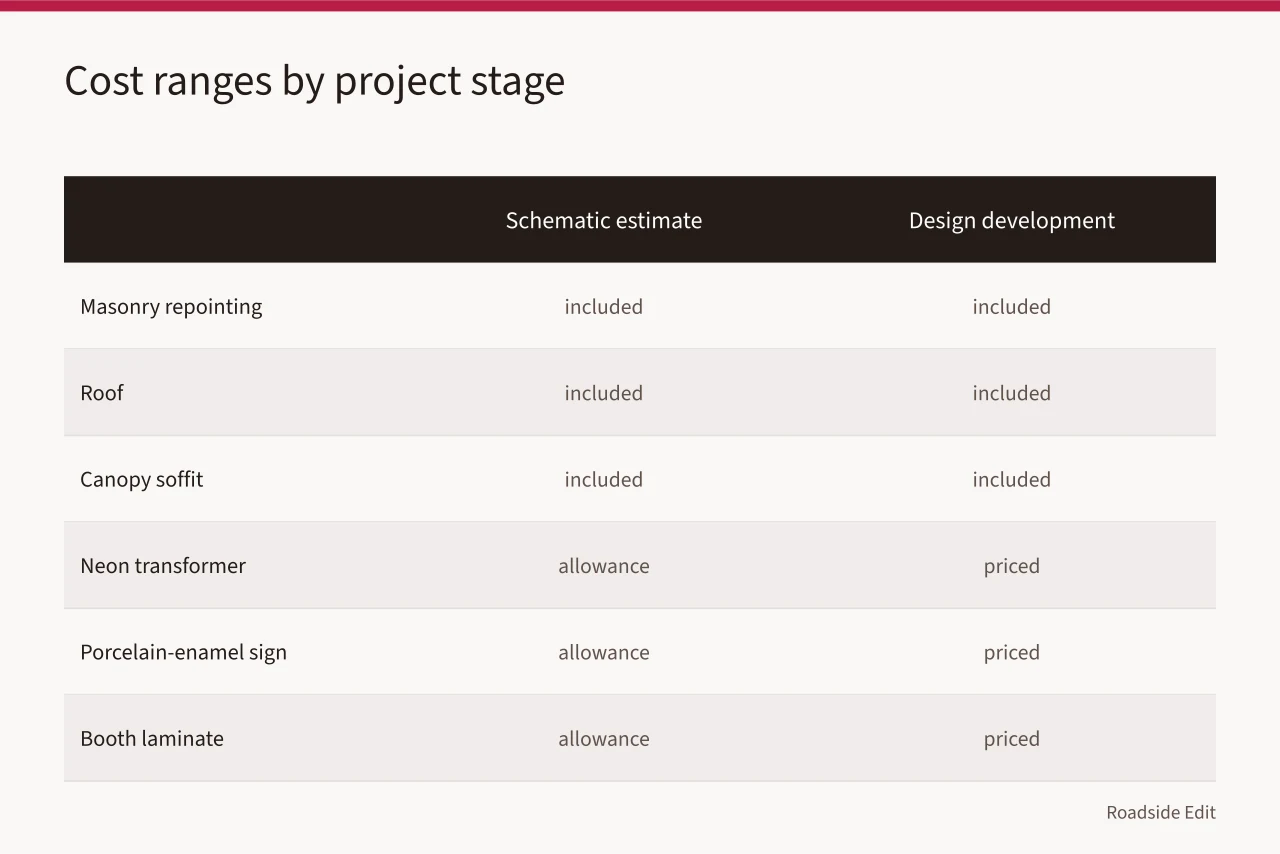
| Schematic estimate | Masonry repointing, roof, canopy soffit, dry-stand pipe, windows | $180,000 to $420,000 |
| Design development | Neon transformer replacement, porcelain-enamel sign repair, booth laminate | $310,000 to $690,000 |
| Bid | Named subcontracts with dates and inclusions | Bidder's figure |
| Completed work | Pay applications and change orders | Final documented cost |
On a 20-unit 1950s courtyard motel, repointing, roof and canopy work often sit in the $180,000 to $420,000 schematic band. Add neon transformer, porcelain-enamel sign repair and booth laminate, and the design-development band runs $310,000 to $690,000.
The jump from schematic to design development is usually scope, not inflation: the later stage prices the neon and the sign, which the earlier one left as an allowance. Say that in the note.
Where the money actually goes
Repointing original brick veneer is measured in square feet of joint and priced by scaffold days, not by wall area. A butterfly roof with failed membrane costs more than the same area of flat roof because the slope changes the tie-off and the tear-off sequence.
Curtain-wall glazing on a 1962 motel is the line that most often breaks a schematic estimate. Replacement units are fabricated, so lead time and freight land in the same column as the glass.
Porcelain-enamel sign faces and neon tube work are the two items owners most often cut and later regret. Over-painting original enamel or swapping neon for LED both destroy the material the National Register nomination cited.
Record the salvage source, the customs paperwork for a booth or tube order from Canada, and the fabricator's lead time as separate lines.
Why you cannot total across stages
A National Park Service guide on federal disaster mission assignments says an estimate should rest on the mission's stated scope and period of performance. See the NPS scope-and-period example.
That covers federal assignments, not motel restoration pricing, but the principle holds: without a scope and a period, a figure is not comparable to anything.
The NPS cost-estimate definitions separate conceptual estimates from design estimates and other cost uses. Review the NPS estimate definitions. Use the source's own stage label when it has one. If the source is silent, do not invent a label from the size of the number.
GSA guidance explains that estimates evolve as requirements become more definite. Read GSA's cost-management guidance. A change between two dated records is a change in scope or assumptions, not an error to correct.
The false progression
An early allowance does not lead to a bid, an award, or a finished job. Many records stop at planning. Others describe a motel that was demolished, sold, or re-roofed with a different product two years later.
Writing "costs rose from $180,000 to $690,000" invents a trend the sources do not support. Writing "the 2027 schematic covered masonry and roof; the 2028 design figure added neon and sign work" states what changed. The second sentence is the one a preservation commission can check.
NPS documentation standards require reliable source material and stated limits so another person can verify the work. See the NPS documentation standard. Keep stage, source date, scope and limitation in one place, and a later editor can revise the article when a better record surfaces.
How to close the article
Use a dated timeline when several cost records describe one motel. Use a single source note when they do not. If the evidence will not connect the figures, say that, and point the reader to the case study records for how a documented project reads end to end.
Common questions
Can an early figure become a final budget?
Only if a source documents how scope, assumptions and stage changed between the two. Do not make that link by inference, and do not present the earlier number as a starting point for the later one.
Why does the time period matter?
The period identifies the conditions the estimate was prepared under: labor market, material availability, and what the scope then included. Without it, a reader mistakes past planning context for a current amount.
What is the safest label for an unclear figure?
Call it a reported figure from the named source and date, then state that its stage and scope are not established. That is honest and it still tells the reader where the number came from.
Do these ranges apply to my motel?
No. They are illustrative for a 20-unit courtyard property. Your survey days, travel, scaffold access and fabrication costs set the real figure, and your State Historic Preservation Office sets what the work must preserve.