Guides
Part of How to plan historic motel restoration costs for 2027 without guessing a price
Historic motel restoration cost checklist: what to verify before you compare a 2027 estimate
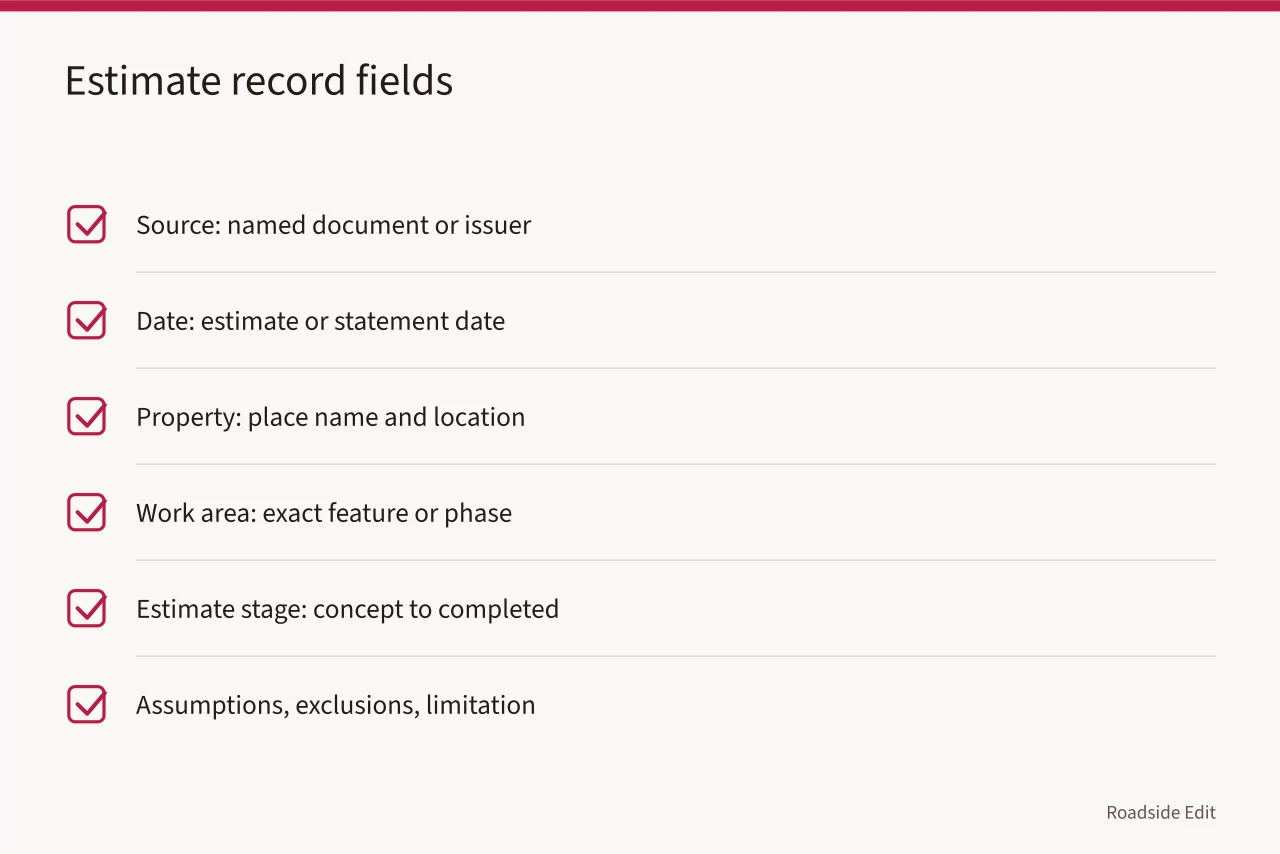
A historic motel restoration cost checklist records the source, date, property, work area, and estimate stage before any figure is compared.
A cost figure for a roadside motel is only as good as the record behind it. Before you quote one, compare two, or fold one into a scope, capture the eight fields below. The table is the checklist; the five-step test that follows is what to do when a figure arrives without them.
What to take away
- Eight fields turn a bare dollar amount into a checkable record: source, date, property, work area, estimate stage, assumptions, exclusions, limitation.
- A 1962 grant award and a current canopy soffit bid are not the same kind of number, even when both are real.
- Write the limitation in the same sentence as the figure, not in a footer.
- If most fields are missing, label the amount historical context and stop there.
- A photograph documents a feature. It never documents a price.
Complete the estimate record
National Park Service cost-estimate definitions separate conceptual estimates from more-developed ones and name the inputs that distinguish them: scope, assumptions, local market research, cost factors. Review the NPS estimate definitions. Those are federal project definitions, not a pricing formula for a motor court. They show why a figure needs its basis recorded before anyone repeats it.
Fill the work-area row with the trade's own vocabulary, not a category. "Canopy soffit and dry-stand pipe inspection, pump island 3" is a work area. "Exterior" is not. The same applies to a neon scope: tube diameter, transformer count, and whether the raceway is reused are the fields that decide whether two bids describe the same job.
Check the comparison
Two figures compare only when they describe the same work at the same stage. A current fabrication quote for replacement neon and a 1998 state preservation grant award cannot be set side by side. One covers labor and glass at today's rates; the other records what a program funded in a different decade.
A total may also carry planning, design, contingencies, permits, or work outside the feature under discussion. Ask what the number includes before you ask what it is. Where a project needs a property-specific scope and a current review rather than an online comparison, the cost planning sequence is the right next read.
Test the number before using it
The General Services Administration notes that estimates change as requirements and scope become clearer. Read GSA's project cost guidance. That is not a price for a motel. It explains why the stage field matters, and why an early allowance should never be presented as a final figure.
Run this five-step test before a figure enters an article:
- Identify what the source calls the number.
- Match it to a defined feature or work area.
- Record the source date and any stated assumptions.
- List exclusions and unknown conditions.
- State whether the record supports comparison with another.
An amount with no project boundary is not a headline estimate. It may be one funding source, a proposed phase, or a past expenditure. Keep those roles separate.
Keep source limits next to the claim
NPS documentation standards require reliable sources and stated limitations so a second person can check the work. See the NPS documentation standard.
The 2004 award of $X covered masonry repointing on the street facade only. The NPS Historic Property Project Documentation process links existing property information to later scope and design decisions. Review the NPS documentation overview.
An article may cite a cost record without turning that record into a work scope.
Write the comparison result plainly
Three outcomes are honest. The figures are comparable because they cover the same dated work. They offer historical context at different scopes. Or the record supports no comparison at all. Choose the smallest conclusion the documents carry.
Where a figure is missing and you still need the arithmetic, state it in named variables. Survey days times day rate, plus travel, plus fabrication, equals a planning total the reader fills in. Never substitute an invented rate for the missing one.
For condition, ownership, or eligibility questions, name the survey source and send the reader to the primary record.
For compliance questions, the State Historic Preservation Office or the local landmarks commission answers under its adopted ordinance.
Common questions
Is a conceptual estimate a firm price?
No. It is an early estimate built on limited information. Label it that way and keep its source date and scope attached.
What if the source gives only one total?
Report the total as stated, then name which elements, date, or work boundary remain unknown. A single figure with no boundary is context, not a benchmark.
Can an image establish a restoration cost?
No. A photograph documents a feature, its material, and its condition at a moment. It cannot establish scope, access, labor, or current market rates.