Guides
Part of How to plan historic motel restoration costs for 2027 without guessing a price
Historic motel restoration cost warning signs: fix the scope before you cite
Historic motel restoration cost warning signs for 2027 show when an article has confused a building scope, funding amount, estimate, or final price.
Cost errors often begin when an article expands a source beyond its stated boundary. A number can become a total, a proposal can become a finished project, or a line item can become a whole-property claim. These warning signs help stop that drift.
What to take away
- A review scope is not a price or work authorization.
- A funding record is not necessarily a total project cost.
- A whole-building source may not support a claim about one room or sign.
- Do not present an unverified source as a current quote.
Watch for scope substitution
The National Park Service defines project scope for its historic rehabilitation tax-incentive review as the entire building and historically associated property under the same ownership. Read the NPS application-process scope.
That definition applies to that federal review only and does not establish a motel's cost or eligibility. Identify the source's actual project boundary before using an associated figure.
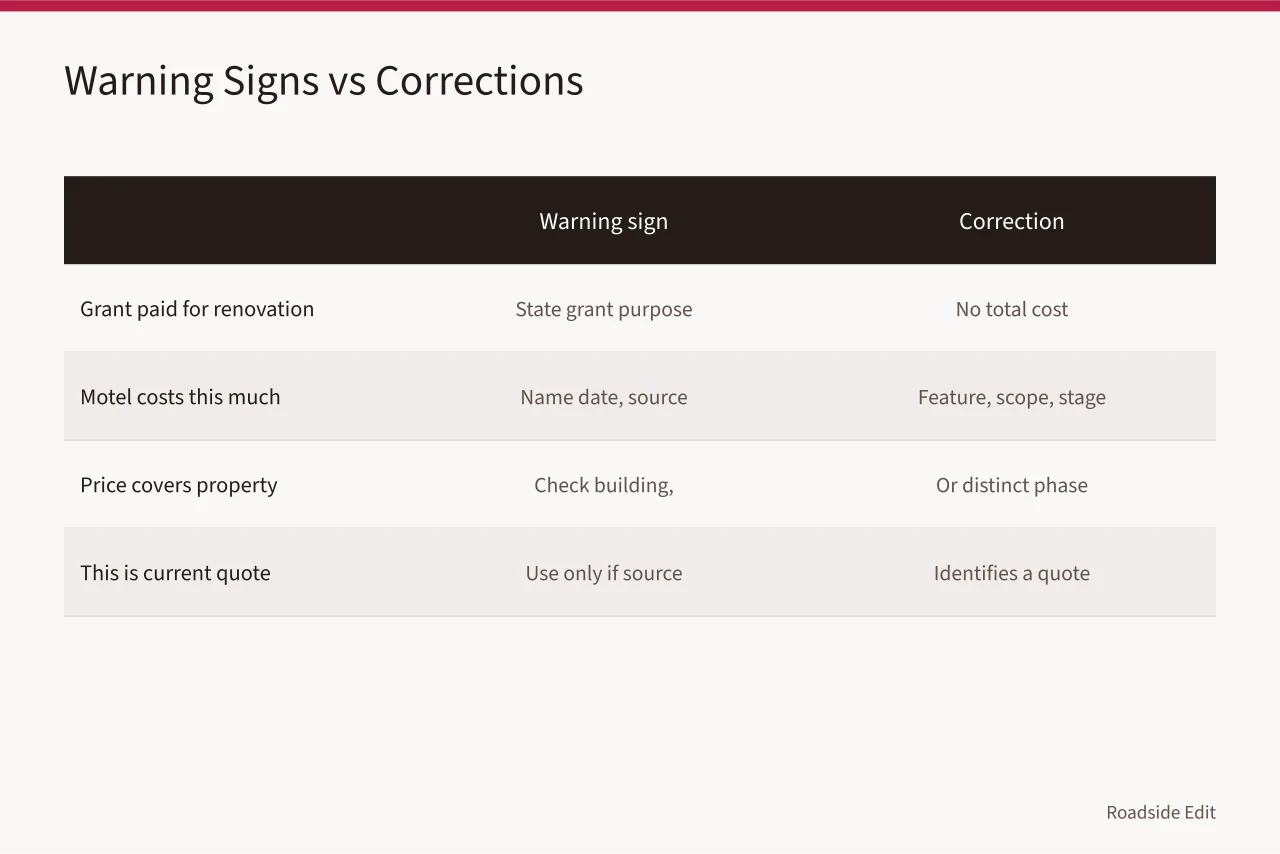
| Warning sign | Correction |
|---|---|
| "The grant paid for the renovation." | State the grant purpose and do not assume total project cost. |
| "The motel costs this much to restore." | Name the date, source, feature, scope, and stage or remove the claim. |
| "The price covers the property." | Check whether the source covers a whole building, a feature, or a distinct phase. |
| "This is the current quote." | Use that wording only when a current source actually identifies a quote. |
Another warning sign is false precision. A source may contain a rounded figure, a preliminary allowance, or a total that includes categories the article cannot identify. Do not add dollar signs, decimal places, percentage changes, or present-tense wording the original record does not support.
If the source does not establish why the figure changed, say that the reason is not available in the reviewed materials.
Check the role of the amount
The National Park Service cost-estimate definitions distinguish estimates used at different project points. Review the NPS estimate definitions. A source might be an early planning amount, a design-stage estimate, a bid, a funding award, or a past expenditure.
Do not pick the label that makes the number easiest to compare. Use the label the source provides. Describe an unlabeled amount as unlabeled.
The U.S. General Services Administration notes that project costs are managed as scope and requirements become more definite. Read GSA's cost-management guidance. A later number may differ for many documented reasons. Unless the records state why, an article should not assign a cause, a savings percentage, or a cost trend.
Use a short warning review
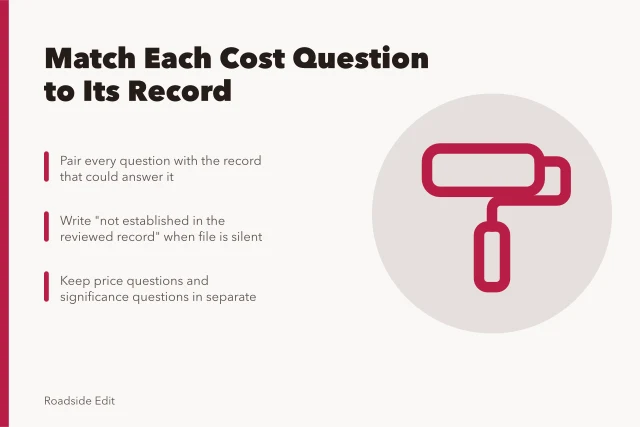
| Before publishing | Check this point |
|---|---|
| Source title | Does the record name the property or only a program? |
| Date | Is the number current, historical, or undated? |
| Work boundary | Does it name a feature, phase, building, or broader project? |
| Role | Is it an estimate, award, proposal, invoice, or unknown? |
| Limitation | What cannot the figure establish? |
NPS documentation standards ask for reliable sources and clear limits that allow independent verification. See the NPS documentation standard. Put the limit next to the amount. A sentence such as "the source reports an award for the stated purpose" is accurate when the record does not provide a complete project budget.
Correct the sentence before adding a citation
A link cannot repair an overstated cost claim. Rewrite the claim so it matches the source, then place the link at that claim. If the source is too broad, narrow the article or remove the number. This preserves the useful part of the record without turning it into advice for a different motel.
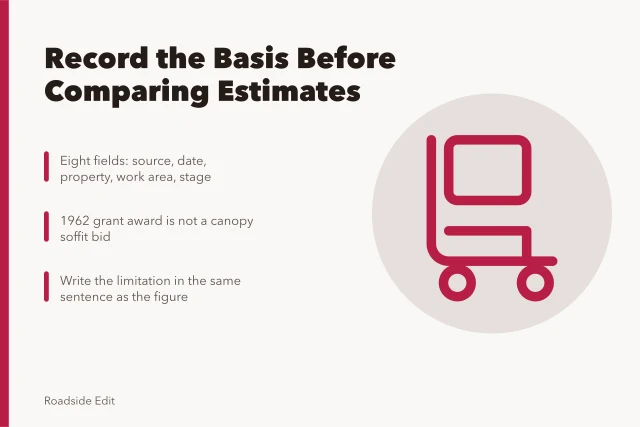
Keep a short review note for every cost sentence. Include source title, source date, precise role of the amount, feature covered, and one limitation.
This makes it easier to spot a sentence that moved from a historical fact into a current price claim during later editing. When two records disagree, describe their different scopes first, and do not treat the larger number as more authoritative because it looks more complete.
Common questions
Is a tax-credit application a cost estimate?
No. It is a program application with a defined review scope. The article should not use it as a price unless a specific cost record supports that statement.
Can a project article use a range from another location?
Not as a property-specific estimate. Different scope, condition, timing, and market context can make the comparison misleading.
What should be removed first?
Remove any total, savings, or affordability claim that lacks a named source, date, scope, and clear role.