Guides
Part of How a roadside architecture maintenance plan keeps observation separate from repair work
How to write roadside architecture maintenance cost notes without false precision
Cost notes for roadside architecture should record scope, date, and source, so a 2027 estimate is never read as a price for another property.
What to take away
- A dollar amount with no date, scope, and source is not a maintenance record.
- One property's invoice never becomes another property's budget line.
- Keep recurring care, assessment, project work, and allowances in separate categories.
- Quote the exclusion, not just the total. The exclusion is usually the honest part.
- Store the source document with the note, or say in writing why it cannot be shared.
Start with the document, not the number
A 2027 invoice for repainting one porcelain-enamel sign face is evidence about that sign face, that month, that crew. It is not a price for a 1962 plastic-faced box sign two states away. The two share a trade and nothing else.
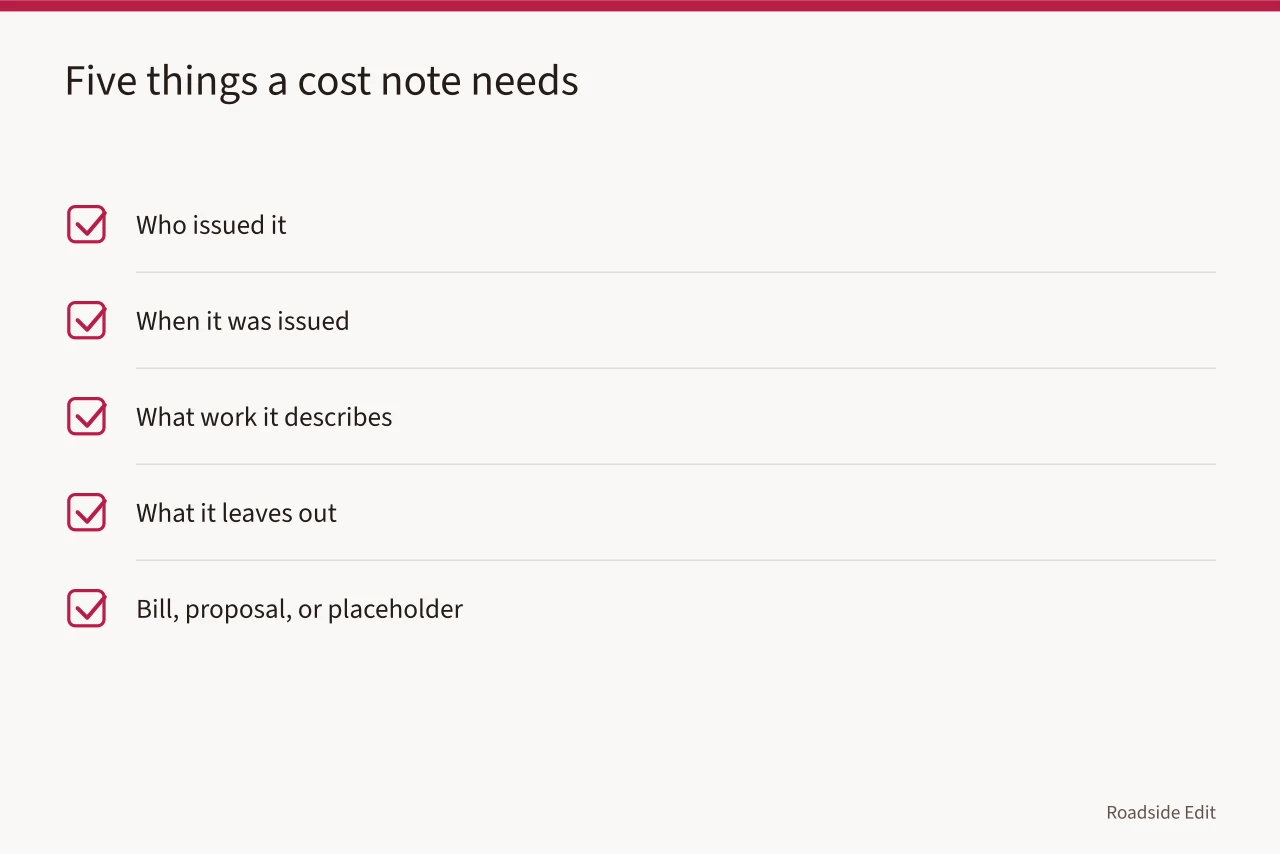
Read the document before you repeat any amount from it.
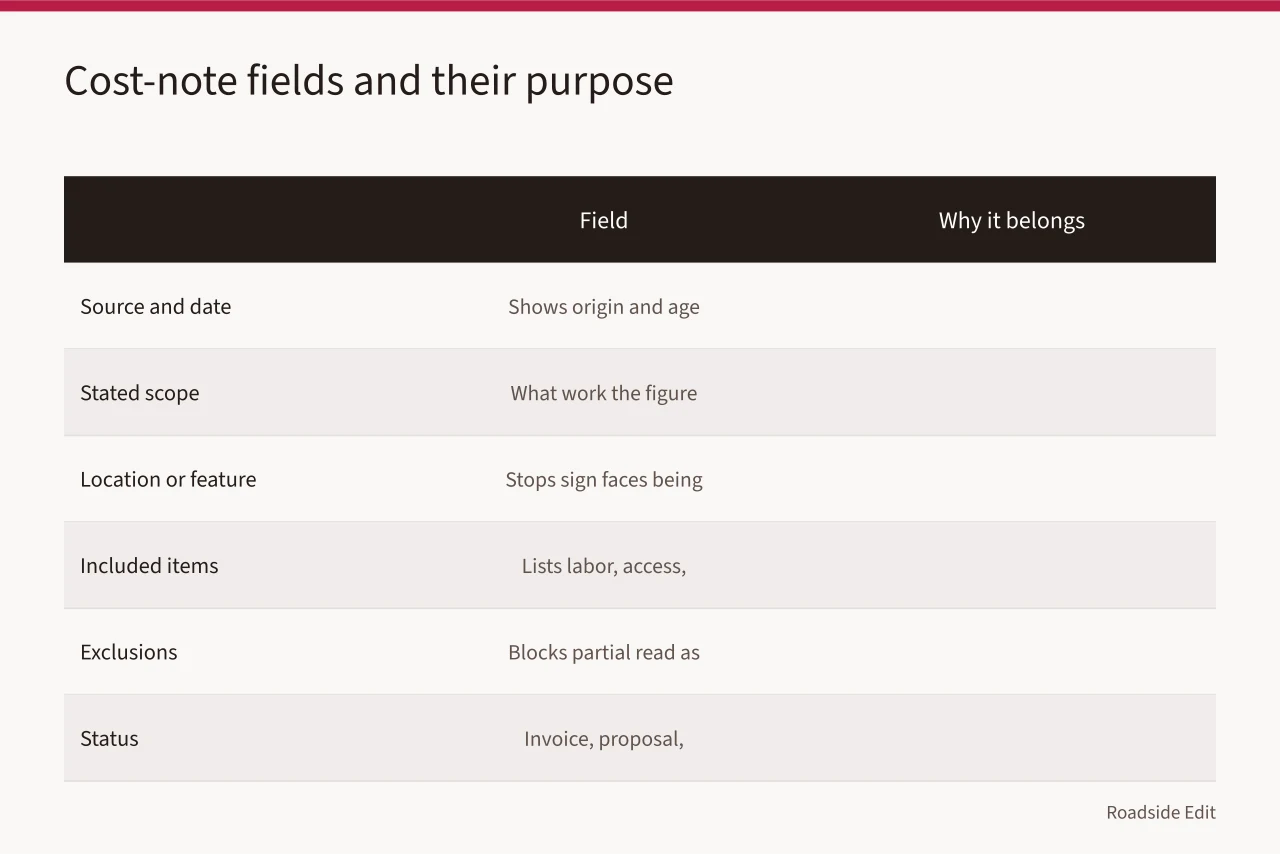
| Cost-note field | Why it belongs in the record |
|---|---|
| Source and date | Shows where the amount came from and how old it is |
| Stated scope | Tells readers what work the figure describes |
| Location or feature | Stops one sign face or canopy from being confused with another |
| Included items | Identifies listed labor, access, materials, or fees |
| Exclusions | Prevents a partial amount from being read as a total |
| Status | Separates an invoice, a proposal, an allowance, and a paid record |
GSA states that its historic-building technical procedures require project-specific editing and professional judgment about whether a procedure applies to a particular building, project, or location. Review GSA technical procedures. Cost notes work the same way. A source can inform a question without becoming a promise.
False precision has a shape, and it is easy to spot
False precision is a real number doing a job no real number can do. It usually arrives as an average, a range with tight endpoints, or a per-unit figure that quietly assumes identical sites.
Ask where the decimal came from. If the answer is "that is what the other job cost," you have a comparison, not a cost. If the answer is "we estimated," you have an allowance, and it needs that word in the sentence.
Scope, access, materials, and season drive the number. So does who holds the license. None of those travel between properties.
| Use this wording | Avoid this wording |
|---|---|
| "The 2027 invoice describes repainting one sign face." | "Sign repairs cost this amount." |
| "The proposal excludes electrical work." | "The price covers all needed work." |
| "The figure is a dated planning allowance, not a bid." | "The project will cost this amount." |
| "The supplied record does not state permit fees." | "Fees are included." |
The NPS treatment standards state that treatment choices depend on several factors. These are a property's significance, physical condition, available documentation, and interpretive goals. See NPS standards for treatment choices. That source says nothing about price. It supports the narrower point: preservation work turns on facts that vary by property, so a figure carried across properties carries nothing.
Separate the types of money in the file
Do not file every amount under "maintenance." These four categories describe what a record is for, not a universal accounting system.
- Recurring care covers scheduled, authorized tasks with a known, limited scope, such as annual dry-stand pipe inspection or a cleaning cycle.
- Assessment and planning covers a survey day, a research task, or a written scope. It does not set a future construction price.
- Project work covers a proposal, contract, or completed-work record for a named feature and a stated date.
- Allowance is a planning placeholder. Label it so no reader mistakes it for a bid or a confirmed total.
NPS Preservation Brief 43 describes a historic structure report as carrying a physical description, existing condition, a treatment approach, and a later record of work performed. Read NPS guidance on historic structure reports.
A cost note is not that report. It can still keep three things apart: what the record shows about condition, what someone proposes to do, and what has already been done. Blur them and a proposal reads as history.
Build a trail a later editor can check
Store the original document, or a dated note explaining why it cannot be shared. Redact personal addresses, account numbers, and direct contact details before publication.
If a contributor gives you a statement with no document, label it an attributed statement. Attach no number unless the contributor authorizes publication and the scope is clear in the same sentence.
NPS says heritage documentation should be prepared accurately from reliable sources with limitations stated, so another person can assess its reliability. Use the NPS documentation standard as a recordkeeping model. A cost note should hold source, scope, and limitation together. Split them across a caption, a spreadsheet, and a private email, and the next editor will reassemble them wrongly.
Where the arithmetic goes
Never publish a total you cannot source. Publish the arithmetic instead, in named variables the reader fills in.
A repaint allowance reads as: sign face area in square feet, times a rate per square foot for surface preparation, plus a rate for finish coats, plus access setup, plus a mobilization charge. The reader supplies the rates from their own dated quotes.
That form is honest because it shows its parts. It also survives a change in year, which a single figure does not.
For the field-side version of this record, see the recurring care checklist. For the safety and scope items that sit outside a cost note, see the motel safety budget notes. Neither replaces a licensed professional's written scope.
Common questions
Can I use one property's invoice to budget another roadside site?
Only as a dated historical reference, and say so in the sentence. Access, materials, scope, season, and licensing differ. A copied figure reads as an estimate, and an estimate you did not make is a claim you cannot defend.
What should be removed before a cost note is published?
Personal and account information, and anything not needed to explain the documented scope. Keep the date, the issuer's role, the work description, and the exclusions. Those four carry the note.
Is routine maintenance the same as capital work?
No. Keep repeated care and a proposed or completed project in separate records. Merged, a small recurring task starts to look like a complete treatment plan, and readers budget against the wrong number.