Guides
Part of How a roadside architecture maintenance plan keeps observation separate from repair work
Roadside architecture maintenance questions: who can answer what
Roadside architecture maintenance questions for 2027 help U.S. readers separate visible evidence, urgent access concerns, records, and expert decisions.
What to take away
- Good questions preserve the difference between a visible fact and an unverified explanation.
- Ask about access, authority, and evidence before asking what repair is needed.
- A question log should identify its source and its limit, then send the question to the right person.
- Do not ask a visitor to enter, test, or investigate a closed roadside place.
Begin with questions that a record can answer
When a roadside sign, storefront, motel office, or service station looks different, first ask what the current record proves rather than name the problem.
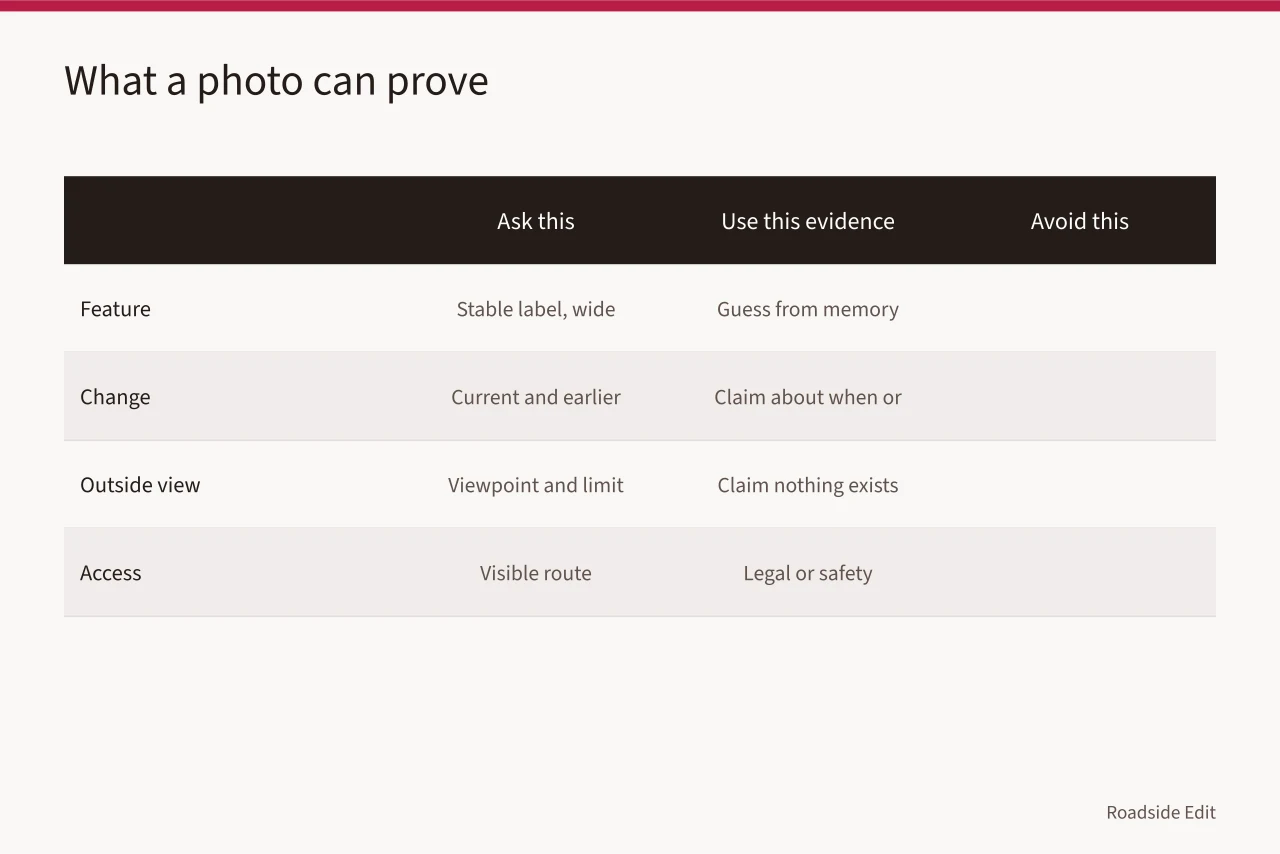
A dated photo from a lawful viewpoint may show a changed surface, a missing panel, or a blocked path. It cannot confirm hidden damage, title, code compliance, or the intended scope of work.
| Ask this | Use this evidence | Avoid this conclusion |
|---|---|---|
| What feature is in the image? | Stable feature label and wide view | A guess based on memory |
| What changed? | Current and earlier dated photos | A claim about when or why it changed |
| What was outside the view? | Viewpoint and limit note | A claim that nothing exists there |
| Does access look affected? | Description of the visible route | A legal or safety finding |
NPS documentation standards call for records prepared from reliable sources with limitations stated so the information can be independently checked. Review the NPS documentation standards. A short question log can follow that habit even though it is not a professional HABS, HAER, or HALS record.
Sort questions by who can answer them
Some answers belong in the observation log. Others require a property record or a professional assessment. Sorting them first prevents a story from making a confident claim merely because the question sounds reasonable.
- Observation questions ask what is plainly visible: Is there a new opening? Does the sign face look different from the prior image? Is the public route shown as blocked?
- Record questions ask what a supplied document says: Does a permit, owner statement, or project notice identify work? What date and scope does it state?
- Assessment questions ask about conditions that cannot be seen safely: Is a crack active? Is a roof sound? Are hazardous materials present?
- Decision questions ask what will happen next: Should a component be repaired, replaced, moved, or left in place?
The National Park Service says its treatment standards guide owners, managers, consultants, architects, contractors, and project reviewers before work begins. See the NPS treatment standards overview. It also says the guidelines do not offer case-specific advice. A public article should be even more careful about moving from a visible condition to a project decision.
Write a question log that does not overreach
Every useful question needs a trigger. The trigger is the factual reason the question exists, not a dramatic description. Use the exact image file, record date, or supplied document where possible.
| Log field | Example |
|---|---|
| Question | "Does the owner-provided record identify the work at the east sign?" |
| Trigger | "The sign face differs from the image dated 2028-10-02." |
| Evidence | "2029-01-12_east-sign_public-road_01.jpg" |
| Limit | "Fasteners and rear face were not visible." |
| Route | "Ask the listed property contact or local office." |
NPS guidance on mothballing puts documentation and a condition assessment before stabilization and a maintenance plan. Read NPS Preservation Brief 31. The document addresses a different situation than a roadside observation, but its sequence is useful: gather information before choosing a response.
Keep public-access concerns separate
An observation may point to an access concern without proving a safety condition. A blocked sidewalk, a fallen visible item, or a barrier across a public path is not a reason to get closer. Record the public view, step away, and use the reporting process for that location.
Do not publish entry details, private phone numbers, or directions that encourage visitors to approach a closed property.
The NPS architectural-preservation QA checklist includes existing-condition photographs, field reports, and a record of treatment among the materials used in preservation work. Read the NPS QA checklist. Those materials support a disciplined record. They do not allow a writer to certify that a roadside structure is safe or unsafe.
Common questions
Should I ask an owner for a repair explanation?
You may ask respectfully. Publish only what a reliable record supports, and respect a decision not to comment.
What counts as an urgent question?
A possible public-access concern should go through the responsible party's reporting path. Do not attempt a closer inspection.
Can an old postcard settle a maintenance question?
It may document a past appearance. It rarely establishes a current condition, hidden materials, or a proper treatment method.