Guides
How a roadside architecture maintenance plan keeps observation separate from repair work
Roadside architecture maintenance plan for 2027 helps U.S. readers schedule observation, document exterior changes, and separate care from project decisions.
What to take away
- A roadside maintenance plan is a recurring record and decision routine, not a repair specification.
- Begin with a dated baseline, fixed feature names, lawful viewpoints, and clear limits.
- Keep routine care, a need for assessment, and a project decision in separate lanes.
- Use a schedule that can be completed. A short record made regularly is more useful than an ambitious form left blank.
Define the plan's job
A roadside place may be a motel, diner, motor court, service station, or sign. It may also be a roadside attraction or a small commercial building. Buildings differ, but the planning problem is often the same.
A current photo may show a change. A source register may describe the site's history. A work record may identify an authorized task. Do not mix those evidence forms.
This plan is for people who manage, write about, volunteer with, or follow roadside places in the United States. It is not a condition assessment.
It does not authorize entering a building, climbing a roof, moving a loose item, or testing materials. A responsible plan treats ownership, access, public safety, and privacy as real limits, not details to skip.
The National Park Service says Preservation Brief 47 addresses regular inspection, monitoring, seasonal maintenance, and maintenance treatments for small and medium-size historic building exteriors. Review NPS Preservation Brief 47. That is a useful model for a routine, but its guidance must be applied by people with the right authority and knowledge for a specific property.
Create a baseline before making a schedule
The baseline is the first dated record a later reader can compare with another. It should state exactly what was seen and where the observer stood. A baseline does not need to decide whether a building is original, stable, abandoned, protected, or in need of repair. Those stronger claims require a source or appropriate assessment.
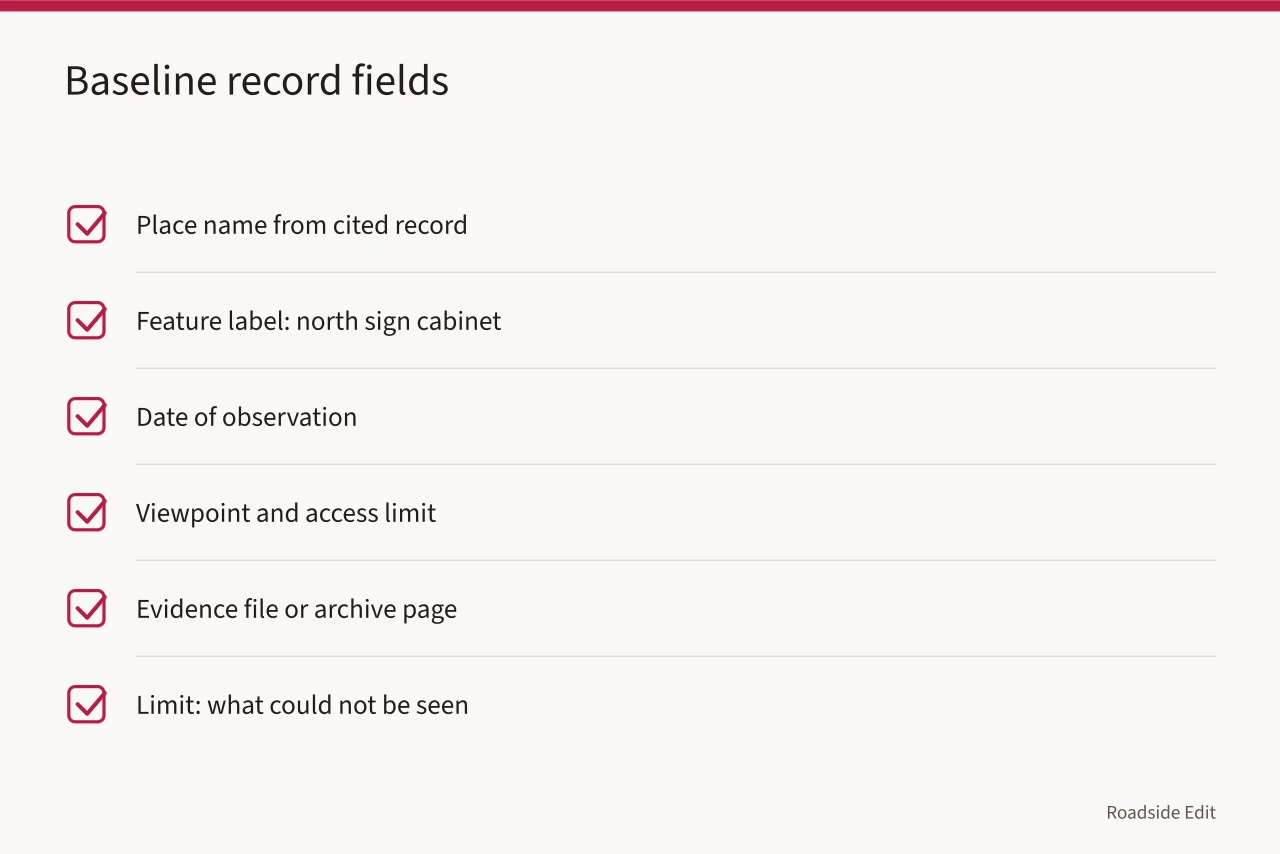
| Baseline field | Record | Why it matters |
|---|---|---|
| Place name | Name used by a cited record or property contact | Keeps one site from being confused with another |
| Feature label | North sign, east canopy, office window group | Makes each observation comparable |
| Date | Day of the observation or document review | Preserves sequence |
| Viewpoint | Public sidewalk, public road, or owner-approved access | Makes the access limit clear |
| Evidence | Photo file, permit, archive page, or supplied record | Lets a later editor check the claim |
| Limit | What could not be seen or confirmed | Stops a note from becoming a diagnosis |
Use stable feature names, and prefer "North sign cabinet" over "the sign," especially at a business with several signs.
If a feature is removed or renamed, and its label changes, leave a note linking the old label to the new one. Continuity matters: a 2029 editor should find the same item a 2027 volunteer photographed.
NPS architectural documentation standards describe field records as notes, field photographs, and other information meant to produce documentation. Read NPS standards for architectural documentation. The same standards call for reliable sources and stated limitations. A roadside log can adopt those habits without claiming professional survey status.
Give the plan a realistic rhythm
A schedule should match the property, the climate, access, and who is responsible for the work. A writer working from a public street has a narrower role than an owner or authorized manager. Do not create a calendar that assumes permission to enter interiors, fenced areas, roofs, utility spaces, or private land.
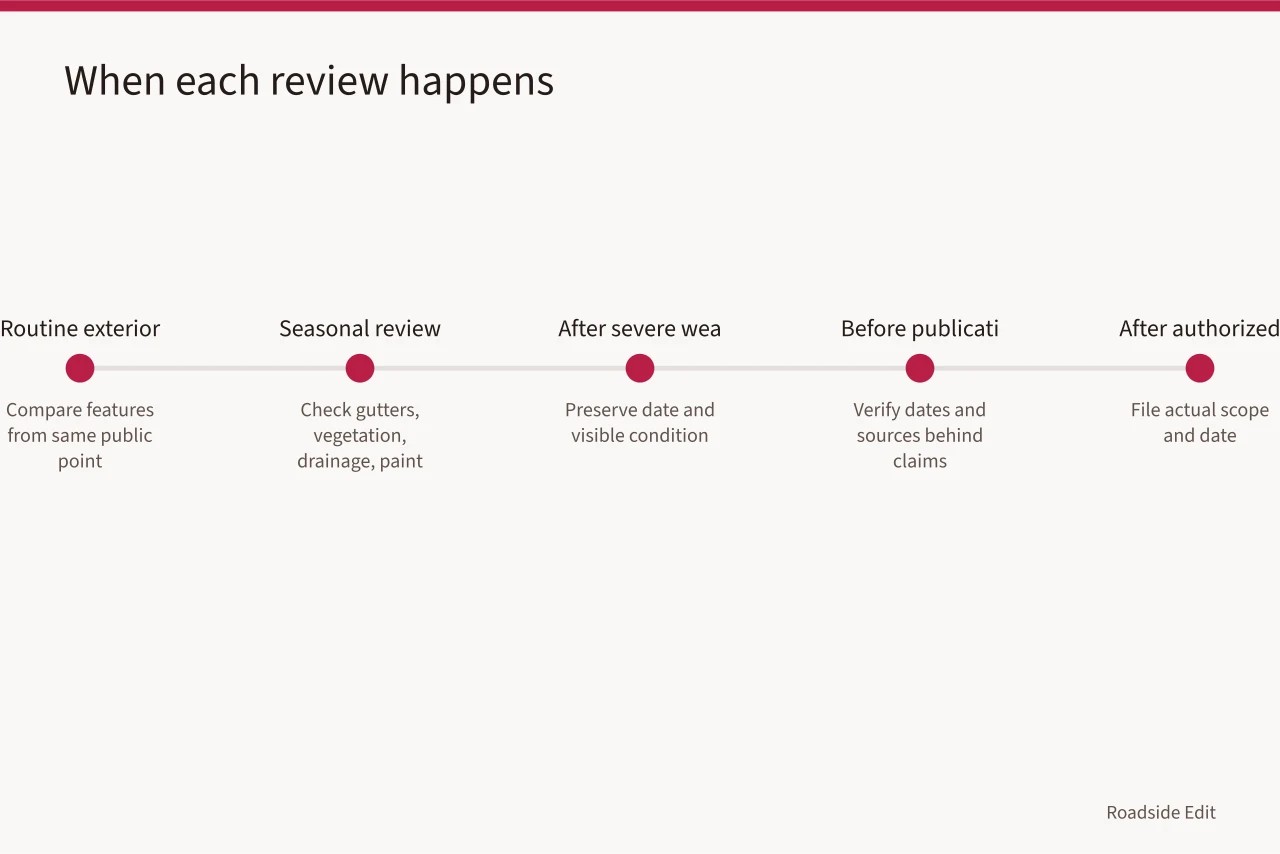
| Timing | Purpose | Example of a bounded note |
|---|---|---|
| Routine exterior view | Compare familiar features from the same public point | "The office sign face differs from the image dated 2028-09-01." |
| Seasonal review | Check visible gutters, vegetation, drainage, paint, and openings | "Leaves are visible at the gutter line; roof surface was not observed." |
| After severe weather | Preserve the date and visible condition without naming a cause | "New debris appears beside the public walkway in this view." |
| Before publication | Check dates and sources behind historical or work claims | "The opening date is attributed to the cited archive record." |
| After authorized work | File the actual scope and date from the supplied record | "The work note describes repainting one sign face." |
NPS moisture guidance says moisture diagnosis differs with a building's location, climate, soil conditions, groundwater effects, and construction traditions. Read NPS guidance on controlling unwanted moisture. That variation explains why a plan should record water staining, visible debris, or drainage patterns without treating them as proof of a particular defect.
Put every note in the right lane
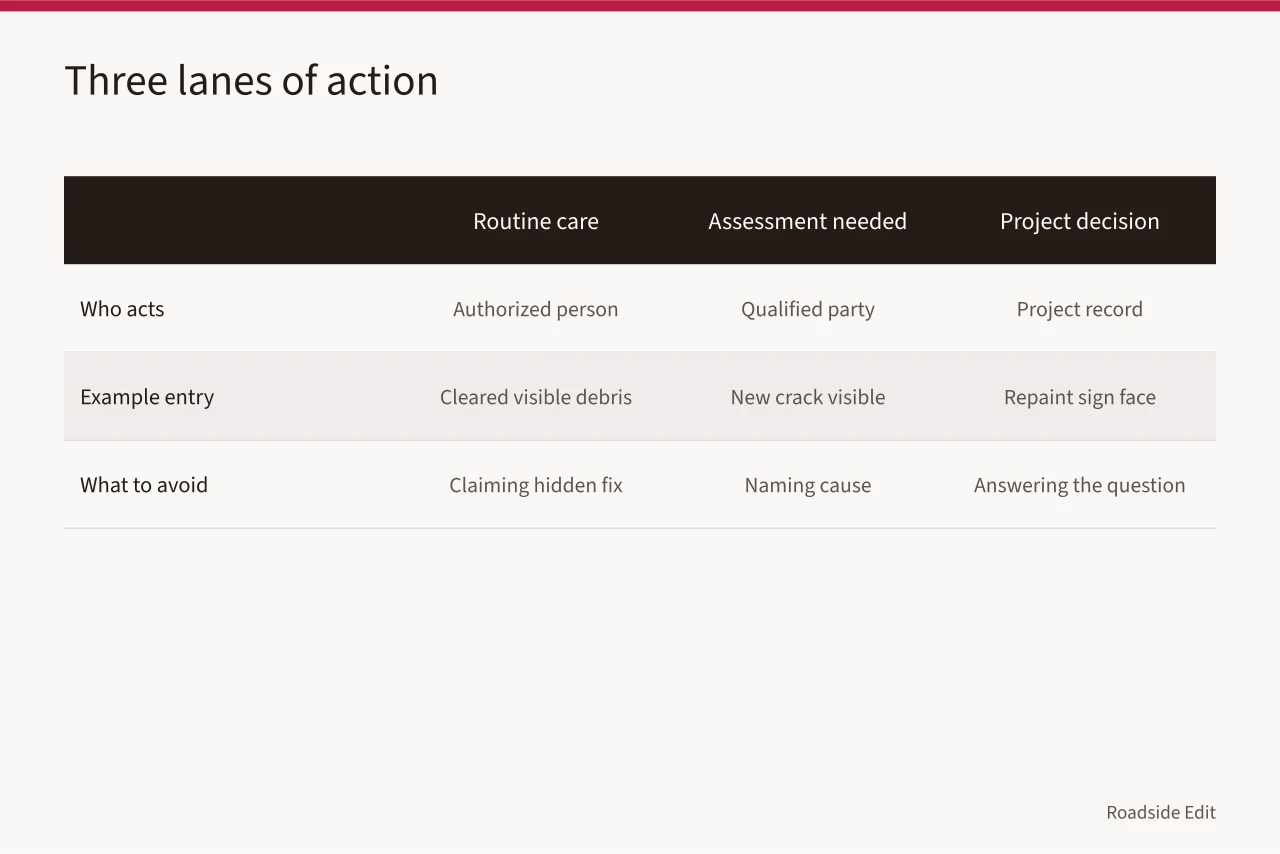
The most useful maintenance plans keep three kinds of action separate. The separation prevents an ordinary observation from becoming an unsupported repair recommendation.
Routine care
Routine care is repeatable work an authorized person has already chosen to perform. It may include clearing visible debris from a known drainage route, cleaning a documented surface, updating a photo log, or filing a completed-work record. Record the date, person or document source, feature, and stated scope. Do not claim that the task solved a hidden problem.
Assessment needed
This lane is for a change that should be documented and sent to a qualified person or responsible party. Write exactly what is visible: a new crack, missing material, stain, displaced panel, or changed opening. Do not assert cause, severity, public-safety status, or repair method from a roadside image.
Project decision
This lane is for proposed repair, replacement, relocation, new use, compliance, or funding questions. It requires a project record and may require specialized advice. The maintenance plan can name the question and preserve the evidence. It should not answer it just because a reader wants a direct recommendation.
| Lane | Appropriate entry | Unsupported leap |
|---|---|---|
| Routine care | "The log records gutter cleaning on the stated date." | "The building will not have moisture damage." |
| Assessment needed | "A visible crack appears near the west opening." | "The wall is failing." |
| Project decision | "A supplied proposal names a sign repair scope." | "The repair will preserve the sign." |
NPS says its treatment standards apply one approach based on a property's significance, physical condition, available documentation, and interpretive goals, where relevant. See how NPS describes treatment choices. The statement supports a practical editorial rule: project decisions depend on property-specific evidence, not a generic online checklist.
Make the observation route repeatable
Pick a route starting at the same point and moving in the same direction. On every visit, take a wide context view. When useful, take a closer view of a labeled feature.
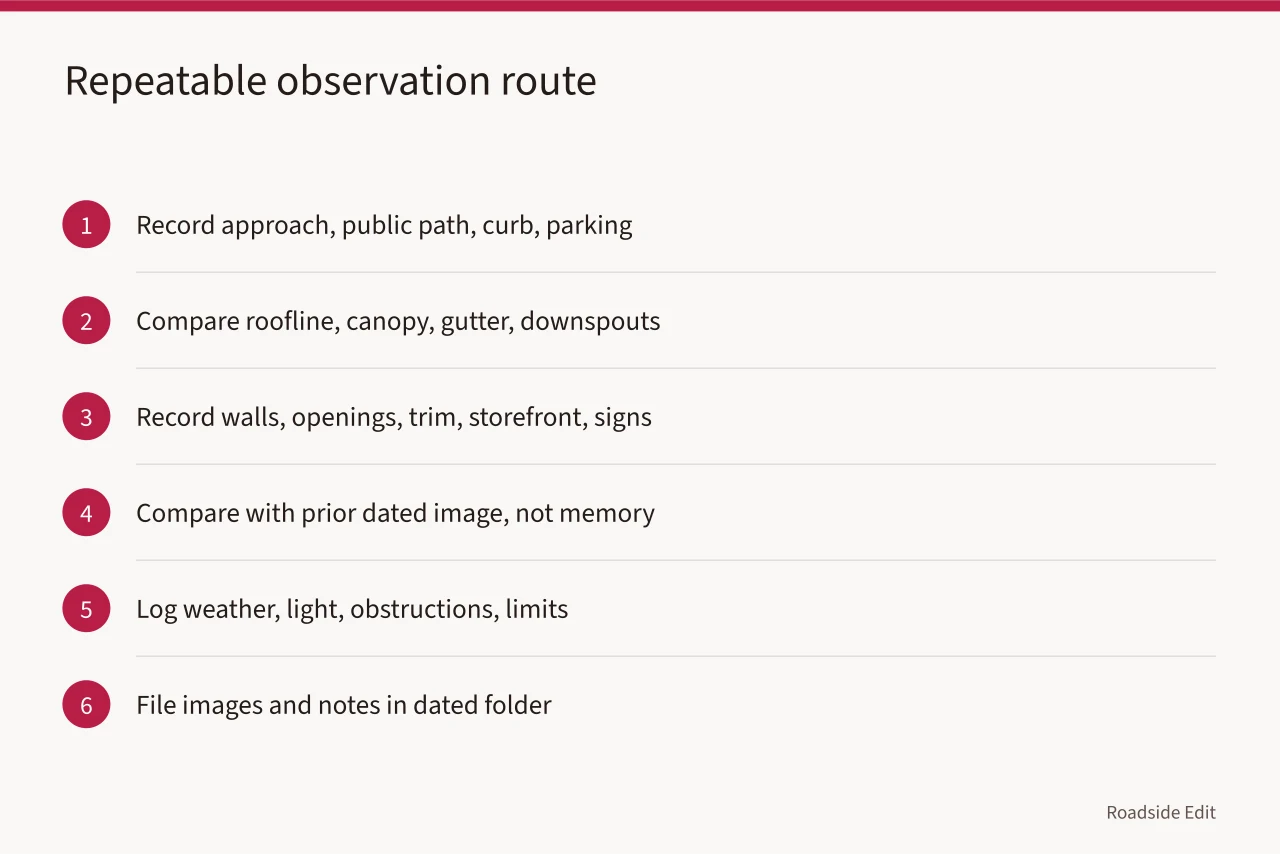
Name the file with the date first, then the feature label. Before you close the entry, write one limit, such as "rear elevation not visible," "interior not observed," or "view blocked by parked truck."
- Record the approach, public path, curb, and visible parking access.
- Compare the roofline, canopy, gutter line, and downspouts from the lawful viewpoint.
- Record walls, openings, trim, storefront elements, and signs under fixed labels.
- Compare with the prior dated image rather than relying on memory.
- Log weather, light, obstructions, and access limits that affect the view.
- File images and notes in the same dated folder or system.
Do not organize a visit around the most dramatic detail. A systematic route makes small changes easier to find and helps separate a real change from a different angle, shadow, seasonal growth, or a temporary obstruction.
Set triggers before a condition appears
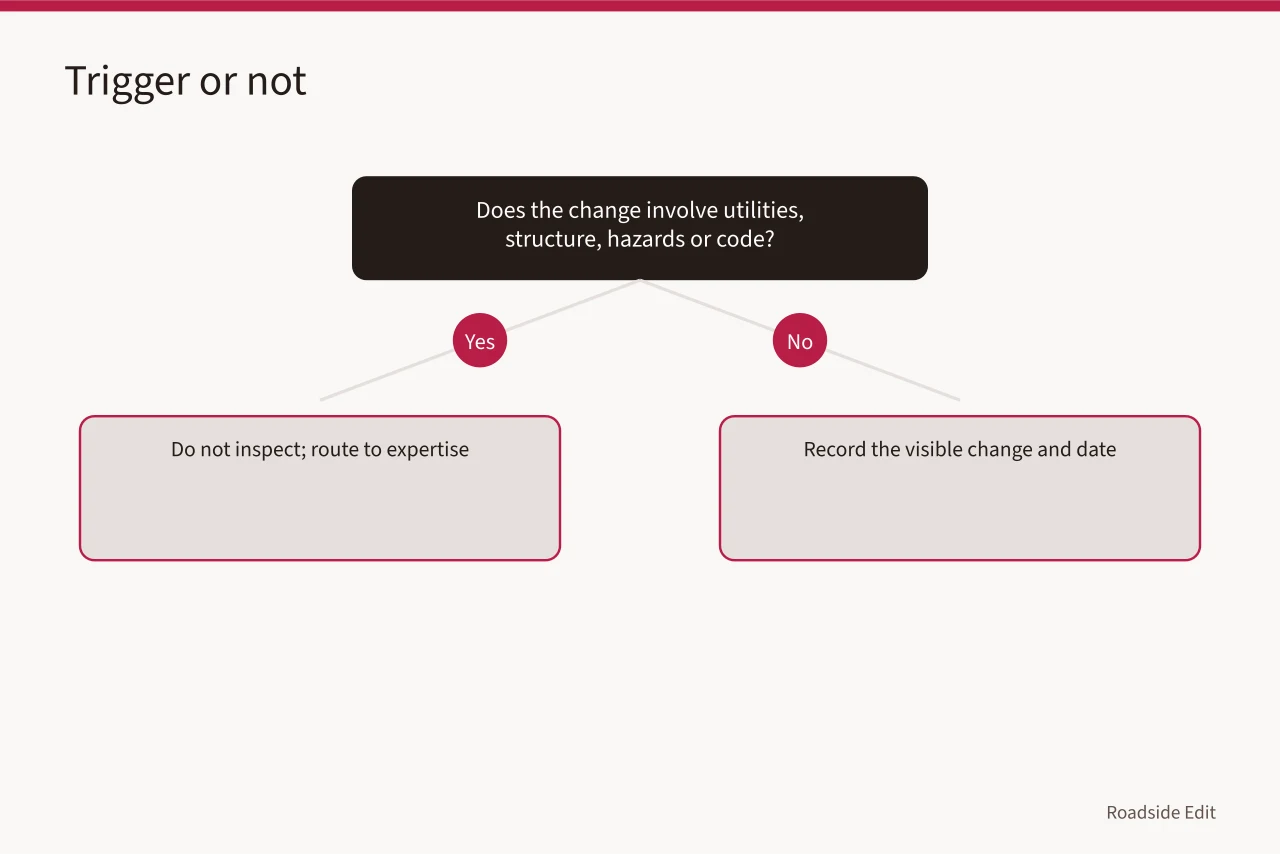
A trigger is a prewritten reason to pause and send the record to a different person. It is not an instruction to repair. Good triggers protect both the site and the writer.
| Trigger | Record action |
|---|---|
| A public route appears blocked | Stay clear, record the public view, and use the applicable reporting process |
| A feature appears newly detached or missing | Preserve the date and notify through a responsible route |
| A current image conflicts with a caption or archive record | Mark the conflict and verify the source before publishing |
| A proposal would replace, cover, remove, or relocate a visible feature | Request the project record and avoid predicting the outcome |
| A question involves utilities, structure, hazardous materials, or code | Do not inspect. Route the issue to appropriate expertise or authority |
NPS mothballing guidance begins with documenting a building's architectural and historical significance and calls for a condition assessment before stabilization. Review NPS Preservation Brief 31. Its setting is more formal than a routine roadside visit, yet its sequence remains useful: gather reliable information before selecting an action.
Protect the history record from the maintenance log
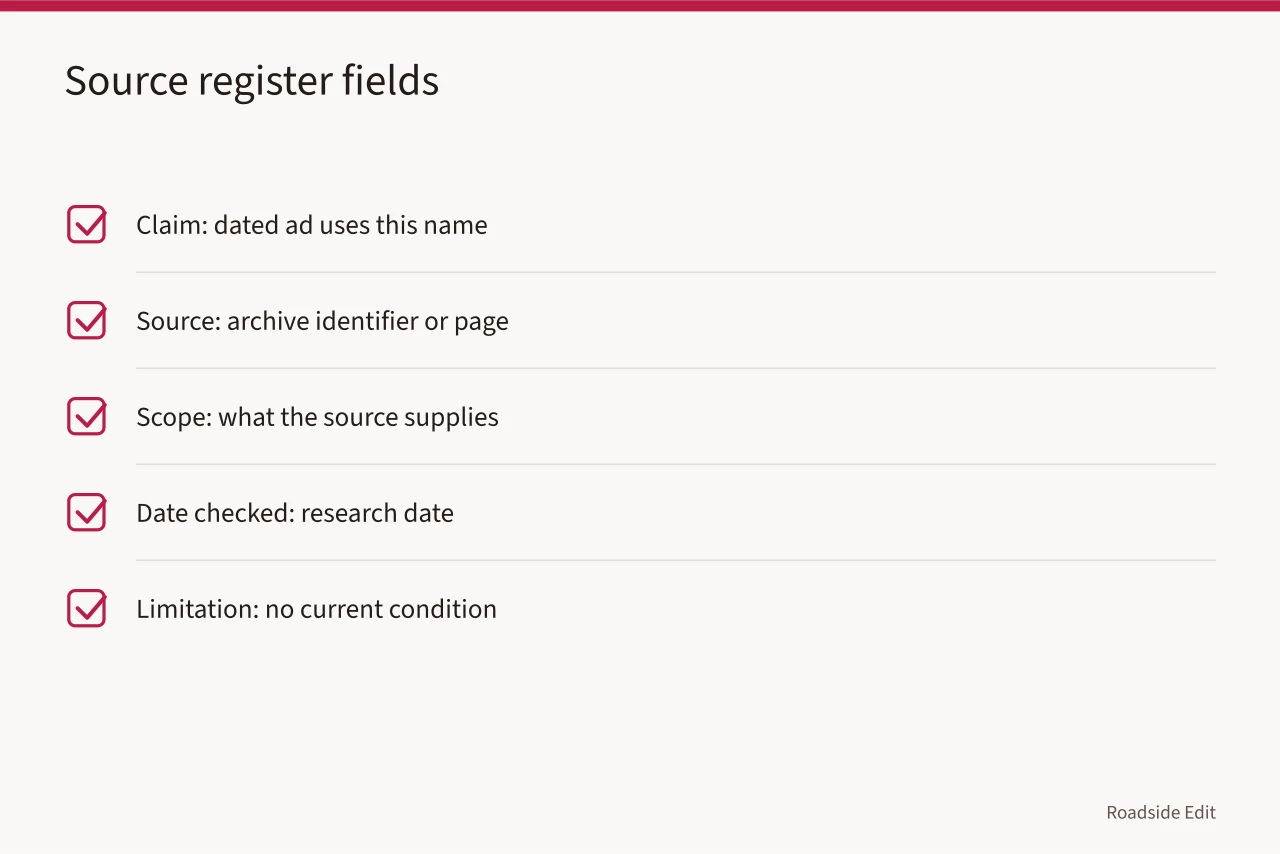
Historical details can make an article better, but they should live in a source register rather than in every visit note. Keep a separate line for each claim about a construction date, former business, owner, architect, designation, or documented past work. Include the exact source, the date you checked it, what it establishes, and what it does not establish.
| Source register field | Example use |
|---|---|
| Claim | "A dated newspaper advertisement uses this business name." |
| Source | Archive identifier or specific publication page |
| Scope | The precise information the source supplies |
| Date checked | The research date |
| Limitation | The source does not establish a current condition or later ownership |
NPS historical documentation standards say that documentation should be made available while balancing access against the need to protect information whose release might damage a property. Read the NPS historical documentation standard. For a public page, that means leaving out security details, private contacts, and unnecessary access information.
Review and revise the plan
Review the plan twice a year, or on dates that fit the site's weather and operating season. Compare the schedule with the notes actually completed. Remove tasks no one has authority to perform. Clarify a trigger when similar questions keep appearing. Retain earlier feature labels when names change, so past files stay readable.
Before publishing an update, make sure every work claim is backed by a supplied record, every historical claim has a specific source, and every observation names its viewpoint and limit. Replace labels such as "unsafe," "original," "failing," and "restored" with a direct description unless a reliable source supports the stronger term.
Common questions
How often should a roadside maintenance plan be reviewed?
Use a rhythm the responsible person can maintain. A regular short observation and seasonal review are better than a long schedule no one completes.
Can a photograph prove that a building needs repair?
No. A photo documents a visible condition at a particular time. It may support a question or follow-up, but it does not replace a qualified assessment.
Should a public visitor enter a closed roadside building to make a record?
No. Stay in lawful public areas unless the owner has granted clear permission. Do not enter, climb, test, or disturb a property for an article or maintenance note.
In this guide
- How a roadside architecture maintenance checklist keeps exterior surveys repeatableRoadside architecture maintenance checklist for 2027 gives U.S. readers a repeatable, safe way to document visible exterior changes and limits.
- Roadside architecture maintenance questions: who can answer whatRoadside architecture maintenance questions for 2027 help U.S. readers separate visible evidence, urgent access concerns, records, and expert decisions.
- How to write roadside architecture maintenance cost notes without false precisionCost notes for roadside architecture should record scope, date, and source, so a 2027 estimate is never read as a price for another property.
- How to document roadside architecture maintenance warning signs safelyRoadside architecture maintenance warning signs call for dated photos, careful wording, and a reporting route, never a diagnosis from the curb.
- How to keep roadside architecture maintenance records that stay usefulRoadside architecture maintenance records for 2027 give U.S. editors a durable system for photos, observations, completed work, and source limits.